【 The Concept 】
A handmade wooden five-storied pagoda — a gojū-no-tō — in richly grained, reddish-brown wood, with dark metal temple bells hanging from every roof corner and a dark-stained wooden spire of stacked rings rising from the top. Five roofs sweep gently upward at their corners, each one a little narrower than the one below, so that the whole tower draws the eye steadily up toward the pointed jewel at the summit. Between the roofs, each storey's square core is pierced by a round window. It comes in its original printed box, which reads simply: Tezukuri no Gojū-no-tō — "Handmade Five-Storied Pagoda." In Japan the full-size pagoda is the heart of a Buddhist temple, built to hold relics of the Buddha and to stand for the whole ordered universe. This is that same form, brought down to the scale of a shelf.
【 Why the Pagoda Stands at the Heart of the Temple 】
The pagoda began in India as the stūpa, a rounded mound built over the relics of the Buddha. As Buddhism travelled east through China and Korea, the mound grew upward into a tower of stacked roofs, and by the sixth and seventh centuries it had reached Japan. In the great temples the pagoda was never a place to enter or climb. It was a monument, and a kind of sacred body: relics were placed at its base, and the tower above them was a sign that the Buddha's presence remained.
A popular reading in Japan links the five roofs to the five great elements of Buddhist thought — earth, water, fire, wind and sky, rising from the ground to the heavens. The spire at the top, with its stacked rings, points past all five into the empty sky. Read this way, a pagoda is a whole universe set in a single column, and to keep one in the home is to keep a small picture of an ordered, settled world.
【 Built to Sway, Never to Fall 】
The most surprising thing about Japan's tall wooden pagodas is how well they survive earthquakes. Japan is one of the most earthquake-prone countries on earth, yet there are almost no records of a wooden five-storied pagoda being toppled by a quake. The secret is flexibility. The five storeys are stacked rather than rigidly fixed together, and they are threaded around a great central pillar, the shinbashira. When the ground shakes, the storeys sway against one another in opposite directions — Japanese builders call it the "snake dance" — and the energy dissolves.
The idea still matters today. When Tokyo Skytree, the tallest tower in Japan, was designed, its engineers gave it a central concrete column that moves independently of the outer frame to damp the sway. They said the idea was inspired by the shinbashira of the old wooden pagodas. A form more than a thousand years old helped steady one of the most modern towers in the world.
【 What Owning This Piece Brings 】
・ A quiet guardian. Traditionally, the pagoda protects the ground it stands on. In the home, a small pagoda is kept the same way: as a steadying presence for the shelf, the study or the household altar.
・ Stillness and focus. The five rising roofs and the vertical spire give the eye one calm, upright thing to rest on. It is an object for a meditation corner, a reading room, or anywhere you want a moment of calm.
・ Resilience. A form that has come through fire, typhoon and earthquake for more than a thousand years carries a simple message: bend, and stand again. It makes a meaningful gift for someone starting over or getting through a hard season.
・ A piece of Japan's temple towns. Pagoda models like this were long sold near the great temples of Kyoto, Nara and beyond, for travellers who wanted to bring the view home. For anyone who has stood beneath a real pagoda, it brings back that memory.
A fitting gift for a new home, a graduation, a retirement, a lover of Japanese architecture — or anyone who needs a steady thing to look at every day.
【 Stories of the Pagoda 】
Kyoto's Tō-ji holds the tallest wooden pagoda in Japan, about 55 metres high. The great monk Kūkai began work on it in the ninth century, but the timber was so hard to gather that he petitioned the court for help hauling logs, and the tower took decades to finish. Since then it has burned down four times, mostly after lightning strikes. Each time it was rebuilt. The tower standing today, the fifth, was completed in 1644 with the support of the shōgun Tokugawa Iemitsu, and it has stood through every earthquake since.
In Tokyo, the novelist Kōda Rohan wrote one of the most beloved stories in modern Japanese literature, The Five-Storied Pagoda (1892). A clumsy, stubborn carpenter nicknamed Nossori Jūbei — "Slowpoke Jūbei" — begs to be allowed to build the pagoda of a temple in Yanaka, and pours his whole life into it. On the night a terrible storm strikes the newly finished tower, he climbs to the top floor with a chisel in his belt, ready to take his own life if his pagoda falls. By morning the storm has passed, and the pagoda stands untouched. The real Yanaka pagoda survived until 1957. Its foundation stones can still be seen in Yanaka Cemetery.
【 Where to Place It 】
On a household altar or in a tokonoma alcove; on a study desk or a high bookshelf; on a hallway console where it can be seen as you pass. Give it open space above the spire, since the whole design is meant to lift the eye upward. A lamp at a low side angle will bring out the deep figure of the wood and throw soft shadows from the bells.
【 Care 】
Dust with a soft, dry brush. Keep away from direct sunlight, heaters and humidity. Do not use polish or solvents. When moving it, lift from the base with both hands, never by the spire or the roofs.
【 Reading the Object 】
Five wooden roofs, graduated from the widest at the bottom to the narrowest at the top, each with a rounded centre and four corners that sweep gently upward. Between the roofs, square wooden cores with a round window on each face; the lowest core is pierced with a cluster of small round holes. Twenty dark metal bells, one at each roof corner, hang from small brass hooks. The dark-stained wooden spire has stacked rings and a pointed jewel finial. The whole stands on a stepped square base. Throughout, the wood is reddish brown with bold grain and a soft sheen.
【 Presence 】
Tall, warm and steady. A small temple tower that brings a sense of calm and upward movement to the room around it.
Archive Note: The number in the name (1644) marks the completion of the present five-storied pagoda of Tō-ji in Kyoto, the tallest wooden pagoda in Japan, rebuilt after four fires. NOT the date this piece was made, and this piece is not a replica of that specific pagoda.
Provenance Note: Sourced from a private household in Japan. A handmade wooden five-storied pagoda model in its original printed box. Attributed to the Japanese tradition of temple-town pagoda models rather than to a specific workshop or maker.
Condition Note: Very good vintage condition. Natural variations in the wood grain are features of the material. A small dark spot on the lower edge of the base. The box shows light wear consistent with age.


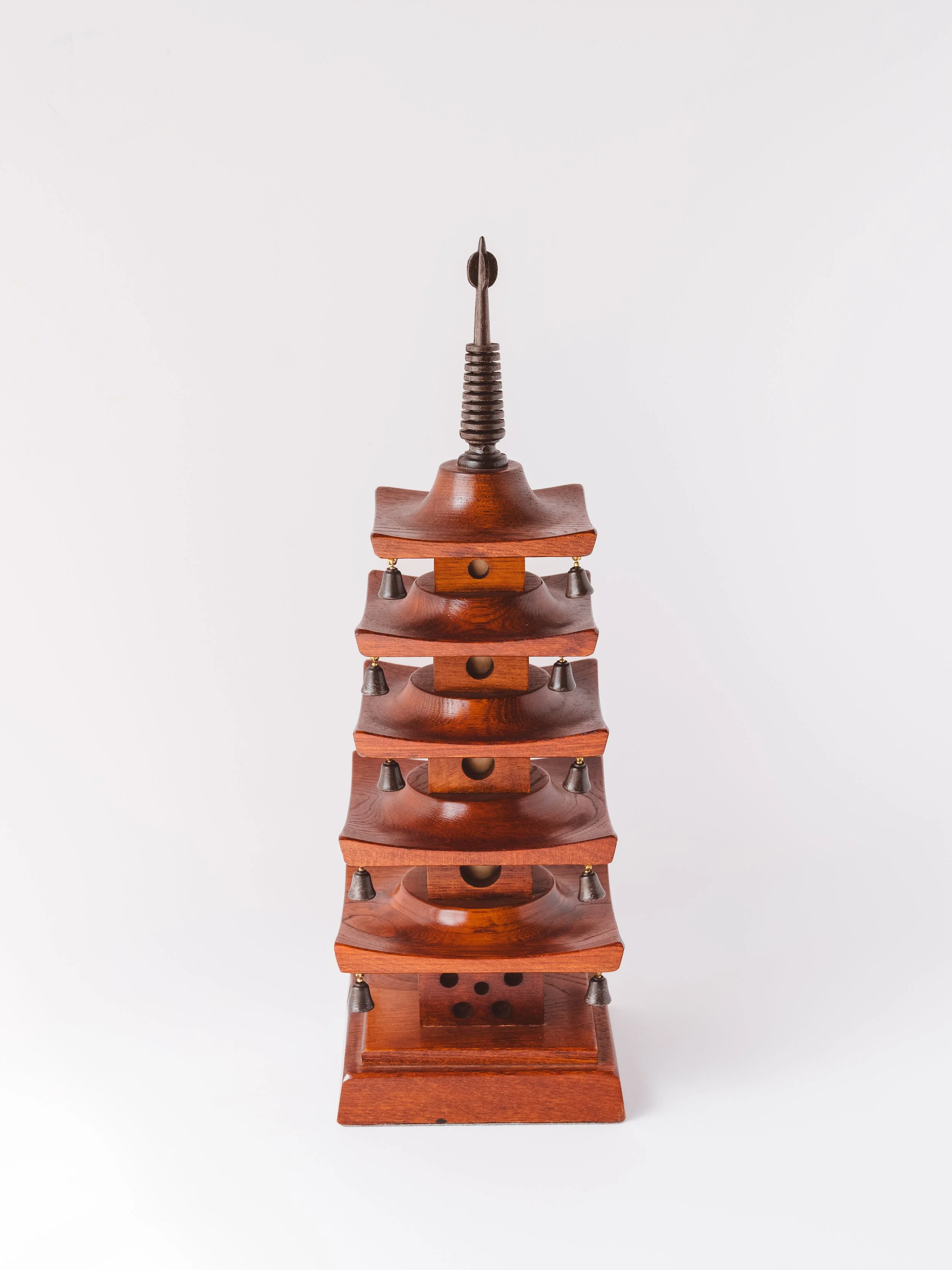 Image 1 of 7
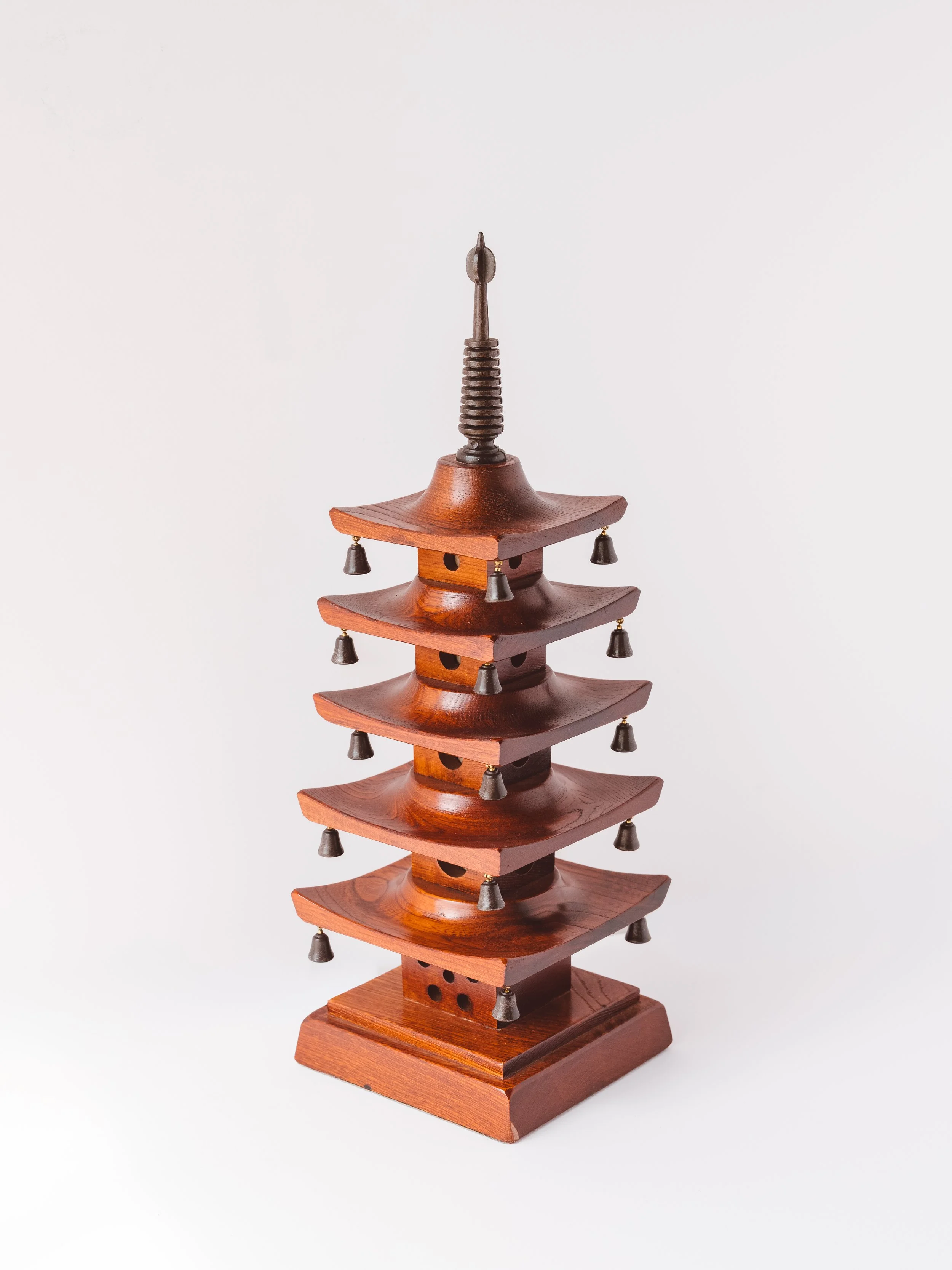 Image 2 of 7
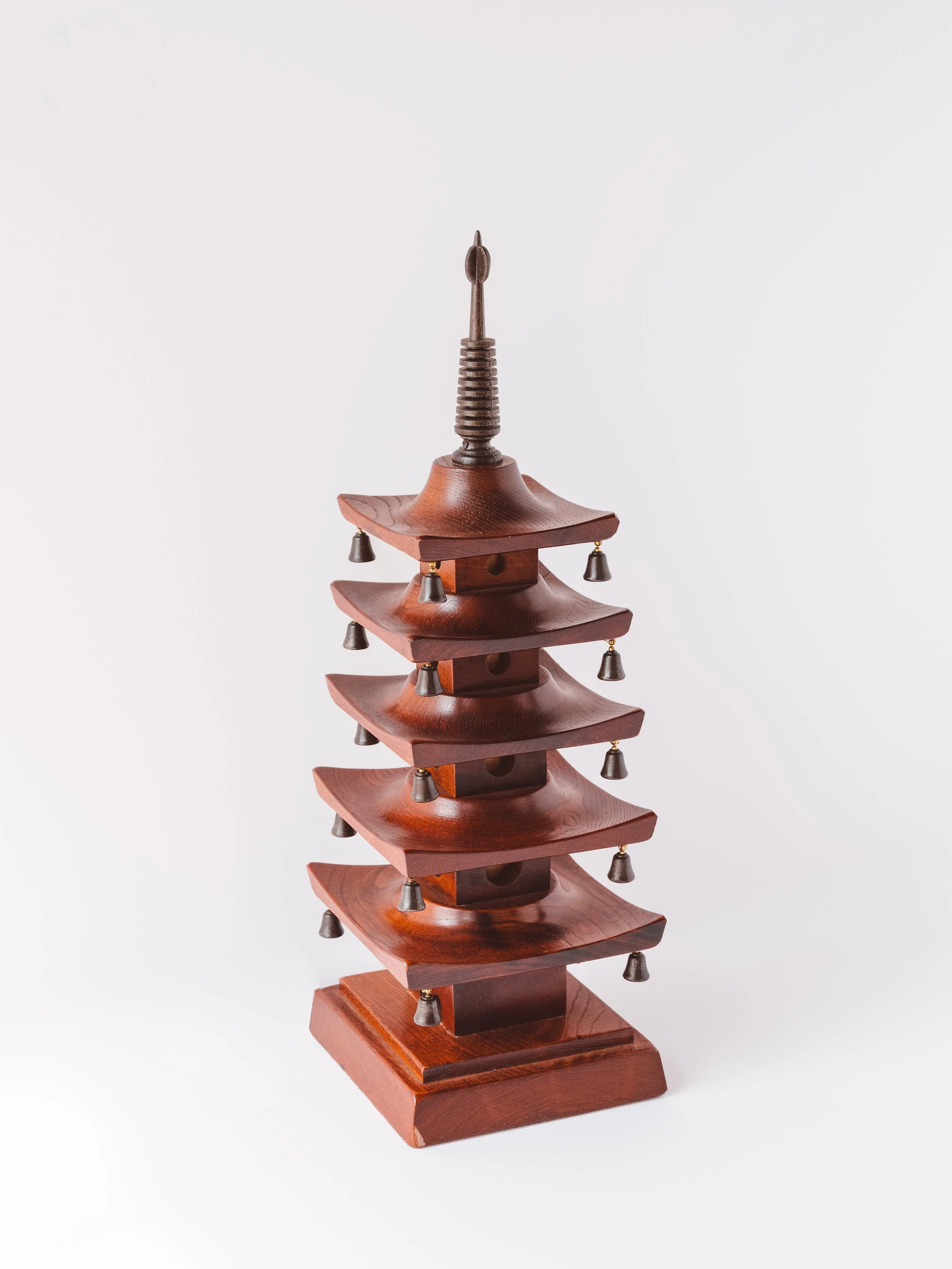 Image 3 of 7
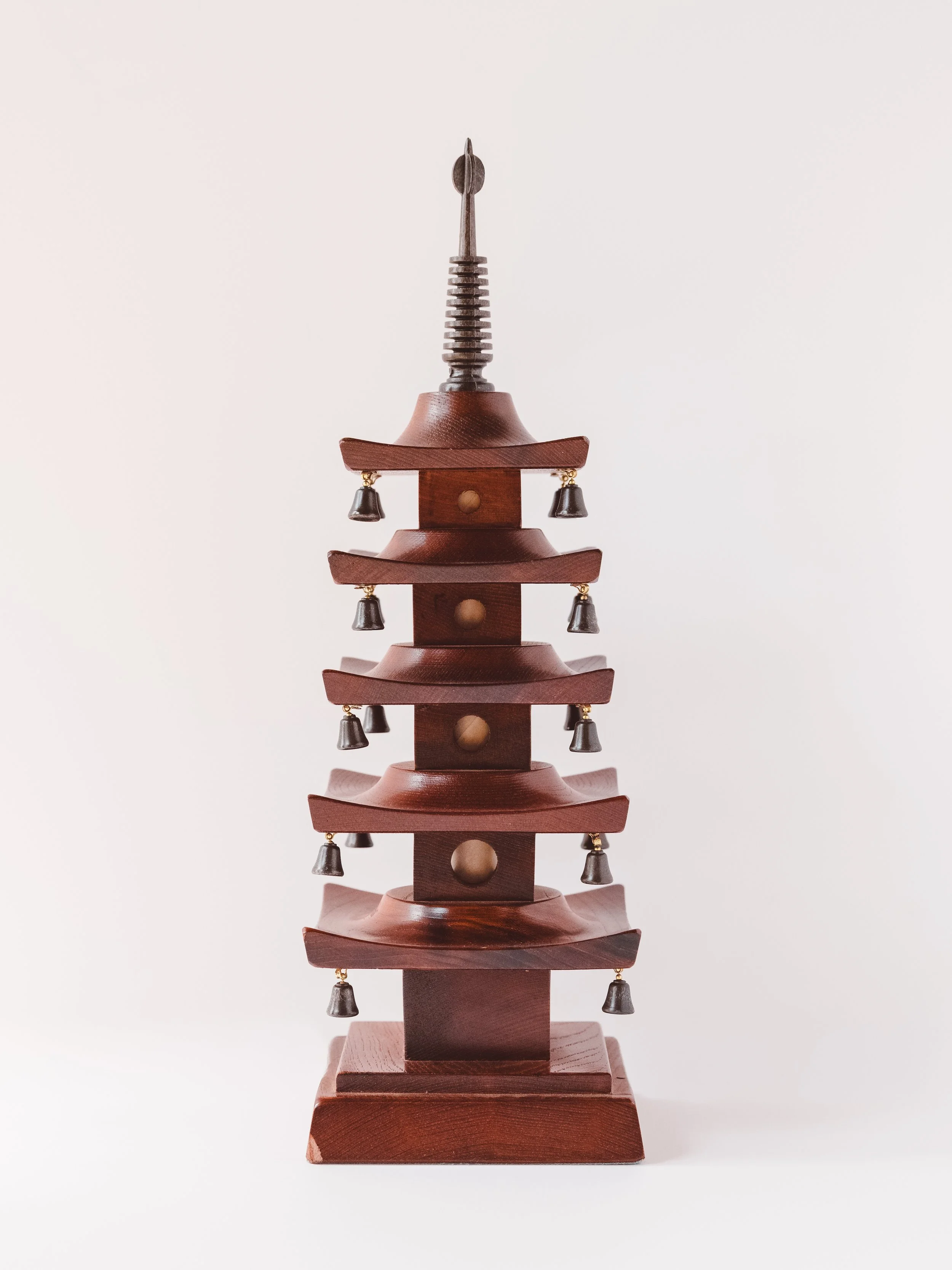 Image 4 of 7
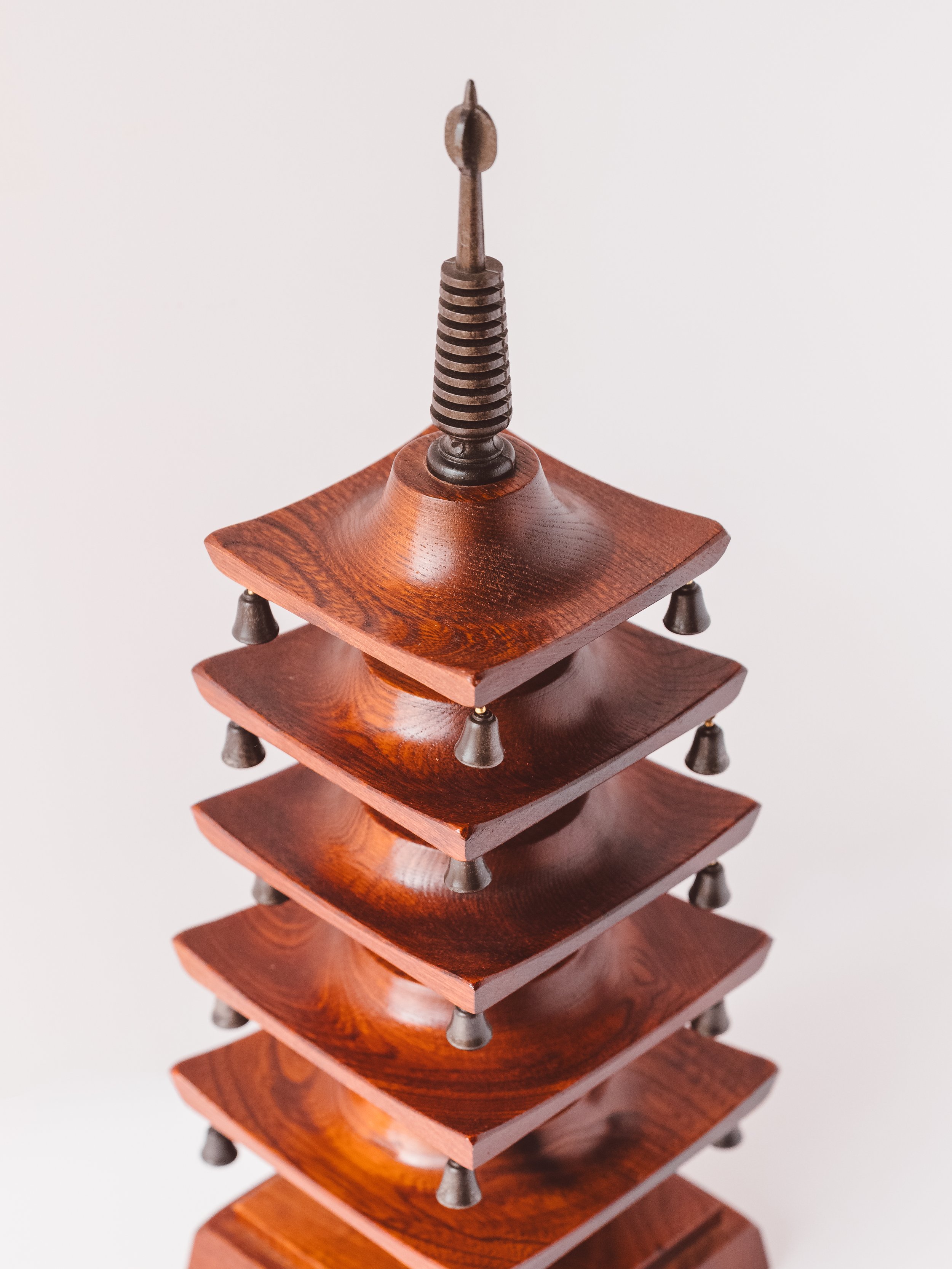 Image 5 of 7
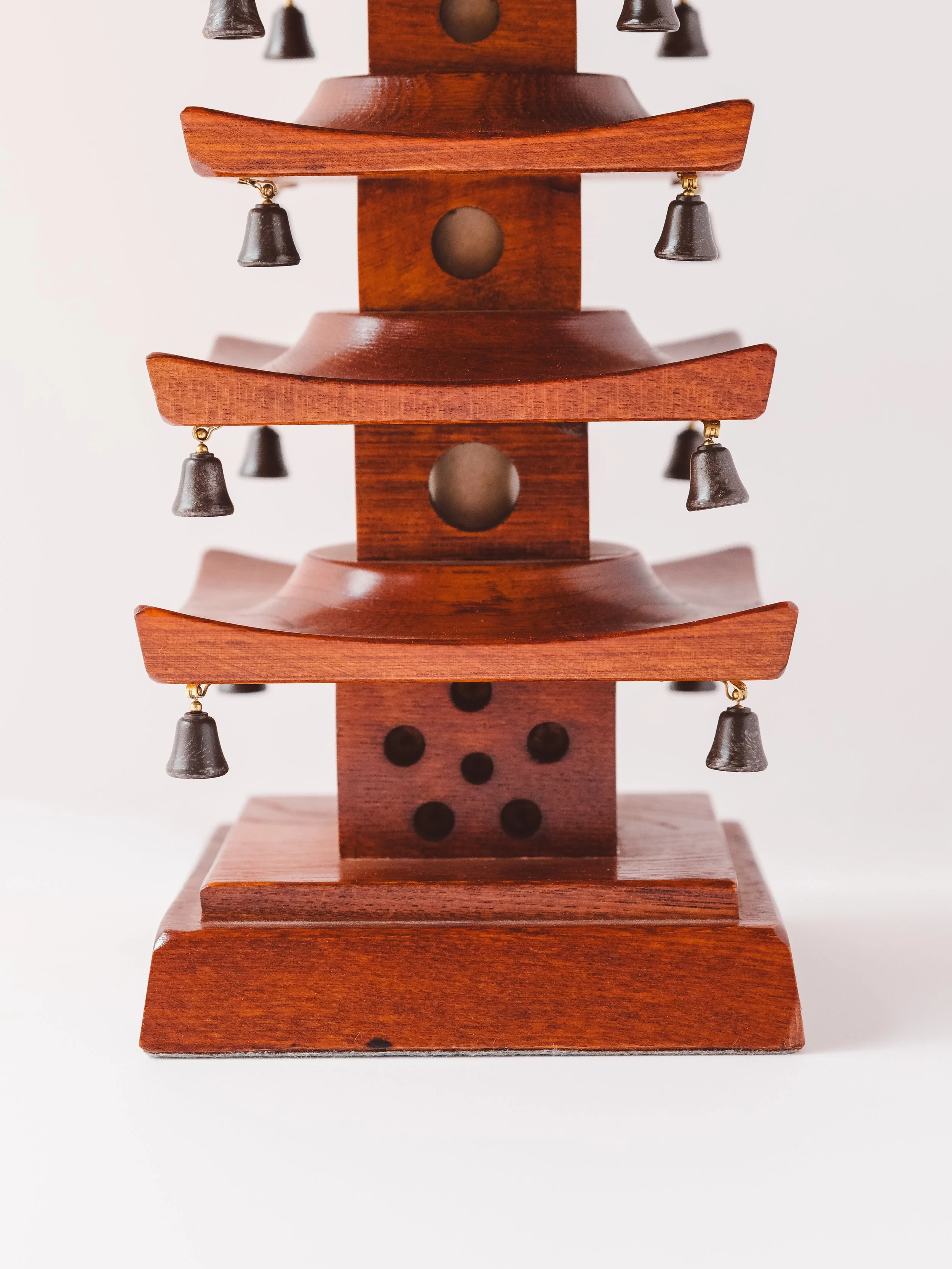 Image 6 of 7
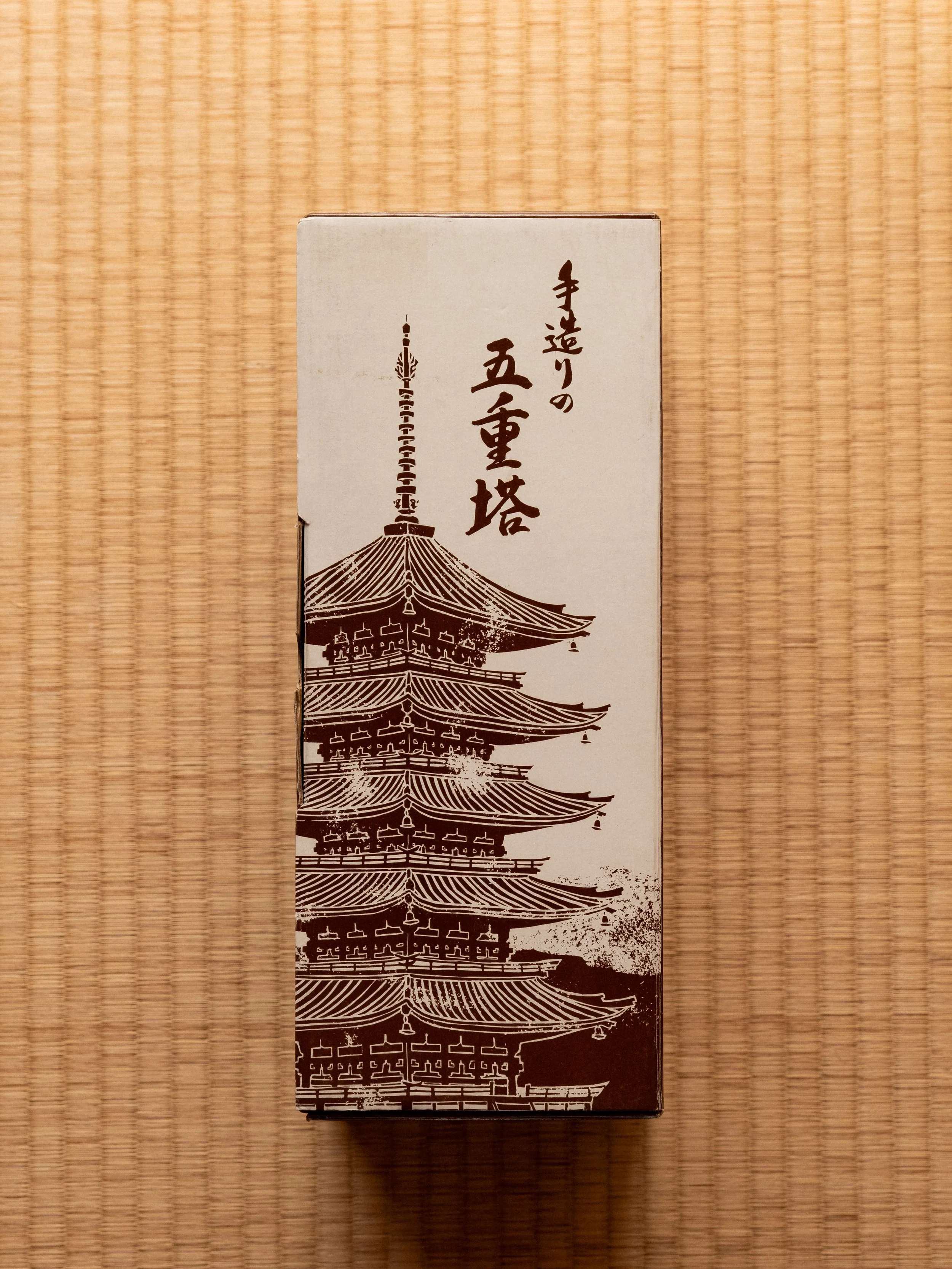 Image 7 of 7