【 The Concept 】
A wooden hawk perched at the top of a slim tree-trunk column — the whole piece carved from a single length of pale koshiabura wood, from the bark-crusted foot at the base to the fierce painted eye at the crown. The hawk stands upright, chest forward, head lifted and facing straight ahead, its yellow-taloned feet gripping the log below. From its shoulders, its wings do something extraordinary: instead of being carved as solid feather forms, they are made from dozens of paper-thin wood shavings, sliced up from the body of the log itself and left curling outward in tight, layered spirals — like a bird whose feathers are still in the process of being lifted from the wood. The long tail sweeps back in the same technique, an arc of layered curls. This is Sasano ittōbori, the "single-blade carving" of Yonezawa in northern Japan, and the piece is called an Otaka-poppo — a folk hawk that Japanese farmers have been carving in the deep snow country for centuries.
【 What Sasano Ittōbori Is 】
Sasano ittōbori (笹野一刀彫) is a folk woodcarving tradition from the Sasano district of Yonezawa, in the mountains of southern Yamagata Prefecture. Its name means "single-blade carving" — because the entire piece, from the rough shape of the trunk down to the finest curled feather, is worked with a single specialised knife called a saru-kiri. The wood is always koshiabura, a soft, pale local tree that shaves cleanly. The technique's signature move is not to cut a curl off but to leave it attached: the maker slices a thin sliver upward and stops before it separates, then does it again below, and again below that, until a fan of layered wood ribbons has been raised from the trunk. In the winter — when the Yonezawa valley is buried in metres of snow — those curls become the feathers of a hawk, the wings of an owl, and, most famously, the petals of the sasano-bana, the "Sasano flower," offered every 17 January at Sasano Kannon temple to bring flowers into a season that has none. The technique is far older than the modern era; local tradition dates it to well over a thousand years ago, linked to the temple's founding.
【 Why a Hawk 】
The hawk is Sasano's most beloved subject, and there is a good local reason for it. In the late 18th century the lord of the Yonezawa domain, Uesugi Yōzan — himself famous throughout Japan as a reforming ruler who dragged his impoverished domain back from bankruptcy — actively encouraged Sasano carving as a winter side-work for the farmers of his lands, to give them income and dignity through the deepest months of the year. Yōzan's own name is written with the character taka (鷹, "hawk"), and out of respect the carvers began making a hawk as one of their principal subjects. The hawk carried further meanings on its own — a bird of sharp sight and quick strike, in Japanese folk belief a natural amulet against misfortune and a symbol of a "rise in fortune" (rokudaka o masu, "to increase one's stipend"). Even now the Otaka-poppo is bought and taken home each year at the Sasano Kannon festival as an engimono — a good-luck object — kept where the family can see it, so that the hawk's clear gaze watches over the household.
【 Reading the Object 】
The composition works from bottom to top. At the base, a section of natural bark and a knot are deliberately left uncarved: a scallop-edged patch of grey-brown bark, with the pale wood rising out of it. This is the honest signature of a one-log carving — the whole figure comes from a single trunk, and the maker has kept the tree visible at the foot. The mid-column is left smooth and pale, so that the piece stands like a young sapling. At the top, the log widens slightly and the hawk begins: two yellow feet with black talons wrapped over the crown of the log, then the body rising from them. The chest is left in bare wood; on it the natural growth rings of the koshiabura show through as a repeated wave of concentric arcs — a beautiful accidental "breast plumage" that no brush could imitate. The back, head, and crown carry the painted feather pattern in strong black — repeating U-shapes and scale-forms that read as feathers without ever pretending to be one. The head is angular, almost geometric, a wedge-shape rather than a rounded skull; the eye is the piece's real drama — very large, yellow-rimmed, dark-centred, with radiating black lines and a lowered "brow" stroke that gives the bird a look of intense concentration. The beak is painted yellow with a sharp hooked tip. And from the shoulders and the back of the tail sweep those long fans of layered curls, each a single shaving still attached to the trunk it was cut from — this is what Sasano is famous for.
【 A Craft in Which the Shavings Become the Sculpture 】
The most interesting thing about Sasano ittōbori is philosophical as much as technical. In most woodcarving, the shavings are what you throw away; the sculpture is what is left. In Sasano the reverse is true: the shavings themselves are the sculpture. What most other carvers would sweep off the workbench, the Sasano maker keeps attached, curls, and lifts into feathers, wings, tail-fans, flower petals. This is why the tradition is so quietly extraordinary — and why a Sasano piece, even a small one, looks like nothing else. Here, both wings and the long swept tail are these lifted-curl feathers, still connected to the body of the trunk they were cut from. The layered edges are meant to be slightly irregular, and the pale, freshly-sliced faces of the wood are meant to stay visible; they are not defects but the whole point of the technique.
【 The Ink Signature 】
On the side of the column, in strong brushed sumi ink, the piece is signed with a lineage inscription of the Sasano ittōbori tradition, and stamped below in red with a small square seal. Local resources note that the master name inscribed on the piece has been used across the tradition's twentieth-century revival and passed down through generations of the workshop, so this signature identifies the piece as a work of that lineage, rather than pinning it to any one dated hand — an honest reading in keeping with how these folk crafts are actually made and marked. The ink and seal are clear and complete.
【 The Object 】
A vertical hand-scale carving in pale koshiabura wood, worked and signed in the Sasano ittōbori tradition. Steady on its base, light in the hand, meant to be looked at from any angle — the curled tail alone rewards walking around it.
【 Where to Place It 】
Anywhere a small vertical piece can catch its own light — a study desk, a bookshelf, a tokonoma alcove, an entrance shelf, a windowsill. In its home country the Otaka-poppo is traditionally placed where it can watch the room, its clear eye acting as a household amulet against misfortune — a folk role it has kept in Yonezawa homes for generations. Keep it out of direct sun and away from heaters and humidifiers, which move any thin-shaved wood too much.
【 Care 】
Dust with a soft dry brush or a can of compressed air, always in the same direction as the curls. Never wipe the shaved feathers with a cloth — the curls are fragile by design and are the piece's most valuable feature. Keep it in a stable dry indoor environment; do not oil the wood.
【 Function & What It Brings 】
Keep it, place it, or give it. As a piece of Japanese folk art it is a fine example of a genuinely distinctive regional tradition, sitting comfortably alongside kokeshi, Ainu carving, or any collection of mingei woodwork. As a talisman it carries the Otaka-poppo's traditional Yonezawa role — a bird of sharp sight, a household amulet against misfortune, and a wish for one's "stipend to rise." A fitting gift for a promotion, a new home, a milestone, or anyone born in the Year of the Bird.
【 The Texture 】
Pale koshiabura wood, satin-smooth on the log and the chest, showing the tree's own concentric growth rings. Strong sumi-black feather painting on the head and back; small bright yellow accents on the beak and the taloned feet. The wings and long swept tail are made of many thin, layered wood curls with slightly irregular edges — light, feathery, and dry to the touch. A patch of natural grey-brown bark and a knot are deliberately left at the base as a mark of the single-log origin.
【 Presence 】
Alert, still, deeply serious. The Sasano hawk is not a decorative bird — the pose is upright and gathered, the eye is fixed and unblinking, and the whole silhouette reads as a small guardian rather than an ornament. Its beauty is not in prettiness but in the honesty of the wood and the courage of the eye.
Archive Note: The number in the name (1751) references the birth year of Uesugi Yōzan, the reforming lord of Yonezawa who encouraged Sasano ittōbori as a winter side-work for his farmers, and whose own name (Yō-zan, "eagle mountain") carries the character taka, "hawk" — the reason the Sasano hawk is called Otaka-poppo. It is NOT the date this piece was made.
Provenance Note: Sourced from a private collection in Japan. A hand-carved Otaka-poppo in the Sasano ittōbori (笹野一刀彫) folk tradition of Yonezawa, Yamagata Prefecture; the side of the column carries a brushed ink lineage signature of the tradition with a red square seal. Attributed to the Sasano workshop tradition rather than to a specific individual maker.
Condition Note: Sold as acquired, in very good vintage condition. The naturally uneven edges of the layered wood curls that form the wings and tail, and the deliberately preserved patch of bark and knot at the base, are inherent features of a single-blade Sasano carving, not damage. The thin curled feathers are fragile by design and should not be wiped with a cloth. Please see the photographs as part of the description.
【 The Concept 】
A wooden hawk perched at the top of a slim tree-trunk column — the whole piece carved from a single length of pale koshiabura wood, from the bark-crusted foot at the base to the fierce painted eye at the crown. The hawk stands upright, chest forward, head lifted and facing straight ahead, its yellow-taloned feet gripping the log below. From its shoulders, its wings do something extraordinary: instead of being carved as solid feather forms, they are made from dozens of paper-thin wood shavings, sliced up from the body of the log itself and left curling outward in tight, layered spirals — like a bird whose feathers are still in the process of being lifted from the wood. The long tail sweeps back in the same technique, an arc of layered curls. This is Sasano ittōbori, the "single-blade carving" of Yonezawa in northern Japan, and the piece is called an Otaka-poppo — a folk hawk that Japanese farmers have been carving in the deep snow country for centuries.
【 What Sasano Ittōbori Is 】
Sasano ittōbori (笹野一刀彫) is a folk woodcarving tradition from the Sasano district of Yonezawa, in the mountains of southern Yamagata Prefecture. Its name means "single-blade carving" — because the entire piece, from the rough shape of the trunk down to the finest curled feather, is worked with a single specialised knife called a saru-kiri. The wood is always koshiabura, a soft, pale local tree that shaves cleanly. The technique's signature move is not to cut a curl off but to leave it attached: the maker slices a thin sliver upward and stops before it separates, then does it again below, and again below that, until a fan of layered wood ribbons has been raised from the trunk. In the winter — when the Yonezawa valley is buried in metres of snow — those curls become the feathers of a hawk, the wings of an owl, and, most famously, the petals of the sasano-bana, the "Sasano flower," offered every 17 January at Sasano Kannon temple to bring flowers into a season that has none. The technique is far older than the modern era; local tradition dates it to well over a thousand years ago, linked to the temple's founding.
【 Why a Hawk 】
The hawk is Sasano's most beloved subject, and there is a good local reason for it. In the late 18th century the lord of the Yonezawa domain, Uesugi Yōzan — himself famous throughout Japan as a reforming ruler who dragged his impoverished domain back from bankruptcy — actively encouraged Sasano carving as a winter side-work for the farmers of his lands, to give them income and dignity through the deepest months of the year. Yōzan's own name is written with the character taka (鷹, "hawk"), and out of respect the carvers began making a hawk as one of their principal subjects. The hawk carried further meanings on its own — a bird of sharp sight and quick strike, in Japanese folk belief a natural amulet against misfortune and a symbol of a "rise in fortune" (rokudaka o masu, "to increase one's stipend"). Even now the Otaka-poppo is bought and taken home each year at the Sasano Kannon festival as an engimono — a good-luck object — kept where the family can see it, so that the hawk's clear gaze watches over the household.
【 Reading the Object 】
The composition works from bottom to top. At the base, a section of natural bark and a knot are deliberately left uncarved: a scallop-edged patch of grey-brown bark, with the pale wood rising out of it. This is the honest signature of a one-log carving — the whole figure comes from a single trunk, and the maker has kept the tree visible at the foot. The mid-column is left smooth and pale, so that the piece stands like a young sapling. At the top, the log widens slightly and the hawk begins: two yellow feet with black talons wrapped over the crown of the log, then the body rising from them. The chest is left in bare wood; on it the natural growth rings of the koshiabura show through as a repeated wave of concentric arcs — a beautiful accidental "breast plumage" that no brush could imitate. The back, head, and crown carry the painted feather pattern in strong black — repeating U-shapes and scale-forms that read as feathers without ever pretending to be one. The head is angular, almost geometric, a wedge-shape rather than a rounded skull; the eye is the piece's real drama — very large, yellow-rimmed, dark-centred, with radiating black lines and a lowered "brow" stroke that gives the bird a look of intense concentration. The beak is painted yellow with a sharp hooked tip. And from the shoulders and the back of the tail sweep those long fans of layered curls, each a single shaving still attached to the trunk it was cut from — this is what Sasano is famous for.
【 A Craft in Which the Shavings Become the Sculpture 】
The most interesting thing about Sasano ittōbori is philosophical as much as technical. In most woodcarving, the shavings are what you throw away; the sculpture is what is left. In Sasano the reverse is true: the shavings themselves are the sculpture. What most other carvers would sweep off the workbench, the Sasano maker keeps attached, curls, and lifts into feathers, wings, tail-fans, flower petals. This is why the tradition is so quietly extraordinary — and why a Sasano piece, even a small one, looks like nothing else. Here, both wings and the long swept tail are these lifted-curl feathers, still connected to the body of the trunk they were cut from. The layered edges are meant to be slightly irregular, and the pale, freshly-sliced faces of the wood are meant to stay visible; they are not defects but the whole point of the technique.
【 The Ink Signature 】
On the side of the column, in strong brushed sumi ink, the piece is signed with a lineage inscription of the Sasano ittōbori tradition, and stamped below in red with a small square seal. Local resources note that the master name inscribed on the piece has been used across the tradition's twentieth-century revival and passed down through generations of the workshop, so this signature identifies the piece as a work of that lineage, rather than pinning it to any one dated hand — an honest reading in keeping with how these folk crafts are actually made and marked. The ink and seal are clear and complete.
【 The Object 】
A vertical hand-scale carving in pale koshiabura wood, worked and signed in the Sasano ittōbori tradition. Steady on its base, light in the hand, meant to be looked at from any angle — the curled tail alone rewards walking around it.
【 Where to Place It 】
Anywhere a small vertical piece can catch its own light — a study desk, a bookshelf, a tokonoma alcove, an entrance shelf, a windowsill. In its home country the Otaka-poppo is traditionally placed where it can watch the room, its clear eye acting as a household amulet against misfortune — a folk role it has kept in Yonezawa homes for generations. Keep it out of direct sun and away from heaters and humidifiers, which move any thin-shaved wood too much.
【 Care 】
Dust with a soft dry brush or a can of compressed air, always in the same direction as the curls. Never wipe the shaved feathers with a cloth — the curls are fragile by design and are the piece's most valuable feature. Keep it in a stable dry indoor environment; do not oil the wood.
【 Function & What It Brings 】
Keep it, place it, or give it. As a piece of Japanese folk art it is a fine example of a genuinely distinctive regional tradition, sitting comfortably alongside kokeshi, Ainu carving, or any collection of mingei woodwork. As a talisman it carries the Otaka-poppo's traditional Yonezawa role — a bird of sharp sight, a household amulet against misfortune, and a wish for one's "stipend to rise." A fitting gift for a promotion, a new home, a milestone, or anyone born in the Year of the Bird.
【 The Texture 】
Pale koshiabura wood, satin-smooth on the log and the chest, showing the tree's own concentric growth rings. Strong sumi-black feather painting on the head and back; small bright yellow accents on the beak and the taloned feet. The wings and long swept tail are made of many thin, layered wood curls with slightly irregular edges — light, feathery, and dry to the touch. A patch of natural grey-brown bark and a knot are deliberately left at the base as a mark of the single-log origin.
【 Presence 】
Alert, still, deeply serious. The Sasano hawk is not a decorative bird — the pose is upright and gathered, the eye is fixed and unblinking, and the whole silhouette reads as a small guardian rather than an ornament. Its beauty is not in prettiness but in the honesty of the wood and the courage of the eye.
Archive Note: The number in the name (1751) references the birth year of Uesugi Yōzan, the reforming lord of Yonezawa who encouraged Sasano ittōbori as a winter side-work for his farmers, and whose own name (Yō-zan, "eagle mountain") carries the character taka, "hawk" — the reason the Sasano hawk is called Otaka-poppo. It is NOT the date this piece was made.
Provenance Note: Sourced from a private collection in Japan. A hand-carved Otaka-poppo in the Sasano ittōbori (笹野一刀彫) folk tradition of Yonezawa, Yamagata Prefecture; the side of the column carries a brushed ink lineage signature of the tradition with a red square seal. Attributed to the Sasano workshop tradition rather than to a specific individual maker.
Condition Note: Sold as acquired, in very good vintage condition. The naturally uneven edges of the layered wood curls that form the wings and tail, and the deliberately preserved patch of bark and knot at the base, are inherent features of a single-blade Sasano carving, not damage. The thin curled feathers are fragile by design and should not be wiped with a cloth. Please see the photographs as part of the description.


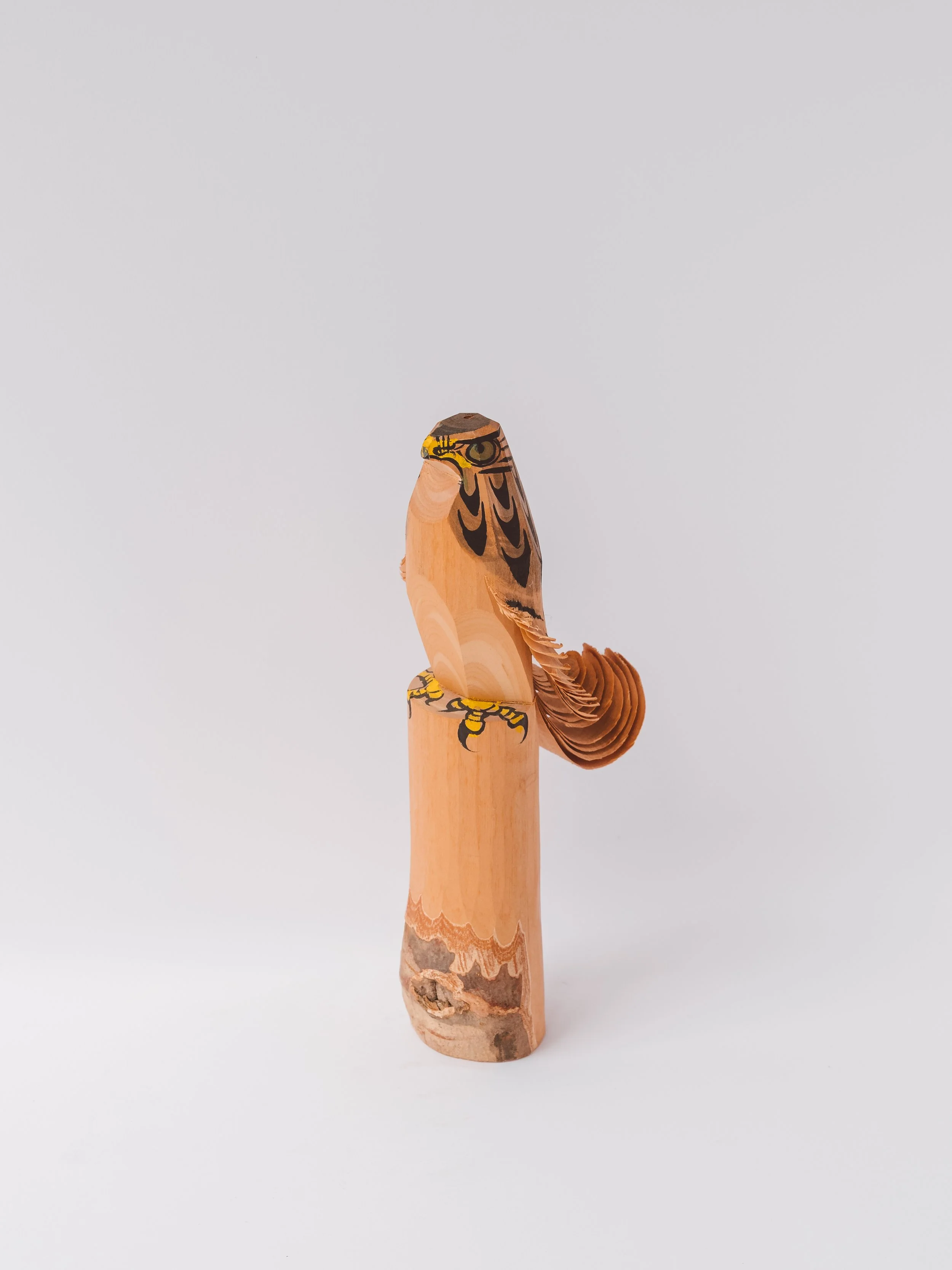 Image 1 of 15
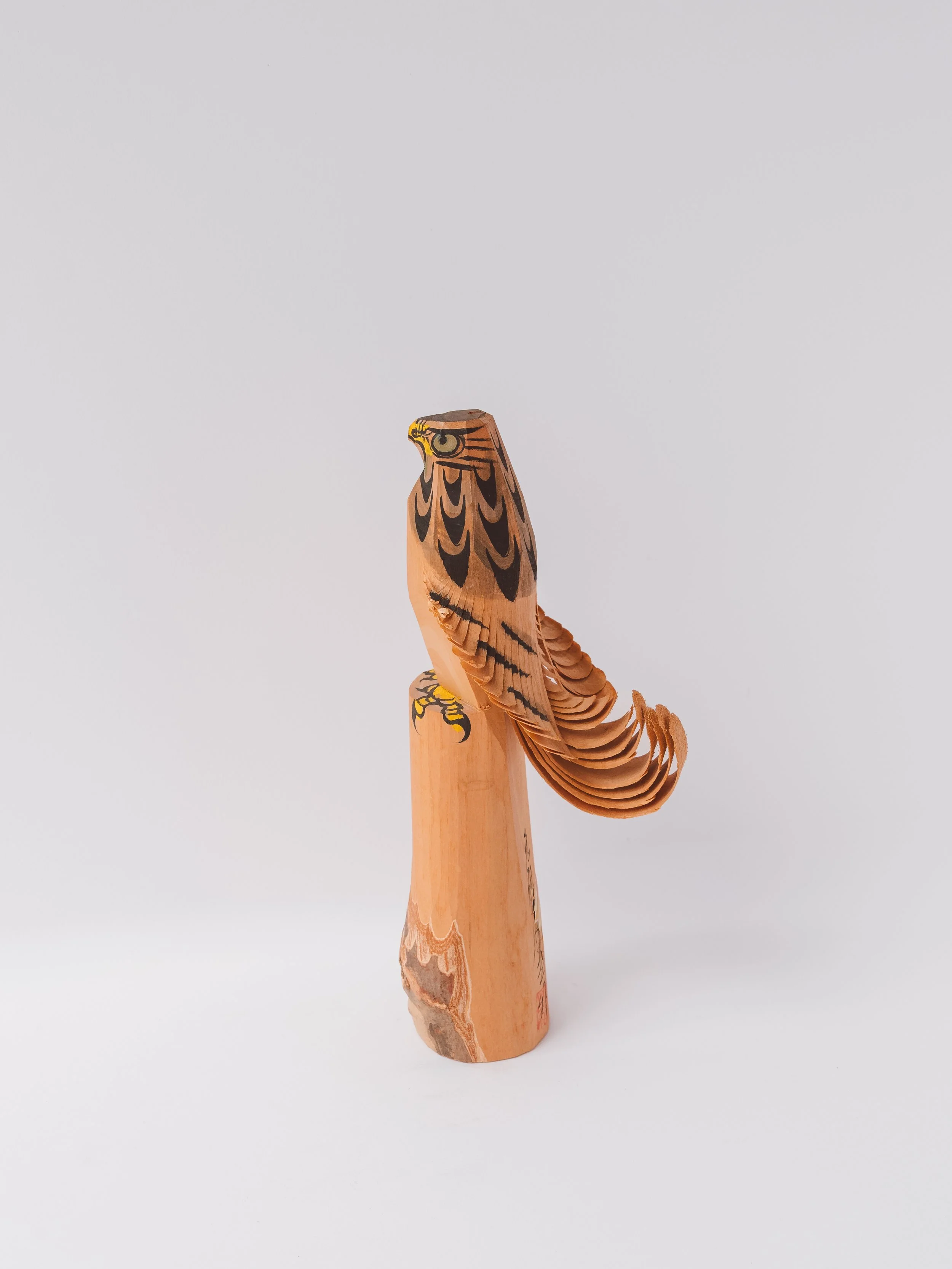 Image 2 of 15
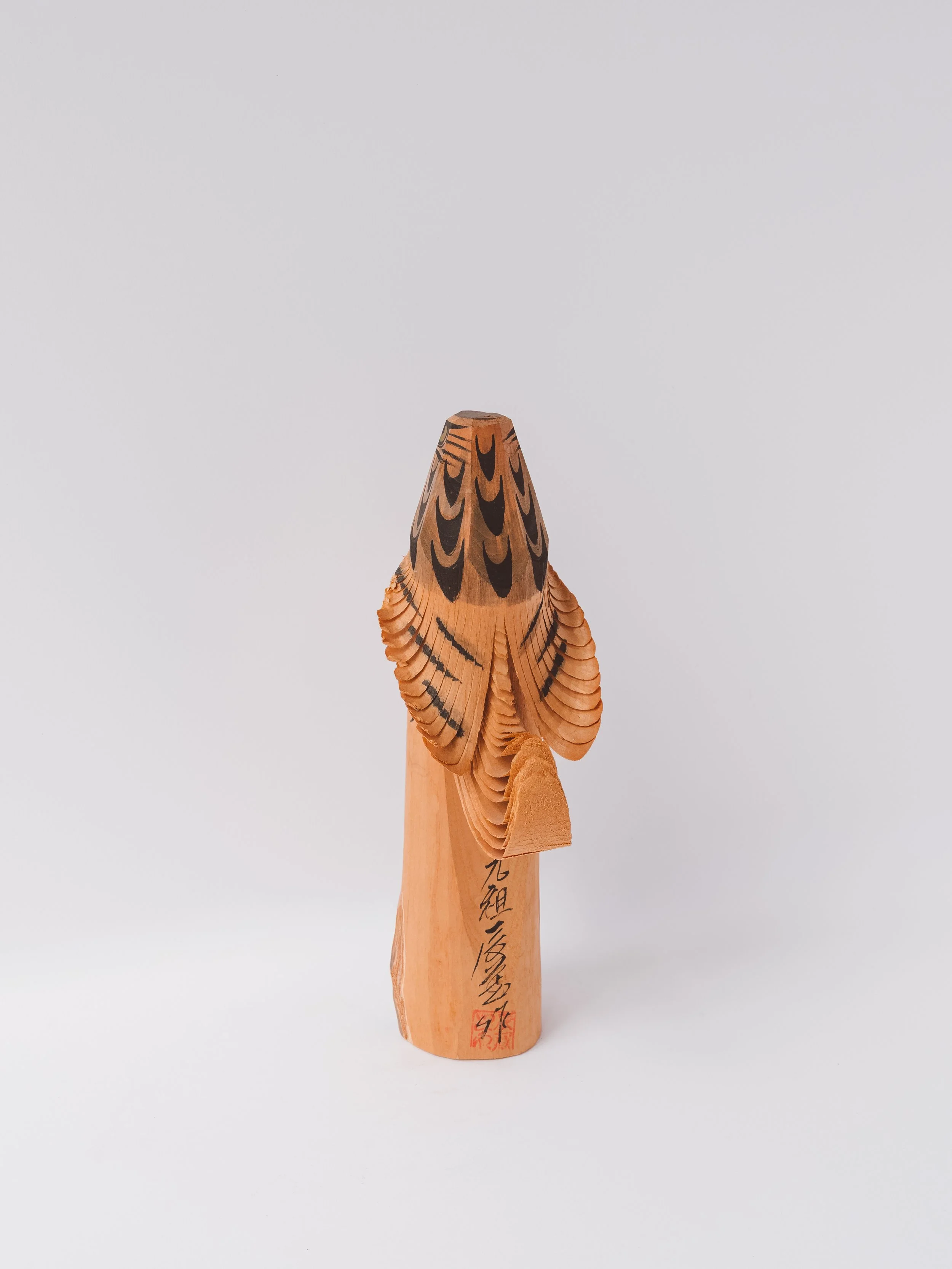 Image 3 of 15
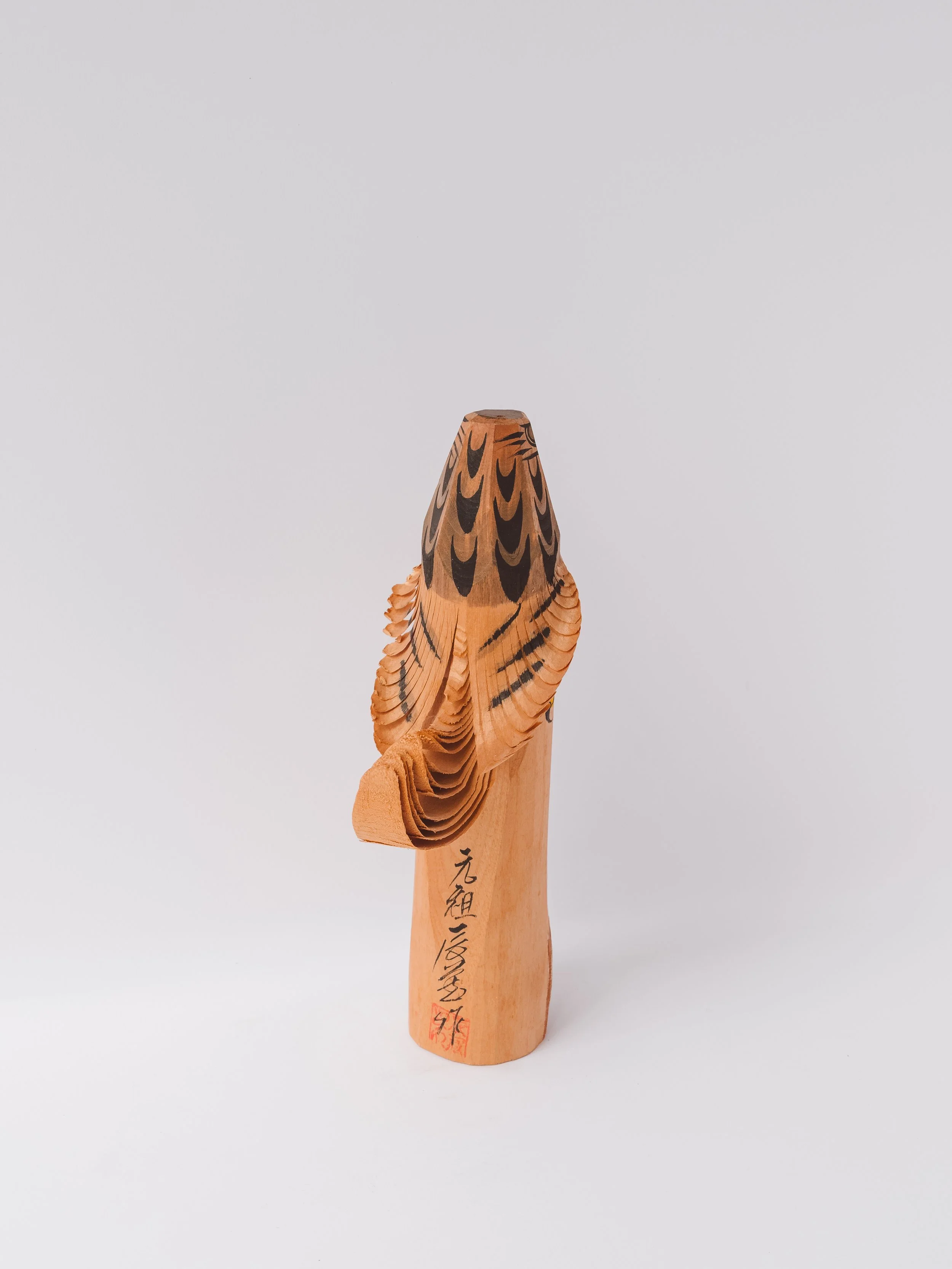 Image 4 of 15
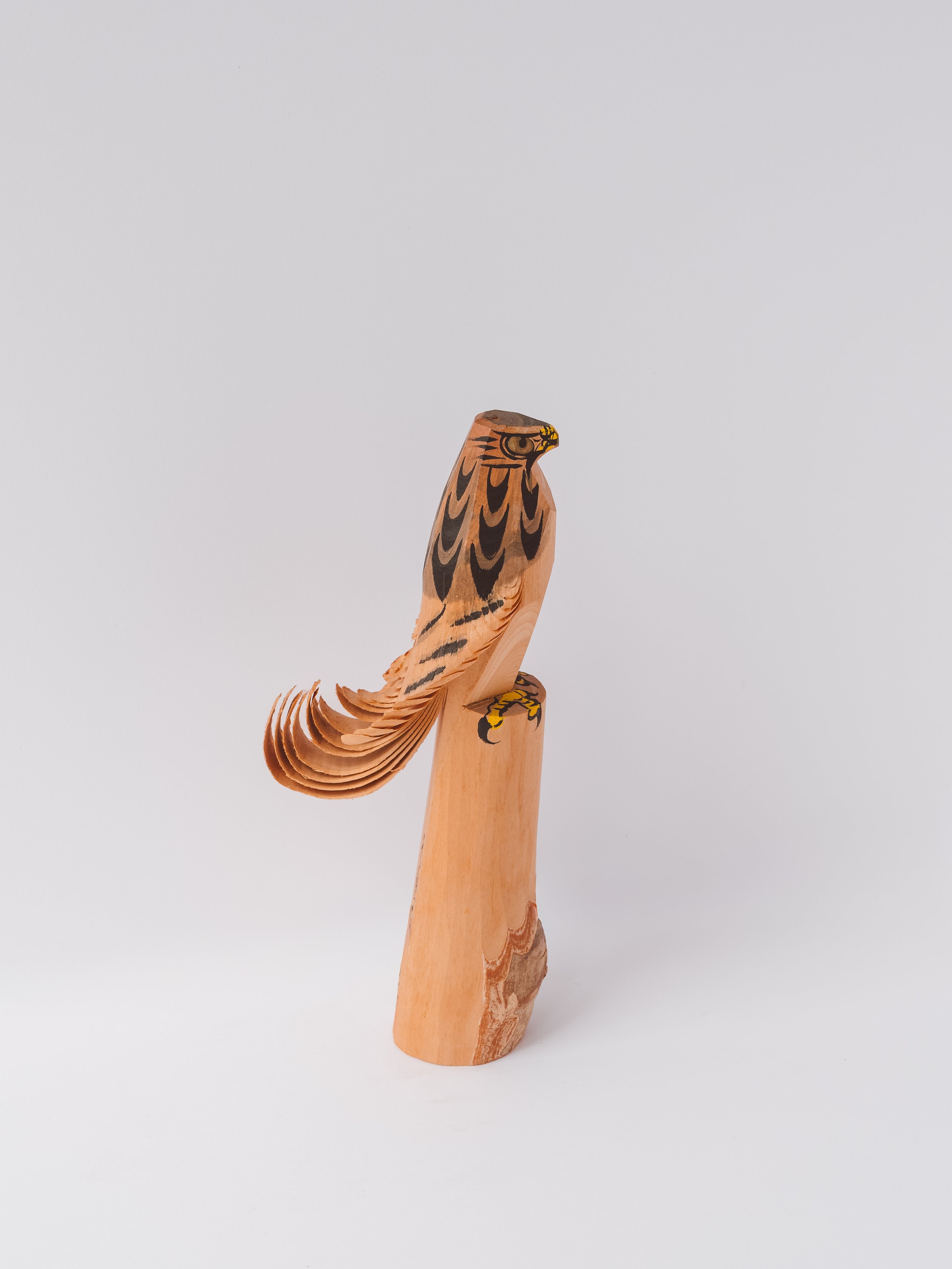 Image 5 of 15
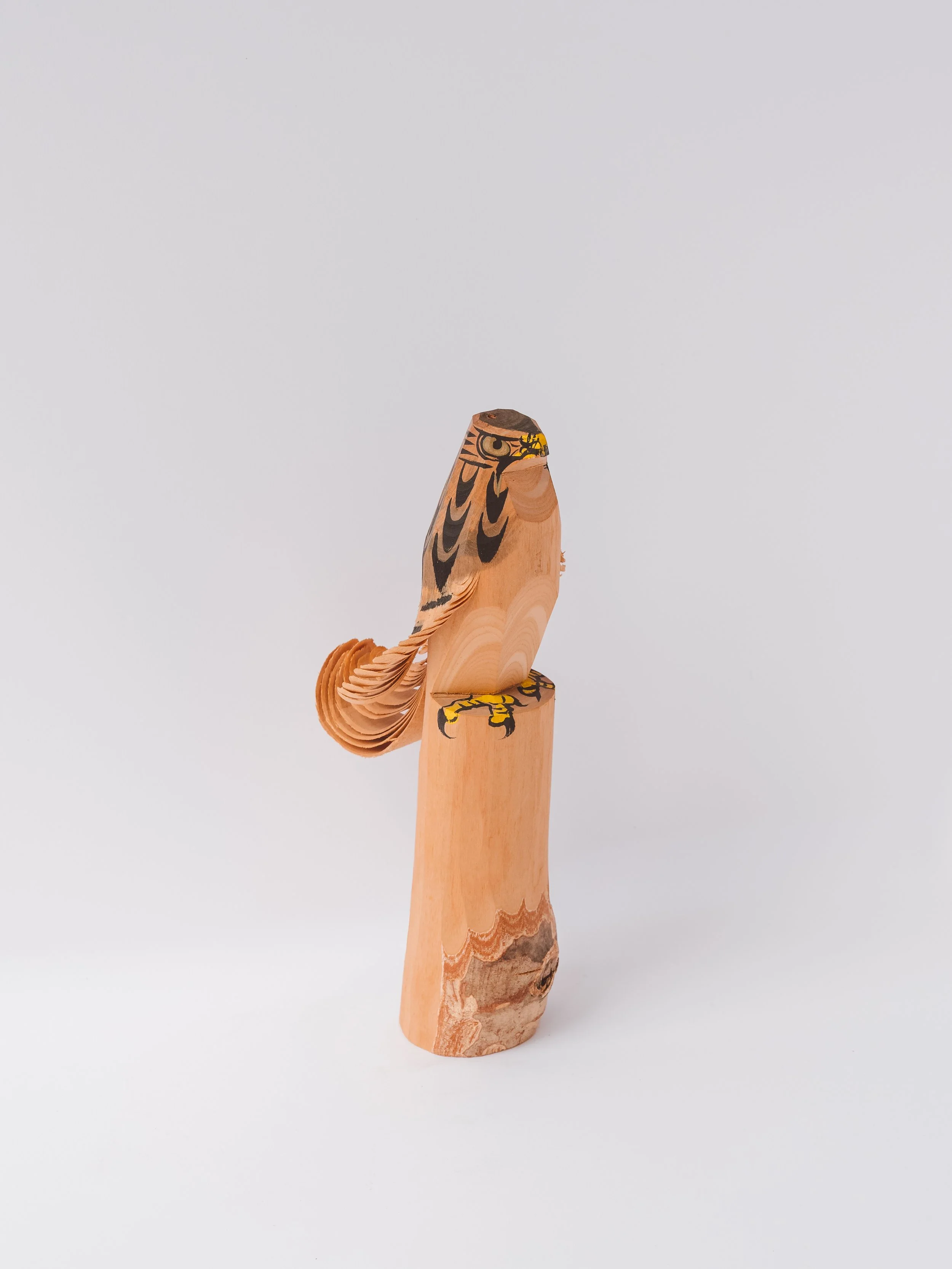 Image 6 of 15
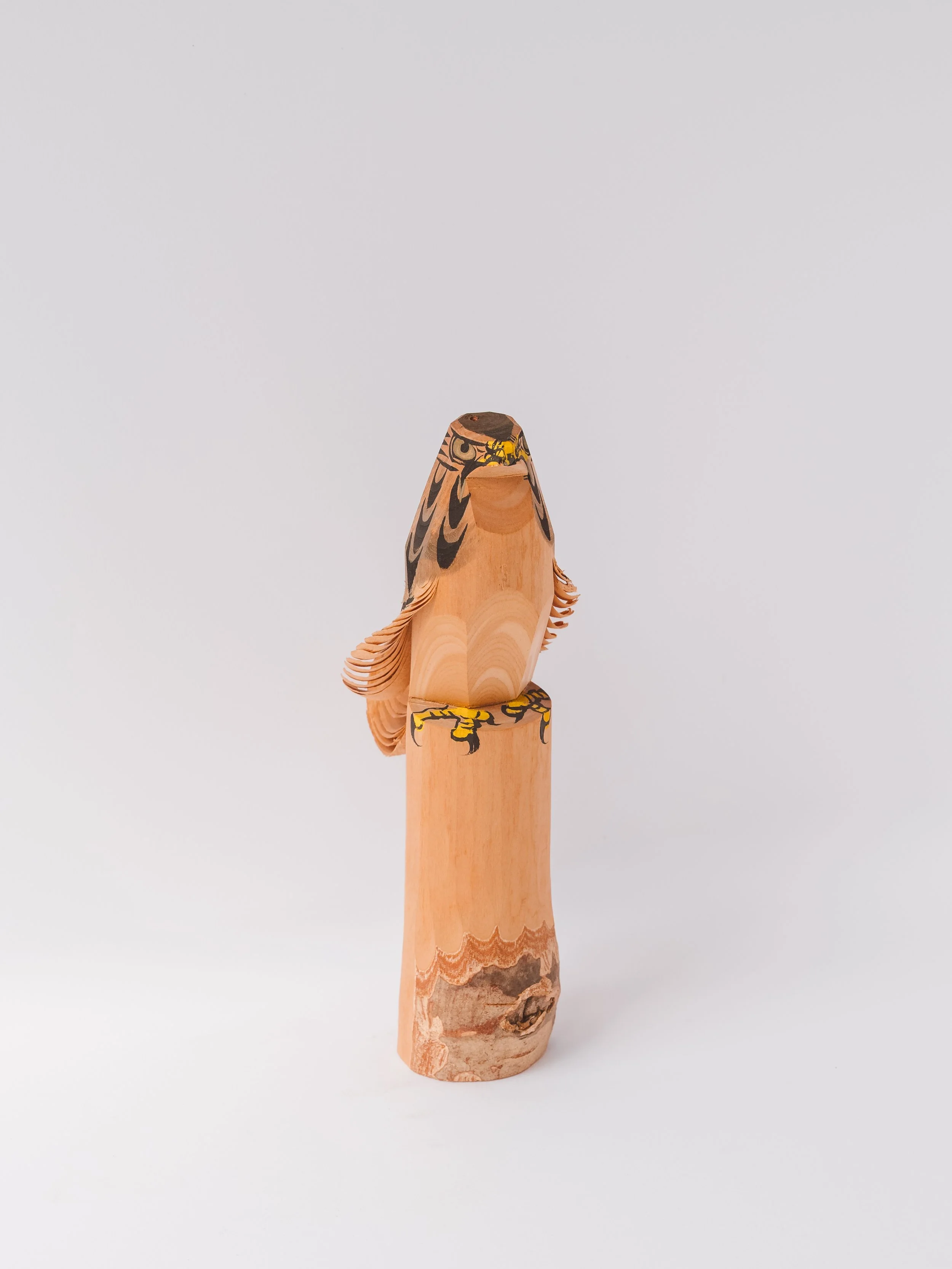 Image 7 of 15
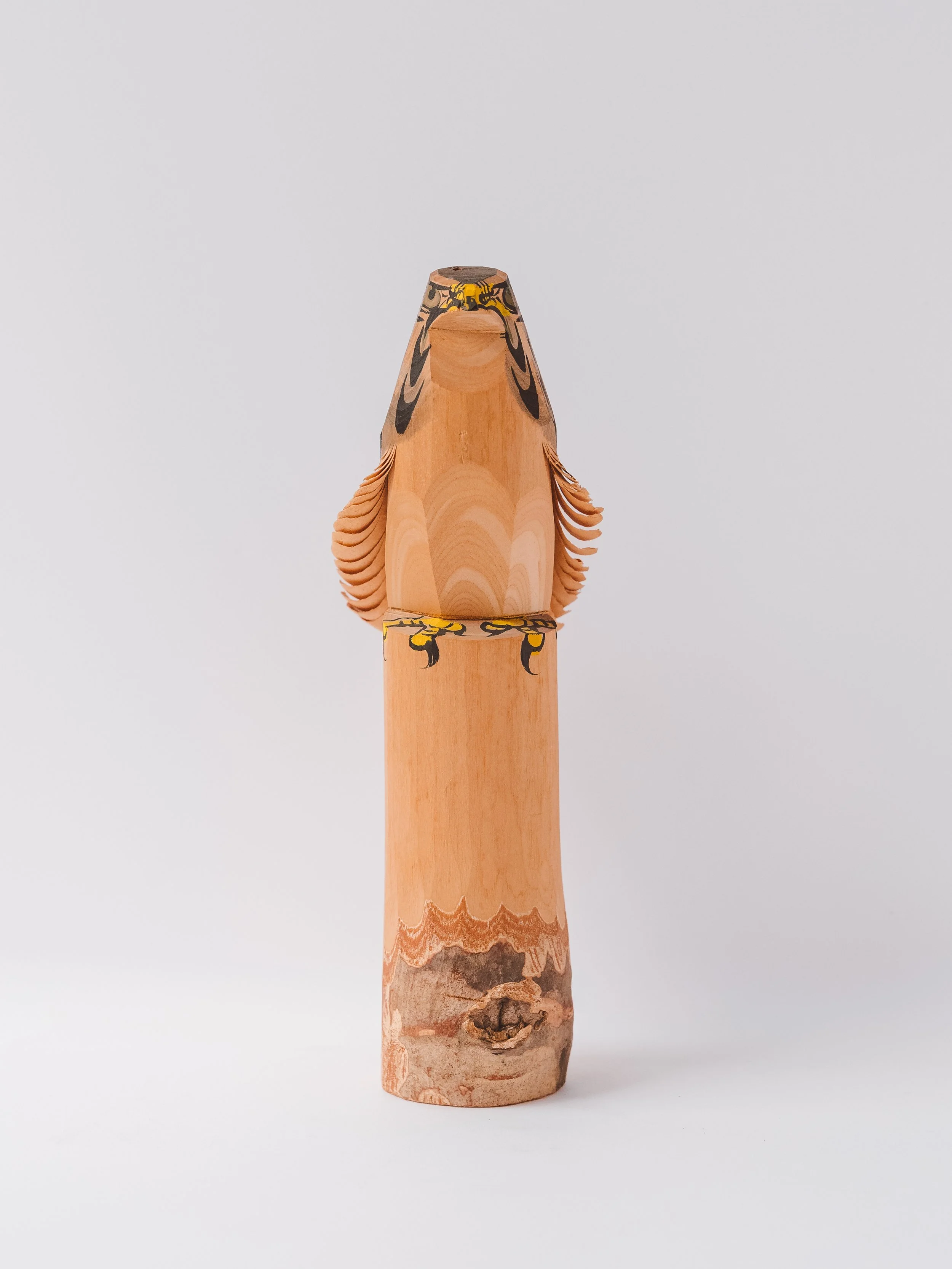 Image 8 of 15
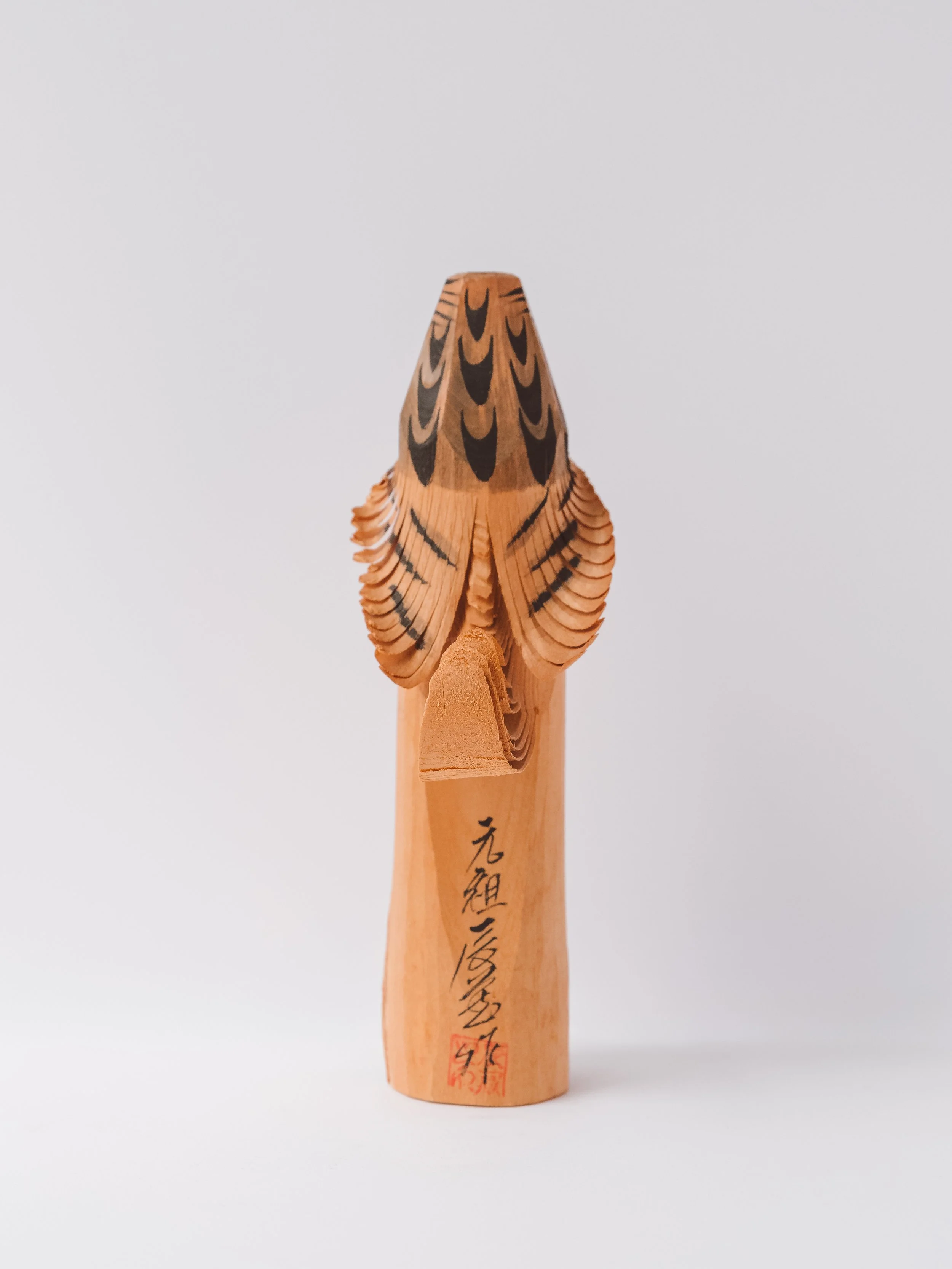 Image 9 of 15
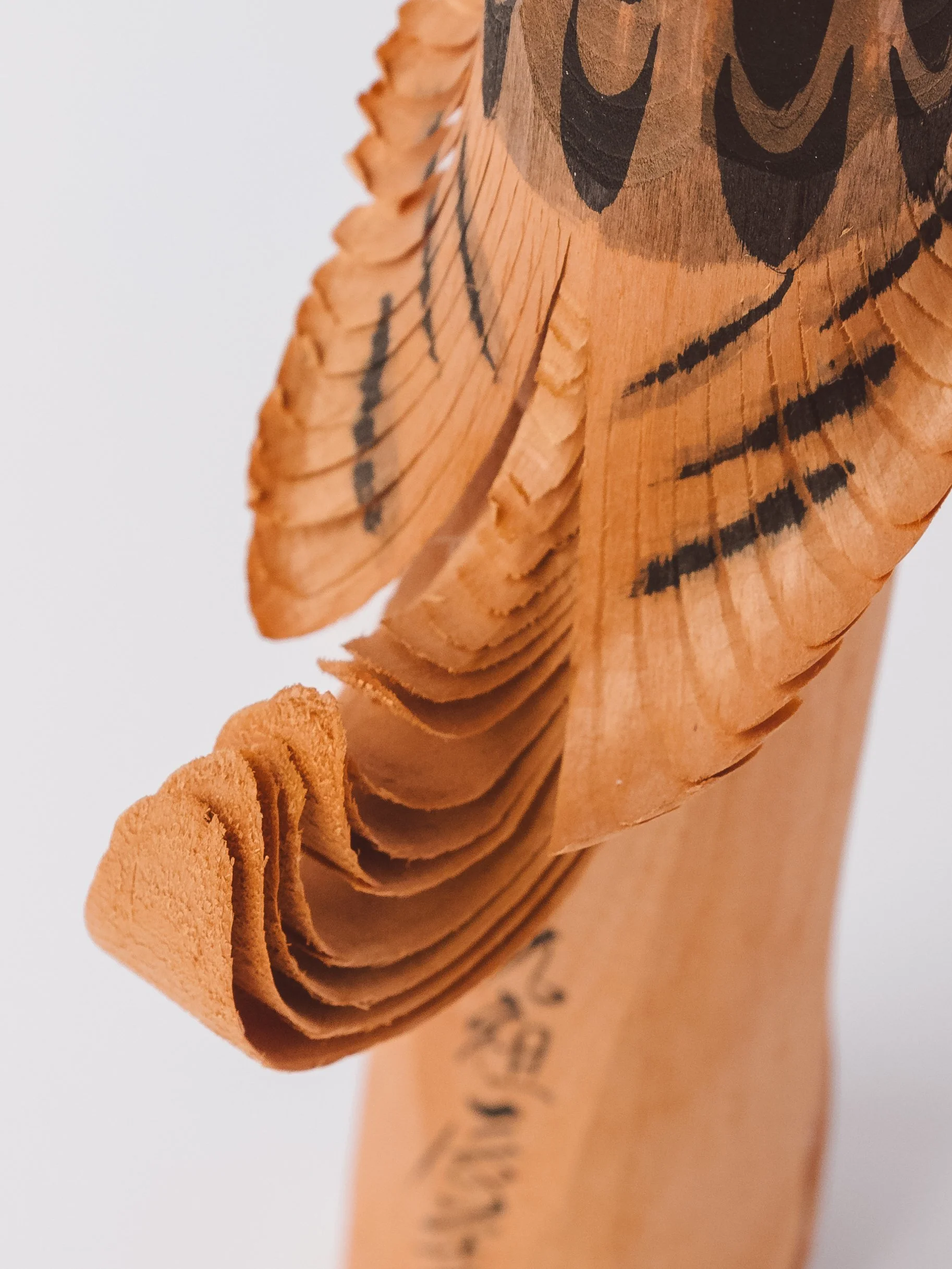 Image 10 of 15
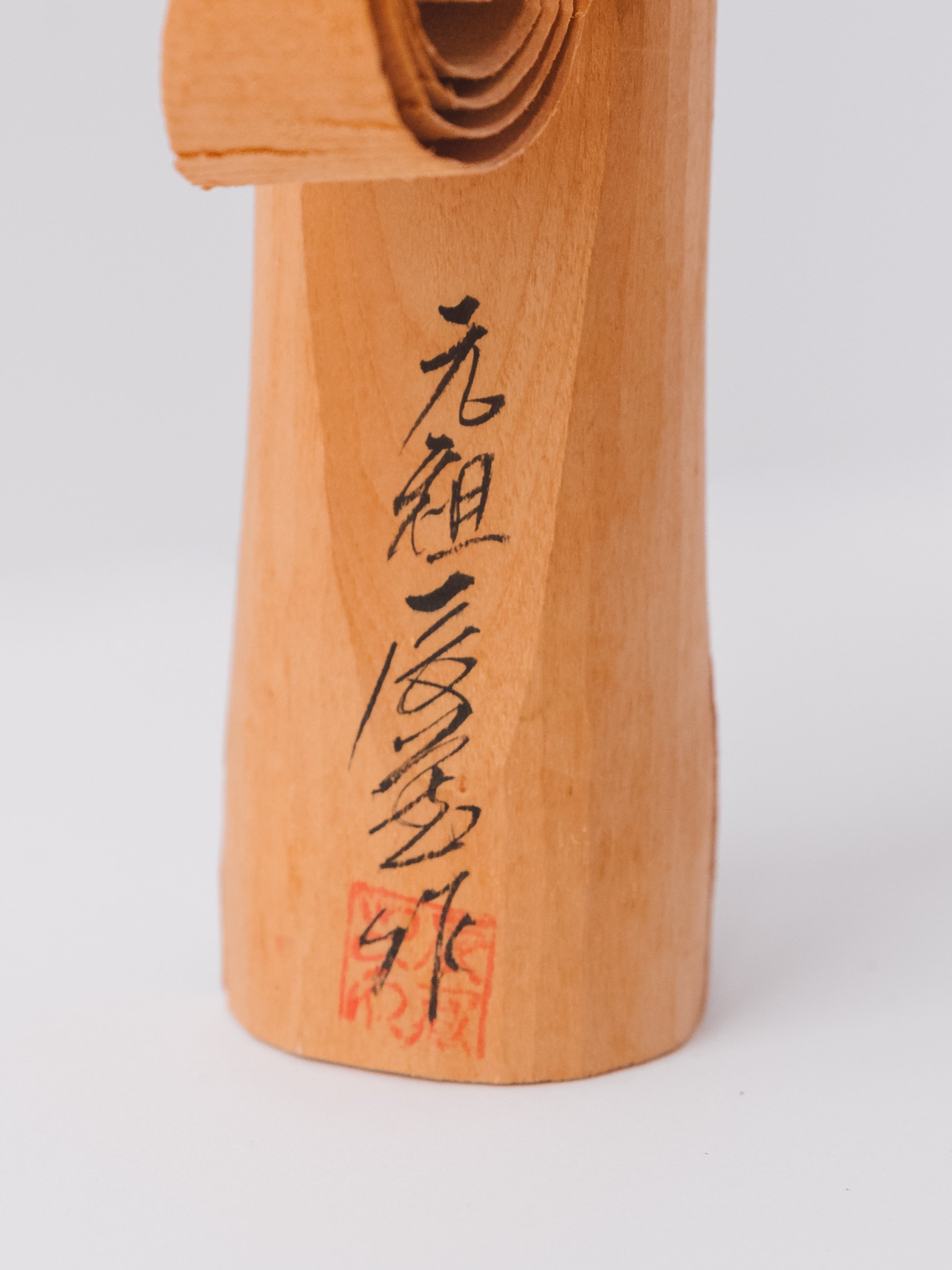 Image 11 of 15
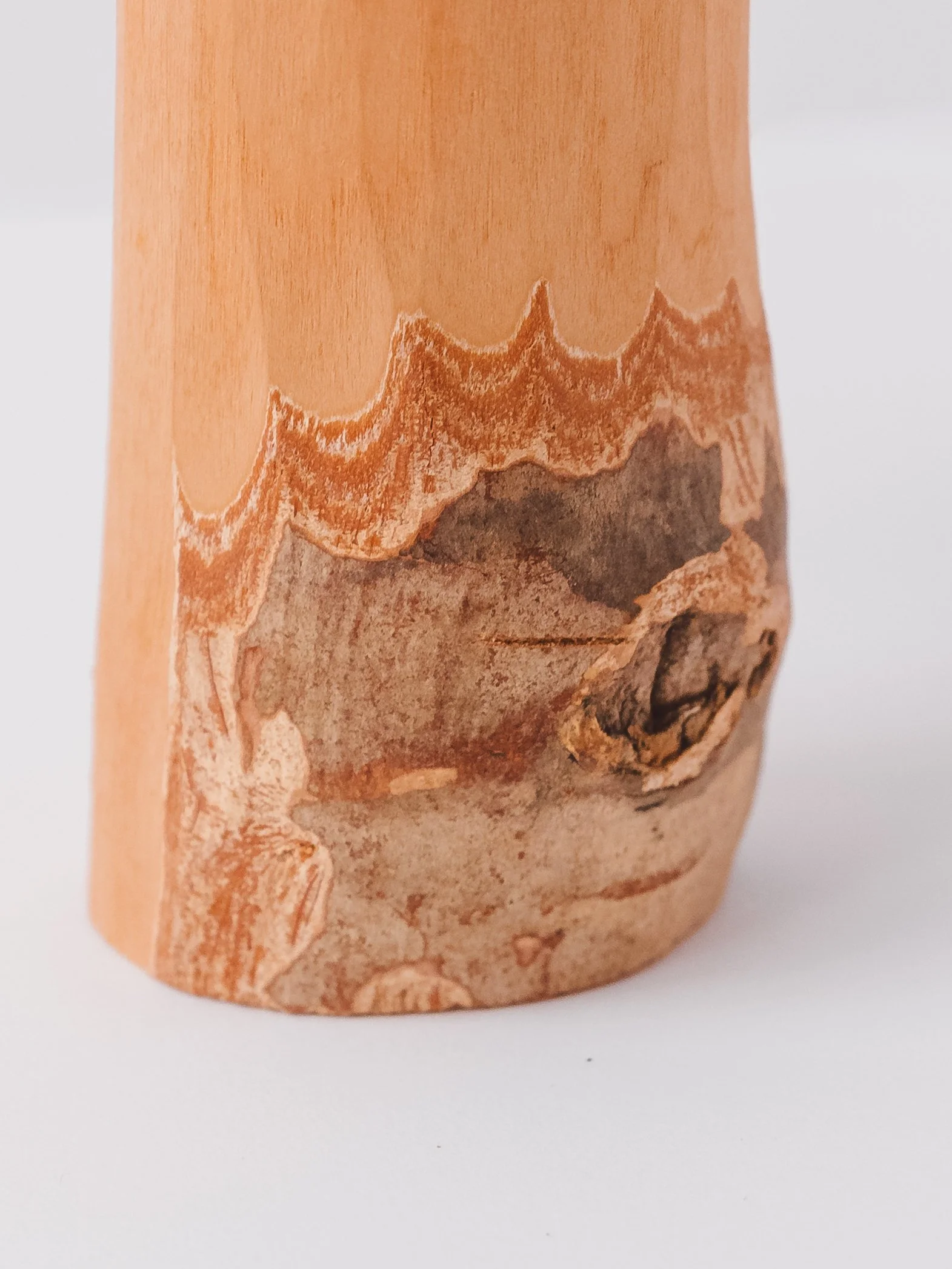 Image 12 of 15
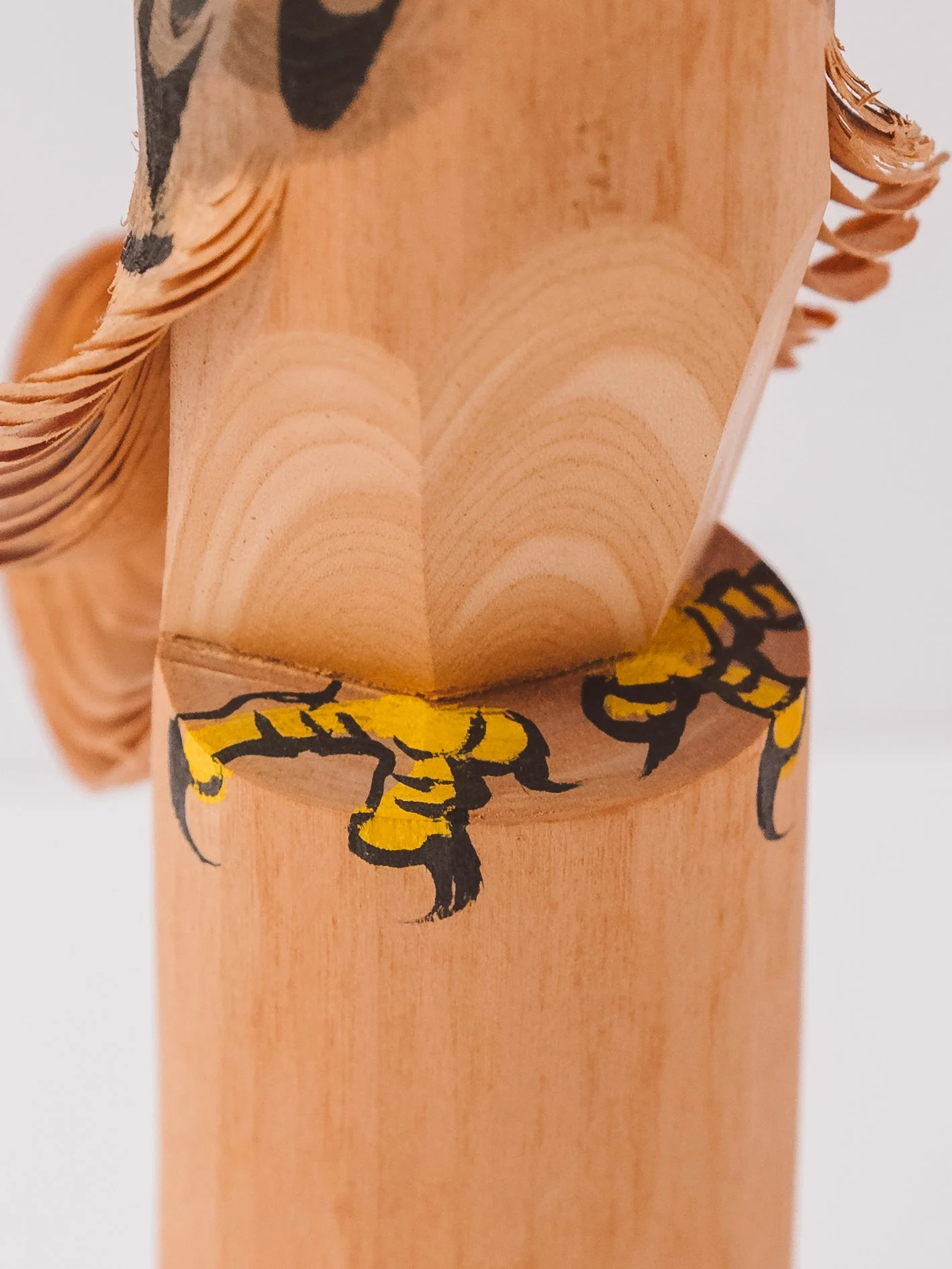 Image 13 of 15
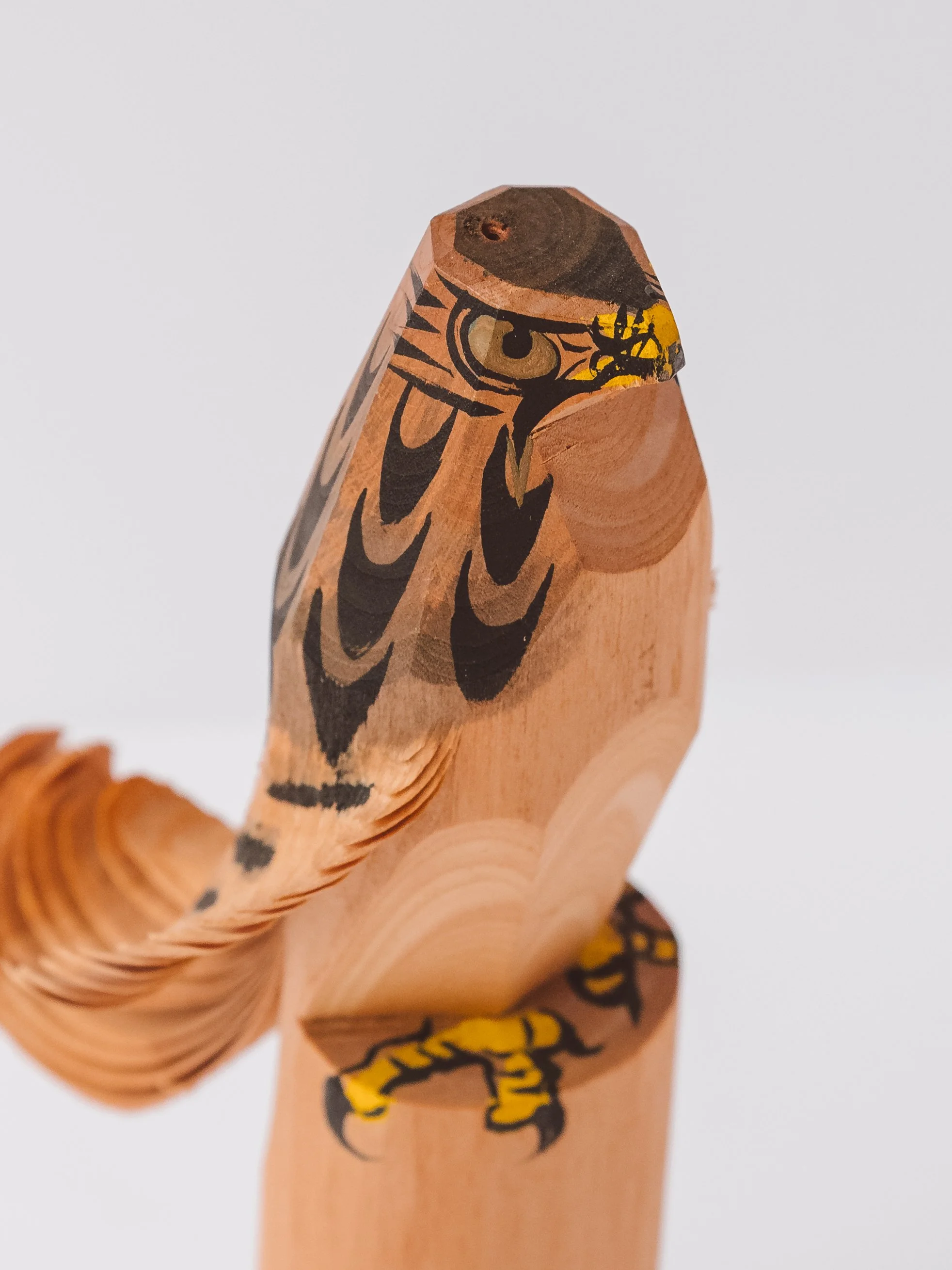 Image 14 of 15
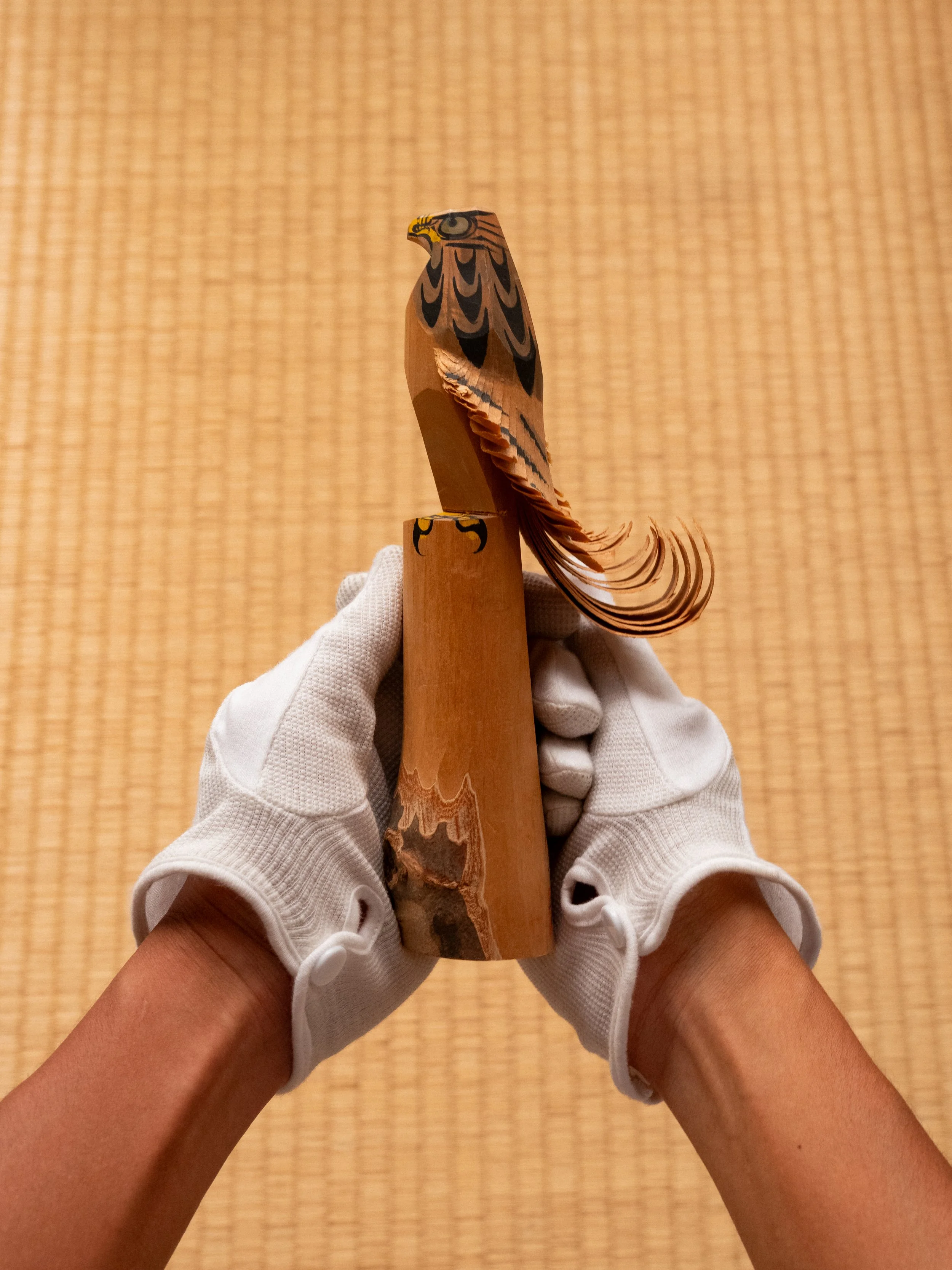 Image 15 of 15