【 The Concept 】
A small gilded figure of Dainichi Nyorai, the Great Sun Buddha, seated in meditation on a lotus throne before a blazing halo of carved flames. He wears a tall jewelled crown, necklaces and armbands, and his hands are joined in front of his chest in one of the most distinctive gestures in all of Buddhist art: the left hand extends only its index finger, and the right hand wraps over it, covering it. This is the chiken-in, the "wisdom fist," and it identifies him at once as the Dainichi of the Diamond Realm (Kongōkai), the central Buddha of Japanese esoteric Buddhism. Beneath him, the lotus rises from a tall, six-sided pedestal carved with lotus and peony panels and edged with a small railing, like a miniature temple dais. Seen from behind, the pedestal is cut away flat — a design that lets the figure stand close against the back wall of a household altar (butsudan). The whole figure is cast in metal and finished in warm gold, and it carries a signature on the back of the halo. It is a household-scale image of the Buddha whom Japan's esoteric tradition regards as the universe itself.
【 The Great Sun at the Centre of Everything 】
Dainichi means "Great Sun." In Sanskrit he is Mahāvairocana, "the Great Illuminator." In the Shingon school of Japanese Buddhism he is not simply one Buddha among many. He is the source from which all other Buddhas and bodhisattvas emerge, and his body is the whole cosmos. Just as the sun lights everything without choosing, Dainichi's wisdom is said to reach every being without exception.
That is why he looks so different from other Buddhas. Most Buddhas are shown in a plain monk's robe, having given up all worldly things. Dainichi alone wears a crown and jewels like a king. The treasure he wears is not wealth, but a sign that he is the sovereign of all the Buddhas, the one who holds every virtue in himself.
【 The Fist of Wisdom 】
Every Buddhist image speaks through its hands, and this gesture is one of the easiest to recognise. In the chiken-in, the single finger extended from the left hand is traditionally read as the world of living beings, and the right hand covering it as the world of the Buddha. The two are held together as one: the teaching that ordinary people and the Buddha are, at the deepest level, not separate. It is a gesture of union and of protection, as if wisdom were gently holding the whole world in its hand.
The flames behind him have their own meaning. A flaming halo (kaen kōhai) represents the fire of wisdom, burning away ignorance, anger and greed. In esoteric Buddhism, fire is not something to fear but something that purifies.
【 Kūkai and the Road from China 】
In 804 a young Japanese monk named Kūkai sailed to Tang China. In the capital, Chang'an, he became the disciple of the great esoteric master Huiguo, who, it is said, recognised him at first sight and passed on the full teaching in a matter of months. Kūkai returned to Japan in 806 carrying scriptures, mandalas and ritual implements, and founded the Shingon school, with Dainichi at its heart. He later opened the mountain monastery of Kōya-san, which is still the centre of Shingon today. More than twelve centuries later, Kūkai, known as Kōbō Daishi, remains one of the most beloved figures in Japanese history, and images of Dainichi like this one are found on household altars throughout the country.
【 What Owning This Piece Brings 】
・ A light at the centre of the home. Dainichi is the Buddha of universal light. On a shelf or altar he is a quiet reminder that wisdom and clarity are always within reach, even on the darkest days.
・ A guardian for your birth year. In Japanese tradition each of the twelve zodiac animals has its own protective Buddha, and Dainichi is the guardian of those born in the Year of the Sheep and the Year of the Monkey. It makes a meaningful personal gift for anyone born in those years.
・ Focus for meditation. The closed, centred gesture and the still, seated posture make this an ideal focal point for a meditation space.
・ Purification and a fresh start. The fire behind him burns away what is no longer needed. Many people keep such an image at the start of a new chapter in life.
A fitting gift for a meditation practitioner, a collector of Buddhist art, a new home, or anyone born in the Year of the Sheep or Monkey.
【 Stories of the Great Sun Buddha 】
In medieval Japan, Buddhism and Shinto grew so closely together that the two were often seen as one. Many Shinto gods were understood to be local forms of Buddhas, and the sun goddess Amaterasu, ancestor of the imperial family, was identified with Dainichi. Both are the sun, one in the language of the native gods and one in the language of Buddhism.
And one small surprise from the art world: in 2008, a wooden Dainichi statue attributed to Unkei, the most celebrated sculptor in Japanese history, came up for auction in New York. It sold for about 14 million dollars, one of the highest prices ever paid for a Japanese work of art. It was brought back to Japan and has since been designated an Important Cultural Property. The Great Sun Buddha, it seems, still draws the world's attention.
【 Where to Place It 】
On a household altar, in a tokonoma alcove, on a meditation shelf or a quiet corner of a study. Place it at or slightly above eye level so that his lowered gaze meets yours, and give the halo some space behind it. Because the back of the pedestal is cut flat, it sits neatly against a wall or at the back of an altar cabinet. Low, warm light from the side brings out the carved flames and the relief of the pedestal.
【 Care 】
Dust gently with a soft, dry brush. Do not use polish, water or cleaning products on the gold finish. Keep away from humidity. Lift with both hands from the pedestal, never by the halo.
【 Reading the Object 】
A seated, crowned Dainichi Nyorai with hands in the chiken-in (wisdom-fist) gesture, the left index finger extended and covered by the right hand, legs crossed in meditation, wearing jewelled necklaces, armbands and flowing robes. Behind him a flaming mandorla: a round halo behind the head with an openwork flower at its centre, a second halo around the body, and a border of carved flames. He sits on a multi-layered lotus throne above a tall hexagonal pedestal with a small railing and carved panels of lotus and peony. The back of the pedestal is cut away flat, leaving the carved tiers on the front and sides only. Cast metal throughout with a warm gold finish; a signature is engraved on the back of the mandorla.
【 Presence 】
Still, radiant and composed. A small sun on the altar, holding the world quietly in its hand.
Archive Note: The number in the name (806) marks the year Kūkai returned from China with the esoteric teachings of Shingon, in which Dainichi Nyorai stands at the centre. NOT the date this piece was made.
Provenance Note: Sourced from a private household in Japan. A signed, cast-metal figure of Kongōkai Dainichi Nyorai with a gold finish, made for a household Buddhist altar. Attributed to the Japanese tradition of cast Buddhist figures rather than presented as the work of a named maker.
Condition Note: Good vintage condition. Light wear to the gold finish on raised areas and scattered darker speckling, especially on the mandorla, consistent with age. No breaks or missing parts observed.


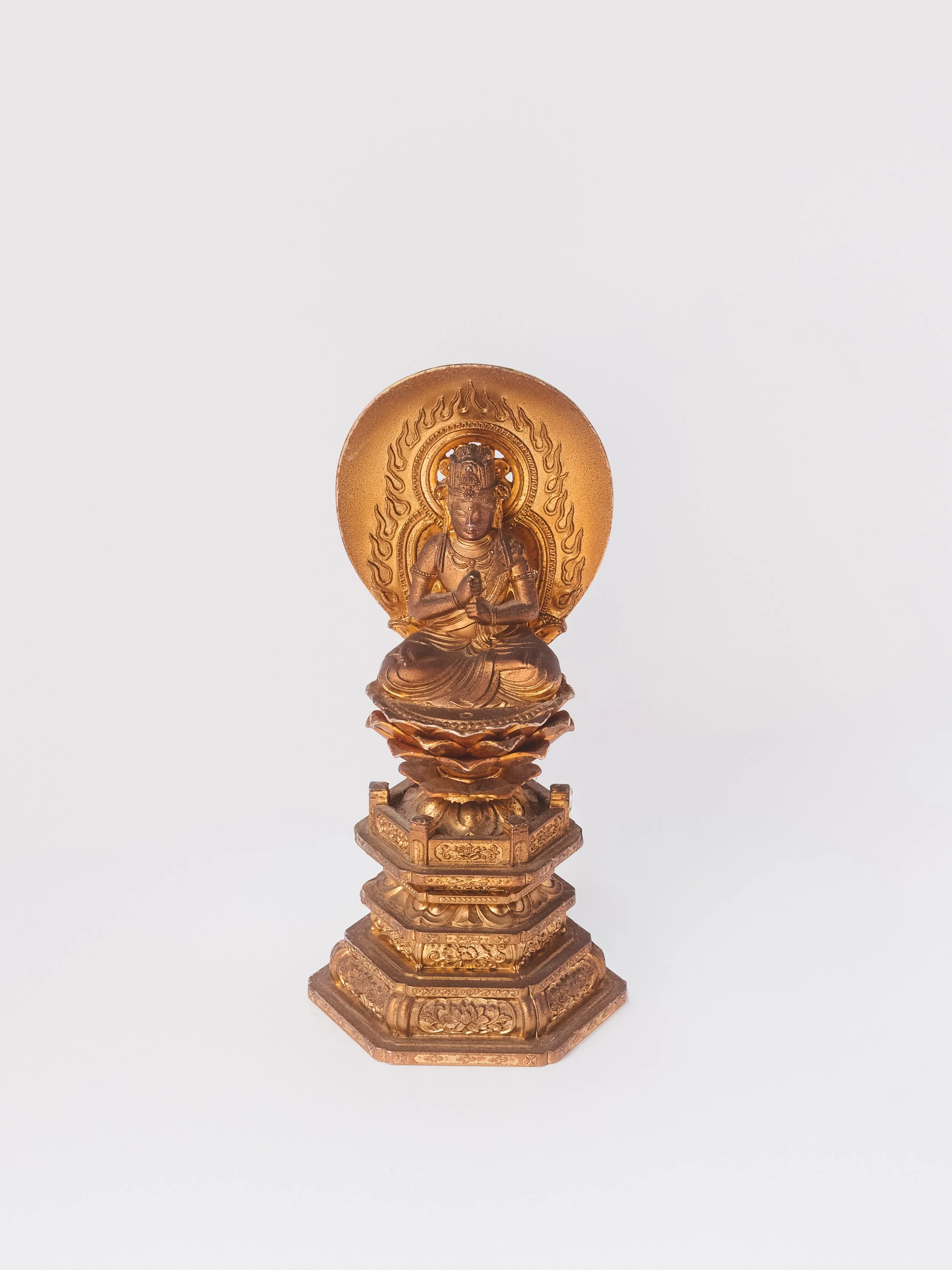 Image 1 of 8
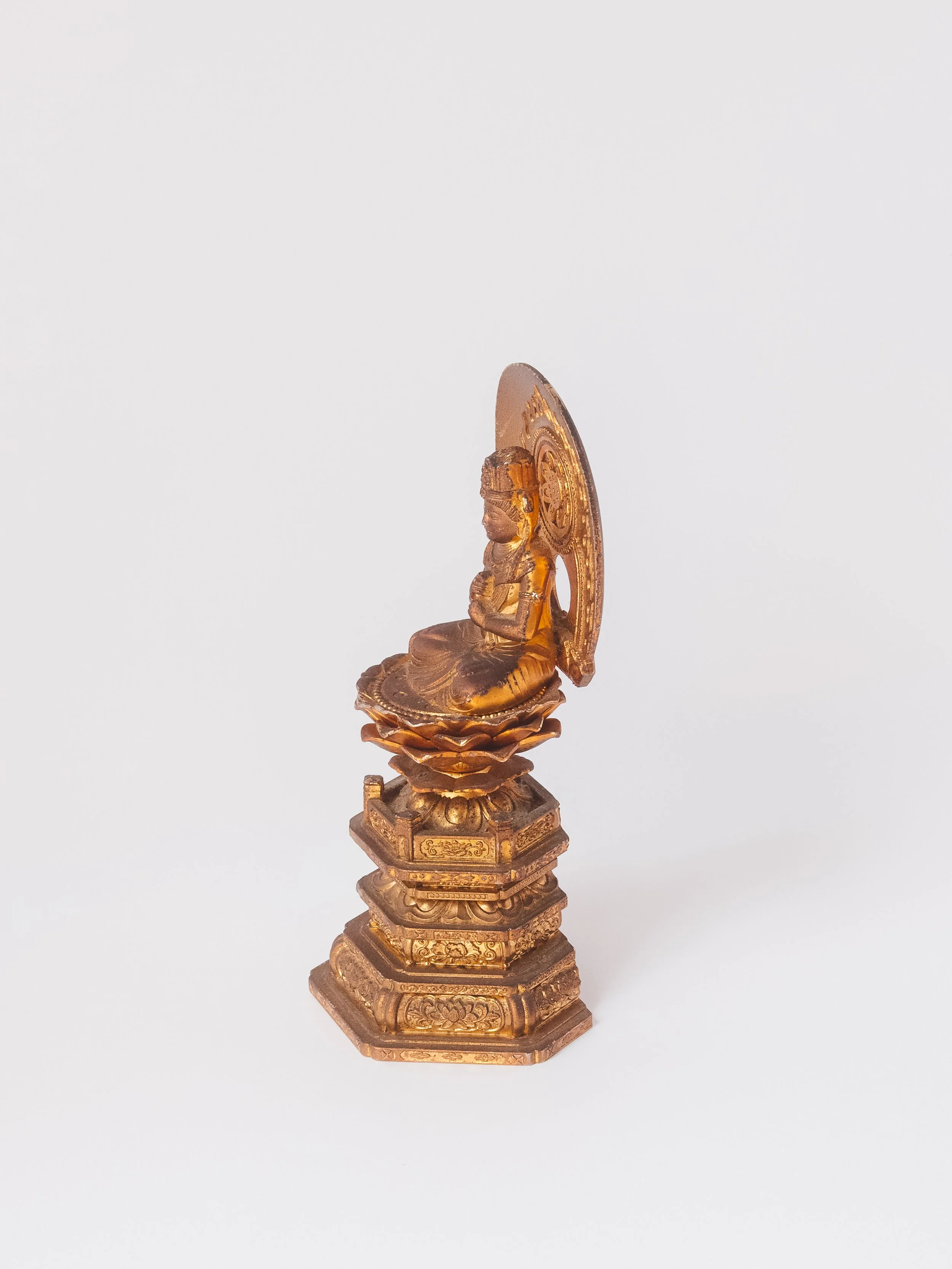 Image 2 of 8
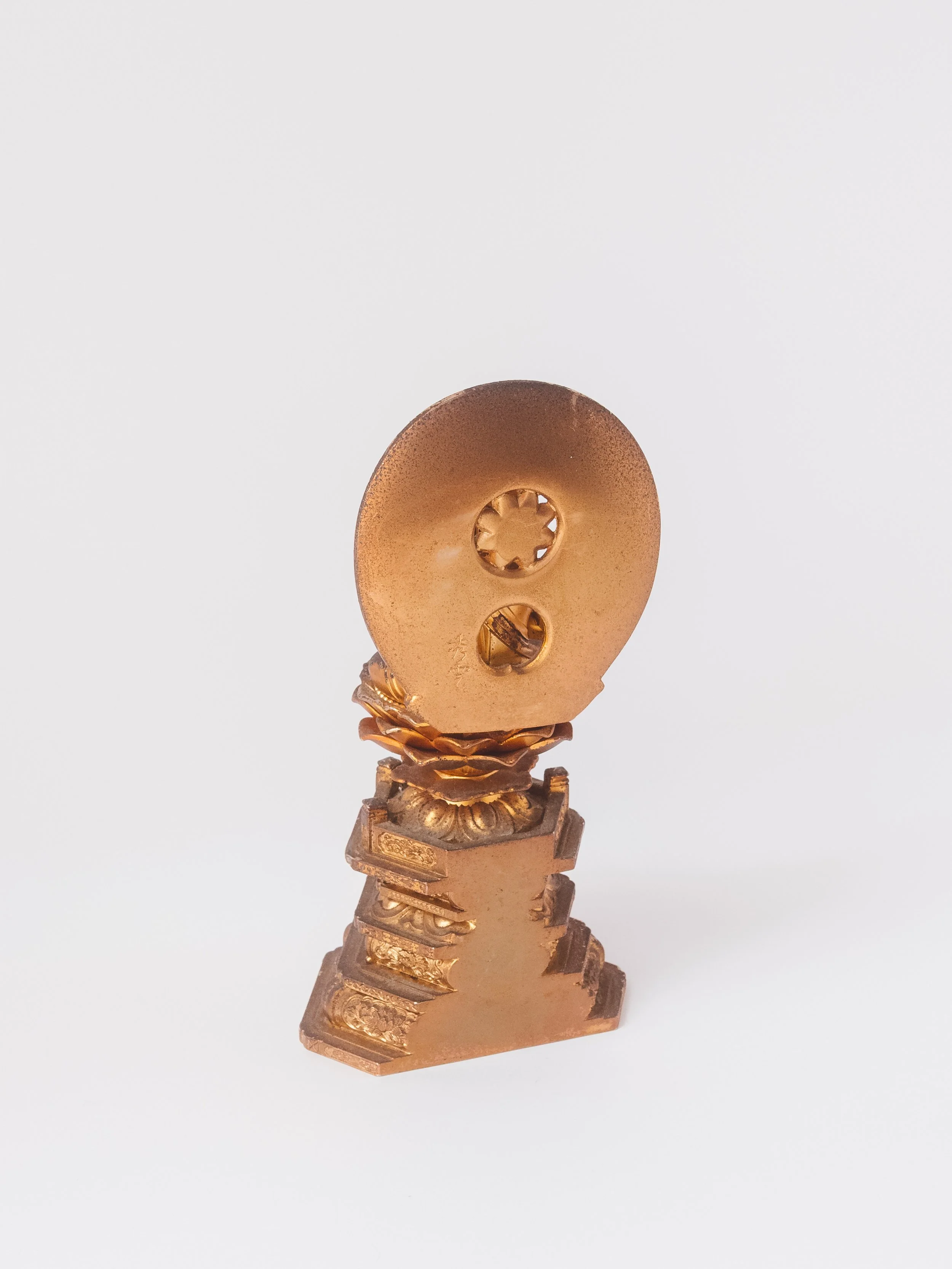 Image 3 of 8
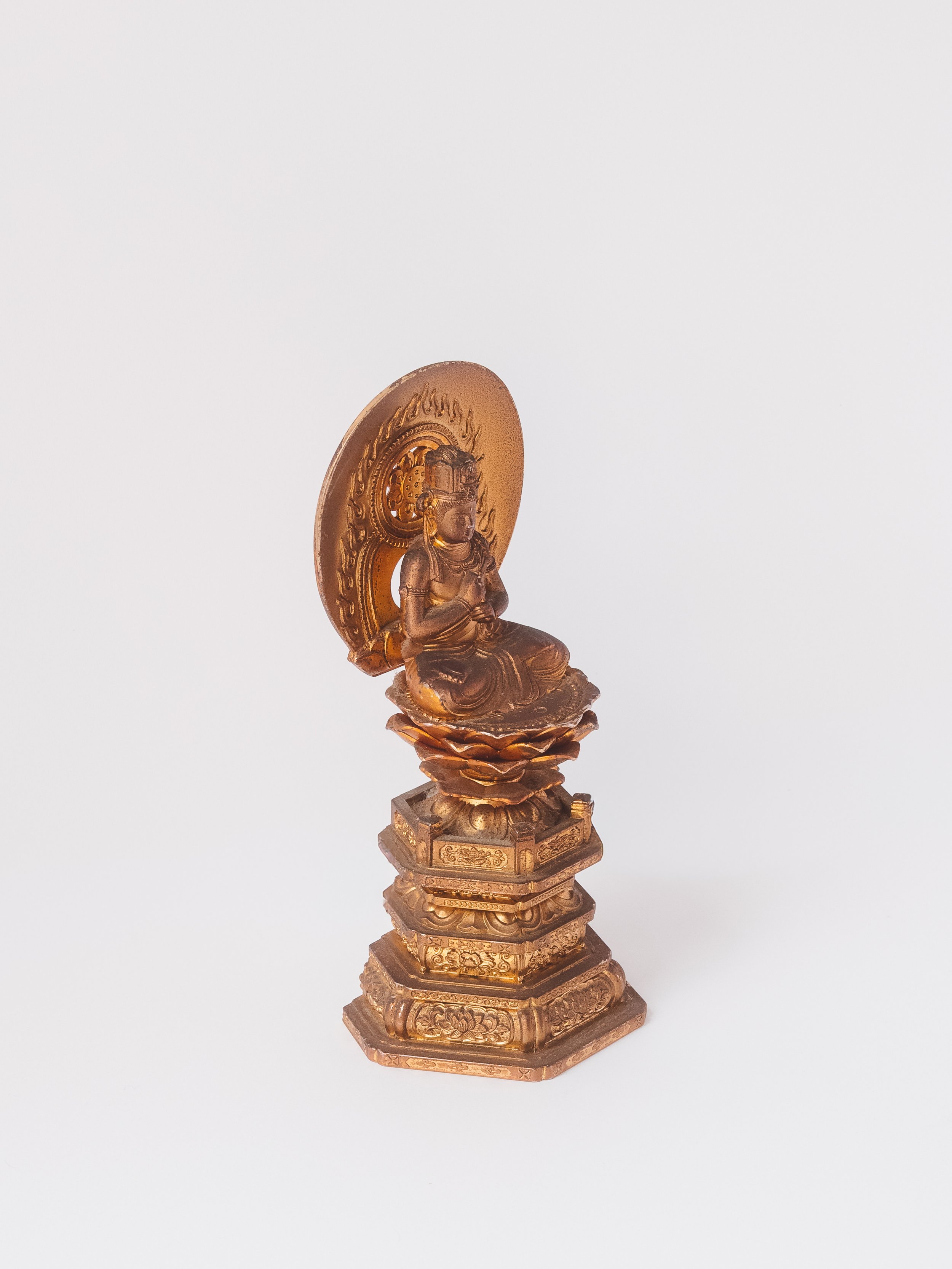 Image 4 of 8
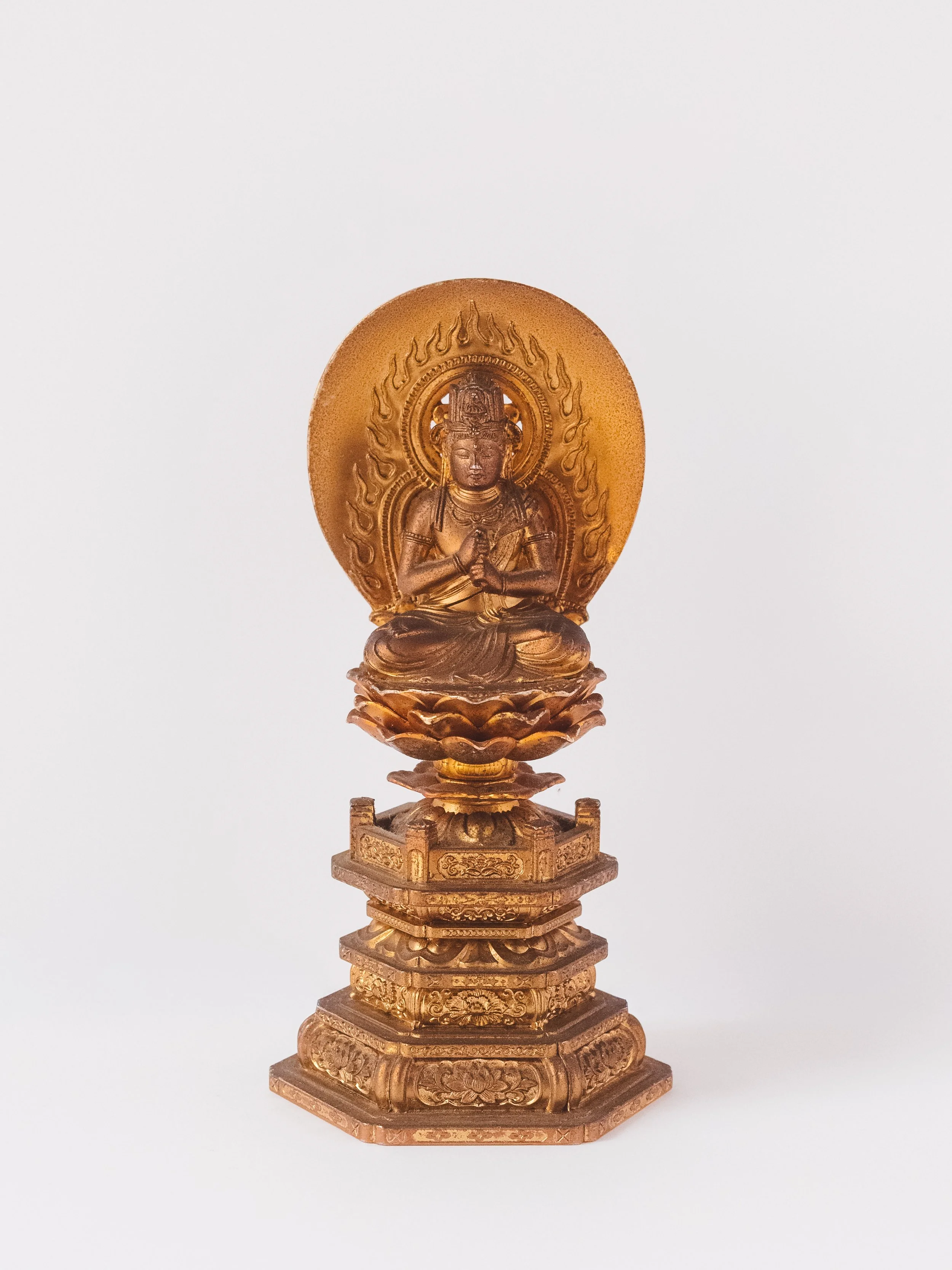 Image 5 of 8
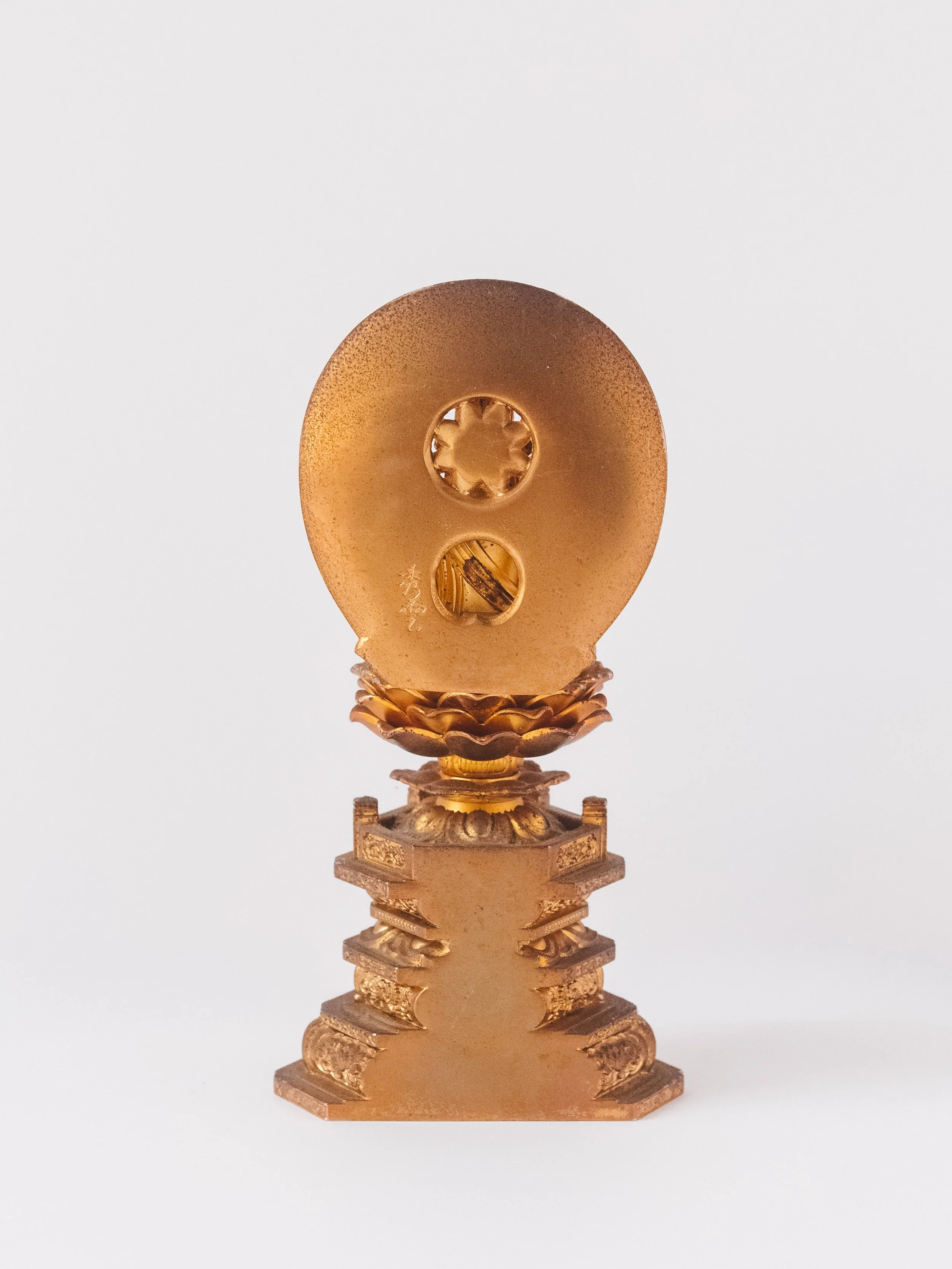 Image 6 of 8
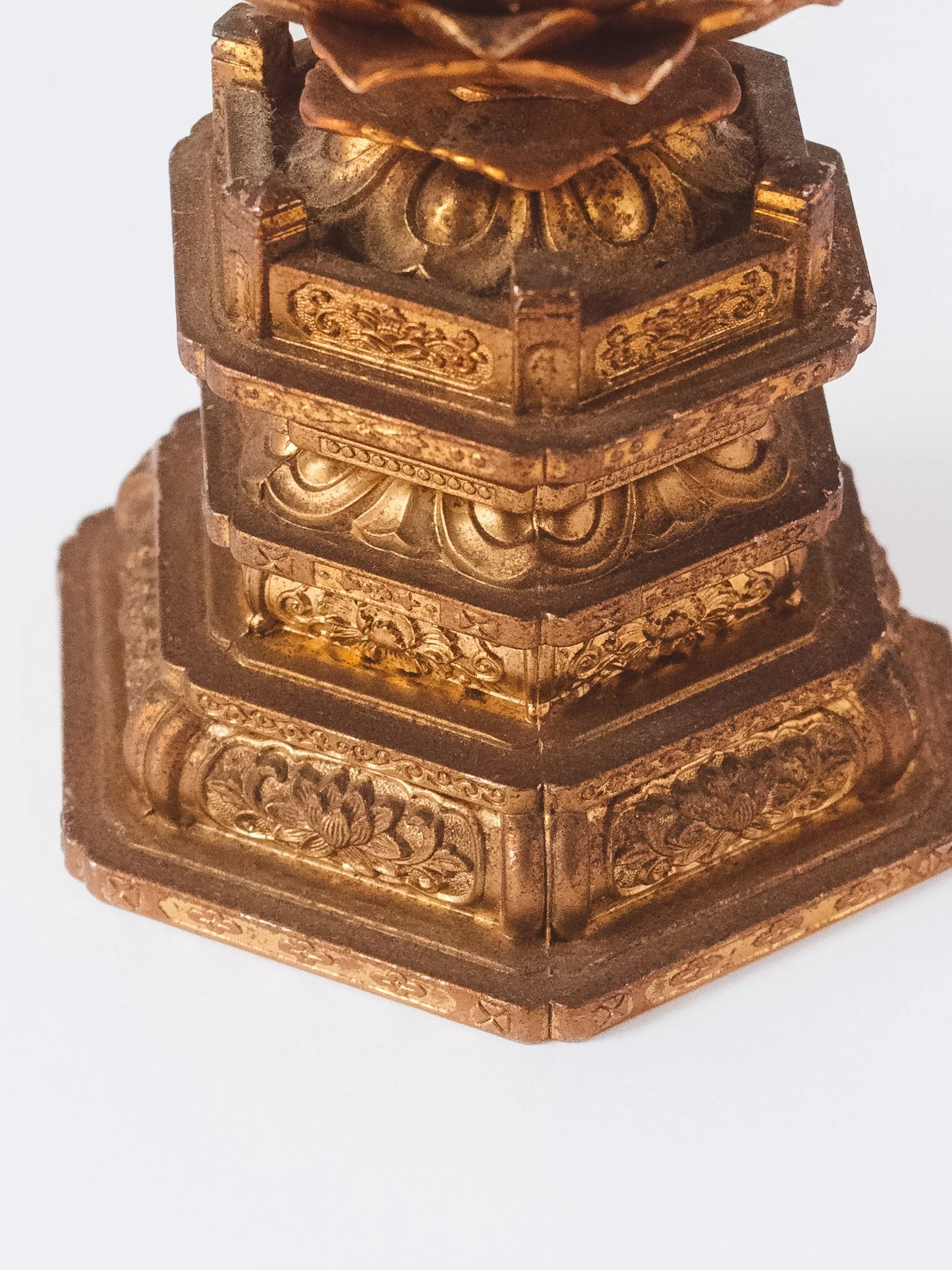 Image 7 of 8
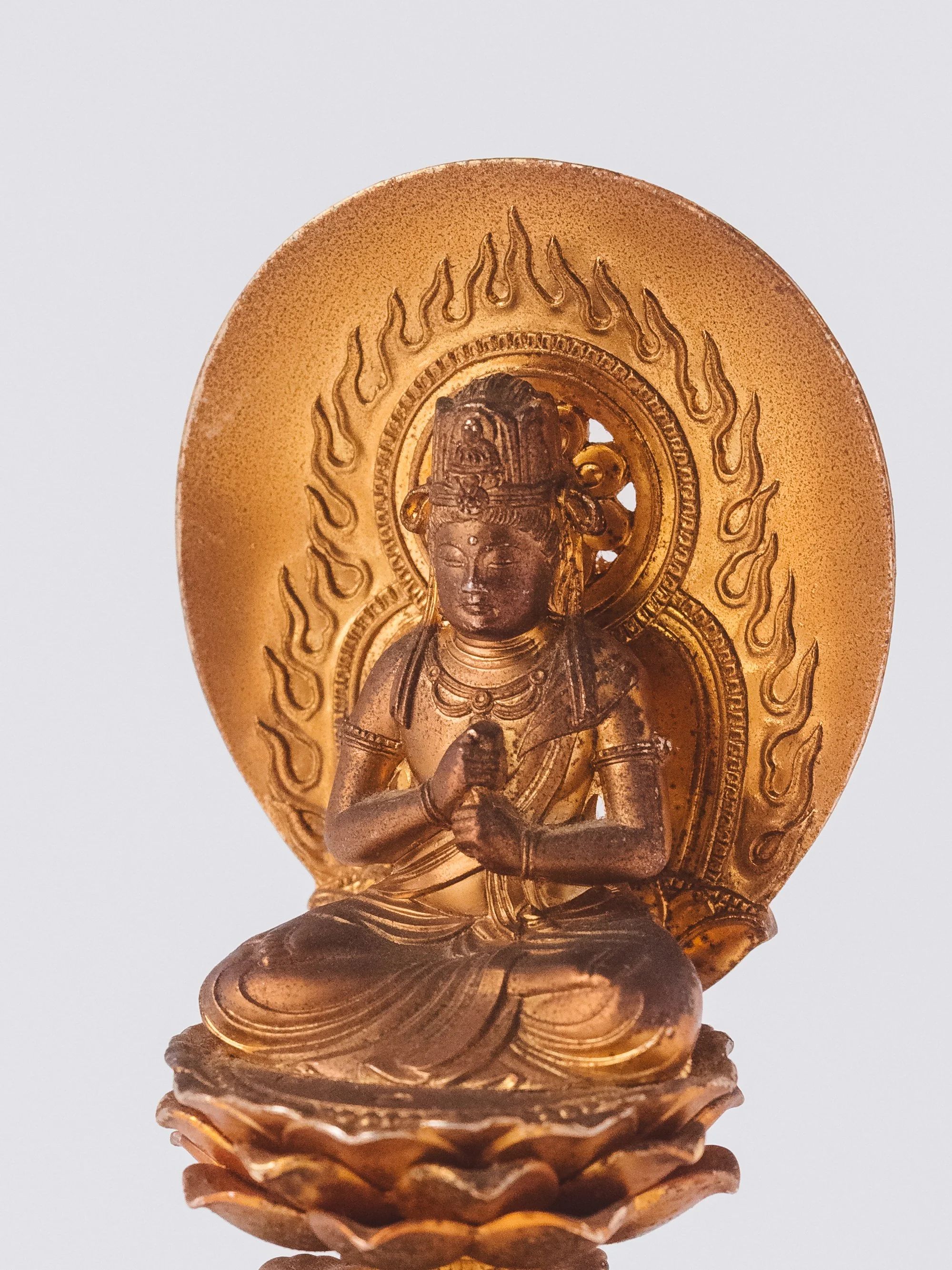 Image 8 of 8