【 The Concept 】
A finely lathe-turned wooden model of the classical Japanese five-storied pagoda — the gojū-no-tō — the architectural form that has stood at the heart of Japanese Buddhism since the seventh century. Thirty-seven centimetres tall, warm honey-orange wood throughout, five graceful upswept roofs stacked around a central mast, small wooden pendant ornaments in the shape of temple wind-bells hanging from every corner (they swing gently when touched but do not ring), and at the very top the classical spire (sōrin) of stacked rings crowned by the sacred jewel (hōju). Each of the five roof levels is a separate lathe-turned unit joined onto the central mast — and each of the five independently rotates around it, so the roofs can be aligned or offset at will. This is not simply a decorative object. It is a household-scale version of one of the most spiritually loaded forms in Japanese architecture — a form designed, at every temple where it stands full-size, to hold a relic of the Buddha at its centre and to release blessing on the community that gathers around it. To bring one into the home is to bring that same architectural logic, at hand-scale, into daily life.
【 What a Gojū-no-tō Is, and Why It Matters 】
The gojū-no-tō (五重塔) — the five-storied pagoda — is the Japanese descendant of the Indian stūpa, the reliquary mound that Buddhist civilisation carried east from India through Central Asia and China. By the time it reached Japan in the sixth and seventh centuries, the stūpa had become a tall wooden tower, and it became the visible centrepiece of every serious Buddhist temple in the country. At Hōryū-ji in Nara, built at the beginning of the seventh century and standing to this day, is the oldest surviving wooden building anywhere in the world — a five-storied pagoda that has watched over its temple for more than fourteen hundred years. What it holds, at its centre and at its base, are the relics of the Buddha; what it does, in the deeper Buddhist reading, is act as a small model of the entire cosmos.
Each of the five roofs stands for one of the five great elements of Buddhist cosmology: earth (chi 地), water (sui 水), fire (ka 火), wind (fū 風), and the void or sky (kū 空). Read from the ground up, a pagoda is the whole physical universe stacked in one column, with the sacred jewel at the top holding everything together. To keep such a form in the home — even at model scale — is to keep a very old Japanese reminder in the room: that the world is a single ordered thing, held up by five settled forces, watched over by something quietly at the summit.
【 The Miyajima-zaiku Workshop Tradition Behind It 】
The underside of the base of this piece carries the official certification sticker of the Miyajima Zaiku Cooperative Association — the guild of the wood-turners of Miyajima (Itsukushima), the sacred island in Hiroshima Bay whose great red torii, rising out of the sea, is one of the three most photographed views in Japan. Miyajima-zaiku (宮島細工) is the wood craft of that island — a Traditional Craft (伝統的工芸品) whose lineage on the island runs back to the twelfth century, when master craftsmen were first summoned to work on the great Itsukushima Shrine complex. Over the centuries the tradition has produced trays, tea utensils, dishes, and the famous large rice-scoop (shamoji) that pilgrims have carried home from the island since the Edo period — and also, as here, hand-turned wooden models of the great Japanese Buddhist pagodas, made for the traveller who stood at the foot of the five-storied pagoda beside Itsukushima Shrine, and wanted to take one home. To own a certified Miyajima piece is to own an object made by hands that trained on wood the sea gave, on an island that Japan has treated as sacred for more than a thousand years.
【 What Owning This Piece Brings 】
In Japan, small wooden and metal pagoda models have been kept as household objects since at least the eighth century, when Empress Shōtoku commissioned a million tiny wooden pagoda models (Hyakumantō Darani, 764–770) and had them distributed to the great temples — the earliest recorded printed objects in the world, and the earliest documentation of a specifically household-scale pagoda in Japanese culture. Ever since, a pagoda model in the home has carried a specific set of quiet meanings:
・ Protection. The pagoda is protective architecture. The Buddhist logic is that its presence stabilises the ground on which it stands and keeps calamity at bay. In folk practice a household pagoda is understood the same way: a small guardian for the corner of the room, the shelf, the altar.
・ Peace and settled attention. The five stacked roofs, the vertical spire, the perfectly balanced silhouette are objects of meditation. To sit with a small pagoda in the corner of one's field of vision is to have, always, one still vertical thing to which the eye can return.
・ The blessing of the temple, at hand-scale. The full-size pagoda was traditionally built by a community as an act of merit. To keep a small model at home is, in the traditional reading, to keep a portion of that merit alive in the household.
・ A remembered visit. Small wooden pagoda models have been sold at Japan's great temple gates for centuries — Hōryū-ji, Kōfuku-ji, Tō-ji, Yasaka, Miyajima — as a way for the traveller to bring a piece of the temple visit home. On many Japanese sideboards, this is the object that says: we went there together.
・ A daily reminder of the cosmos as a settled thing. The reading of the five roofs as earth, water, fire, wind and void is the strongest and most consistent traditional meaning of a Japanese pagoda. The piece is a small quiet statement, kept where the eye returns to it, that the world stands on ordered ground.
A pagoda model does not shout. It sits. And what it does, quietly, over years, is settle the room it is in. A very fitting gift for a new home, a new business, a wedding, a milestone birthday, or the founding of a household altar.
【 Why the Five-Roof Form Was Chosen 】
Buddhist temples across Asia have towered above their compounds in many forms — the multi-storied brick pagodas of China, the swept spires of Southeast Asia, the great white stūpas of Tibet and Nepal. In Japan, the form settled into something distinctive: five wooden roofs stacked around a single continuous central pillar, each roof's four corners swept upward, and at every corner a small bronze bell (fūtaku) that sounds gently in the wind. In the great full-scale pagodas of the country the roofs are graded from a large lower one to a smaller upper one and each of the small corner bells sounds gently in the wind; in this model, characteristically, all five roofs are of the same size and each is a separate lathe-turned unit that rotates independently around the central mast, and the small hanging wooden ornaments at each corner — shaped after the temple wind-bell (fūtaku) — swing softly but do not sound. It is a wood-lathe workshop's clean, rhythmic reading of the form, in which the sense of ascent comes from the even repetition itself rather than from a tapered silhouette, and in which the owner can — quietly, over a coffee — turn each of the five roofs to align their corners as they wish. This is one of the most quietly beautiful architectural solutions in the world. It was engineered to survive earthquakes (Japan's tall wooden pagodas have almost never collapsed in fourteen hundred years of seismic history) and it was designed to be looked at from below — to lift the eye of a visitor up through the five roofs to the spire, and, through the spire, to the sky. A model brings that same upward pull into the room.
【 Where to Place It, and How to Live With It 】
On a household altar, in a tokonoma alcove, on a study desk, at the top of a bookshelf, on a hallway console, or on the corner shelf of a meditation room. In the traditional reading, a pagoda should stand somewhere the eye returns to often and where nothing crowds it from above — the piece's whole visual work is to lead the gaze upward, and it should have air over its spire to do that. A pagoda kept where a lamp can catch it at a low angle will show every one of its lathe rings and the delicate hanging bells to their best. Kept quietly on a shelf, it becomes, over time, the object the household looks at without noticing that it looks at it.
【 Care 】
Dust with a soft dry brush. Keep out of direct sunlight, away from radiators and humidity. Do not use polish or solvents. When moving, lift by the base with both hands, never by the spire or roofs.
【 Reading the Object 】
Five gracefully upswept lathe-turned roofs stacked around a continuous central mast — each of the same size, each an independent lathe-turned unit that rotates around the mast. Four small wooden pendant temple-bell ornaments at each roof corner, hanging on fine cords (they swing softly but do not ring). A sōrin spire of stacked lathe rings at the top, crowned by the sacred jewel. A square wooden base with four small turned pillars around the base level and four small feet beneath. Throughout: warm honey-orange wood, satin-smooth and softly matte, with clearly visible lathe-turning rings on the mast and spire.
【 Presence 】
Still, vertical, settled. A small piece of architecture in the room — one perfectly balanced vertical thing to which the eye returns.
Archive Note: The number in the name (607) references the founding year of Hōryū-ji — the temple whose five-storied pagoda still stands as the oldest surviving wooden building in the world, and the founding archetype of the Japanese gojū-no-tō form. NOT the date this piece was made.
Provenance Note: Sourced from a private household in Japan. A hand-turned Miyajima-zaiku (宮島細工) wooden model of the classical Japanese five-storied pagoda. The underside of the base carries the official certification sticker of the Miyajima Zaiku Cooperative Association, identifying the piece as a certified Traditional Craft (伝統的工芸品) of Hiroshima Prefecture. Attributed to the Miyajima-zaiku tradition, not to a specific workshop or individual maker.
Condition Note: Sold as acquired, in very good vintage condition. Natural wood-grain variations and light patination are inherent features, not damage. All five roof levels rotate freely as designed. Pendant bells and sōrin spire are fragile; handle from the base. No structural cracks.


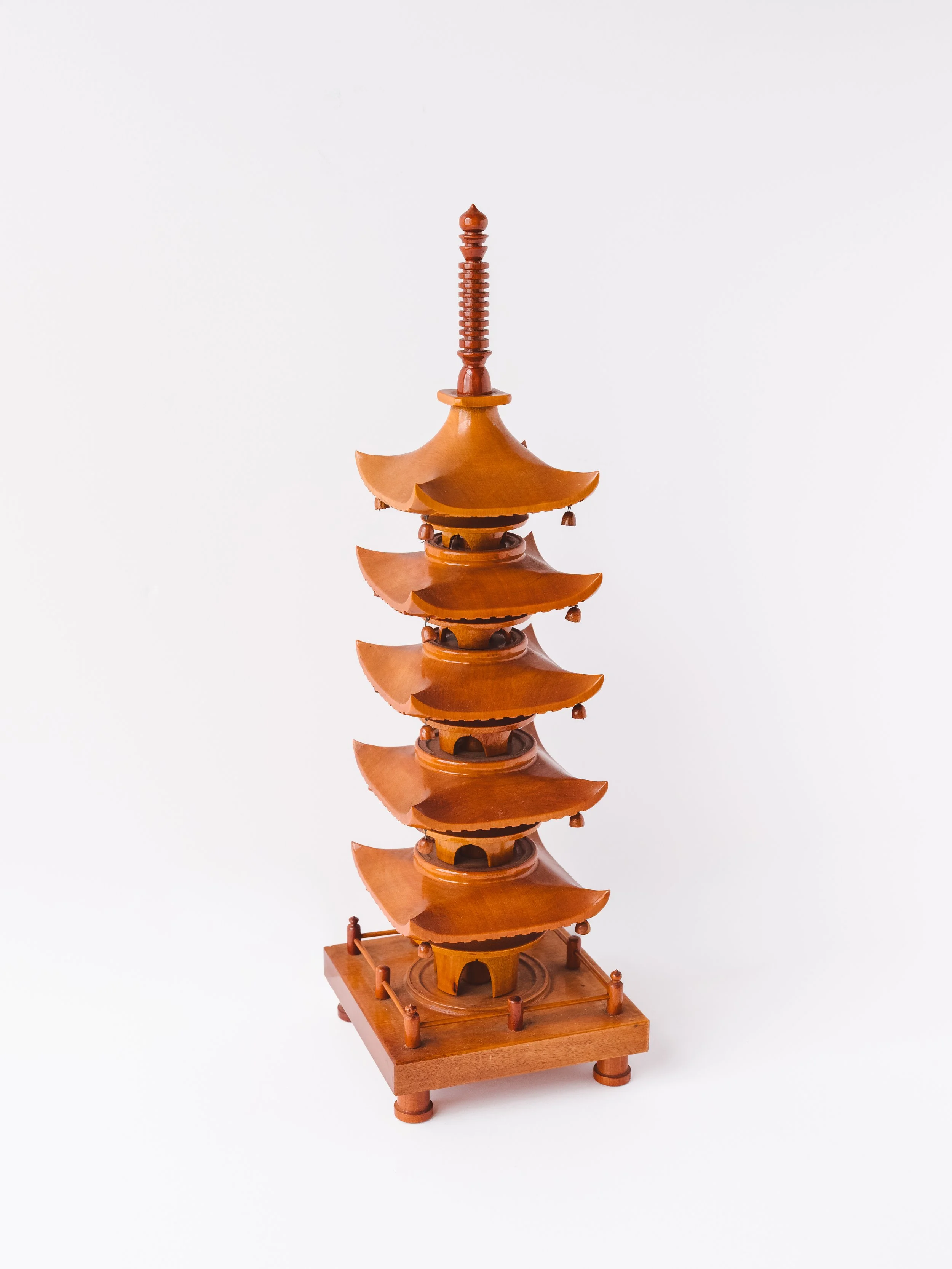 Image 1 of 7
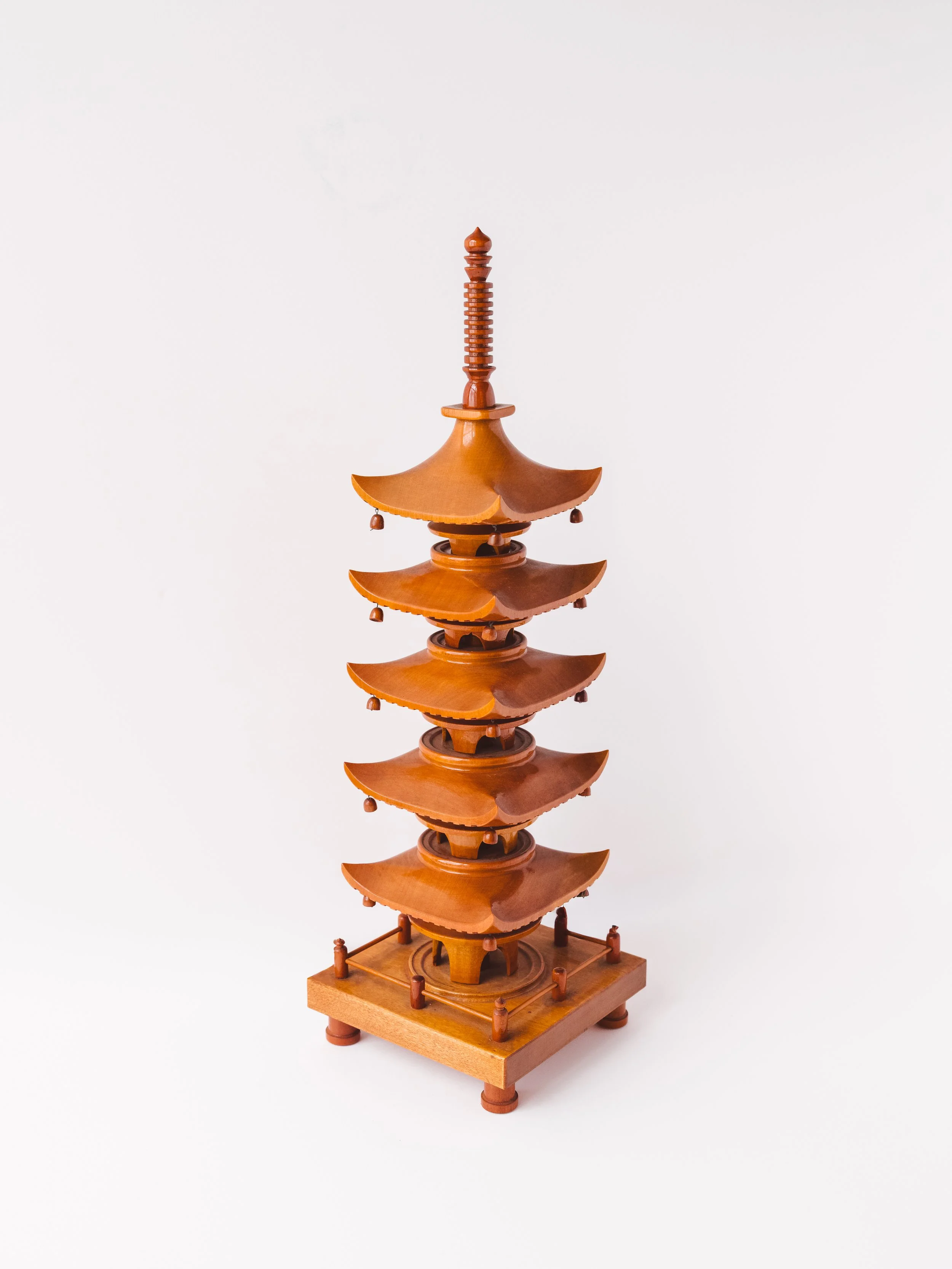 Image 2 of 7
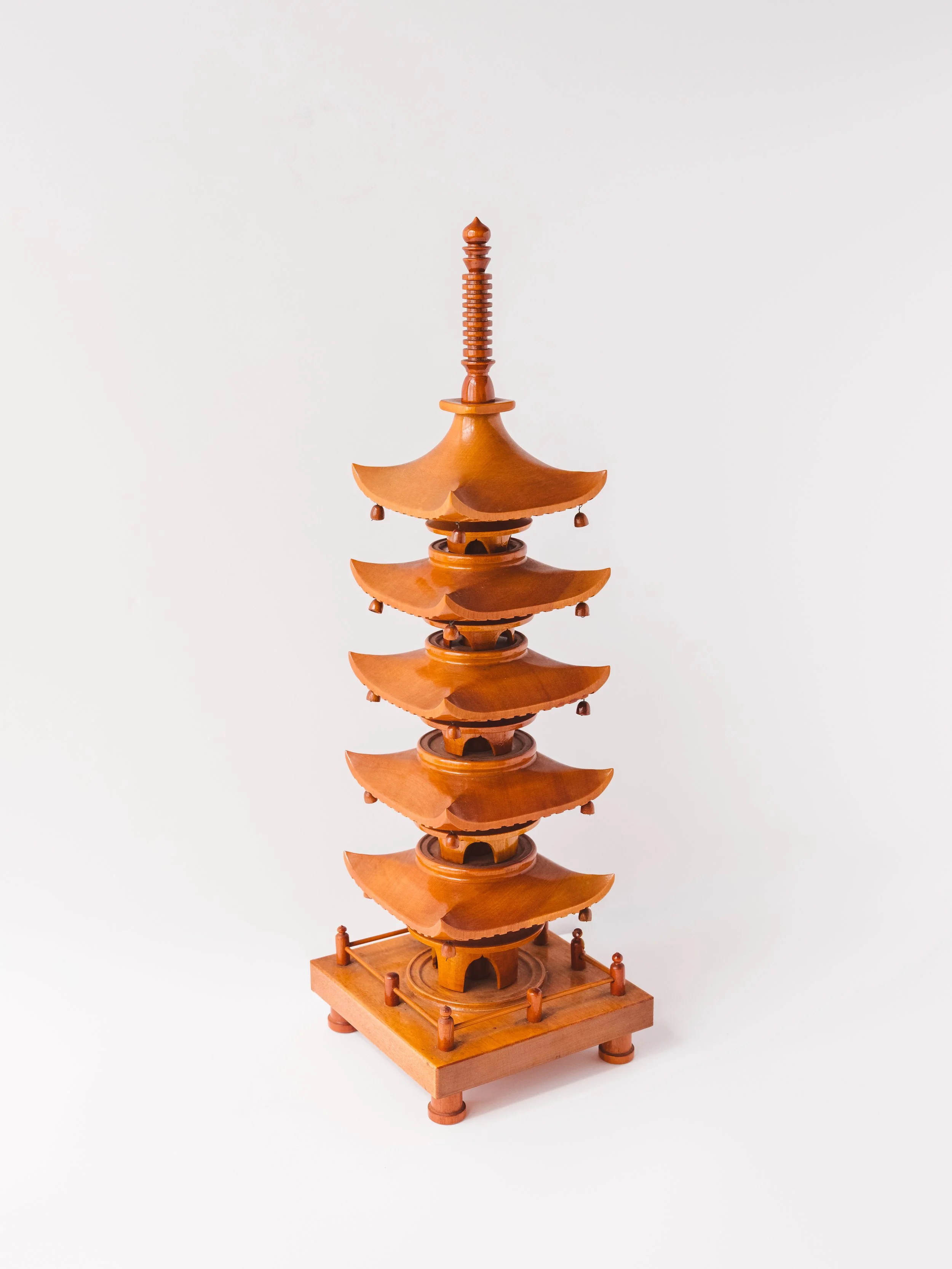 Image 3 of 7
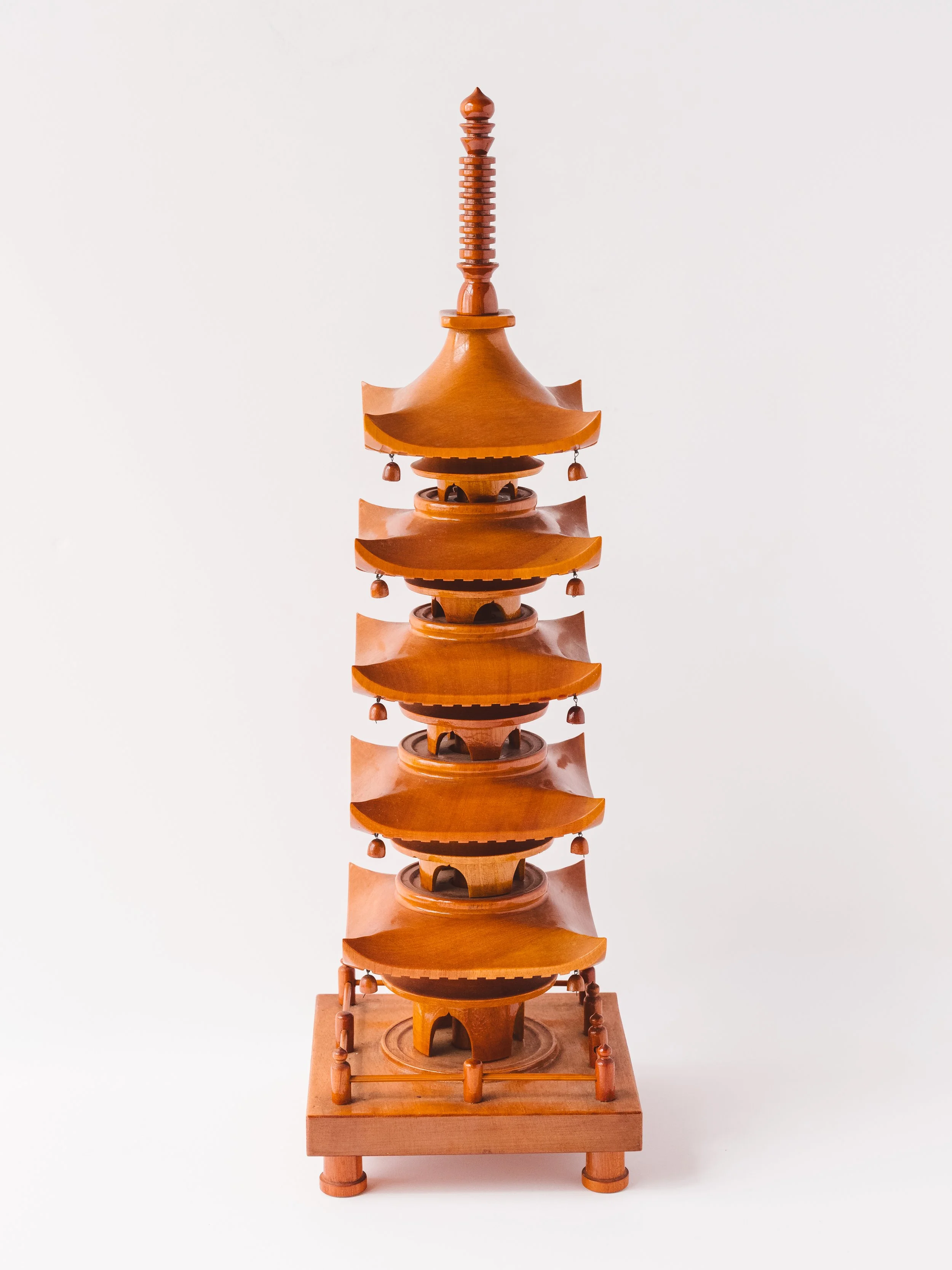 Image 4 of 7
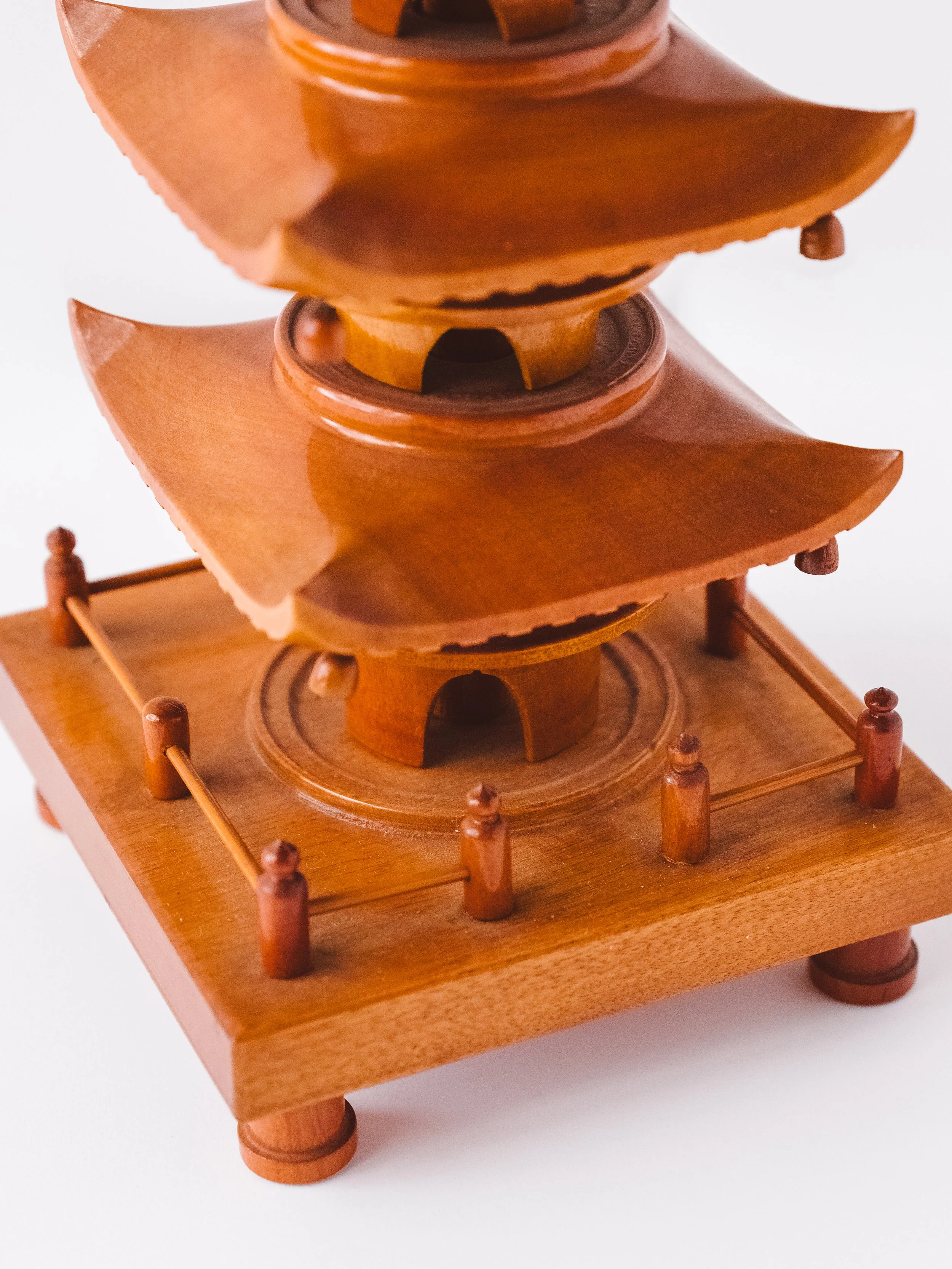 Image 5 of 7
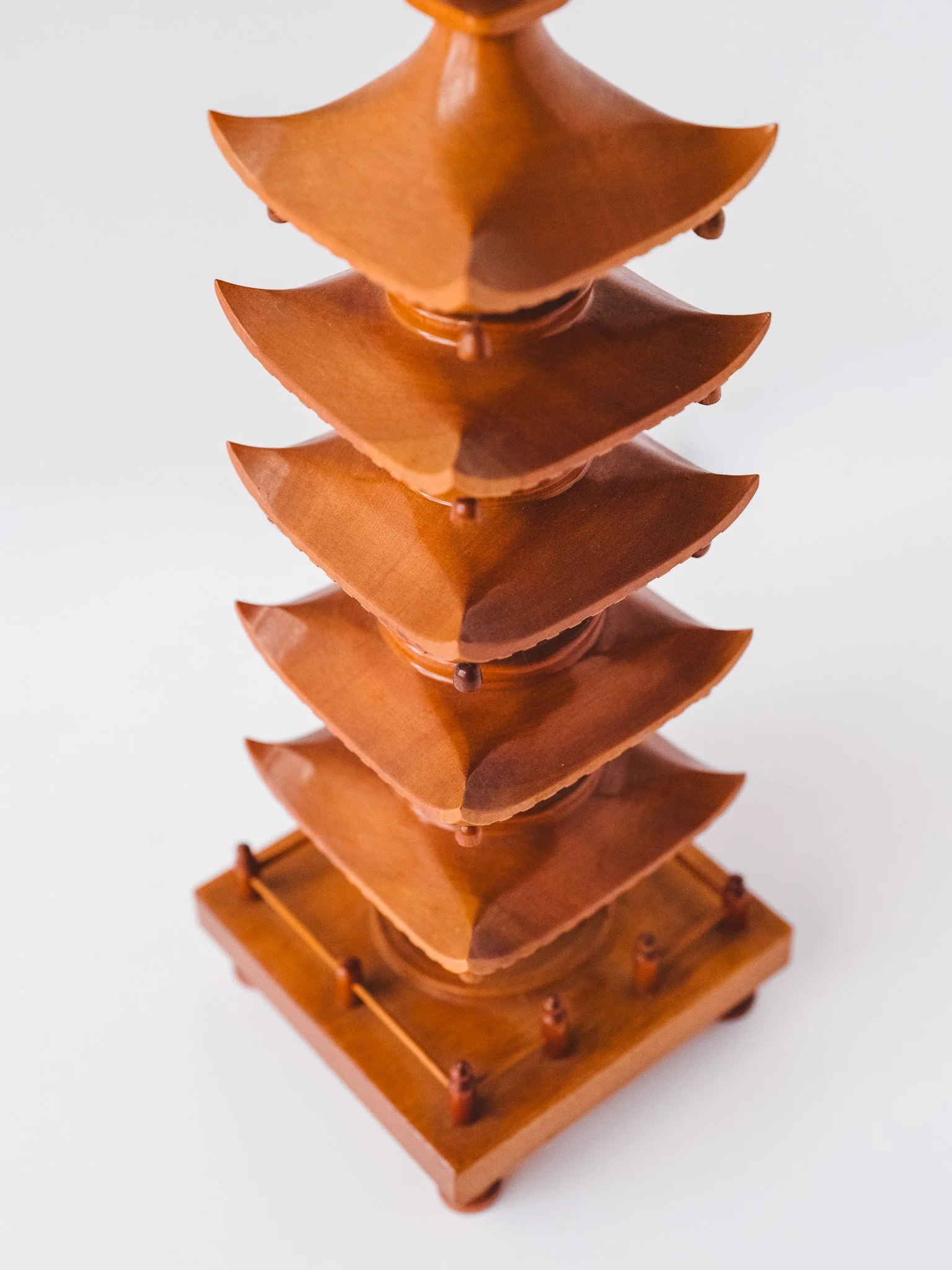 Image 6 of 7
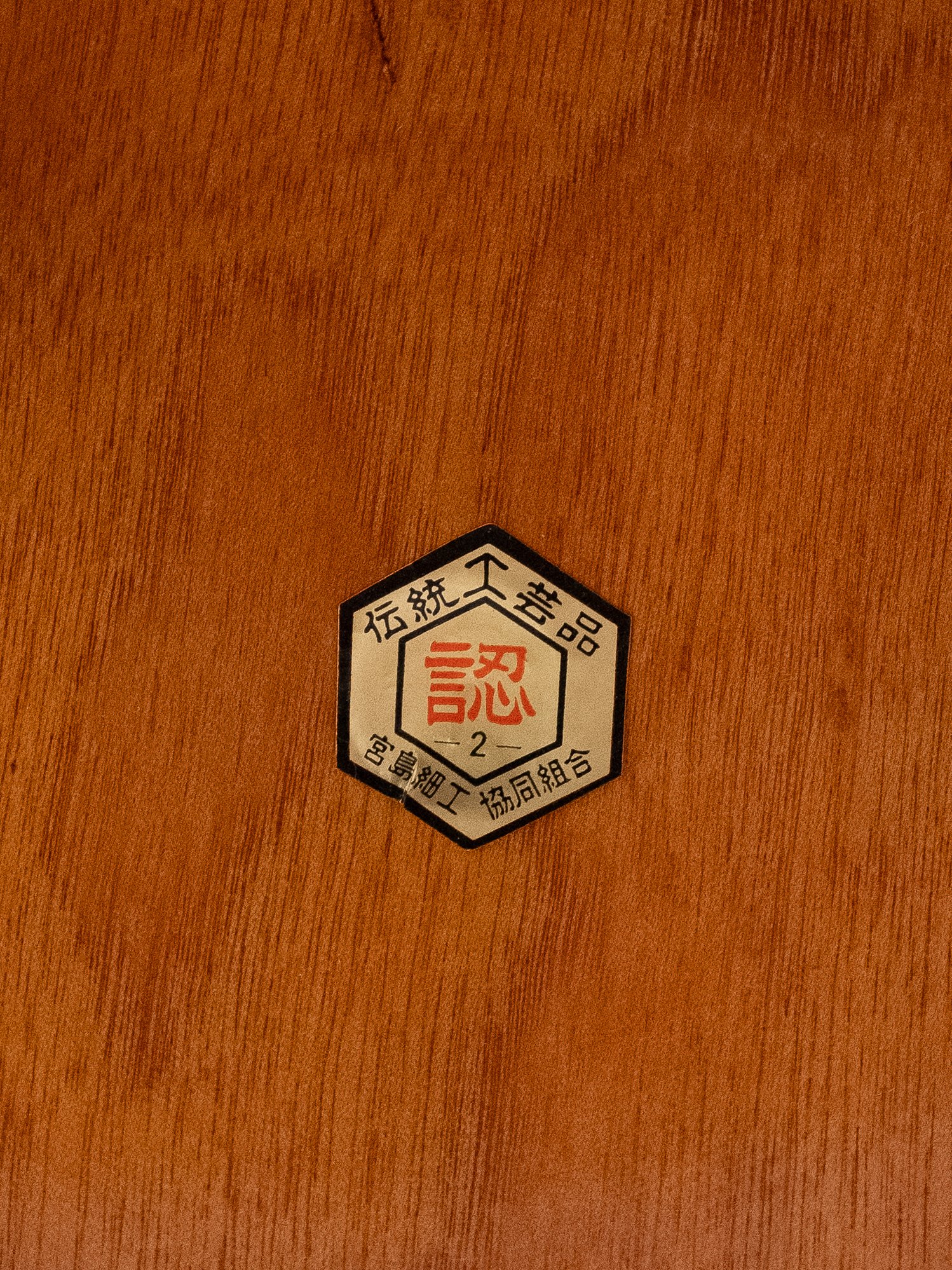 Image 7 of 7