【 The Concept 】
A small cloisonné turtle that is also a secret box. Seen on the table it is simply a bright little creature in sky-blue enamel, head raised, four stubby legs planted, a domed green shell edged in gold. But lift the shell away and the body opens into a small oval hollow lined in deep turquoise — a hiding place for a ring, a pair of earrings, a few pills, a folded note. On top of the shell sits a round red medallion holding the Chinese character for long life, shou (壽), and around it flutter small blue winged figures. Their stylised shape leaves some room for interpretation, but in Chinese craft the character for long life is so often paired with bats — the old Chinese sign for good fortune — that they are most likely meant as bats. Read that way, the shell spells out a blessing that has been painted, carved and woven across China for centuries: fushou (福壽), "fortune and long life." Every line of colour on its surface is held in place by fine gilded wire, laid by hand — the craft the Chinese call jingtailan, and the rest of the world calls cloisonné.
【 A Blessing Written in Pictures 】
Chinese decorative art loves a pun, and this little turtle is full of them. The word for bat, fu (蝠), sounds exactly like the word for good fortune, fu (福). So in Chinese art a bat is never just a bat: it is luck flying in through the window. Bats circling the character for long life are one of the most familiar pairings in all of Chinese craft — so familiar that the pattern has its own name, wufu pengshou (五福捧壽), "the Five Blessings surrounding Longevity." The winged figures on this shell are drawn in a soft, simplified style, but set around the shou roundel they most naturally belong to this tradition. The Five Blessings come from one of China's oldest books, the Book of Documents: a long life, wealth, health and peace of mind, a love of virtue, and a peaceful end after a full life.
And then there is the turtle itself — the living symbol of long life. In the Book of Rites the turtle is named one of the Four Spiritual Creatures (四靈), alongside the dragon, the phoenix and the qilin. A turtle carrying the character for long life on its back is, in other words, a blessing on top of a blessing: a wish for a long, lucky life, said twice so that it cannot be missed.
【 Jingtailan: The Blue of Jingtai 】
Cloisonné reached China from the West around the thirteenth and fourteenth centuries, and it was the Ming dynasty court that made it its own. The craft flourished so brilliantly under the Jingtai Emperor, who reigned from 1450 to 1457, that his name stuck to it for good: to this day, Chinese cloisonné is called jingtailan (景泰藍), "Jingtai blue" — after the reign, and after the glowing blue enamel that became its signature colour.
The method has barely changed in the centuries since. Thin copper wire is bent by hand into tiny cells — each scale, each hexagon, each wing — and fixed to a copper body. The cells are filled with coloured enamel, fired, filled again, and finally polished smooth and gilded, so that every wire becomes a fine golden line. Look closely at the blue scales covering the turtle's neck and legs: each one is its own tiny wall of wire.
【 What Owning This Piece Brings 】
・ A wish for long life, kept close. Few objects carry the longevity blessing as plainly as this one — the turtle and the shou character say the same thing, and the winged figures around it add a wish for good fortune. It is a natural gift for a birthday, especially a milestone one, and for anyone setting out on a new chapter.
・ A small keeper of treasures. The hidden compartment turns a decoration into something used every day: a ring dish on the bedside table, a pill box in a drawer, a place to keep a small keepsake safe.
・ Patience and steadiness. In both Chinese and Japanese tradition, the turtle is the creature that wins by persistence — slow, calm, protected, and still here long after the hurry has passed.
・ A jewel of colour. Cloisonné was made to catch the light. Even this small turtle brings a spot of glowing blue, green and gold to a plain shelf.
A fitting gift for a birthday or anniversary, for a grandparent, for a new home — or for anyone who needs a little good fortune, carried slowly and safely.
【 Turtles in Chinese Legend 】
The turtle is woven into some of China's oldest stories. When Yu the Great was taming the floods of the Yellow River, legend says a divine turtle rose from the River Luo carrying a pattern of dots on its shell — the Luoshu, a square of numbers in which every row, column and diagonal adds up to fifteen. It became the foundation of feng shui and Chinese numerology, and is often called the world's first magic square.
Even older, and entirely true: the earliest Chinese writing we know was cut into turtle shells. More than three thousand years ago, the diviners of the Shang dynasty carved questions to the ancestors onto the flat underside of turtle shells, heated them until they cracked, and read the answer in the cracks. Turn this little turtle over and you will find that underside too — a pale yellow plastron patterned with dark hexagons.
And if you ever visit an old temple in China, look at the base of the great stone tablets: many of them rest on the back of a turtle-like creature called bixi, one of the nine sons of the Dragon King, said to be so strong it can carry the weight of history itself.
【 Where to Place It 】
On a bedside table or dressing table as a ring box; on a desk beside a lamp, where the gold wire catches the light; or on a shelf among small treasures and stones. Placed with its head facing the room, it looks as if it has just stepped in to greet you. In feng shui a turtle is traditionally set behind you or toward the north, as a symbol of support and protection.
【 Care 】
Dust with a soft dry cloth. Avoid water soaking, abrasive cleaners and hard knocks — enamel is glass and can chip if dropped. Lift the shell by its edges, and keep the interior dry.
【 Reading the Object 】
A turtle-form box in cloisonné enamel on metal. The domed shell lifts off as a lid: a green ground with brown hexagons, small blue-and-white winged figures (most likely stylised bats), and a central red-brown roundel with a stylised shou character in black, all bordered by a gilded rim. The body is sky blue, covered in fish-scale wirework, with a brown-scaled head, white-rimmed eyes, a pointed brown tail, and four short legs tipped in yellow with small flower motifs. The underside is a pale yellow plastron with rows of dark hexagons; the interior hollow is lined in turquoise enamel.
【 Presence 】
Small, bright and cheerful. A wish for a long and lucky life, walking quietly across the table on four short legs.
Archive Note: The number in the name (1457) marks the close of the Jingtai reign (1450–1457), the era that gave Chinese cloisonné its name, jingtailan. NOT the date this piece was made.
Provenance Note: Sourced from a private household in Japan. Made in the Chinese cloisonné (jingtailan) tradition, most likely in China during the later twentieth century. No maker's mark.
Condition Note: Very good vintage condition.


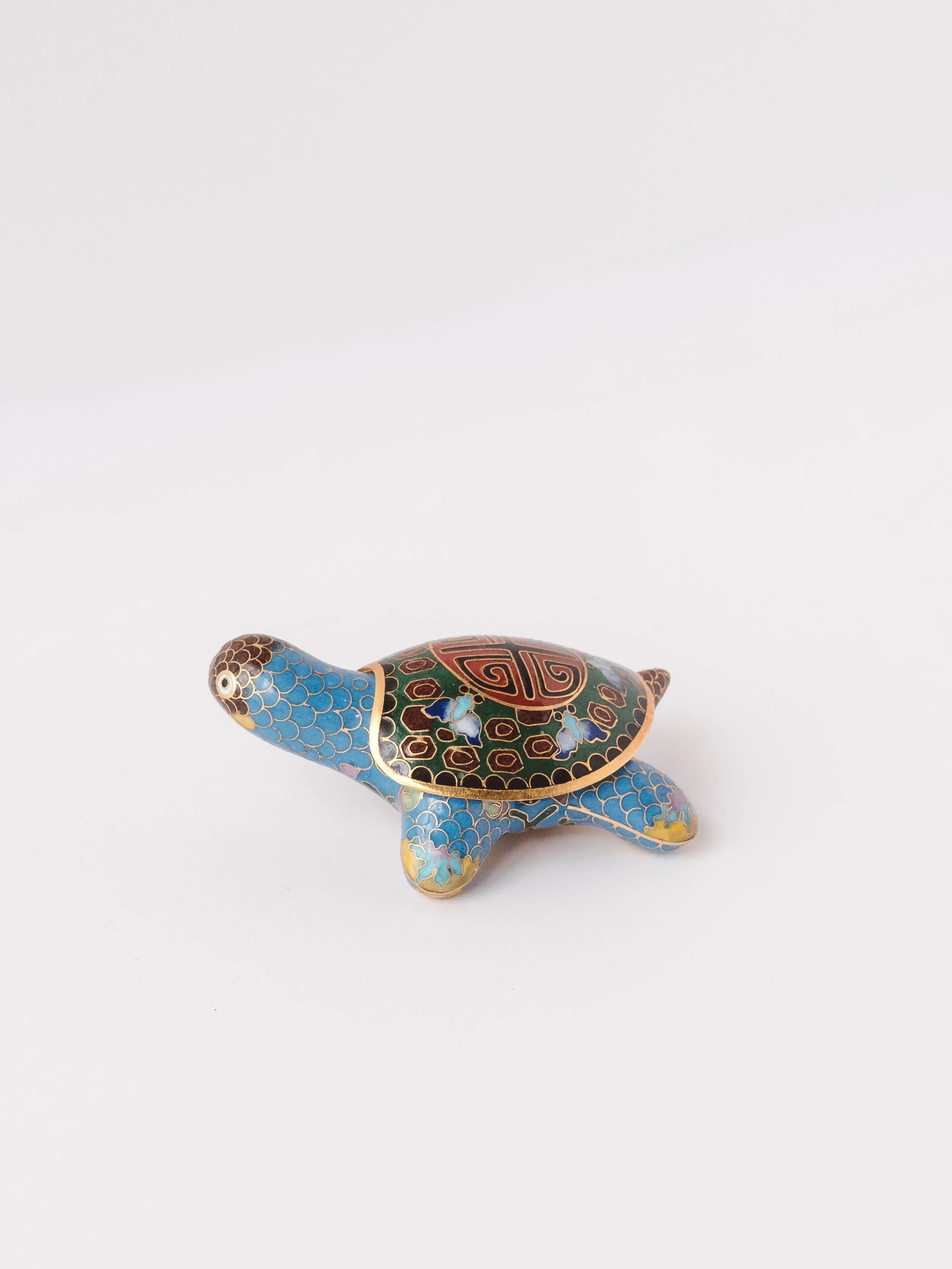 Image 1 of 7
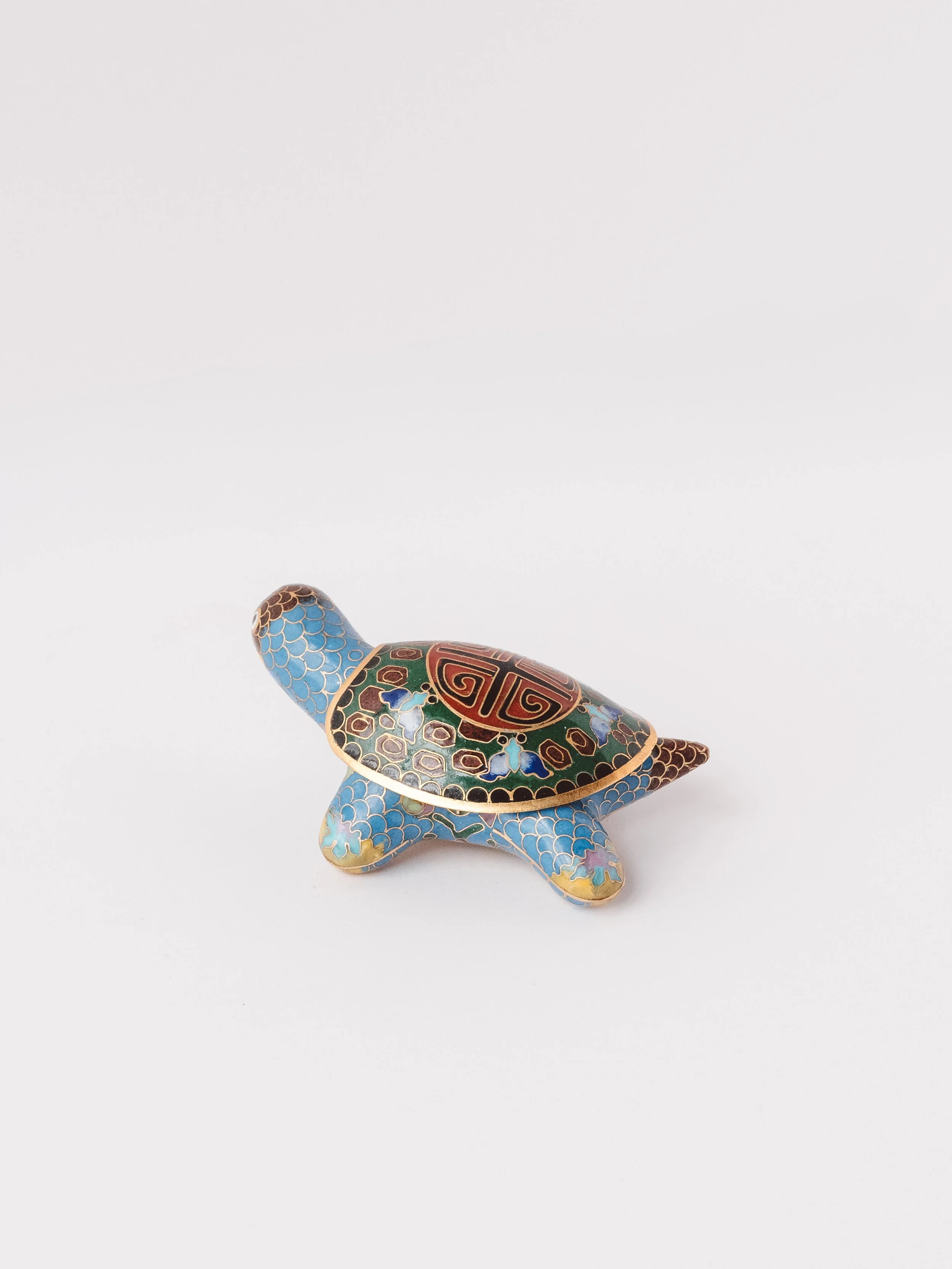 Image 2 of 7
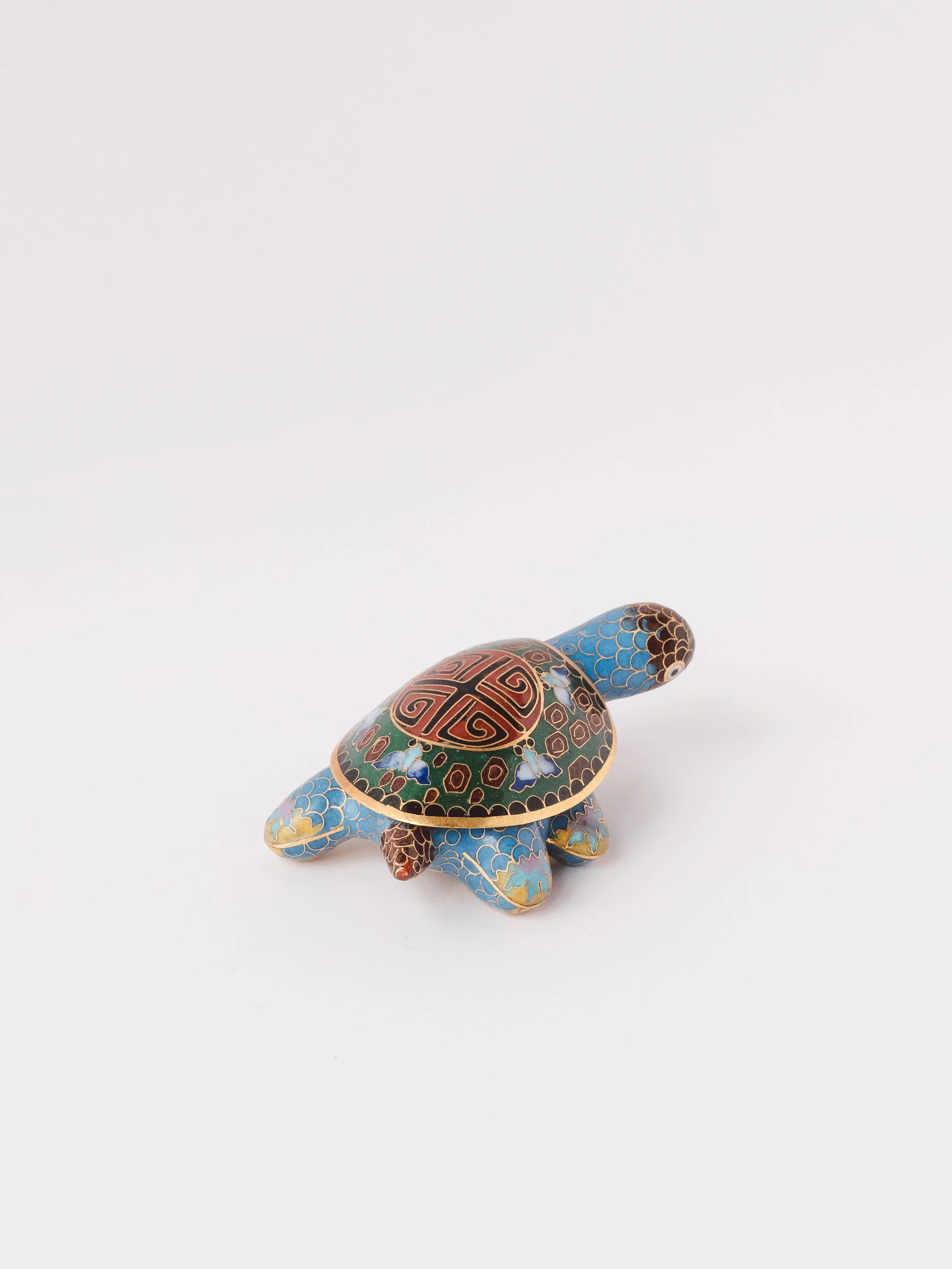 Image 3 of 7
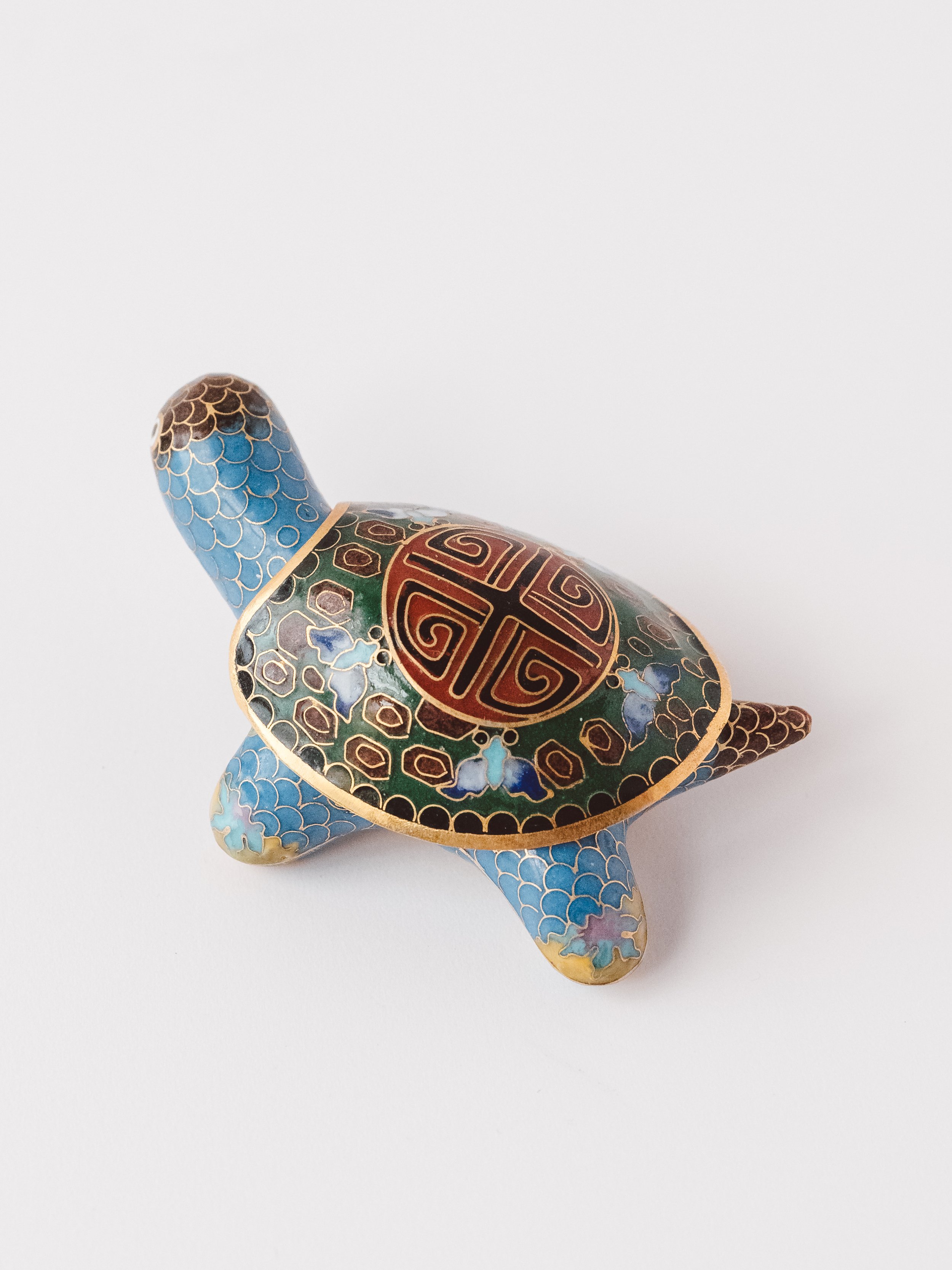 Image 4 of 7
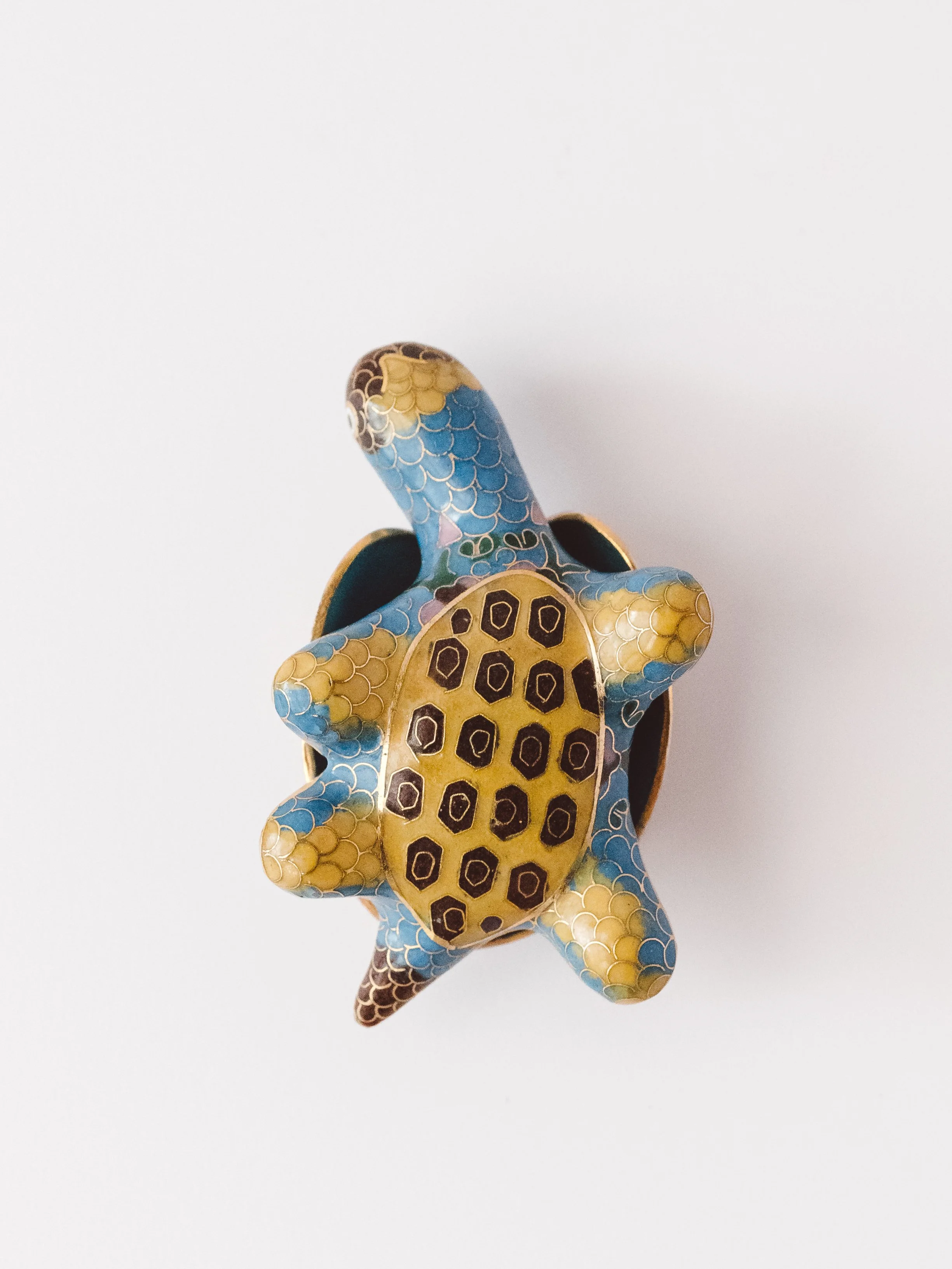 Image 5 of 7
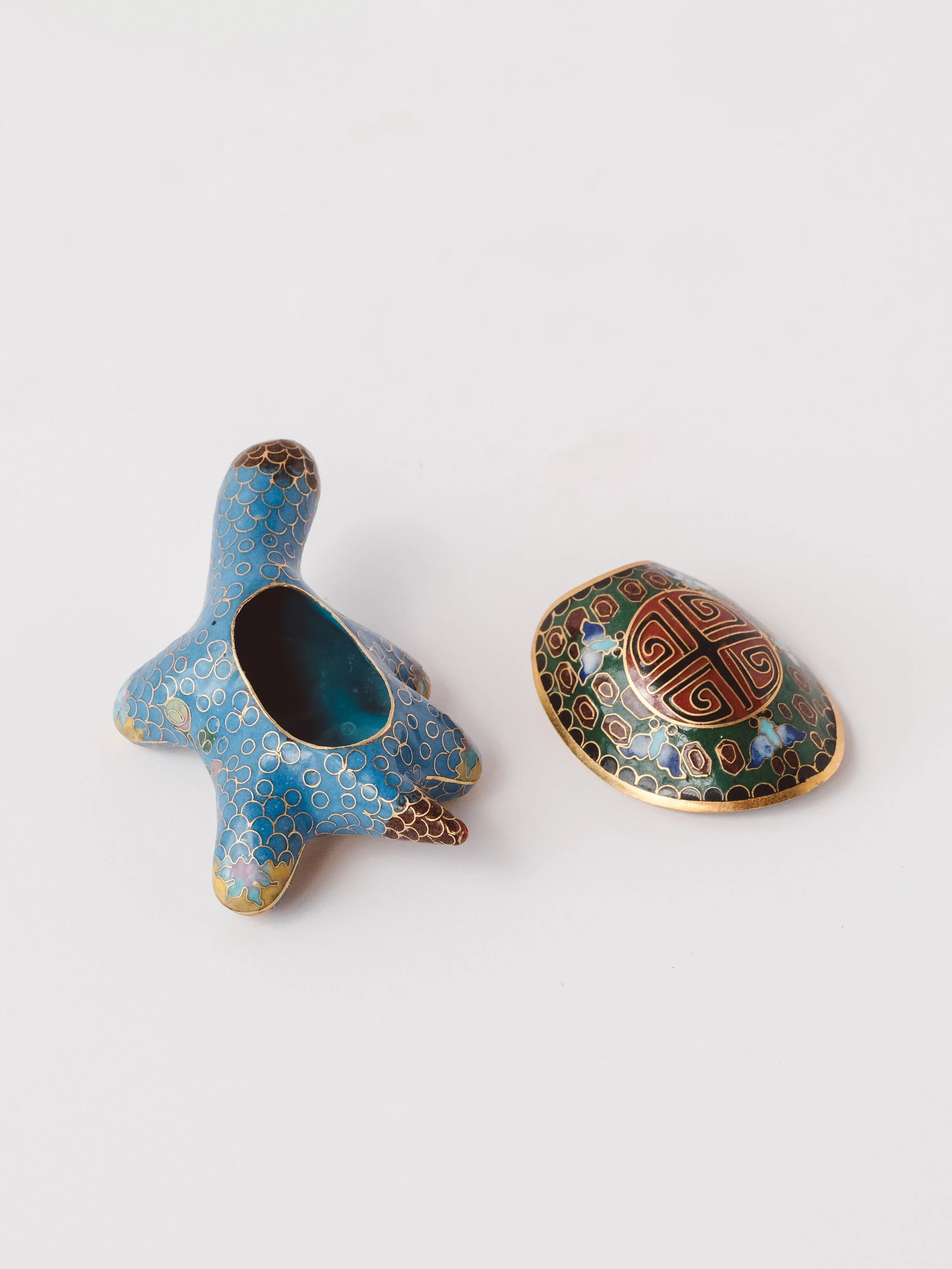 Image 6 of 7
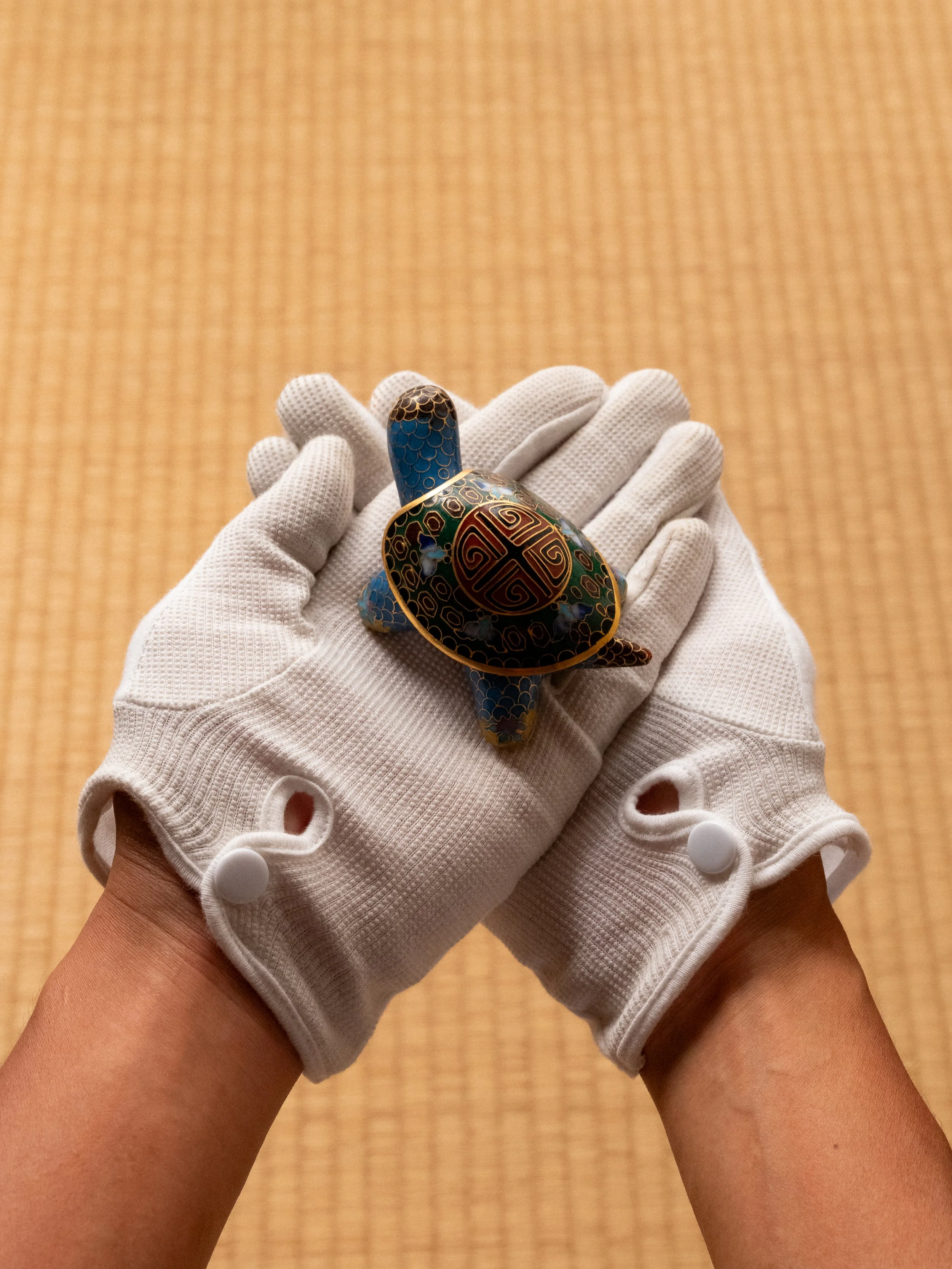 Image 7 of 7