

 Image 1 of 3
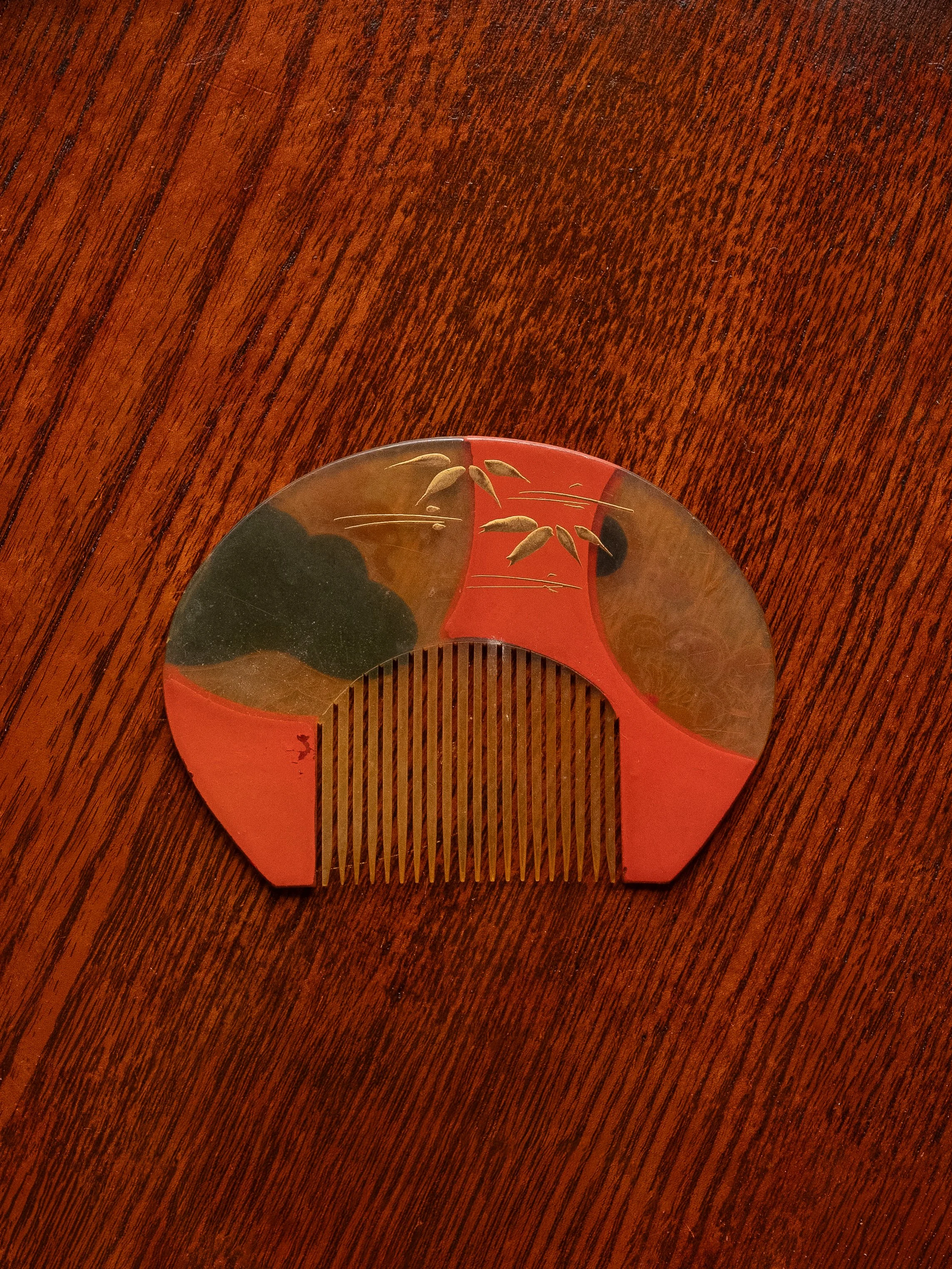 Image 2 of 3
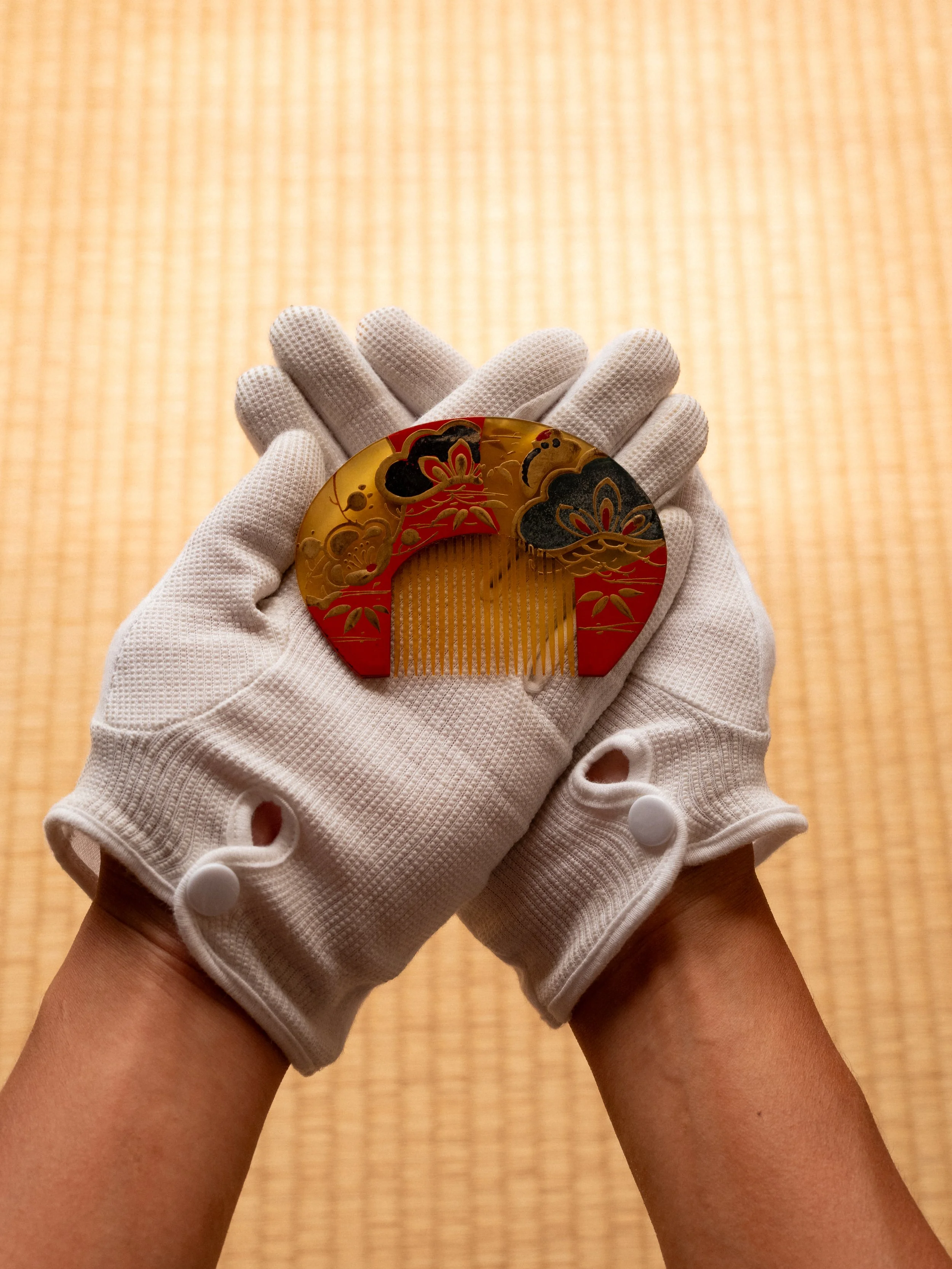 Image 3 of 3
SHOCHIKUBAI COMB 1889
【 The Concept 】
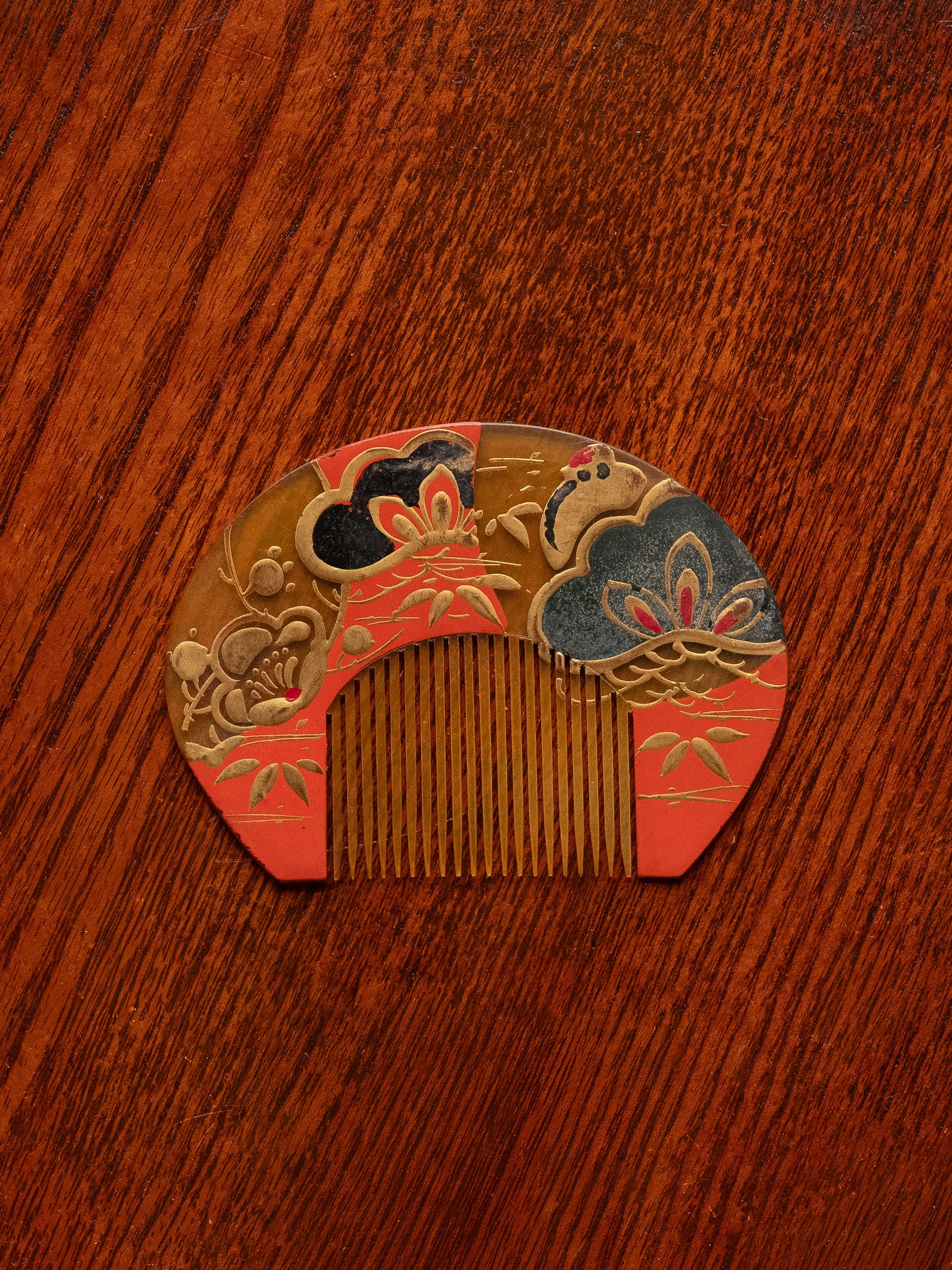
A small Japanese ornamental hair comb of the type known as maegushi — the "front comb," worn tucked into the crown of a traditional Japanese coiffure so that its shaped upper edge shows above the black hair. The body is worked from a warm, transparent honey-amber material in the manner of tortoiseshell (bekkou-fu), cut into a broad low arch. Red-lacquer wings flank the short teeth at the bottom; across the whole upper crescent are laid, in raised gold and dark inks, the three plants of the classical Japanese good-luck triad: the pine, the bamboo and the plum — shōchikubai. Turn it over and the drawing on the back is quieter, but the design is doubled everywhere because the amber body is translucent: the front decoration shows through as a soft shadow on the reverse, giving the whole comb a strange, layered depth. It is a very small thing, easily hidden in a palm, made to be seen against black hair — an entire piece of Japanese decorative iconography compressed into the width of an open hand.
【 What a Maegushi Is 】
In the tradition of the Japanese nyōbo-mage and Edo-period women's coiffures, a distinction was made between the sukigushi (a comb for combing the hair) and the maegushi or kazashi-gushi (a comb worn for ornament). The two look different at a glance. A combing comb has a long, straight, tooth-heavy body meant for the hair itself. An ornamental comb, like the one here, has a large decorated crescent above and only a short row of teeth below, because its purpose is not to comb but to be seen — the teeth simply anchor the piece into the coiffure so that the crescent stands proud of the hair. From the late Edo period onward the maegushi became one of the principal display pieces of a woman's dress, chosen in coordination with the kimono, the season and the occasion, and worked in materials — wood, ivory, tortoiseshell and, later, tortoiseshell-effect substitutes — that lent themselves to lacquer painting, gilding and inlay. This comb belongs firmly to that tradition.
【 What Shōchikubai Means 】
Shōchikubai (松竹梅) — pine, bamboo, plum — is one of the oldest and most beloved combinations in East Asian decorative art. The three plants are known in Chinese tradition as the "Three Friends of Winter" (歳寒三友): the pine keeps its needles through the coldest months, the bamboo bends but does not break under snow, and the plum flowers while snow is still on the ground. Together they stand for endurance, resilience, and the promise that spring will return — and by extension, for long life, uprightness and renewal. In Japan the trio became a general emblem of good fortune, worked into wedding kimono, lacquerware, sword fittings, ceramics and, as here, personal ornaments. To wear shōchikubai in the hair is to wear a small everyday wish: strength through winter, and a spring that will come.
That wish is the whole meaning of this comb. The pine rides at the crown of the right side, dark and heavy; the bamboo runs like a supple gold script across the red band at the centre; the plum blooms at the top of the left, delicate and small. Three plants, one wish, on the width of a hair ornament.
【 The Bekkou-fu Tradition 】
On a woman's dressing table in Meiji and Taishō Japan there were, broadly, two kinds of tortoiseshell hair ornament. The first was hon-bekkou — real hawksbill turtle shell — an expensive luxury imported to Japan since the Edo period and worked by specialised craftsmen. The second was gikou (擬甲), the honestly-named "mock-tortoiseshell," in which a translucent honey-brown material was cut, shaped and decorated in exactly the same way as real tortoiseshell but at a fraction of the cost. During the Edo period gikou was often carved from horse hoof (bazume); from the late Meiji period onward, once celluloid began to be produced in Japan, transparent celluloid became the dominant material for gikou hair ornaments and hair-ornament workshops applied traditional maki-e-like lacquer and gilt raised decoration to it just as they did to real shell. This comb sits within that gikou tradition. The transparent honey-amber body is worked in the visual language of tortoiseshell but is almost certainly not tortoiseshell itself; the exact material is not verified here, and we prefer to describe it honestly as bekkou-fu (tortoiseshell-style) rather than claim a substance we have not tested.
【 Reading the Object 】
The composition works from the outside in.
The outer profile is a broad, low half-moon: a long slow arc across the top, straight sides falling to the ground, a deep U-shaped notch cut into the lower centre. In that notch sit the teeth.
The basework is a single sheet of transparent honey-amber material — warm, glossy, catching the light from behind so the wood beneath shows softly through the empty areas.
The teeth are cut from the same body — fine, dense, straight, and short. Not a combing comb; an anchoring comb.
At the two lower flanks and across a broad central band, opaque vermilion lacquer is laid over the amber, forming red wings and a red vertical bar that reads almost like an obi across the middle of the piece.
On the right, above the red wing, sits the pine: a heavy dark-green-and-black cloud form outlined and internally drawn in raised gold, with a pointed pine-cone / pine-scale motif at its base worked in gold with small vermilion accents. This is a stylised, heraldic pine rather than a botanical one — the classical shorthand for the tree.
On the left, above the red wing, is the plum: a fine gold branch tracing across the amber ground, ending in a small five-lobed blossom whose centre is set with a single dot of vermilion, with several small round buds tucked along the branch.
Across the red central band — both on the front and, more clearly still, on the back — run the fine, quick, calligraphic gold strokes of bamboo leaves and stems: a horizontal culm line, and clusters of narrow lance-shaped leaves lifting from it. This is the bamboo, and it belongs on the red for the same reason a bamboo branch belongs against a red sun in classical New Year prints.
The reverse of the comb is a much quieter face: the pine "cloud" shows there again but softened, the bamboo band is drawn more openly, the plum branch appears as a translucent shadow of the front piece. Because the amber is honestly transparent, the front decoration is always partly visible from the back — and vice versa — giving the whole comb the property of a small window with a picture painted on the far side of the glass.
【 The Object 】
A hand-held hair ornament, palm-sized, extraordinarily light — sixteen grams — and yet dense with worked surface. Meant to sit in the hair; equally at home lying flat on a shallow tray to be looked at, in the way collectors of Japanese hair ornaments have kept and shown them for a century.
【 Where to Place It 】
On a lacquer tray, in a shallow display box, propped against a small stand on a dressing table or bookshelf, or laid inside a glass-topped case with other small Japanese personal objects — tortoise-style combs, silver kanzashi, netsuke, small lacquer boxes. The two faces are both worth seeing, so a stand that lets it be turned over, or a shallow tray in which it lies flat, will serve it best. Keep it out of direct sunlight, away from heat sources and away from any solvent, alcohol or cleaning spray; the lacquer and the raised gilt are old and fragile, and the amber body is not to be exposed to open flame or a hot lamp. As a display object, not as a piece to be worn in the hair now, it should be handled by the red-lacquered flanks rather than by the teeth or the crown.
【 Care 】
Dust with a soft dry brush; if truly needed, wipe with a barely damp soft cloth on the flat amber surfaces only, never on the raised decoration, and dry immediately. Do not use any solvent, alcohol, oil, wax or polish — those attack both old lacquer and vintage decorative substrates of this type. Do not soak. Do not leave in a car, on a sunny windowsill, near a heater, or in a sealed transparent case in the sun. Store lying flat, in a soft-lined shallow box, out of light.
【 Function & What It Brings 】
Keep it, place it, or give it. As a piece of Japanese personal ornament it is a compact and honest example of the maegushi tradition — the ornamental front comb worn as a jewel of the coiffure — in the mock-tortoiseshell manner that carried the older bekkou vocabulary into the modern era. As a piece of iconography it carries shōchikubai, one of the deepest wishes in the Japanese decorative repertoire: endurance through winter and the certainty of spring. A fitting gift for a New Year, a wedding, a milestone birthday, or for anyone who collects Japanese hair ornaments, kimono accessories, or small pieces of applied lacquer.
【 The Texture 】
A warm, glassy, honey-amber body that catches light from behind and lets the wood beneath show through. Opaque vermilion lacquer at the flanks and central band, matte where old, glossy where sound. Raised gold-tone decoration — the pine, the bamboo, the plum — sitting proud of the surface like miniature relief, catching the light along its edges; the gold is softly matt and slightly granular in places, the honest look of aged gilt lacquer work of this kind. Small dots of vermilion mark the hearts of the flowers and the pine scales. On the back, the raised work is felt only faintly through the amber; the whole reverse has the quieter, translucent character of a shadow of the front.
【 Presence 】
Quiet and deliberate. Not the aggressive glitter of a modern hair jewel, but the softer, older elegance of a Japanese ornamental comb: a small crescent of honey and gold and vermilion carrying an entire winter wish on its face. Small enough to be intimate; carefully made enough to reward being turned in the light.
Archive Note: The number in the name (1889) references the year in which celluloid production for hair ornaments began in Japan, opening the modern chapter of the bekkou-fu / gikou (mock-tortoiseshell) hair-ornament tradition that this comb visually belongs to. It carries the earlier Edo-period vocabulary of ornamental combs into the modern era. It is NOT the date this particular piece was made.
Provenance Note: Sourced from a private household in Japan. An ornamental Japanese maegushi (front comb) in the bekkou-fu (tortoiseshell-style) manner, decorated with shōchikubai — pine, bamboo and plum — in raised gold-tone and vermilion lacquer work on a translucent honey-amber body with red-lacquer flanks. Material of the transparent body is not laboratory-verified; the piece is presented honestly as bekkou-fu (tortoiseshell-style) rather than confirmed hawksbill shell. Attributed to the Japanese ornamental-comb tradition rather than to a specific workshop or individual maker.
Condition Note: Sold as acquired, in honest vintage condition. Age-appropriate wear consistent with a hand-worn hair ornament: fine surface scratches and softening of the raised decoration, minor thinning of the gilt in places, a small area of loss / lifting in the red lacquer on the reverse. No cracks through the amber body. The teeth are intact along the visible length. As a display object rather than a working hair comb. Please see the photographs as part of the description.
【 The Concept 】
A small Japanese ornamental hair comb of the type known as maegushi — the "front comb," worn tucked into the crown of a traditional Japanese coiffure so that its shaped upper edge shows above the black hair. The body is worked from a warm, transparent honey-amber material in the manner of tortoiseshell (bekkou-fu), cut into a broad low arch. Red-lacquer wings flank the short teeth at the bottom; across the whole upper crescent are laid, in raised gold and dark inks, the three plants of the classical Japanese good-luck triad: the pine, the bamboo and the plum — shōchikubai. Turn it over and the drawing on the back is quieter, but the design is doubled everywhere because the amber body is translucent: the front decoration shows through as a soft shadow on the reverse, giving the whole comb a strange, layered depth. It is a very small thing, easily hidden in a palm, made to be seen against black hair — an entire piece of Japanese decorative iconography compressed into the width of an open hand.
【 What a Maegushi Is 】
In the tradition of the Japanese nyōbo-mage and Edo-period women's coiffures, a distinction was made between the sukigushi (a comb for combing the hair) and the maegushi or kazashi-gushi (a comb worn for ornament). The two look different at a glance. A combing comb has a long, straight, tooth-heavy body meant for the hair itself. An ornamental comb, like the one here, has a large decorated crescent above and only a short row of teeth below, because its purpose is not to comb but to be seen — the teeth simply anchor the piece into the coiffure so that the crescent stands proud of the hair. From the late Edo period onward the maegushi became one of the principal display pieces of a woman's dress, chosen in coordination with the kimono, the season and the occasion, and worked in materials — wood, ivory, tortoiseshell and, later, tortoiseshell-effect substitutes — that lent themselves to lacquer painting, gilding and inlay. This comb belongs firmly to that tradition.
【 What Shōchikubai Means 】
Shōchikubai (松竹梅) — pine, bamboo, plum — is one of the oldest and most beloved combinations in East Asian decorative art. The three plants are known in Chinese tradition as the "Three Friends of Winter" (歳寒三友): the pine keeps its needles through the coldest months, the bamboo bends but does not break under snow, and the plum flowers while snow is still on the ground. Together they stand for endurance, resilience, and the promise that spring will return — and by extension, for long life, uprightness and renewal. In Japan the trio became a general emblem of good fortune, worked into wedding kimono, lacquerware, sword fittings, ceramics and, as here, personal ornaments. To wear shōchikubai in the hair is to wear a small everyday wish: strength through winter, and a spring that will come.
That wish is the whole meaning of this comb. The pine rides at the crown of the right side, dark and heavy; the bamboo runs like a supple gold script across the red band at the centre; the plum blooms at the top of the left, delicate and small. Three plants, one wish, on the width of a hair ornament.
【 The Bekkou-fu Tradition 】
On a woman's dressing table in Meiji and Taishō Japan there were, broadly, two kinds of tortoiseshell hair ornament. The first was hon-bekkou — real hawksbill turtle shell — an expensive luxury imported to Japan since the Edo period and worked by specialised craftsmen. The second was gikou (擬甲), the honestly-named "mock-tortoiseshell," in which a translucent honey-brown material was cut, shaped and decorated in exactly the same way as real tortoiseshell but at a fraction of the cost. During the Edo period gikou was often carved from horse hoof (bazume); from the late Meiji period onward, once celluloid began to be produced in Japan, transparent celluloid became the dominant material for gikou hair ornaments and hair-ornament workshops applied traditional maki-e-like lacquer and gilt raised decoration to it just as they did to real shell. This comb sits within that gikou tradition. The transparent honey-amber body is worked in the visual language of tortoiseshell but is almost certainly not tortoiseshell itself; the exact material is not verified here, and we prefer to describe it honestly as bekkou-fu (tortoiseshell-style) rather than claim a substance we have not tested.
【 Reading the Object 】
The composition works from the outside in.
The outer profile is a broad, low half-moon: a long slow arc across the top, straight sides falling to the ground, a deep U-shaped notch cut into the lower centre. In that notch sit the teeth.
The basework is a single sheet of transparent honey-amber material — warm, glossy, catching the light from behind so the wood beneath shows softly through the empty areas.
The teeth are cut from the same body — fine, dense, straight, and short. Not a combing comb; an anchoring comb.
At the two lower flanks and across a broad central band, opaque vermilion lacquer is laid over the amber, forming red wings and a red vertical bar that reads almost like an obi across the middle of the piece.
On the right, above the red wing, sits the pine: a heavy dark-green-and-black cloud form outlined and internally drawn in raised gold, with a pointed pine-cone / pine-scale motif at its base worked in gold with small vermilion accents. This is a stylised, heraldic pine rather than a botanical one — the classical shorthand for the tree.
On the left, above the red wing, is the plum: a fine gold branch tracing across the amber ground, ending in a small five-lobed blossom whose centre is set with a single dot of vermilion, with several small round buds tucked along the branch.
Across the red central band — both on the front and, more clearly still, on the back — run the fine, quick, calligraphic gold strokes of bamboo leaves and stems: a horizontal culm line, and clusters of narrow lance-shaped leaves lifting from it. This is the bamboo, and it belongs on the red for the same reason a bamboo branch belongs against a red sun in classical New Year prints.
The reverse of the comb is a much quieter face: the pine "cloud" shows there again but softened, the bamboo band is drawn more openly, the plum branch appears as a translucent shadow of the front piece. Because the amber is honestly transparent, the front decoration is always partly visible from the back — and vice versa — giving the whole comb the property of a small window with a picture painted on the far side of the glass.
【 The Object 】
A hand-held hair ornament, palm-sized, extraordinarily light — sixteen grams — and yet dense with worked surface. Meant to sit in the hair; equally at home lying flat on a shallow tray to be looked at, in the way collectors of Japanese hair ornaments have kept and shown them for a century.
【 Where to Place It 】
On a lacquer tray, in a shallow display box, propped against a small stand on a dressing table or bookshelf, or laid inside a glass-topped case with other small Japanese personal objects — tortoise-style combs, silver kanzashi, netsuke, small lacquer boxes. The two faces are both worth seeing, so a stand that lets it be turned over, or a shallow tray in which it lies flat, will serve it best. Keep it out of direct sunlight, away from heat sources and away from any solvent, alcohol or cleaning spray; the lacquer and the raised gilt are old and fragile, and the amber body is not to be exposed to open flame or a hot lamp. As a display object, not as a piece to be worn in the hair now, it should be handled by the red-lacquered flanks rather than by the teeth or the crown.
【 Care 】
Dust with a soft dry brush; if truly needed, wipe with a barely damp soft cloth on the flat amber surfaces only, never on the raised decoration, and dry immediately. Do not use any solvent, alcohol, oil, wax or polish — those attack both old lacquer and vintage decorative substrates of this type. Do not soak. Do not leave in a car, on a sunny windowsill, near a heater, or in a sealed transparent case in the sun. Store lying flat, in a soft-lined shallow box, out of light.
【 Function & What It Brings 】
Keep it, place it, or give it. As a piece of Japanese personal ornament it is a compact and honest example of the maegushi tradition — the ornamental front comb worn as a jewel of the coiffure — in the mock-tortoiseshell manner that carried the older bekkou vocabulary into the modern era. As a piece of iconography it carries shōchikubai, one of the deepest wishes in the Japanese decorative repertoire: endurance through winter and the certainty of spring. A fitting gift for a New Year, a wedding, a milestone birthday, or for anyone who collects Japanese hair ornaments, kimono accessories, or small pieces of applied lacquer.
【 The Texture 】
A warm, glassy, honey-amber body that catches light from behind and lets the wood beneath show through. Opaque vermilion lacquer at the flanks and central band, matte where old, glossy where sound. Raised gold-tone decoration — the pine, the bamboo, the plum — sitting proud of the surface like miniature relief, catching the light along its edges; the gold is softly matt and slightly granular in places, the honest look of aged gilt lacquer work of this kind. Small dots of vermilion mark the hearts of the flowers and the pine scales. On the back, the raised work is felt only faintly through the amber; the whole reverse has the quieter, translucent character of a shadow of the front.
【 Presence 】
Quiet and deliberate. Not the aggressive glitter of a modern hair jewel, but the softer, older elegance of a Japanese ornamental comb: a small crescent of honey and gold and vermilion carrying an entire winter wish on its face. Small enough to be intimate; carefully made enough to reward being turned in the light.
Archive Note: The number in the name (1889) references the year in which celluloid production for hair ornaments began in Japan, opening the modern chapter of the bekkou-fu / gikou (mock-tortoiseshell) hair-ornament tradition that this comb visually belongs to. It carries the earlier Edo-period vocabulary of ornamental combs into the modern era. It is NOT the date this particular piece was made.
Provenance Note: Sourced from a private household in Japan. An ornamental Japanese maegushi (front comb) in the bekkou-fu (tortoiseshell-style) manner, decorated with shōchikubai — pine, bamboo and plum — in raised gold-tone and vermilion lacquer work on a translucent honey-amber body with red-lacquer flanks. Material of the transparent body is not laboratory-verified; the piece is presented honestly as bekkou-fu (tortoiseshell-style) rather than confirmed hawksbill shell. Attributed to the Japanese ornamental-comb tradition rather than to a specific workshop or individual maker.
Condition Note: Sold as acquired, in honest vintage condition. Age-appropriate wear consistent with a hand-worn hair ornament: fine surface scratches and softening of the raised decoration, minor thinning of the gilt in places, a small area of loss / lifting in the red lacquer on the reverse. No cracks through the amber body. The teeth are intact along the visible length. As a display object rather than a working hair comb. Please see the photographs as part of the description.
【Specifications】
Material: transparent honey-amber body in the bekkou-fu (tortoiseshell-style) manner; opaque vermilion lacquer flanks and central band; raised gold-tone and dark-ink decoration in the maki-e-like manner (materials of body, lacquer and gilt not laboratory-verified)Style: a Japanese maegushi (ornamental front comb) with shōchikubai (pine — bamboo — plum) design; the crescent form and short anchoring teeth of a display comb rather than a combing combBase: none — the comb is meant to sit in the hair or to lie flat / propped for displayCondition: sold as acquired, in honest vintage condition. Softening of gilt and small area of lacquer loss / lifting on the reverse noted; no cracks through the body. As a display object rather than a working hair comb
【 Dimensions (Approx.) 】
Width: 9.5 cm (3.7 in)Height: 7 cm (2.8 in)Weight: 0.016 kg (0.035 lb)