【 The Concept 】
A small ceramic horse the color of caramel and honey, standing four-square on a low rectangular plinth. The head lowers and lifts on a long, arched neck; a pale cream mane runs like a ribbon along the crest; a heavy saddle-blanket in glassy green pools across the back, and small green rosettes flower on chest and rump. It is a modern reproduction — a hand-scale desk piece — in the great Chinese ceramic tradition of Tang Sancai, the "three-colour" glazed pottery whose original works from more than a thousand years ago sit today in the display cases of the world's finest museums.
【 What Sancai Was 】
Tang Sancai (唐三彩, Táng Sāncǎi) is one of the classic achievements of Chinese ceramics — a family of multi-coloured, low-fired lead-glazed earthenware made during the Tang dynasty, roughly 618 to 907 CE, and reaching its full flowering in the seventh and eighth centuries at the great kilns near Luoyang and Chang'an. The name means "three colours" — amber-brown, green and cream-white were the classic palette — but the real magic of Sancai was not the number of colours but what happened between them. The glazes were made to melt and flow at low kiln temperatures, so that in firing the colours bled softly into one another; iron gave the ambers, copper gave the greens, and the "white" was really a clear glaze over a light body. No two pieces came out the same. The result is what makes any real Sancai piece instantly recognisable: a warm, blurred, semi-liquid landscape of colour that no painted decoration can imitate.
【 Why a Horse 】
Of all the objects the Tang potters made, the horse is the most famous — and for good reason. In Tang China the horse was not merely a working animal; it was a symbol of imperial power, of military strength, of long-distance travel, and of the great cosmopolitan reach of the empire itself. The finest breeds came in from Central Asia along the Silk Road as prized tribute; they carried the emperor's cavalry, played polo at court, and appeared in every state ceremony. When a Tang aristocrat was buried, small ceramic horses were placed in the tomb — míngqì, "spirit vessels" — so that the rider would have his mounts in the afterlife too. It is those tomb-horses of the eighth century, dug up from the great cemeteries near Xi'an and Luoyang, that gave the world the image everyone now recognises as "the Tang horse": broad-chested, heavy-quartered, head high on a strong arched neck, standing calmly on its plinth. Every element of this small figure descends from that eighth-century archetype.
【 What You Are Looking At 】
The composition follows the classic Sancai formula precisely, in miniature.
The pose is the standing horse — four hooves planted on a rectangular base, weight balanced, head slightly turned. Not a galloping horse but one at attention: gathered, still, dignified.
The body carries the classic amber glaze — honey along the flanks and neck, deeper caramel where the glaze pools in the modelled hollows. This is the iron colour of the Tang palette.
The mane and short upright tail are left in the pale cream of the "white" — a clear glaze over a light body, a favourite Sancai contrast against the amber coat.
The saddle-and-blanket is the piece's real jewel: a heavy dressed saddle-cloth in vivid glassy green with cream tassels, running the length of the back and falling in folds down both flanks. Green here is copper, the third of the three Sancai colours.
Small green rosettes on the chest and rump are the stylised memory of the metal ornaments — xìngyè fittings — that Tang grooms hung from the harness of a nobleman's horse. In real Tang pieces they are sculpted pendants; here they read as small flowers, the modern potter's shorthand for the same idea.
The base — a low rectangular plinth in a darker amber — is not decorative but structural: Tang horses have always stood on such a plinth so the fragile legs would carry the weight of the body without failure. Here it grounds the figure with the same quiet authority.
【 A Long Journey East 】
The Sancai tradition did not end at the Tang court. As Chinese ceramics travelled outward along the sea and land routes, the technique reached Japan in the eighth century and became the foundation of Nara Sancai (奈良三彩), the earliest Japanese multi-coloured glazed ware, examples of which are still preserved in the imperial Shōsō-in treasure house at Nara. Sancai's amber-and-green vocabulary is, in that sense, one of the direct ancestors of Japan's own tradition of coloured glazes. A small Tang horse on a shelf is therefore not only a piece of Chinese art history — it is a quiet reminder of one of the greatest chapters of East Asian cultural exchange.
【 A Reproduction, Honestly Named 】
This piece is a modern reproduction in the Tang Sancai idiom, not an eighth-century tomb figure. It carries none of the deep weathering, silvering, or excavated wear that authentic Tang-era pieces show, and it has not been aged to imitate one. What it does carry, faithfully and with real charm, is the composition, palette, and saddled-horse iconography that make Sancai one of the most recognisable images in world ceramics — worked at a size for a shelf, a desk, a study, an entrance table.
【 The Object 】
A small hand-scale figure, solid and well-balanced on its plinth, glossy and warm to the touch. Fine crazing (a network of very fine hairlines in the glaze) crosses parts of the surface — the natural signature of a low-fired glaze cooling on a ceramic body.
【 Where to Place It 】
On a study desk, a low bookshelf, an entrance console, or a mantel — anywhere its silhouette can be seen against a plain wall. In feng shui the horse belongs to the south and to the element fire, and is traditionally read as an emblem of forward momentum, success, and a successful arrival — the phrase mǎ dào chéng gōng ("the moment the horse arrives, success arrives") is a common New Year and business-opening wish. Set it toward the room, not out the door.
【 Care 】
Glazed ceramic — dust with a soft dry cloth or brush and lift, do not slide, when moving. Avoid dishwashers, hard knocks, and prolonged direct sun.
【 Function & What It Brings 】
Keep it, place it, or give it. As an object it is a small, warm, recognisable classic of East Asian ceramic imagery — a good piece for anyone who loves Chinese art, the Silk Road, horses, or the Tang. As a talisman it is aimed at forward momentum and success — a fitting gift for a promotion, a new venture, a Year of the Horse, or the opening of any new chapter.
【 The Texture 】
Glazed low-fired ceramic. Warm honey-amber over the body, glassy green saddle-blanket and rosettes, pale cream mane, tail and hooves; the darker amber plinth beneath. Fine glaze crazing across sections of the surface; a warm, softly reflective sheen throughout.
【 Presence 】
Calm, poised, unmistakably Tang. Not a running horse but a standing one — a piece with the composed authority of an animal ready to be mounted, and, in that stillness, the whole image of an empire's confidence.
Archive Note: The number in the name (750) references the mid-eighth century, the peak of Tang Sancai horse production, when the great tomb-figure kilns near Luoyang and Chang'an produced the pieces this figure descends from. It is NOT the date this piece was made.
Provenance Note: Sourced from a private collection in Japan. A modern reproduction in the Chinese Tang Sancai tradition; not an antique, not represented as an eighth-century work.
Condition Note: Sold as acquired, in very good condition. The soft blurring and pooling of colour where amber meets green, and the fine hairline crazing across parts of the glaze, are inherent features of a low-fired multi-colour lead-family glaze, not damage. Please see the photographs as part of the description.
【 The Concept 】
A small ceramic horse the color of caramel and honey, standing four-square on a low rectangular plinth. The head lowers and lifts on a long, arched neck; a pale cream mane runs like a ribbon along the crest; a heavy saddle-blanket in glassy green pools across the back, and small green rosettes flower on chest and rump. It is a modern reproduction — a hand-scale desk piece — in the great Chinese ceramic tradition of Tang Sancai, the "three-colour" glazed pottery whose original works from more than a thousand years ago sit today in the display cases of the world's finest museums.
【 What Sancai Was 】
Tang Sancai (唐三彩, Táng Sāncǎi) is one of the classic achievements of Chinese ceramics — a family of multi-coloured, low-fired lead-glazed earthenware made during the Tang dynasty, roughly 618 to 907 CE, and reaching its full flowering in the seventh and eighth centuries at the great kilns near Luoyang and Chang'an. The name means "three colours" — amber-brown, green and cream-white were the classic palette — but the real magic of Sancai was not the number of colours but what happened between them. The glazes were made to melt and flow at low kiln temperatures, so that in firing the colours bled softly into one another; iron gave the ambers, copper gave the greens, and the "white" was really a clear glaze over a light body. No two pieces came out the same. The result is what makes any real Sancai piece instantly recognisable: a warm, blurred, semi-liquid landscape of colour that no painted decoration can imitate.
【 Why a Horse 】
Of all the objects the Tang potters made, the horse is the most famous — and for good reason. In Tang China the horse was not merely a working animal; it was a symbol of imperial power, of military strength, of long-distance travel, and of the great cosmopolitan reach of the empire itself. The finest breeds came in from Central Asia along the Silk Road as prized tribute; they carried the emperor's cavalry, played polo at court, and appeared in every state ceremony. When a Tang aristocrat was buried, small ceramic horses were placed in the tomb — míngqì, "spirit vessels" — so that the rider would have his mounts in the afterlife too. It is those tomb-horses of the eighth century, dug up from the great cemeteries near Xi'an and Luoyang, that gave the world the image everyone now recognises as "the Tang horse": broad-chested, heavy-quartered, head high on a strong arched neck, standing calmly on its plinth. Every element of this small figure descends from that eighth-century archetype.
【 What You Are Looking At 】
The composition follows the classic Sancai formula precisely, in miniature.
The pose is the standing horse — four hooves planted on a rectangular base, weight balanced, head slightly turned. Not a galloping horse but one at attention: gathered, still, dignified.
The body carries the classic amber glaze — honey along the flanks and neck, deeper caramel where the glaze pools in the modelled hollows. This is the iron colour of the Tang palette.
The mane and short upright tail are left in the pale cream of the "white" — a clear glaze over a light body, a favourite Sancai contrast against the amber coat.
The saddle-and-blanket is the piece's real jewel: a heavy dressed saddle-cloth in vivid glassy green with cream tassels, running the length of the back and falling in folds down both flanks. Green here is copper, the third of the three Sancai colours.
Small green rosettes on the chest and rump are the stylised memory of the metal ornaments — xìngyè fittings — that Tang grooms hung from the harness of a nobleman's horse. In real Tang pieces they are sculpted pendants; here they read as small flowers, the modern potter's shorthand for the same idea.
The base — a low rectangular plinth in a darker amber — is not decorative but structural: Tang horses have always stood on such a plinth so the fragile legs would carry the weight of the body without failure. Here it grounds the figure with the same quiet authority.
【 A Long Journey East 】
The Sancai tradition did not end at the Tang court. As Chinese ceramics travelled outward along the sea and land routes, the technique reached Japan in the eighth century and became the foundation of Nara Sancai (奈良三彩), the earliest Japanese multi-coloured glazed ware, examples of which are still preserved in the imperial Shōsō-in treasure house at Nara. Sancai's amber-and-green vocabulary is, in that sense, one of the direct ancestors of Japan's own tradition of coloured glazes. A small Tang horse on a shelf is therefore not only a piece of Chinese art history — it is a quiet reminder of one of the greatest chapters of East Asian cultural exchange.
【 A Reproduction, Honestly Named 】
This piece is a modern reproduction in the Tang Sancai idiom, not an eighth-century tomb figure. It carries none of the deep weathering, silvering, or excavated wear that authentic Tang-era pieces show, and it has not been aged to imitate one. What it does carry, faithfully and with real charm, is the composition, palette, and saddled-horse iconography that make Sancai one of the most recognisable images in world ceramics — worked at a size for a shelf, a desk, a study, an entrance table.
【 The Object 】
A small hand-scale figure, solid and well-balanced on its plinth, glossy and warm to the touch. Fine crazing (a network of very fine hairlines in the glaze) crosses parts of the surface — the natural signature of a low-fired glaze cooling on a ceramic body.
【 Where to Place It 】
On a study desk, a low bookshelf, an entrance console, or a mantel — anywhere its silhouette can be seen against a plain wall. In feng shui the horse belongs to the south and to the element fire, and is traditionally read as an emblem of forward momentum, success, and a successful arrival — the phrase mǎ dào chéng gōng ("the moment the horse arrives, success arrives") is a common New Year and business-opening wish. Set it toward the room, not out the door.
【 Care 】
Glazed ceramic — dust with a soft dry cloth or brush and lift, do not slide, when moving. Avoid dishwashers, hard knocks, and prolonged direct sun.
【 Function & What It Brings 】
Keep it, place it, or give it. As an object it is a small, warm, recognisable classic of East Asian ceramic imagery — a good piece for anyone who loves Chinese art, the Silk Road, horses, or the Tang. As a talisman it is aimed at forward momentum and success — a fitting gift for a promotion, a new venture, a Year of the Horse, or the opening of any new chapter.
【 The Texture 】
Glazed low-fired ceramic. Warm honey-amber over the body, glassy green saddle-blanket and rosettes, pale cream mane, tail and hooves; the darker amber plinth beneath. Fine glaze crazing across sections of the surface; a warm, softly reflective sheen throughout.
【 Presence 】
Calm, poised, unmistakably Tang. Not a running horse but a standing one — a piece with the composed authority of an animal ready to be mounted, and, in that stillness, the whole image of an empire's confidence.
Archive Note: The number in the name (750) references the mid-eighth century, the peak of Tang Sancai horse production, when the great tomb-figure kilns near Luoyang and Chang'an produced the pieces this figure descends from. It is NOT the date this piece was made.
Provenance Note: Sourced from a private collection in Japan. A modern reproduction in the Chinese Tang Sancai tradition; not an antique, not represented as an eighth-century work.
Condition Note: Sold as acquired, in very good condition. The soft blurring and pooling of colour where amber meets green, and the fine hairline crazing across parts of the glaze, are inherent features of a low-fired multi-colour lead-family glaze, not damage. Please see the photographs as part of the description.


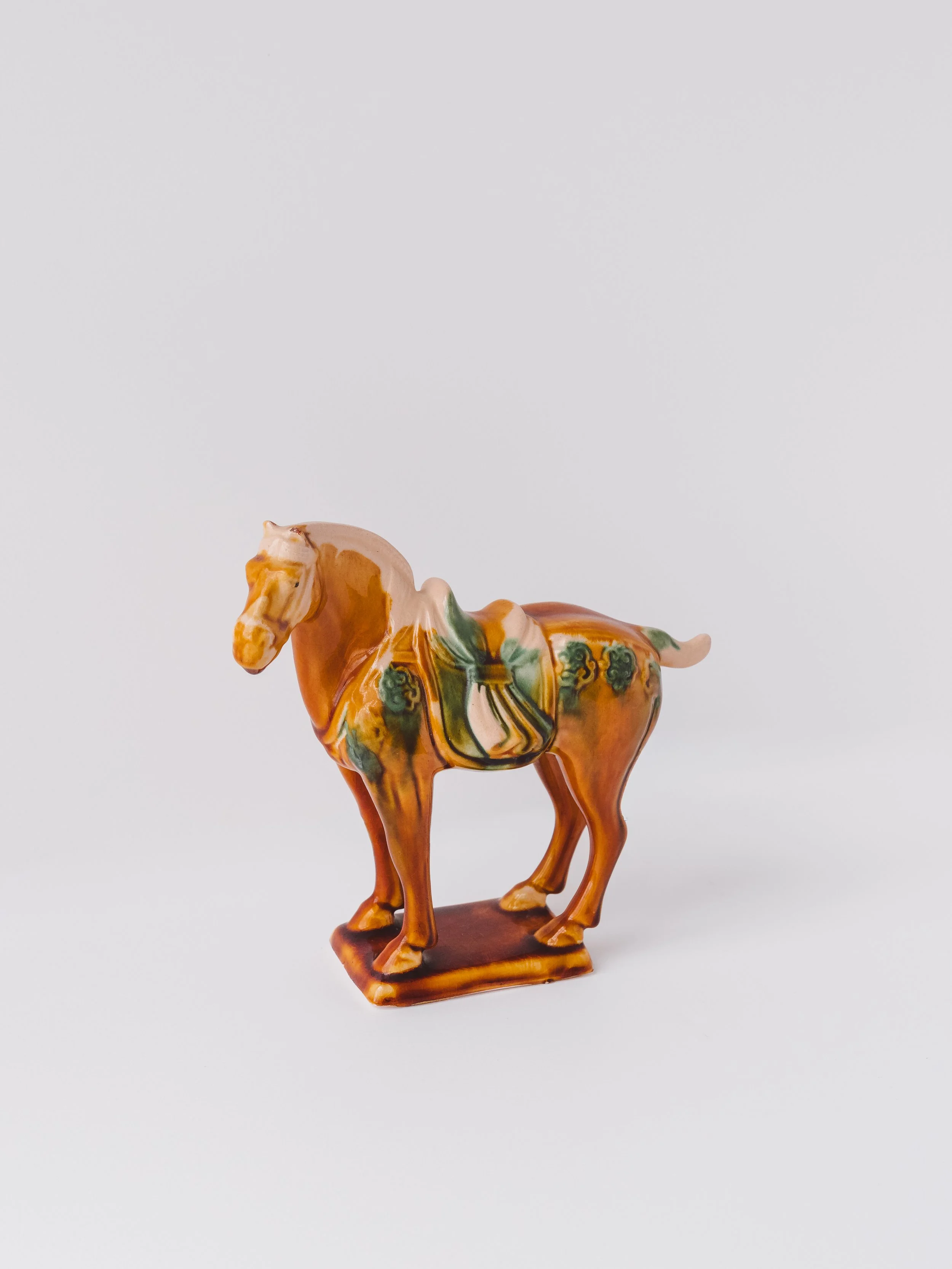 Image 1 of 10
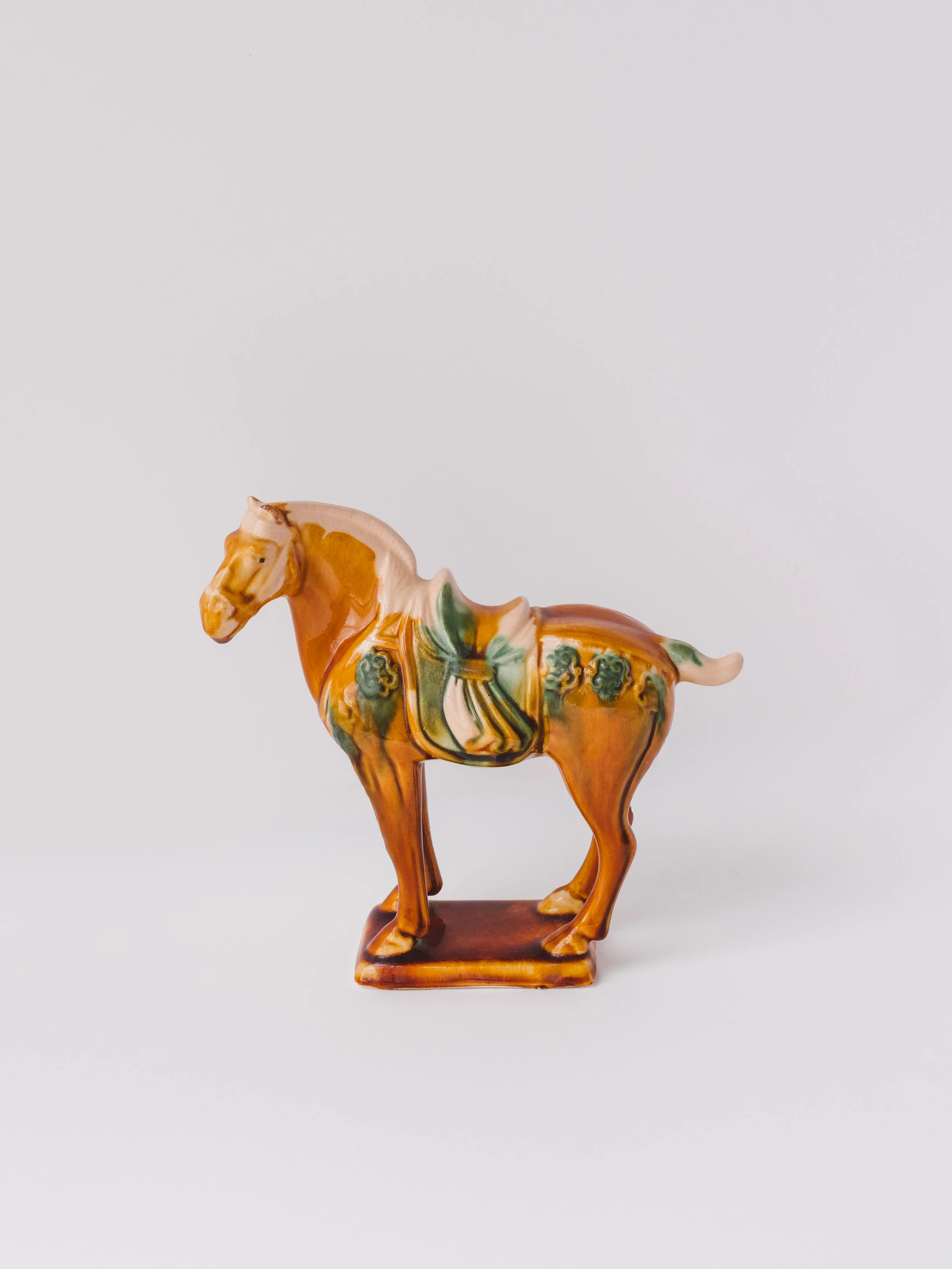 Image 2 of 10
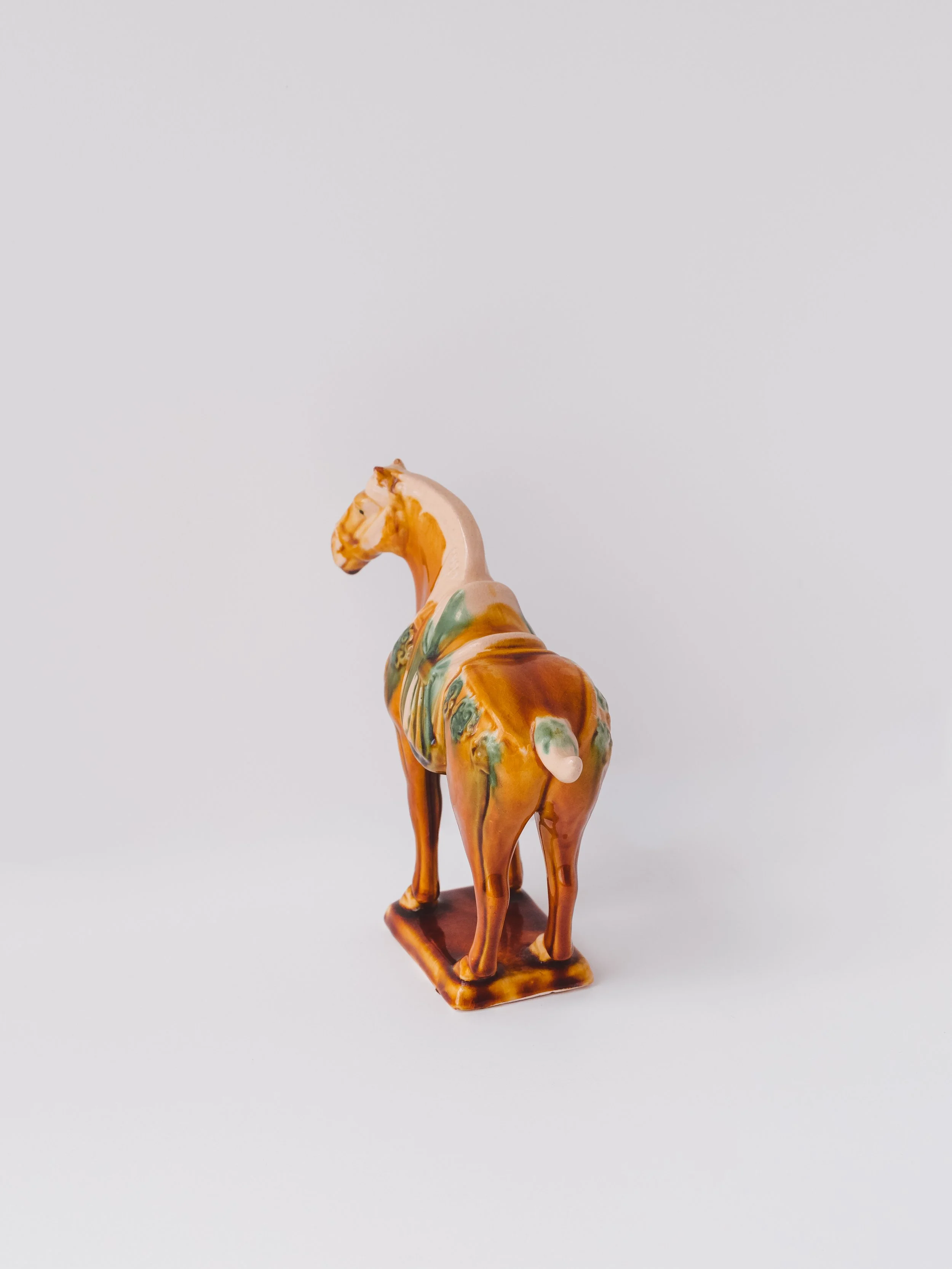 Image 3 of 10
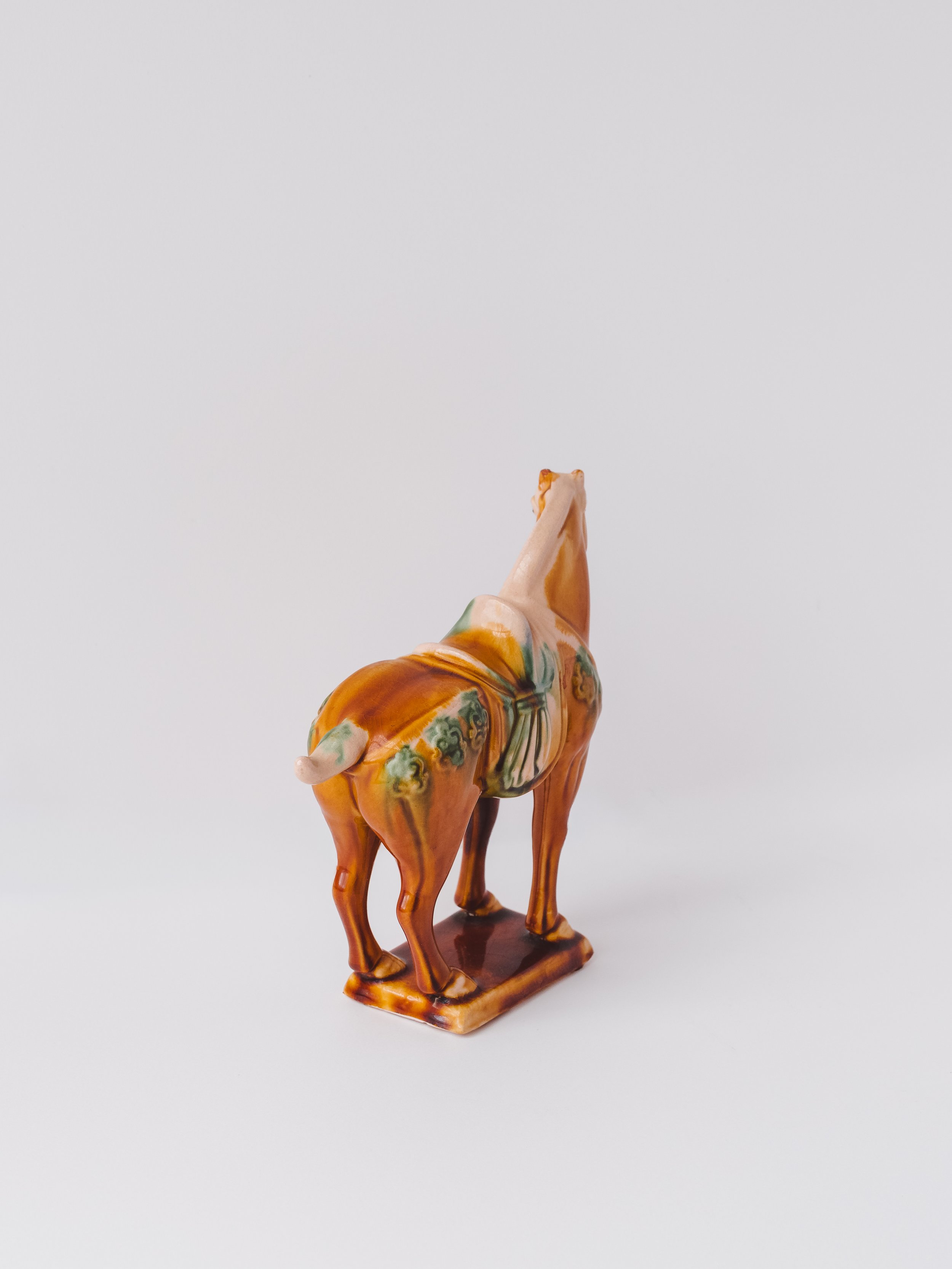 Image 4 of 10
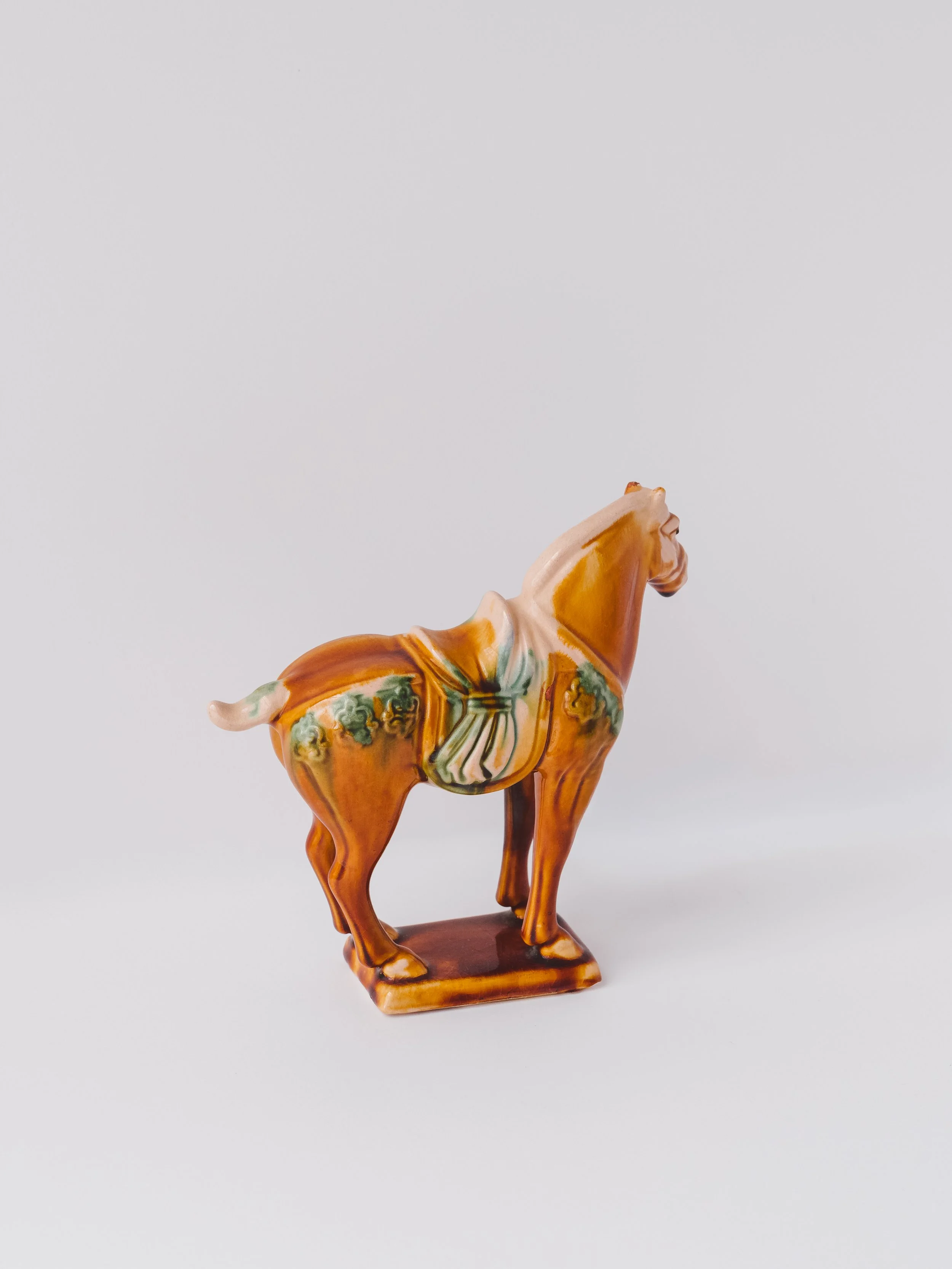 Image 5 of 10
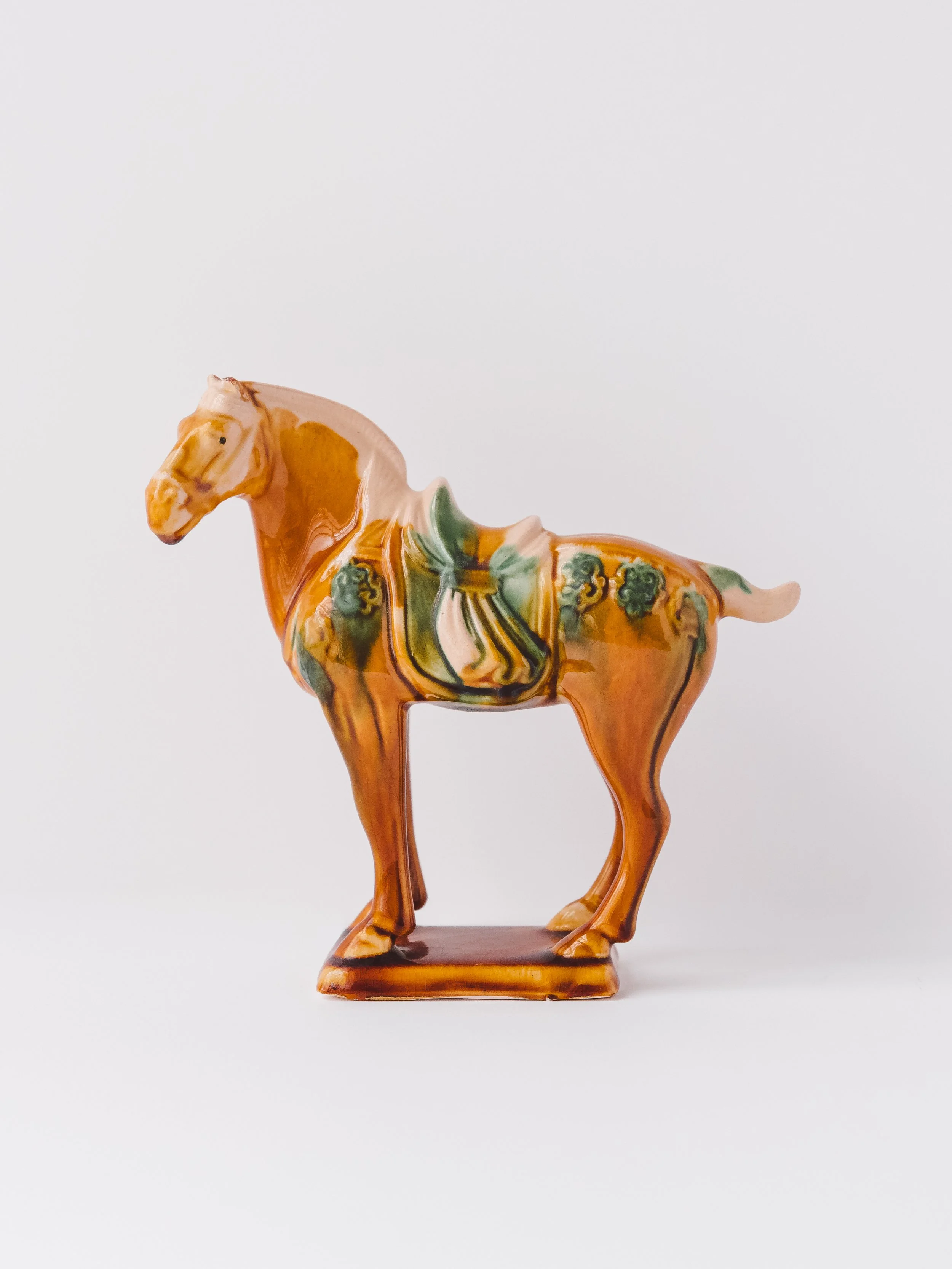 Image 6 of 10
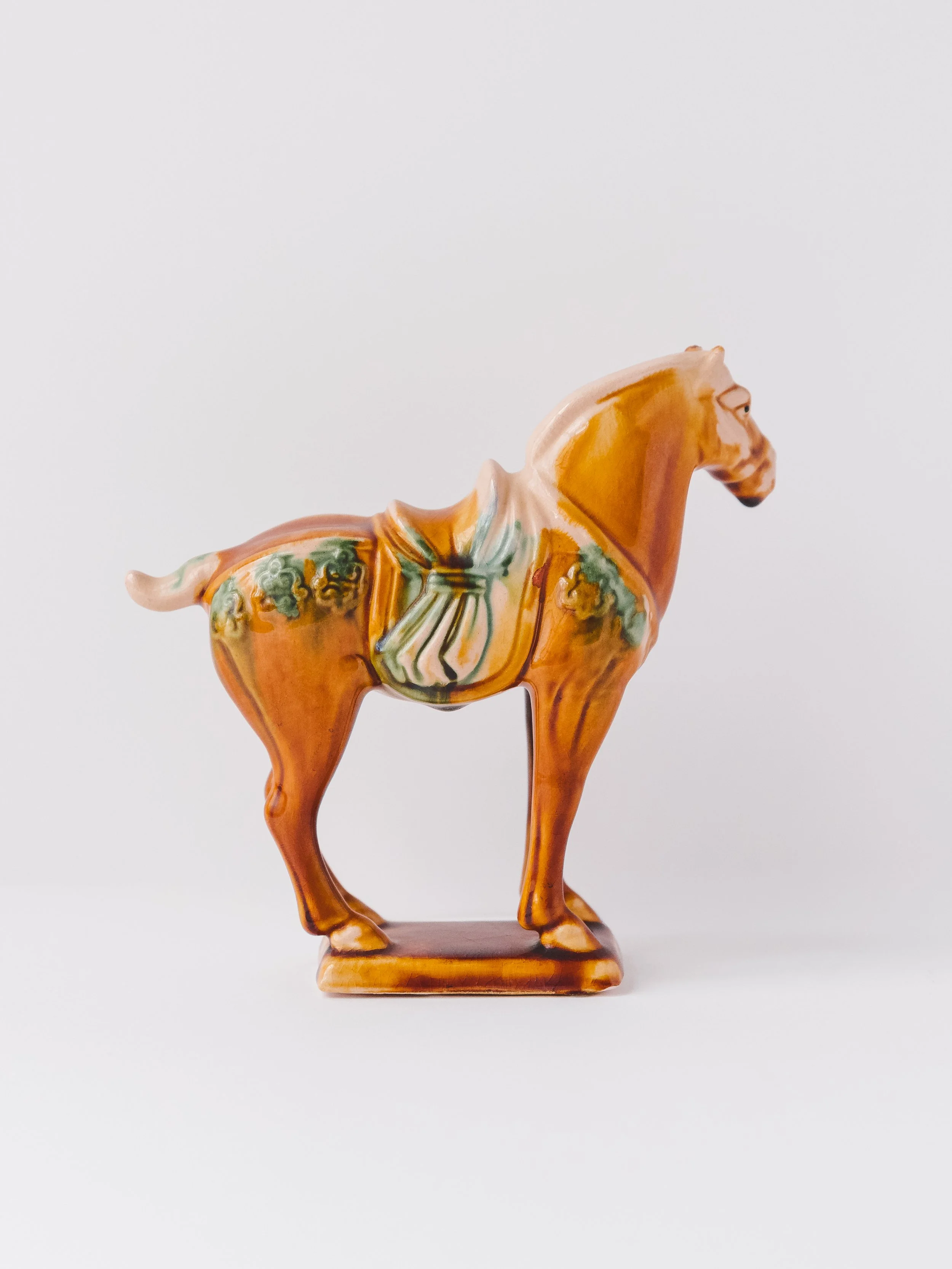 Image 7 of 10
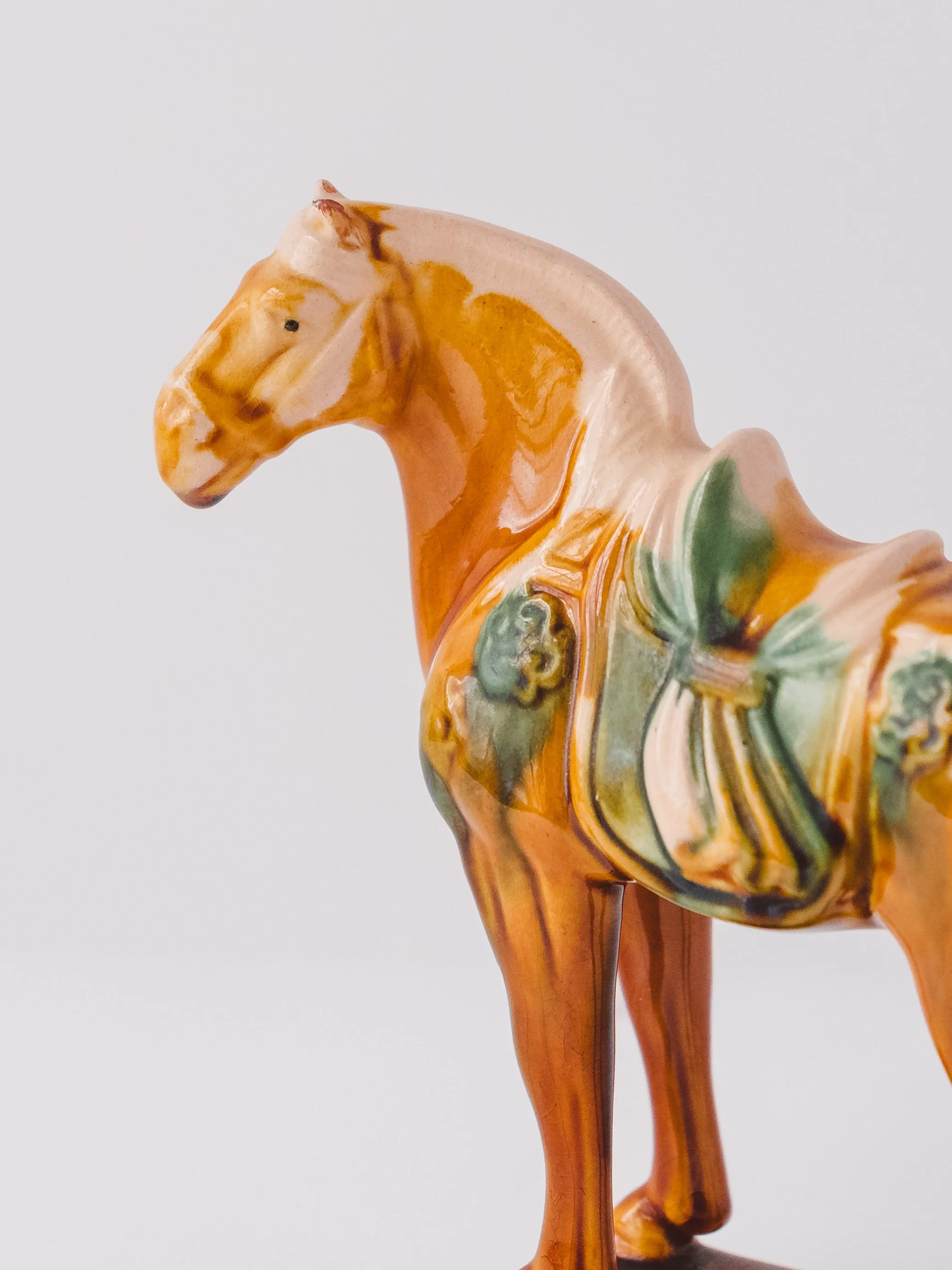 Image 8 of 10
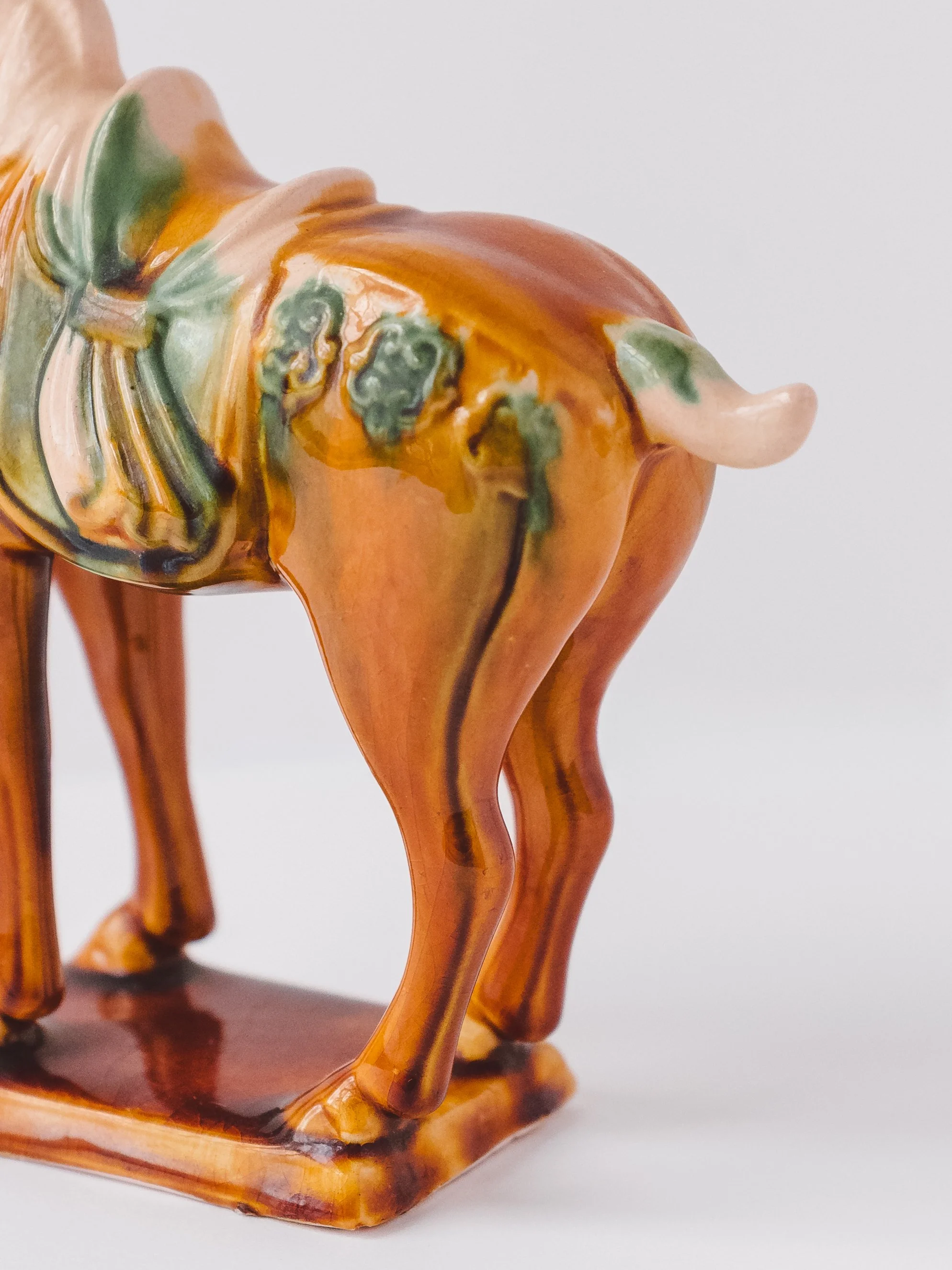 Image 9 of 10
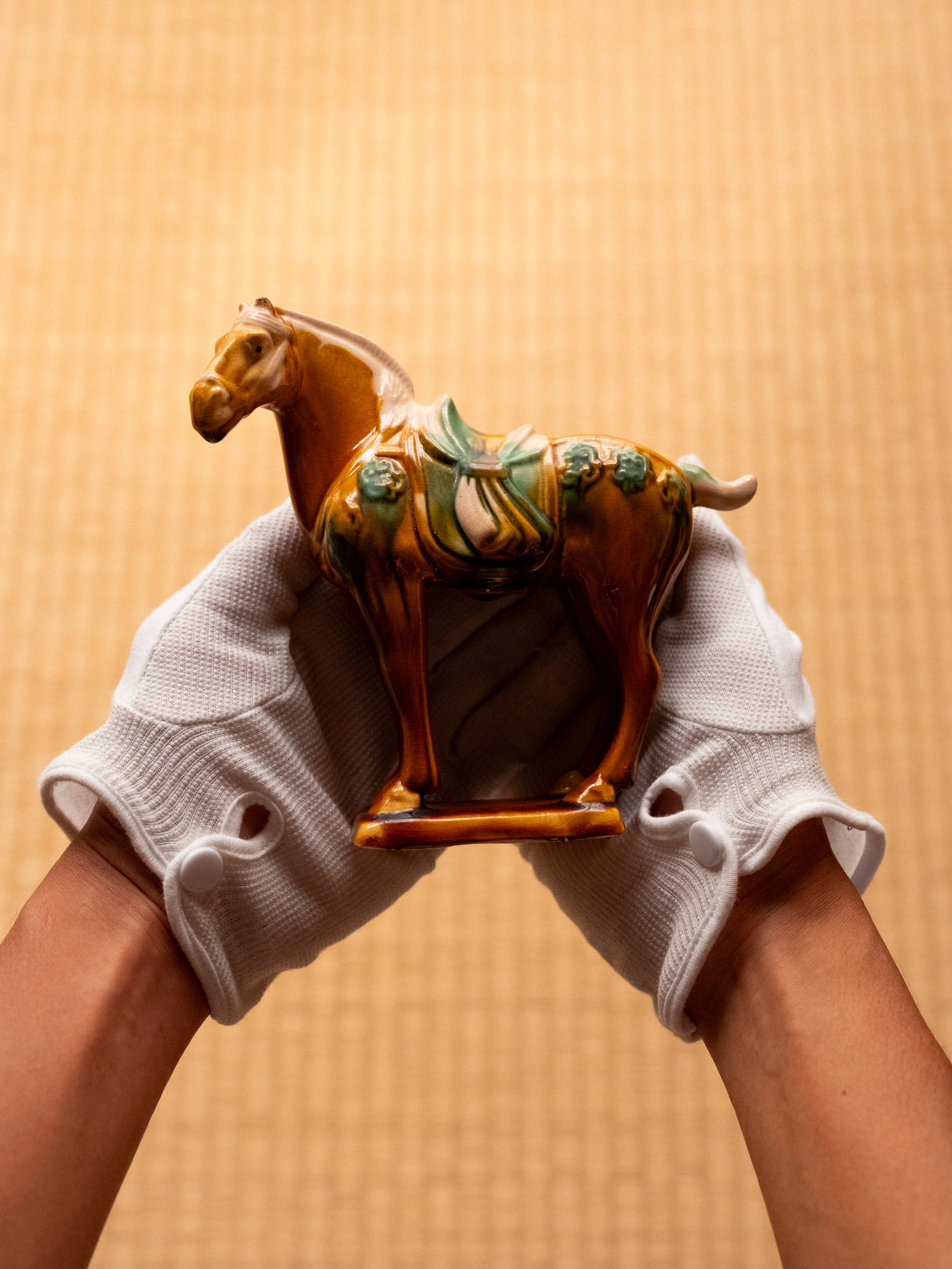 Image 10 of 10