

 Image 1 of 2
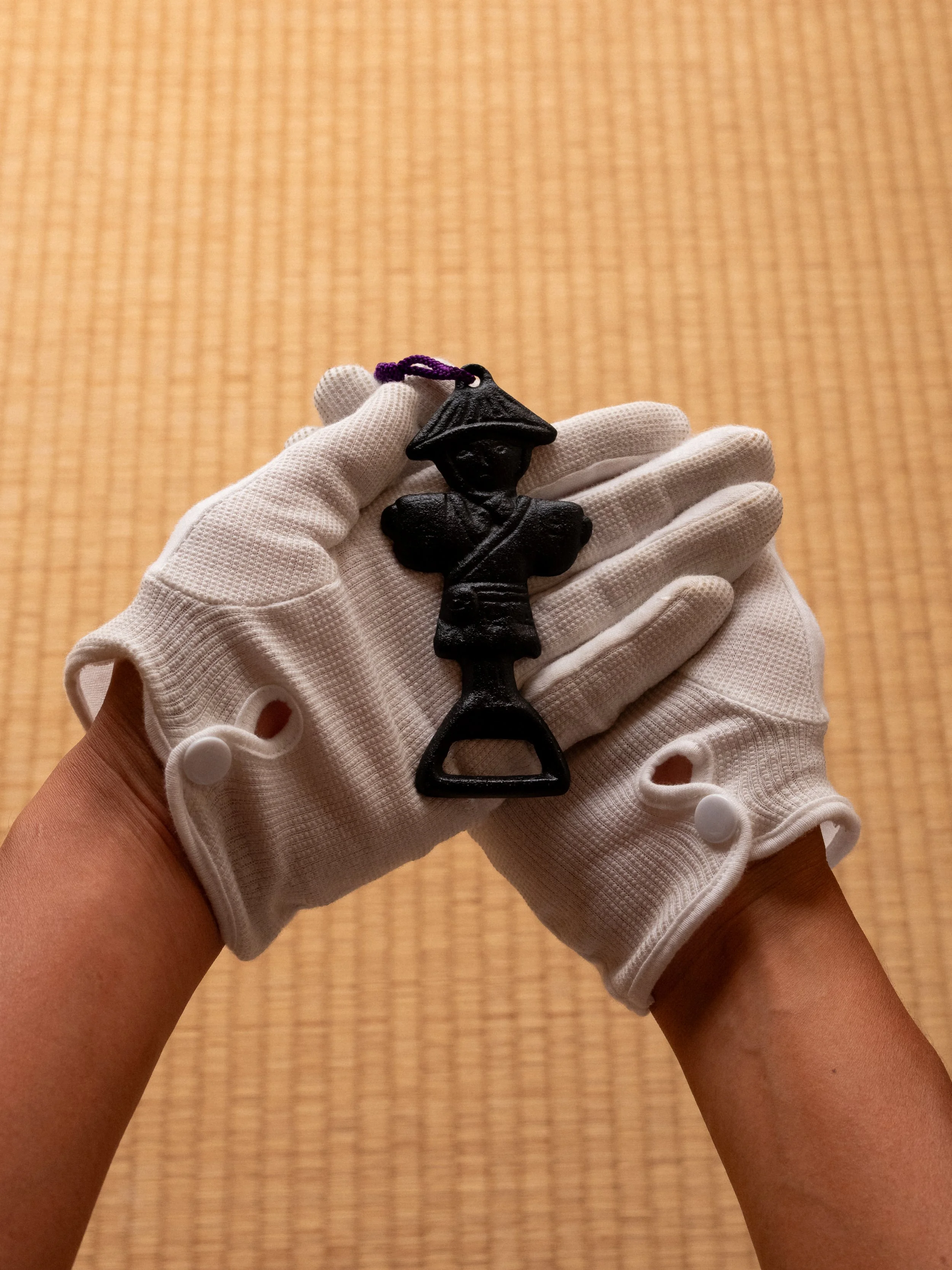 Image 2 of 2
NAMBU KAKASHI 1625
【 The Concept 】
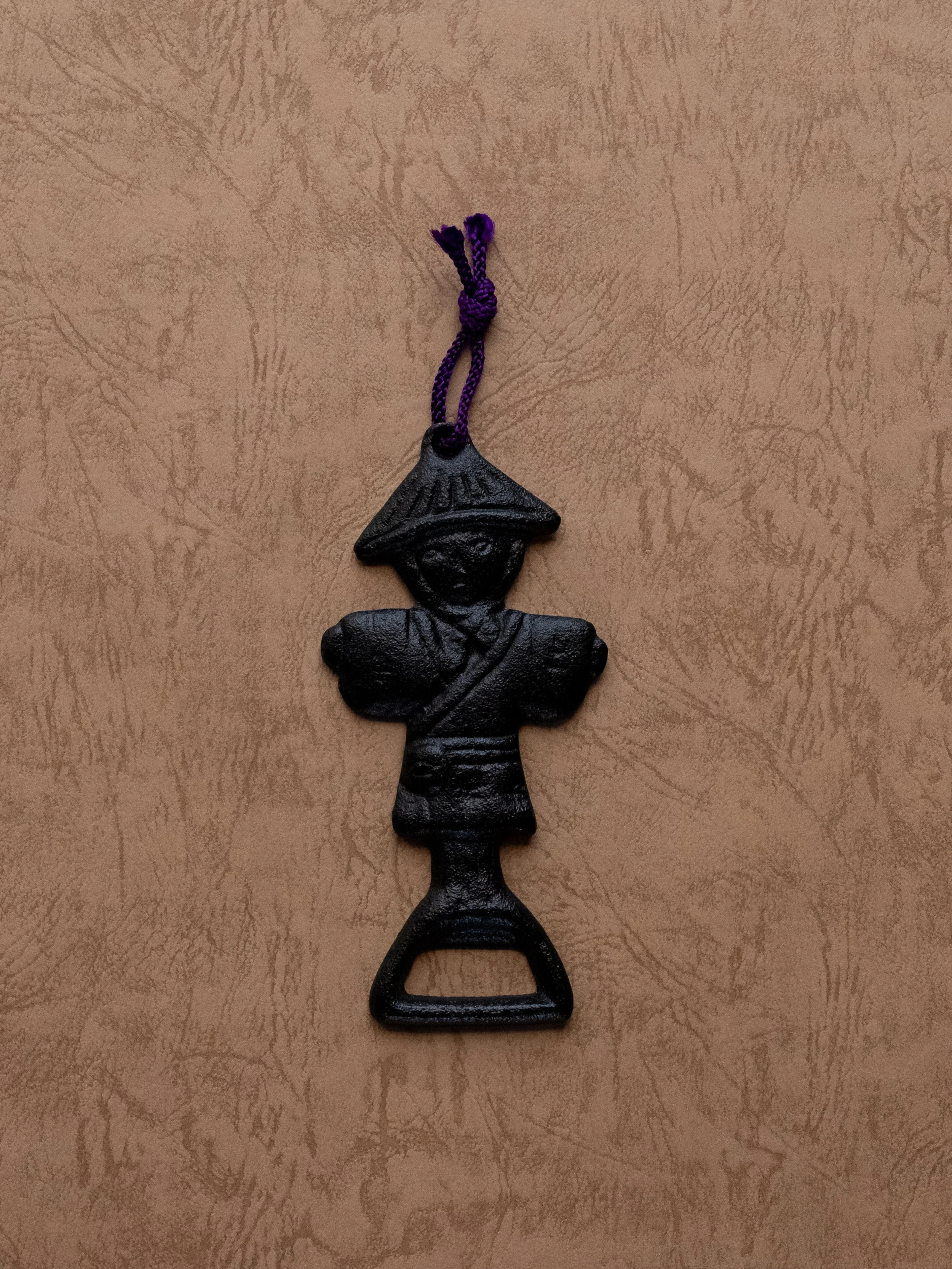
A small cast-iron scarecrow — kakashi — in the classical black finish of Nambu-tekki, the ironware of Morioka, Iwate Prefecture. The figure is cast as a single flat silhouette: a wide, radiating sugegasa straw hat crowns a small round face; the shoulders are horizontal with two blocky sleeves; a cross-body sash and a broad waist-obi are worked into the front of the robe; and the whole body narrows to a shaft that opens, at the base, into a clean rectangular slot with the small raised lip inside it that catches the edge of a crown cap. A short braided purple cord is threaded through a hole at the tip of the hat, so that the piece can hang from a beam, a hook by the door, or the neck of a bottle-crate. The finish is the deep matte satin black that only Nambu ironware carries — not painted, but built up through the traditional urushi-and-charcoal blackening that gives cast iron its rich, slightly matte, softly reflective surface. Twelve centimetres tall, one hundred grams in the hand: the honest weight and cool temperature of real cast iron, worked here as one of the most beloved figures of the Japanese rural landscape.
【 What Nambu-tekki Is 】
Nambu-tekki (南部鉄器) is the cast-iron ware of the former Nambu Morioka domain, today's Iwate Prefecture in the north-east of Honshū. Its origins are traditionally traced to the early Edo period, and specifically to the year 1625, when the lord of the Nambu domain, Nambu Toshinao, invited master metal-casters from Kyoto to settle in Morioka and set up their foundries there. Those first workshops made tea kettles, temple bells, cauldrons and altar bronzes; by the eighteenth century, when the smaller kettle known as the tetsubin came into wide use for boiling water for tea, Nambu-tekki had become one of Japan's most sought-after ironwares, and it has remained so ever since. Today Nambu-tekki is recognised by the Japanese government as a Traditional Craft (伝統的工芸品), and its makers still cast their pieces one at a time, in sand and clay moulds, and finish them in the traditional Nambu black. This small kakashi belongs, in materials and in surface, to that same lineage.
【 Why a Kakashi 】
The kakashi (案山子) is the scarecrow of the Japanese rice field — a small standing figure of straw, cloth and old rice-farming clothes, set out in the paddy at the end of summer to keep birds and small animals from the ripening rice. But the kakashi's role in Japanese folk imagination has never been only agricultural. In the classical texts the kakashi is a guardian of the field; in the Shinto-tinged countryside it is quietly understood as an eye that watches over the harvest; in the classical poem, it is the small figure that stands out through the wind and the rain until the rice is safely cut. To cast a kakashi in iron and set it on a shelf or by a doorway is to bring a small piece of that field-guardian meaning into the house: a quiet standing figure at the edge of the room, watching, and — in this case — also happening to open the beer bottles.
【 Reading the Object 】
The composition works from the hat down.
At the very top, a wide sugegasa hat sits low over the face, rendered as a series of clean radial lines that read at once as the woven ridges of a real straw hat. A small pierced hole at the tip carries the purple cord that lets the piece hang.
Under the hat the face is a small round form, with the nose and eyes worked in relief — the schematic, unfussy face of the folk kakashi, deliberately not portrait-like.
The shoulders are horizontal and flat, with two short blocky sleeves projecting to left and right — the classic scarecrow's cross-armed stance.
The robe is worked as a low-relief front panel: a cross-body diagonal sash reads clearly across the chest, and a broad horizontal waist obi is set below it, with small vertical fold lines beneath.
The hip and legs are the piece's shaft — a single tapering column from the obi down, without separately modelled feet. This is where the figure quietly stops being an ornament and starts being a tool.
At the base of the shaft, the clean rectangular opener is cut through the iron. Inside it, a small raised lip of cast iron sits at the top edge — the fulcrum that catches under the fluted edge of a crown cap and levers it off when the shaft is lifted. The mechanism of every good flat bottle opener, worked here into the body of a rice-field scarecrow.
【 The Object 】
A compact, cleanly finished cast-iron kakashi, comfortable to hold and heavy for its size in the honest way only iron is heavy. The whole piece is a single flat casting a few millimetres thick, with the scarecrow silhouette above and the bottle-opener silhouette below. Meant to be picked up — or hung by its cord.
【 The Opener 】
A rectangular opening is cut through the shaft below the obi. Inside the opening, a small raised lip of iron sits at the top edge — the fulcrum that catches under the fluted edge of a crown cap and levers it off when the shaft is lifted. The opener is centred, symmetrical, and just wide enough to swallow the largest crown caps easily.
【 Where to Place It 】
Hung from the loop of purple cord in the kitchen, above the bar, on a hook by the entrance, on the wall of a workshop, or laid flat on a shelf, a study desk, the edge of a drinks tray. Because Nambu iron carries a substantial mass for its scale, the piece also works as a small heavy paperweight when it is not in use as an opener. In the older Japanese reading, a small figure like this is best placed somewhere the eye returns to often — a small guardian at the edge of the room.
【 Care 】
Wipe dry with a clean cloth after use — like any cast iron, this piece prefers to stay dry. Do not soak, do not put in a dishwasher, do not use any abrasive or metal polish; the black Nambu finish is a traditional lacquer-and-carbon layer that will lift under strong cleaners. If the opener has come into contact with beer or other liquid, a quick dry-wipe is enough. Over years of use small light rust points may appear on the working edge of the opener; these can be rubbed back with a soft dry cloth, or left as honest wear. The purple cord can be replaced by any thin sturdy cord of the owner's choosing when the original tires.
【 Function & What It Brings 】
Use it, place it, hang it, or give it. As a piece of Japanese ironwork it is a compact, honest example of one of the country's most celebrated regional metal traditions — the same craft that produces the great Nambu tea-kettle — in a folk-figure form that gets picked up almost every day. As a household object it is a serious, satisfying bottle opener and, off duty, a small heavy paperweight or wall ornament. As a talisman it carries the kakashi's classical role — a small standing guardian at the edge of the household. A very fitting gift for anyone who takes their bottle beers seriously, for the opening of a bar or a new kitchen, for a lover of Japanese rural imagery, or for anyone who collects small Japanese cast iron.
【 The Texture 】
Cast iron in the traditional deep matte Nambu black — rich, warm, softly reflective, with the slightly granular skin that only cast iron and its lacquered blackening produce. Sharp cleanly cast radial lines on the sugegasa hat and low-relief robe details. A short braided purple cord threaded through the hat. Cool and heavy in the hand — a hundred grams of solid metal in a twelve-centimetre object, the specific weight that tells you at once this is iron and not a light alloy.
【 Presence 】
Quiet, standing, honestly weighted. Not a decorative doll but a working tool that happens to be a scarecrow. Its beauty is not in ornament but in the confidence of the silhouette, the depth of the traditional black, and the specific pleasure of picking up a real cast-iron object every time you want to open a bottle.
Archive Note: The number in the name (1625) references the year in which the lord of the Nambu Morioka domain, Nambu Toshinao, is traditionally said to have invited master metal-casters from Kyoto to settle in Morioka — the founding moment of the Nambu-tekki (南部鉄器) tradition of northern Japan. It marks the tradition this piece belongs to — not the date this piece was made.
Provenance Note: Sourced from a private household in Japan. A cast-iron scarecrow-form (kakashi ・ 案山子) bottle opener in the classical black finish of Nambu-tekki (南部鉄器), Iwate Prefecture. Threaded with a purple braided cord for hanging. Attributed to the Nambu-tekki tradition rather than to a specific workshop or individual maker.
Condition Note: Sold as acquired, in very good vintage condition. The slightly granular black cast-iron skin, the sharp cast radial hat lines and low-relief robe details, and any light patination on the working lip of the opener are inherent features of a used Nambu-tekki piece, not damage. No cracks through the body; the opener is fully functional. The purple hanging cord is present. Please see the photographs as part of the description.
【Specifications】
Material: cast iron with the traditional Nambu-tekki matte black finish (urushi-and-carbon blackening on cast iron); a short braided purple cord through the tip of the hatStyle: a kakashi (scarecrow) silhouette bottle opener in the Nambu-tekki tradition of Morioka, Iwate Prefecture; also usable as a small hanging ornament, paperweight or desk pieceFunction: fully functional flat bottle opener with an integral crown-cap fulcrum in the rectangular slot; opens standard bottle crown capsBase: none — the piece is a flat cast-iron object designed to be picked up, used, laid flat or hung by its cordCondition: sold as acquired, in very good vintage condition. Slightly granular cast-iron skin and any light patination on the working lip are inherent features of the material, not damage
【 Dimensions (Approx.) 】
Height: 12 cm (4.7 in)Width: 6 cm (2.4 in)Weight: 0.100 kg (0.22 lb)