【 The Concept 】
A small bronze turtle, standing four-square on its own thick, clawed legs — the left forefoot stepped ahead of the others, the neck and head stretched upward and turned to its left as if it has just paused mid-walk to look back, the tail curled at the rear, and the shell rising from its back as a heavy openwork dome. What looks at first like a solid turtle figure is in fact a functional incense burner: the whole shell lifts off as the vessel's lid, and its interior holds the ash and burning charcoal on which the incense sits. The openwork of the shell is the smoke path. Everywhere the metal has been worked by hand — the body carries the fine nanako (ナナコジ, "fish-roe") granulated ground of Japanese classical metalwork, the shell is cut through with confident scroll-and-cloud patterns, and the whole surface has aged into the deep warm brown of long-loved bronze, with a copper glow showing through wherever the hand has touched it for a long time. It is a compact, weighty piece — barely nine centimetres across but three hundred and sixty-five grams in the hand — built with the seriousness of a temple bronze in the size of a desk ornament.
【 What a Kōro Is 】
A kōro (香炉) is an incense burner: a vessel designed to hold a bed of ash and a small piece of glowing charcoal, on which fragrant wood or a pellet of incense is placed to release its scent as smoke. Kōro have belonged to Japanese life since Buddhism first arrived from the continent in the sixth century — first as ritual vessels on the altars of temples and household Butsudan, and then, from the medieval period onward, also as instruments of secular refinement: the meditation of kōdō (香道), the incense-listening ceremony; the winter incense that sweetens the tea room during the sunken-hearth season; the small burner kept on a scholar's desk to accompany reading. Bronze has always been the classical material for a Buddhist kōro, chosen for its density, its acoustic clarity when struck, its ability to hold the deep patina that only time can give. This piece belongs to that long lineage.
【 Why the Turtle 】
The turtle has been one of East Asia's oldest emblems of long life. In the Chinese tradition from which Japanese Buddhism inherited its bronze vocabulary, the tortoise is associated with wisdom, with augury, and with the vast slow patience of a creature whose lifespan is measured in centuries. In Japan the image took on a specifically local form as the minogame (蓑亀) — the "straw-cape turtle," a mythical creature said to have lived so many centuries that trailing water plants and moss have grown on its shell into a long green cape. To depict a turtle is to wish long life; to depict a turtle as an incense vessel is to place that wish into the ritual that most powerfully carries a wish — the burning of incense, whose smoke, in the Buddhist and Shinto imagination alike, rises to carry a prayer upward. A turtle-form kōro is a compact statement: may this household, this practice, this generation, last.
【 Reading the Object 】
The composition works from the ground up.
Four thick, clawed legs plant the turtle on the surface, with the left forefoot stepped clearly ahead of the others — the classical stance of a walking turtle caught mid-step. The legs are the least ornamented parts of the piece — solid, muscular castings finished with the same fine nanako ground as the body, so they read as skin rather than metal.
The body itself is a rounded, low-slung form, oval from above, worked from head to tail in the tiny raised dots of nanako — the "fish-roe" ground that Japanese metalworkers have used since the medieval period to give a soft, matte, hand-worked skin to a bronze surface. Rows of scale-plates run around the underside like a girdle.
The head is stretched upward and turned to its left on a thick, ridged neck, as if the turtle has just paused mid-walk and is looking back to its own left side. A small spiralled scroll is worked into each cheek. Two small eyes and a sharp nose complete the face.
The tail is a short, upward-curling coil at the rear, echoing the scroll motif on the cheek — a small design rhyme that ties the two ends of the animal together.
The shell is the piece's crowning field of work. It is a separate lid: lift it, and the vessel opens. Around its rim run bands of the same fine nanako ground and bordered scale-plates as the body. Above them, the whole crown of the shell rises as pierced openwork — rows of thick scroll clouds and stylised waves, each surrounded and outlined in careful hand-incising — cut all the way through the bronze, so that smoke from the charcoal within can rise through the pattern and out into the room as scent-bearing haze. The design draws on the karakusa (唐草, "Chinese grass") and ryūsuimon (流水文, "flowing water") vocabulary that runs through classical East Asian metalwork.
【 A Vessel That Breathes 】
The pleasure of this small object is that it is designed to breathe. Cold, closed, empty on a shelf, it is a serious little bronze animal. Warm, charged with a piece of incense wood or a small pellet of nerikō, it becomes something else — a turtle from whose shell soft strands of fragrant smoke rise through the cloud openings and drift into the room. The openwork is not merely decoration; it is the vessel's respiration, and the whole design assumes that respiration.
【 The Object 】
A compact, densely worked, satisfyingly heavy bronze turtle kōro — palm-sized in footprint but with the mass of a serious ritual bronze. The shell lifts cleanly off the body as a lid. The four legs give the piece a stable, self-supporting stance on any flat surface.
【 Where to Place It 】
On a desk, a bookshelf, a tokonoma alcove, a Buddhist altar, or the tea room's shelf. Because the piece is designed to release smoke through its shell it is at its best in a room with a little air movement — near, but not directly on, an open window; on a stone or ceramic tile if it is to be used with charcoal, to protect the surface beneath from residual heat; anywhere the eye returns to often, so its long-life symbolism stays in view. Kept cold as an ornament, it is equally happy on a desk with a stack of books.
【 Care 】
Dust with a soft dry cloth or brush. Do not polish with metal cleaner or brass polish — the deep brown patina is the value of an old bronze and is not tarnish to be removed. If used with charcoal, allow the piece to cool completely before handling, empty the ash with a soft brush, and store dry. Do not soak or wash with soap. Lift the shell straight up rather than sliding it, to protect the fit of the lid against the body.
【 Function & What It Brings 】
Keep it, place it, use it, or give it. As a piece of East Asian bronze it is a compact, honest example of the Japanese classical kōro tradition — the small ritual bronze that has been part of Buddhist and secular life on the archipelago for over a thousand years. As a household object it is a fully functional incense burner: fill the interior with a bed of ash, set a small piece of charcoal at the centre, and place a fragment of aromatic wood or a pellet of nerikō on top. As a talisman it carries the turtle's classical wish — long life, patience, steady continuity of the household and its practice. A fitting gift for a milestone birthday, a wedding, a housewarming, a retirement, the founding of a household altar, or for anyone who loves Japanese metalwork or the long life of the turtle.
【 The Texture 】
Cast bronze with a deep, aged brown patina, warmed by exposed copper-orange tones wherever the piece has been handled over the years. Fine hand-punched nanako (fish-roe) ground across the whole body — dense, regular, softly matte. Sharp hand-incised scroll and cloud detail on the pierced shell. Cool, dense, and pleasantly weighty in the hand; a soft dry ring when the shell settles back onto the body.
【 Presence 】
Heavy, quiet, ceremonial. This is not an ornamental turtle but a small piece of ritual metalwork — alert, poised, four-square, its shell open to the air. Its beauty is not in flash but in the depth of the patina and the confidence of the hand that raised the nanako ground and cut through the shell.
Archive Note: The number in the name (1053) references the year of completion of the Byōdō-in Phoenix Hall (Hoō-dō) at Uji, one of the high points of Japanese classical Buddhist metalwork and lacquer. It marks the tradition of Japanese ritual bronze and Buddhist implement design in which a kōro of this kind belongs — not the date this piece was made.
Provenance Note: Sourced from a private collection in Japan. A cast-bronze turtle-form kōro (incense burner) in the classical East Asian Buddhist-bronze idiom — nanako granulated ground body, pierced openwork shell as a lift-off smoke lid — attributed to that long-standing tradition rather than to a specific kiln, workshop or individual maker. Age is not laboratory-verified; the piece is presented honestly as a vintage Japanese bronze kōro without a specific dynasty or period claim.
Condition Note: Sold as acquired, in honest vintage condition. Deep aged patina overall, with warm copper-orange tones showing where the surface has been handled over the years — this is the desired old-bronze surface and is not corrosion to be cleaned off. No cracks through the body. The shell lifts and settles cleanly on the body. Please see the photographs as part of the description.
【 The Concept 】
A small bronze turtle, standing four-square on its own thick, clawed legs — the left forefoot stepped ahead of the others, the neck and head stretched upward and turned to its left as if it has just paused mid-walk to look back, the tail curled at the rear, and the shell rising from its back as a heavy openwork dome. What looks at first like a solid turtle figure is in fact a functional incense burner: the whole shell lifts off as the vessel's lid, and its interior holds the ash and burning charcoal on which the incense sits. The openwork of the shell is the smoke path. Everywhere the metal has been worked by hand — the body carries the fine nanako (ナナコジ, "fish-roe") granulated ground of Japanese classical metalwork, the shell is cut through with confident scroll-and-cloud patterns, and the whole surface has aged into the deep warm brown of long-loved bronze, with a copper glow showing through wherever the hand has touched it for a long time. It is a compact, weighty piece — barely nine centimetres across but three hundred and sixty-five grams in the hand — built with the seriousness of a temple bronze in the size of a desk ornament.
【 What a Kōro Is 】
A kōro (香炉) is an incense burner: a vessel designed to hold a bed of ash and a small piece of glowing charcoal, on which fragrant wood or a pellet of incense is placed to release its scent as smoke. Kōro have belonged to Japanese life since Buddhism first arrived from the continent in the sixth century — first as ritual vessels on the altars of temples and household Butsudan, and then, from the medieval period onward, also as instruments of secular refinement: the meditation of kōdō (香道), the incense-listening ceremony; the winter incense that sweetens the tea room during the sunken-hearth season; the small burner kept on a scholar's desk to accompany reading. Bronze has always been the classical material for a Buddhist kōro, chosen for its density, its acoustic clarity when struck, its ability to hold the deep patina that only time can give. This piece belongs to that long lineage.
【 Why the Turtle 】
The turtle has been one of East Asia's oldest emblems of long life. In the Chinese tradition from which Japanese Buddhism inherited its bronze vocabulary, the tortoise is associated with wisdom, with augury, and with the vast slow patience of a creature whose lifespan is measured in centuries. In Japan the image took on a specifically local form as the minogame (蓑亀) — the "straw-cape turtle," a mythical creature said to have lived so many centuries that trailing water plants and moss have grown on its shell into a long green cape. To depict a turtle is to wish long life; to depict a turtle as an incense vessel is to place that wish into the ritual that most powerfully carries a wish — the burning of incense, whose smoke, in the Buddhist and Shinto imagination alike, rises to carry a prayer upward. A turtle-form kōro is a compact statement: may this household, this practice, this generation, last.
【 Reading the Object 】
The composition works from the ground up.
Four thick, clawed legs plant the turtle on the surface, with the left forefoot stepped clearly ahead of the others — the classical stance of a walking turtle caught mid-step. The legs are the least ornamented parts of the piece — solid, muscular castings finished with the same fine nanako ground as the body, so they read as skin rather than metal.
The body itself is a rounded, low-slung form, oval from above, worked from head to tail in the tiny raised dots of nanako — the "fish-roe" ground that Japanese metalworkers have used since the medieval period to give a soft, matte, hand-worked skin to a bronze surface. Rows of scale-plates run around the underside like a girdle.
The head is stretched upward and turned to its left on a thick, ridged neck, as if the turtle has just paused mid-walk and is looking back to its own left side. A small spiralled scroll is worked into each cheek. Two small eyes and a sharp nose complete the face.
The tail is a short, upward-curling coil at the rear, echoing the scroll motif on the cheek — a small design rhyme that ties the two ends of the animal together.
The shell is the piece's crowning field of work. It is a separate lid: lift it, and the vessel opens. Around its rim run bands of the same fine nanako ground and bordered scale-plates as the body. Above them, the whole crown of the shell rises as pierced openwork — rows of thick scroll clouds and stylised waves, each surrounded and outlined in careful hand-incising — cut all the way through the bronze, so that smoke from the charcoal within can rise through the pattern and out into the room as scent-bearing haze. The design draws on the karakusa (唐草, "Chinese grass") and ryūsuimon (流水文, "flowing water") vocabulary that runs through classical East Asian metalwork.
【 A Vessel That Breathes 】
The pleasure of this small object is that it is designed to breathe. Cold, closed, empty on a shelf, it is a serious little bronze animal. Warm, charged with a piece of incense wood or a small pellet of nerikō, it becomes something else — a turtle from whose shell soft strands of fragrant smoke rise through the cloud openings and drift into the room. The openwork is not merely decoration; it is the vessel's respiration, and the whole design assumes that respiration.
【 The Object 】
A compact, densely worked, satisfyingly heavy bronze turtle kōro — palm-sized in footprint but with the mass of a serious ritual bronze. The shell lifts cleanly off the body as a lid. The four legs give the piece a stable, self-supporting stance on any flat surface.
【 Where to Place It 】
On a desk, a bookshelf, a tokonoma alcove, a Buddhist altar, or the tea room's shelf. Because the piece is designed to release smoke through its shell it is at its best in a room with a little air movement — near, but not directly on, an open window; on a stone or ceramic tile if it is to be used with charcoal, to protect the surface beneath from residual heat; anywhere the eye returns to often, so its long-life symbolism stays in view. Kept cold as an ornament, it is equally happy on a desk with a stack of books.
【 Care 】
Dust with a soft dry cloth or brush. Do not polish with metal cleaner or brass polish — the deep brown patina is the value of an old bronze and is not tarnish to be removed. If used with charcoal, allow the piece to cool completely before handling, empty the ash with a soft brush, and store dry. Do not soak or wash with soap. Lift the shell straight up rather than sliding it, to protect the fit of the lid against the body.
【 Function & What It Brings 】
Keep it, place it, use it, or give it. As a piece of East Asian bronze it is a compact, honest example of the Japanese classical kōro tradition — the small ritual bronze that has been part of Buddhist and secular life on the archipelago for over a thousand years. As a household object it is a fully functional incense burner: fill the interior with a bed of ash, set a small piece of charcoal at the centre, and place a fragment of aromatic wood or a pellet of nerikō on top. As a talisman it carries the turtle's classical wish — long life, patience, steady continuity of the household and its practice. A fitting gift for a milestone birthday, a wedding, a housewarming, a retirement, the founding of a household altar, or for anyone who loves Japanese metalwork or the long life of the turtle.
【 The Texture 】
Cast bronze with a deep, aged brown patina, warmed by exposed copper-orange tones wherever the piece has been handled over the years. Fine hand-punched nanako (fish-roe) ground across the whole body — dense, regular, softly matte. Sharp hand-incised scroll and cloud detail on the pierced shell. Cool, dense, and pleasantly weighty in the hand; a soft dry ring when the shell settles back onto the body.
【 Presence 】
Heavy, quiet, ceremonial. This is not an ornamental turtle but a small piece of ritual metalwork — alert, poised, four-square, its shell open to the air. Its beauty is not in flash but in the depth of the patina and the confidence of the hand that raised the nanako ground and cut through the shell.
Archive Note: The number in the name (1053) references the year of completion of the Byōdō-in Phoenix Hall (Hoō-dō) at Uji, one of the high points of Japanese classical Buddhist metalwork and lacquer. It marks the tradition of Japanese ritual bronze and Buddhist implement design in which a kōro of this kind belongs — not the date this piece was made.
Provenance Note: Sourced from a private collection in Japan. A cast-bronze turtle-form kōro (incense burner) in the classical East Asian Buddhist-bronze idiom — nanako granulated ground body, pierced openwork shell as a lift-off smoke lid — attributed to that long-standing tradition rather than to a specific kiln, workshop or individual maker. Age is not laboratory-verified; the piece is presented honestly as a vintage Japanese bronze kōro without a specific dynasty or period claim.
Condition Note: Sold as acquired, in honest vintage condition. Deep aged patina overall, with warm copper-orange tones showing where the surface has been handled over the years — this is the desired old-bronze surface and is not corrosion to be cleaned off. No cracks through the body. The shell lifts and settles cleanly on the body. Please see the photographs as part of the description.


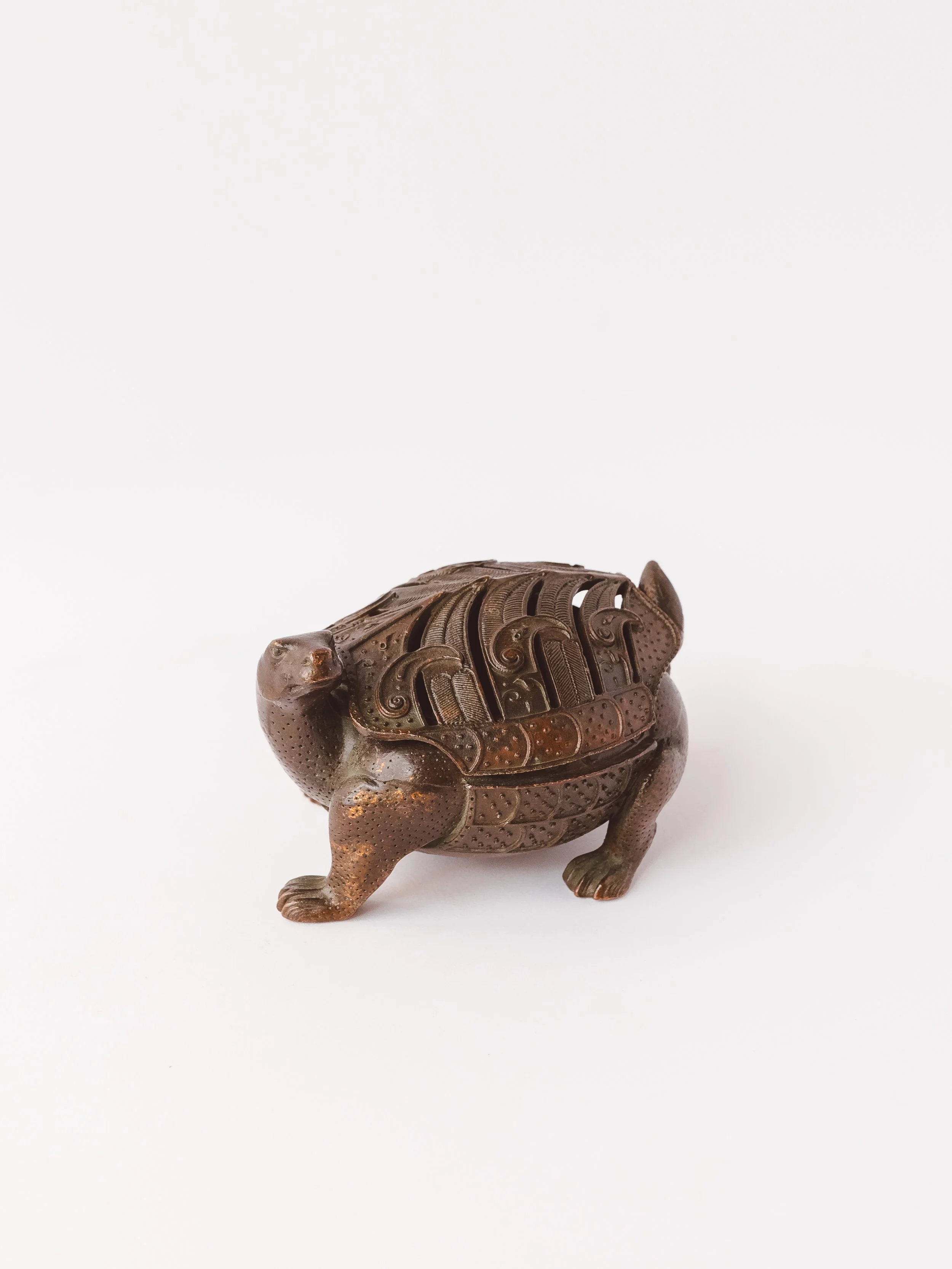 Image 1 of 11
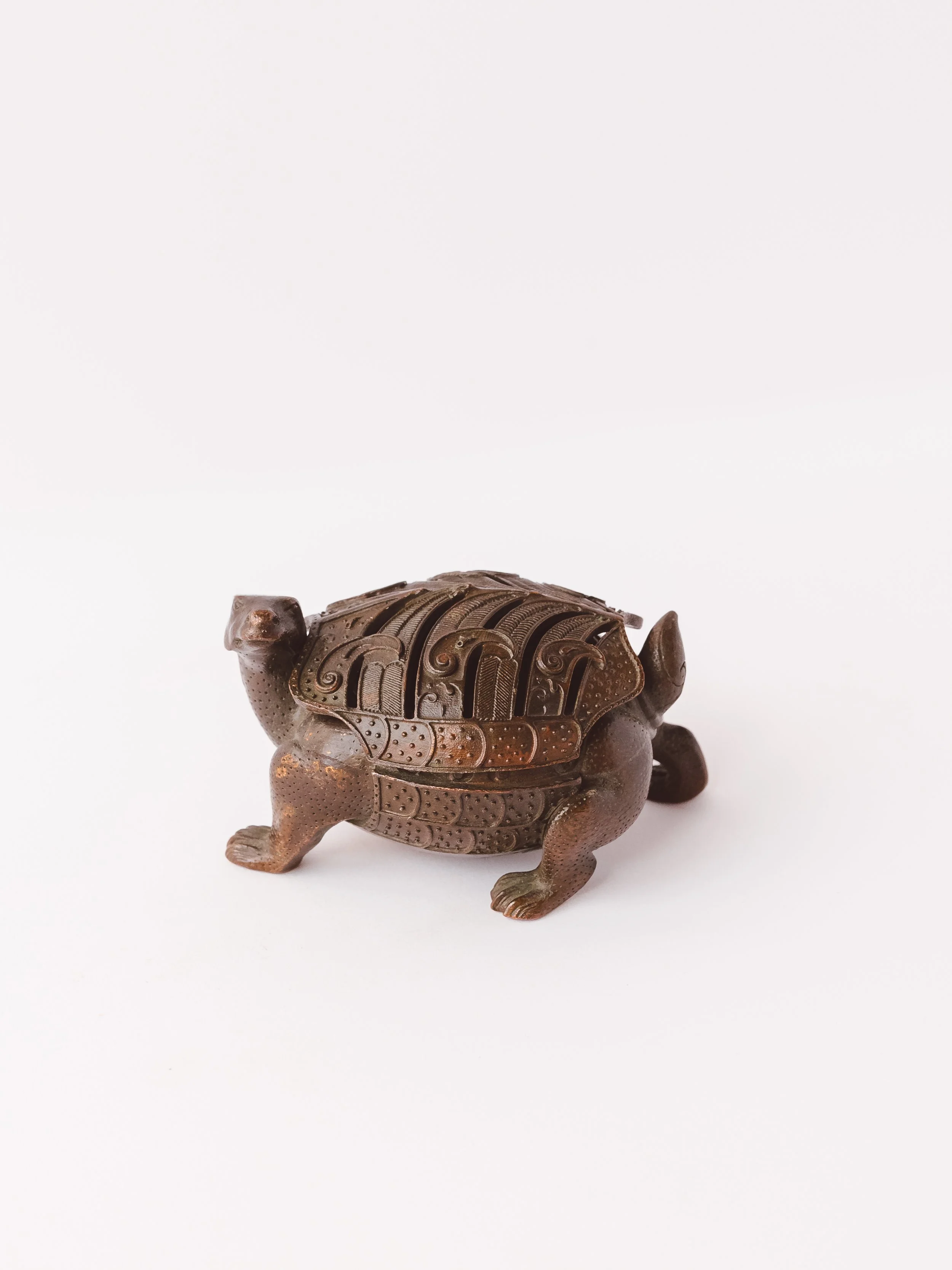 Image 2 of 11
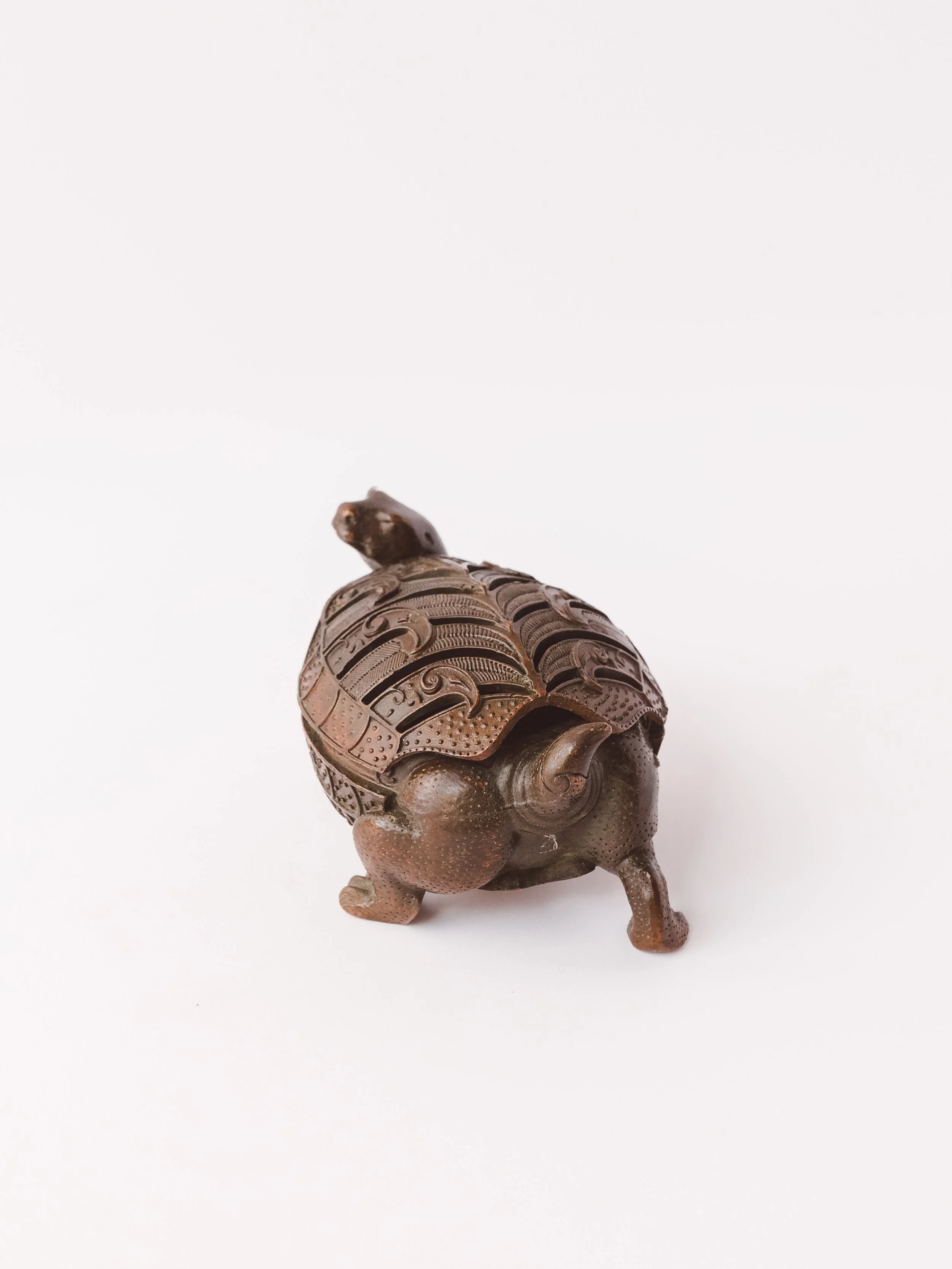 Image 3 of 11
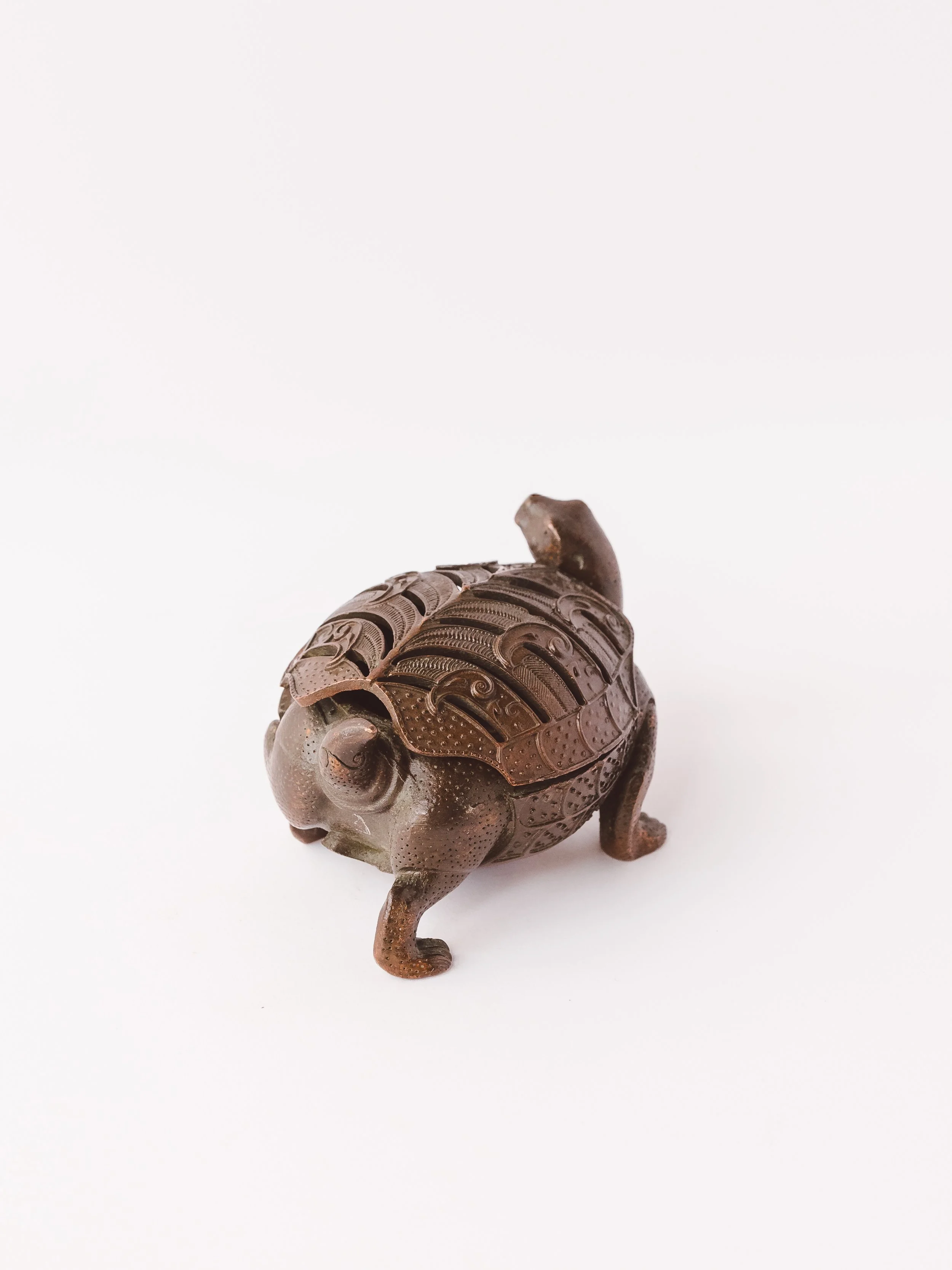 Image 4 of 11
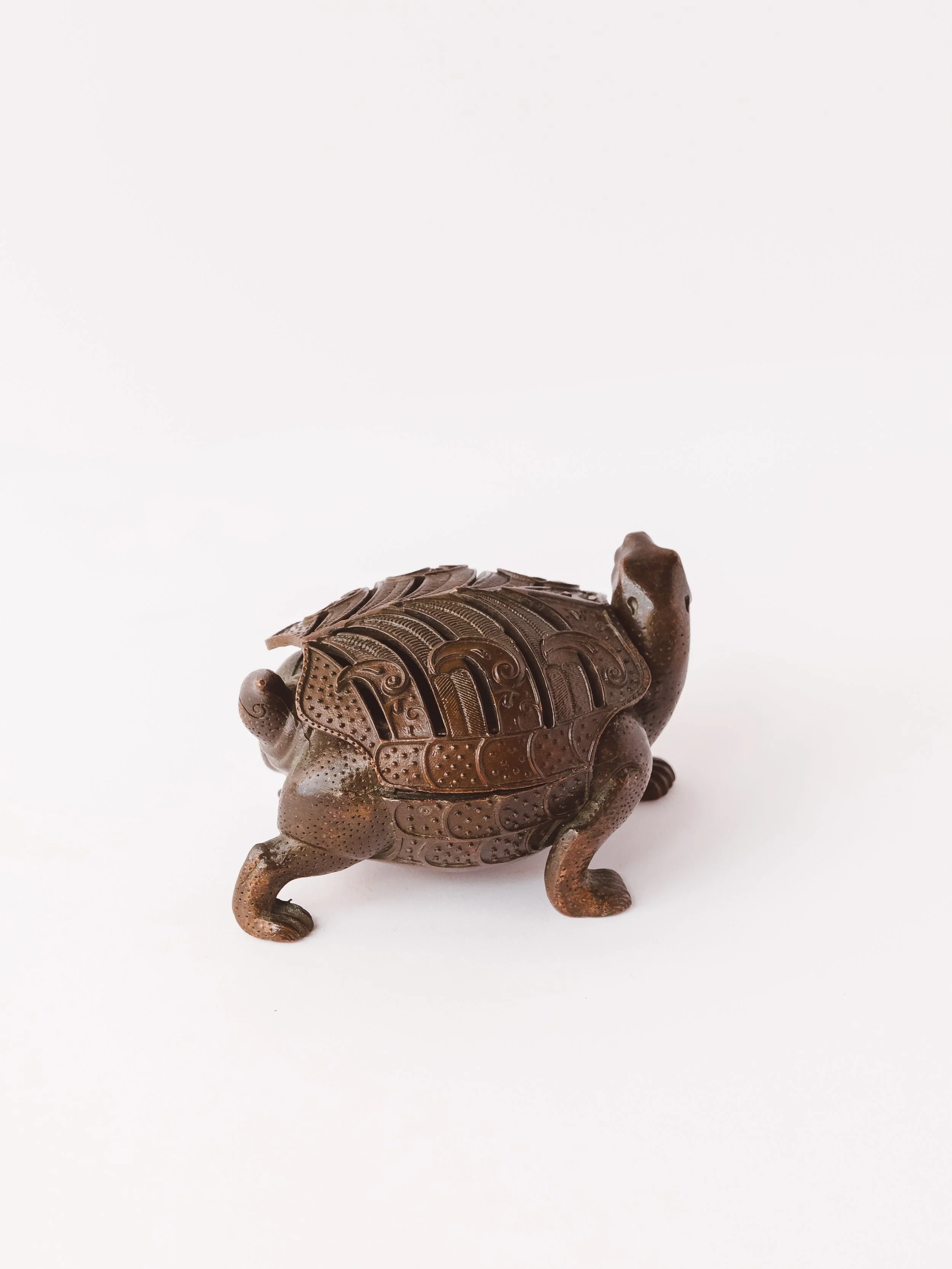 Image 5 of 11
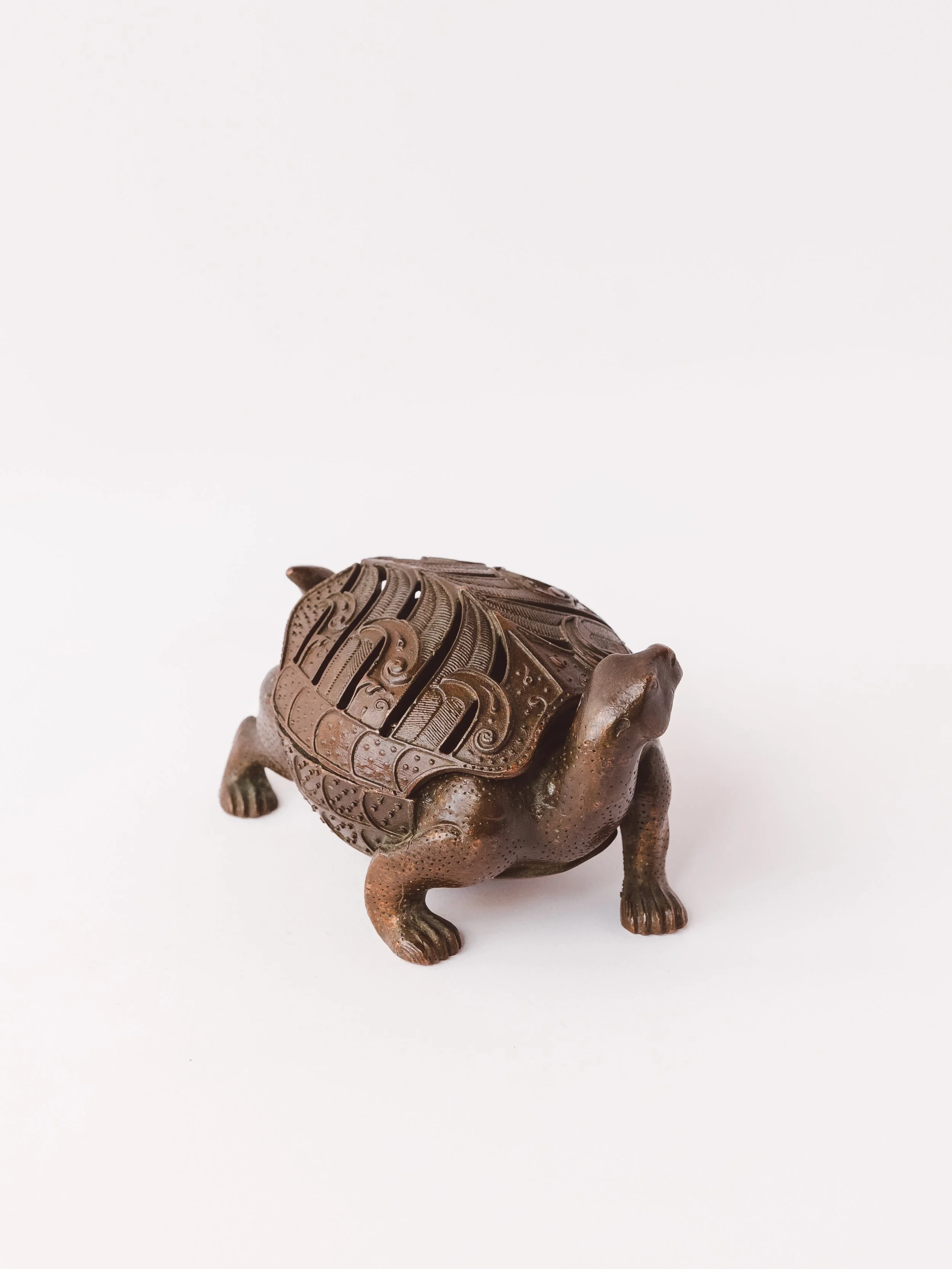 Image 6 of 11
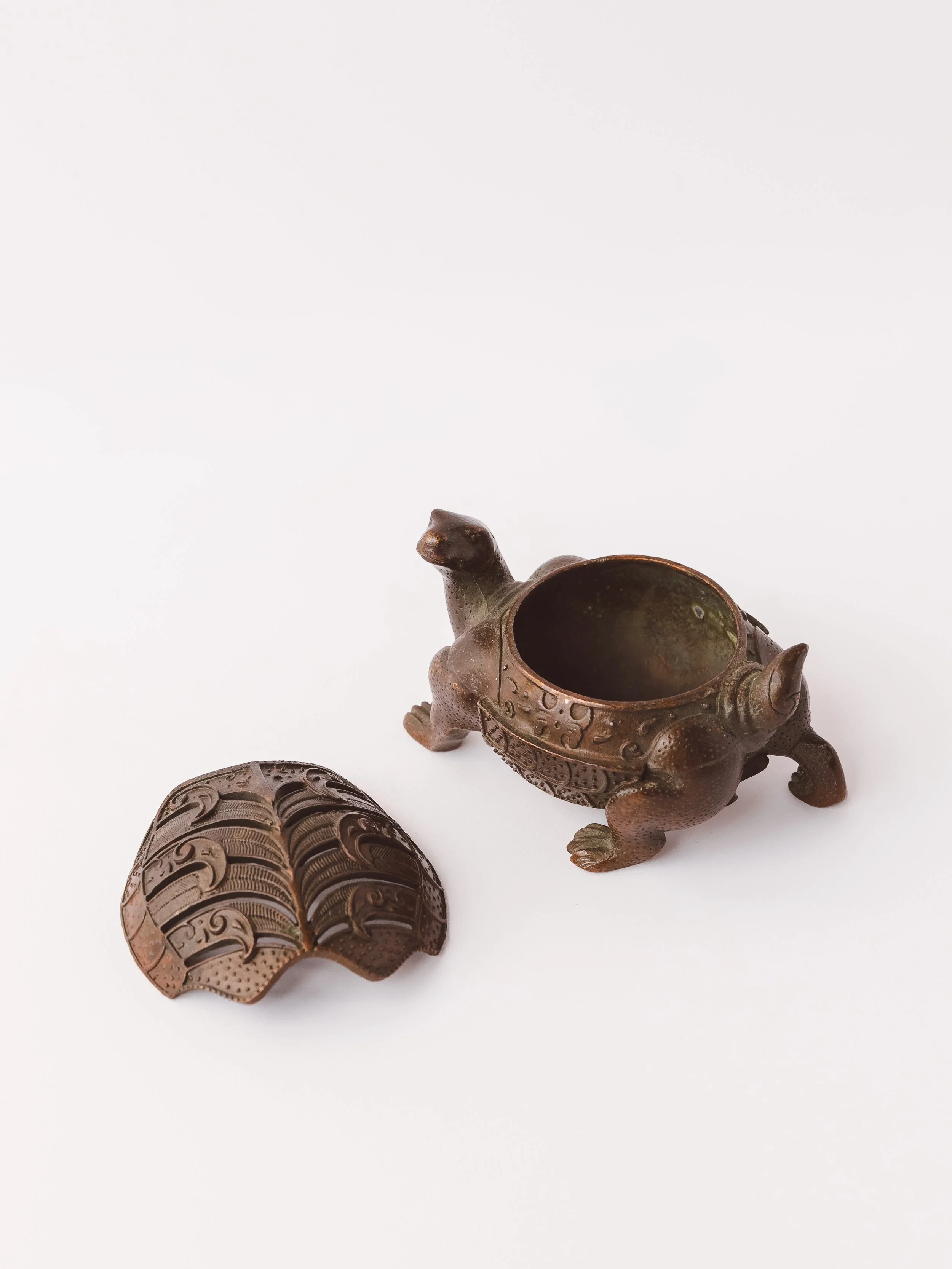 Image 7 of 11
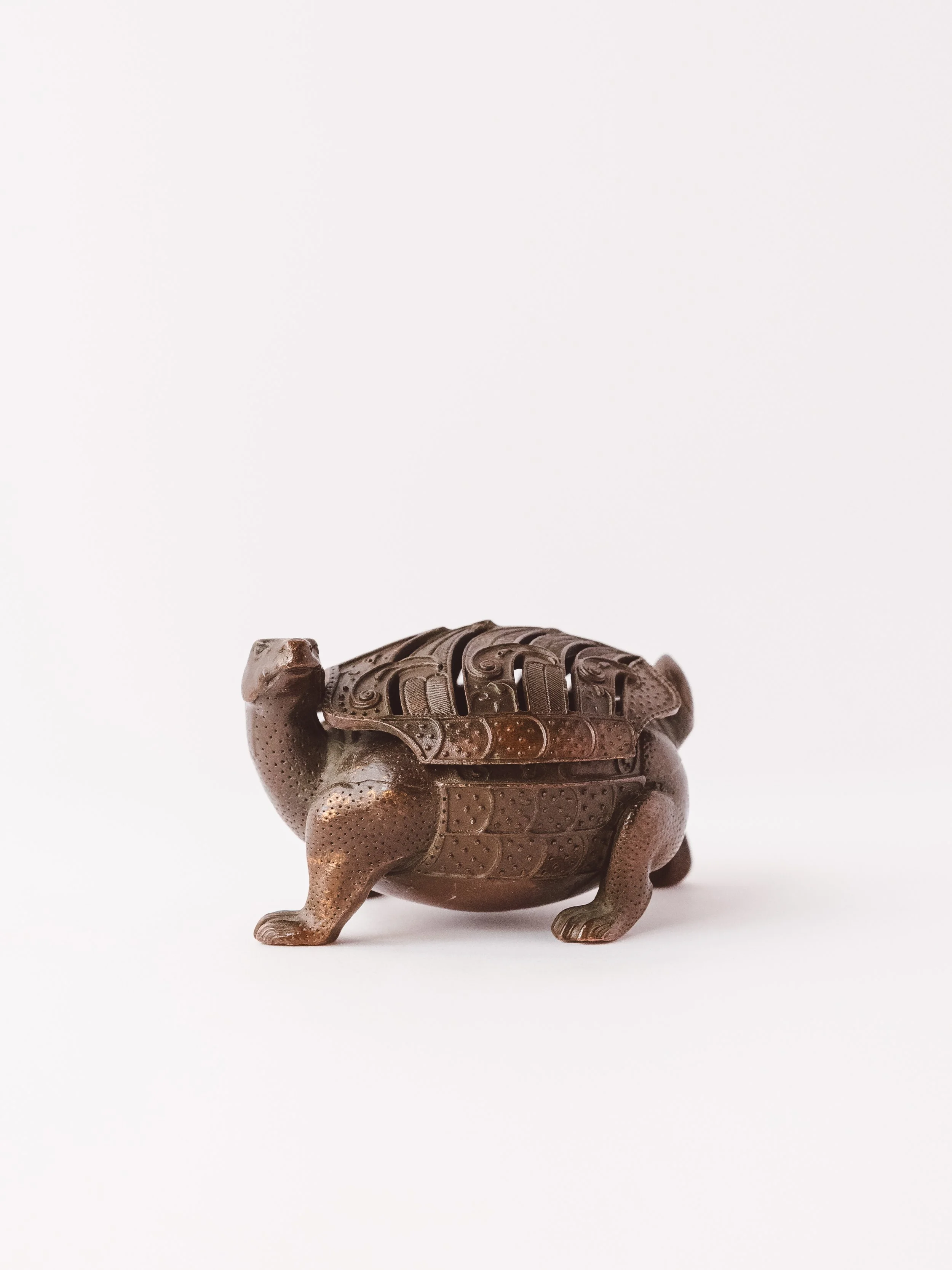 Image 8 of 11
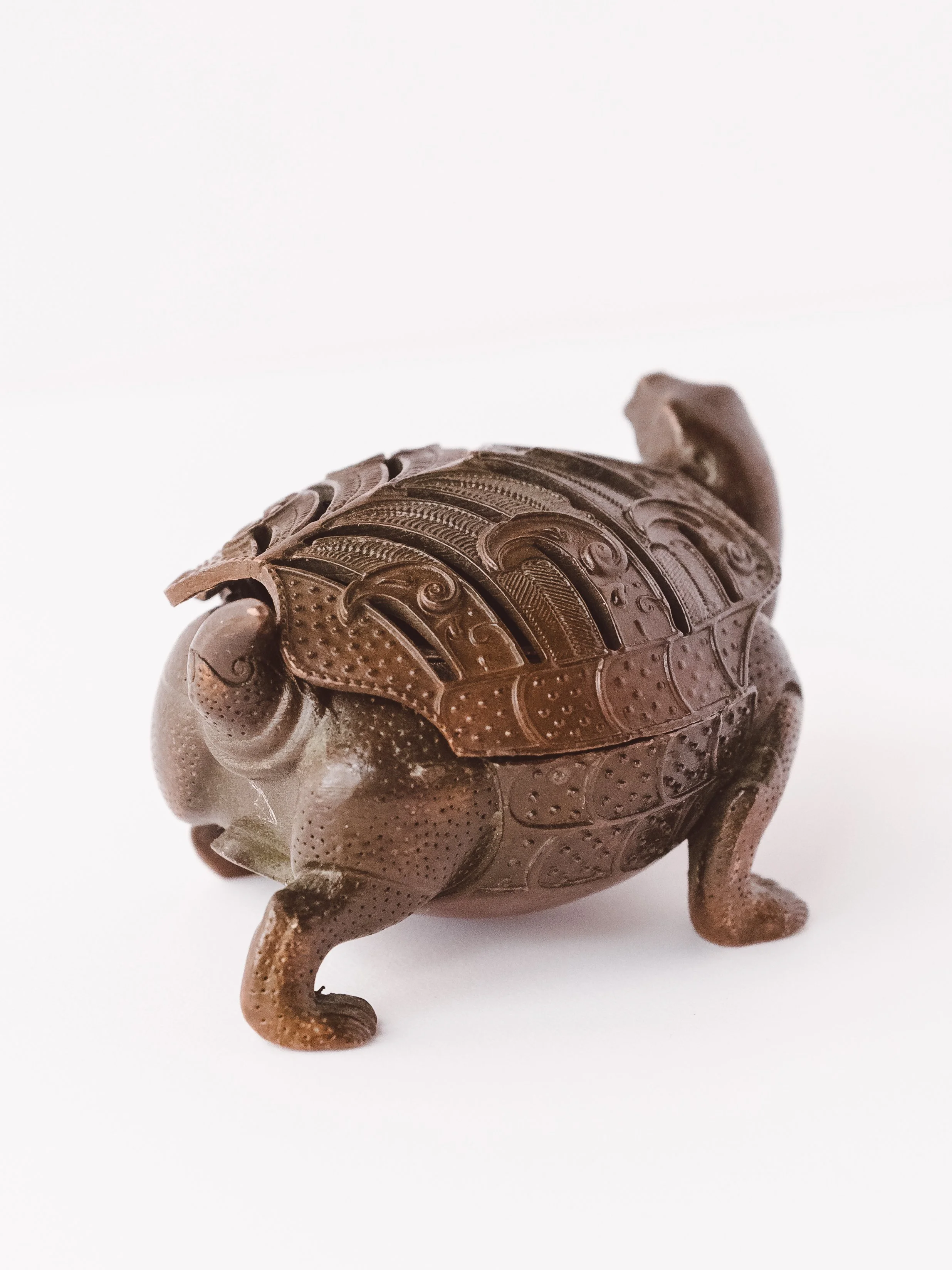 Image 9 of 11
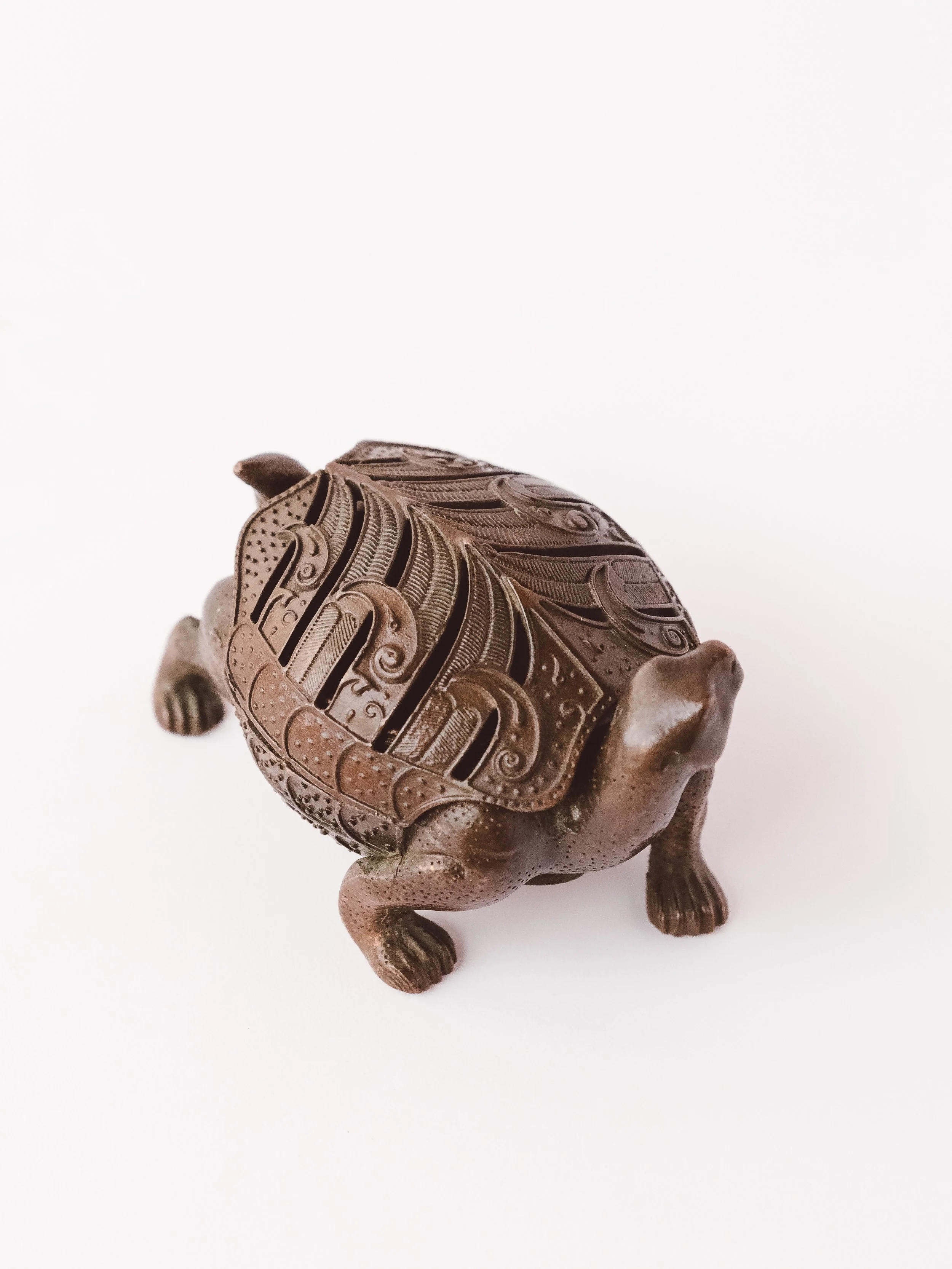 Image 10 of 11
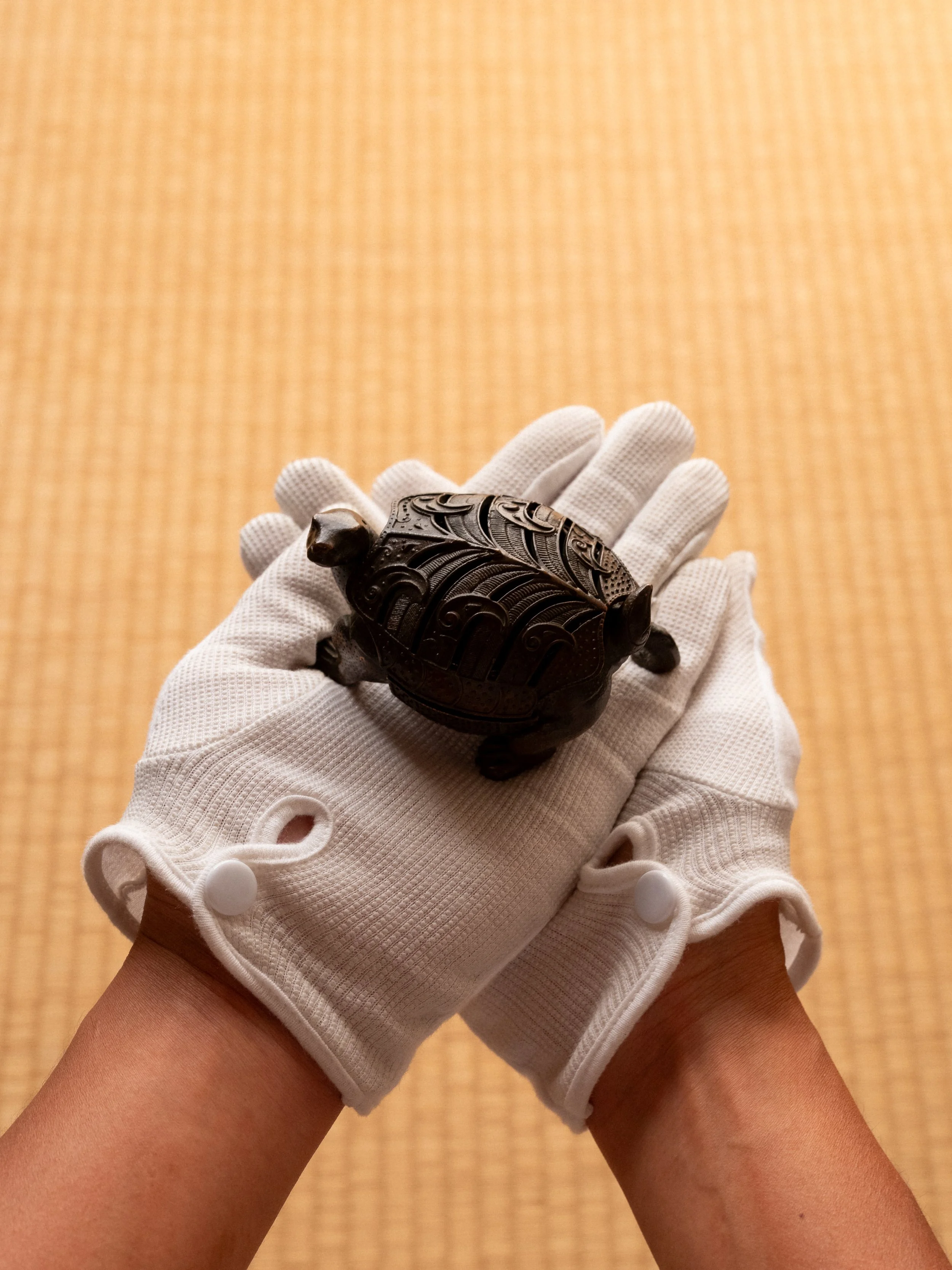 Image 11 of 11