【 The Concept 】
A parent turtle and a small child turtle, worked in the deep green enamel and honey-gold wirework of the great Chinese tradition of Jingtai-lan — cloisonné enamel, one of the classic decorative arts of China. Seen from the outside they are simply a pair: the larger turtle swimming forward with wide paddle limbs, the smaller one riding calmly on the shell above. Lift the little one off, however, and the piece reveals itself — the parent's rounded shell holds a hollow oval well, and the child turtle is not an ornament at all: it is the lid. A trinket box that has disguised itself as a family scene. The whole vessel is small enough to sit in the palm; every surface, from the shell to the flippers to the crown of the little turtle's head, is divided into tiny cells by a fine golden wire and filled with jewelled enamel colour. Together the two turtles read as a compact talisman of long life and quiet continuity, dressed in the four-century-old visual language of Chinese cloisonné.
【 What Jingtai-lan Is 】
Jingtai-lan (景泰藍) is the popular Chinese name for cloisonné enamel — more precisely, 掐絲琺瑯 (qiāsī fàláng), "pinched-wire enamel." The technique is unmistakable and, once you have seen it, easy to read on this piece: a metal body — traditionally copper — is dressed with hundreds of thin flat wires, each one bent by hand into an outline, then fixed to the surface so that the whole object is divided into small cells (cloisons). Vivid coloured enamel powders are packed into those cells, fired to fuse into glass, packed again, fired again, then ground smooth. Finally the exposed metal edges are gilded, so that the finished object appears to be drawn everywhere in golden line — a design in miniature stained glass. It is a slow, additive craft, and it is exactly this technique that gives the two turtles here their scaled cheeks, their hexagonal shell plates, their little flowered flippers.
【 The Name Jingtai, Honestly Read 】
The popular name "Jingtai-lan" links the whole tradition to the Ming-dynasty Jingtai era (1450–1457), the reign in which imperial cloisonné first became famous. In truth, though, cloisonné arrived in China well before the Jingtai reign, was made in many centuries after it, and "Jingtai-lan" today is used broadly to mean Chinese cloisonné as a whole — not a claim of any one date. Museum scholarship is clear on this point: the label names a tradition, not a period. We use it here in that spirit. This piece is not a fifteenth-century imperial work; it is a later object in the long unbroken line of Chinese cloisonné, whose techniques and vocabulary have been continuously practised for centuries and were entered on China's national intangible cultural heritage list in 2006.
【 Why a Turtle, and Why Two 】
The turtle is one of the oldest emblematic animals in Chinese art. In classical iconography it stands for long life, endurance and steadiness — a creature whose slow gait is understood as patience, and whose long span is understood as blessing. Turtle-shaped water droppers, ink-stones and lamps appear in Chinese collections from the early medieval period onward; giving a turtle-form object is, in that tradition, a wish for a long and steady life. The doubling of the motif here — a large turtle with a small one riding above — is quietly meaningful without insisting on any one reading. Some will see a parent and child, others will see generations following generations; either way the composition reads as continuity, as long life passed on. Neither reading is imposed. It is left to whoever keeps the piece to fill in the story.
【 Reading the Object 】
The composition works in two planes at once.
Seen from the side, it is a bird's-eye tableau: the parent turtle low and horizontal, its four flippers splayed wide, its head lifted level, moving forward as if in water; the small turtle up on the shell above, head slightly raised, looking a little further ahead than its parent. Together they read as a pair on the same journey.
Seen from above, the picture becomes purely graphic: the round dome of the parent's shell fills the centre, its dark hexagonal plates radiating outward from the small turtle at the top, four blue-and-gold flippers stretching to the corners, a red-and-gold petal collar running all the way around where shell meets skin.
The parent turtle's shell is the piece's biggest field of pattern. Deep transparent green fills the ground; inside it, dark green-black hexagons — each one drawn with a smaller hexagon inside, all outlined in fine gold wire — tile the whole dome in a heraldic honeycomb. Around the shell's lower edge runs a band of red half-petals, another band of gold-outlined blue scale-work at the shoulders, and, at the very foot of the flippers, small pink lotus-petal tips against a white ground.
The head is a small folded form in scaled green enamel above and white below, with a large round black-and-white eye and a soft rose-pink nose — a face made deliberately gentle rather than reptilian. The flippers repeat the same idea in a different palette: cobalt blue scaled with gold wire, then white, then pink lotus tips.
At the very crown of the parent's shell is an oval opening, cleanly framed by a thick gold rim and encircled by a wreath of small red half-petals. This is the mouth of the vessel.
The small turtle is a miniature of the parent in most respects — same scaled head, same honeycomb shell, same gently raised chin — but with small flowered decorations on its lower body in red-orange, white and gold, and a plain golden underside that fits precisely into the parent's oval well. Lift it, and the piece opens.
【 The Hidden Vessel 】
This is the small joke, and the reason the object rewards a second look. From the outside it is an ornament of a parent and child. From above, it is a small container with a very elaborate lid. The little turtle sits as if riding, but is doing the same work a jade knob does on the lid of a jar. Inside, the well is plain — dark blue — waiting for whatever the owner wants to keep close and small: a pair of earrings, a single ring, a folded slip of paper, a pinch of loose incense. A vessel that hides its purpose behind a family scene is a particularly Chinese kind of design intelligence, and one that appears again and again in classical craft — objects that give their function only to those who look twice.
【 The Object 】
A palm-sized hand-worked cloisonné pair, solid and pleasantly weighty for its size. The parent turtle stands on its own four flippers; the small turtle lifts cleanly and sits back down with a soft, precise settle onto the oval rim. The finish is glossy and jewel-like on the enamel, warm and matt on the exposed gilding at the rims and flipper edges.
【 Where to Place It 】
On a study desk, a bedside stand, a low bookshelf, a mantel, an entrance console. The piece rewards being seen twice: once as an ornament from across the room, once as a container up close. Placed with a small tray of jewellery it functions as a beautiful lidded catch-all; placed on its own it functions as a small sculpture. A traditional Chinese siting would be somewhere the eye returns to often, so its long-life symbolism stays in view. Keep it out of direct sunlight and off any surface where it can be knocked; cloisonné enamel is glass, and glass chips at a fall.
【 Care 】
Dust with a soft dry cloth or brush. If the surface needs more, a barely-damp soft cloth is sufficient; dry immediately. Do not soak, do not use dishwashers, do not use abrasive sponges or metal polish — those will attack the gilded wirework. Lift the small turtle straight up rather than sliding it, to protect the rim gold. Store the two halves together.
【 Function & What It Brings 】
Keep it, place it, or give it. As a piece of Chinese decorative art it is a compact, well-made carrier of the cloisonné tradition — an easy introduction to a craft whose vocabulary has anchored Chinese decorative work for nearly six centuries. As a household object it makes a jewel of a small container for anything the owner wants to keep close and small. As a talisman it carries the turtle's classical wish — long life, patience, steady continuity — with the doubled composition quietly extending that wish across generations. A fitting gift for a milestone birthday, a wedding, a housewarming, a retirement, or for anyone with a fondness for Chinese art or the natural symbolism of the turtle.
【 The Texture 】
Glassy, jewel-bright enamel across the coloured fields — deep transparent green, cobalt blue, red-orange, white, soft pink, black-green — divided everywhere by fine gold wire. Warm matt gilding at the rims, the flipper edges and the underside of the small turtle. The enamel surface is smooth under a fingertip; under raking light it shows the very faint high-and-low of hand-packed cells, the honest signature of a cloisonné piece made and ground by hand.
【 Presence 】
Quiet, jewel-like, unmistakably Chinese in decorative vocabulary. Not a dramatic display piece but one that draws the eye slowly — first as a pair of turtles, then as a piece of colour and gold, then as a hidden vessel. Its charm is that of a well-made small thing that answers more than one question at a time.
Archive Note: The number in the name (1450) references the beginning of the Ming-dynasty Jingtai era (1450–1457), the reign after which Chinese cloisonné enamel is popularly named "Jingtai-lan" (景泰藍). It marks the tradition this piece continues — not the date this piece was made.
Provenance Note: Sourced from a private household in Japan. A hand-worked cloisonné enamel (掐絲琺瑯 / Jingtai-lan / 景泰藍) parent-and-child turtle lidded trinket box in the long-standing tradition of Chinese decorative cloisonné. Attributed to that tradition rather than to a specific kiln, workshop or individual maker.
Condition Note: Sold as acquired, in very good vintage condition. Small variations in the cell walls, faint high-and-low of the enamel surface under raking light, and small areas of natural wear at the rims and flipper edges are inherent features of hand-worked cloisonné, not damage. No large enamel losses. The two halves fit and sit together cleanly. Please see the photographs as part of the description.
【 The Concept 】
A parent turtle and a small child turtle, worked in the deep green enamel and honey-gold wirework of the great Chinese tradition of Jingtai-lan — cloisonné enamel, one of the classic decorative arts of China. Seen from the outside they are simply a pair: the larger turtle swimming forward with wide paddle limbs, the smaller one riding calmly on the shell above. Lift the little one off, however, and the piece reveals itself — the parent's rounded shell holds a hollow oval well, and the child turtle is not an ornament at all: it is the lid. A trinket box that has disguised itself as a family scene. The whole vessel is small enough to sit in the palm; every surface, from the shell to the flippers to the crown of the little turtle's head, is divided into tiny cells by a fine golden wire and filled with jewelled enamel colour. Together the two turtles read as a compact talisman of long life and quiet continuity, dressed in the four-century-old visual language of Chinese cloisonné.
【 What Jingtai-lan Is 】
Jingtai-lan (景泰藍) is the popular Chinese name for cloisonné enamel — more precisely, 掐絲琺瑯 (qiāsī fàláng), "pinched-wire enamel." The technique is unmistakable and, once you have seen it, easy to read on this piece: a metal body — traditionally copper — is dressed with hundreds of thin flat wires, each one bent by hand into an outline, then fixed to the surface so that the whole object is divided into small cells (cloisons). Vivid coloured enamel powders are packed into those cells, fired to fuse into glass, packed again, fired again, then ground smooth. Finally the exposed metal edges are gilded, so that the finished object appears to be drawn everywhere in golden line — a design in miniature stained glass. It is a slow, additive craft, and it is exactly this technique that gives the two turtles here their scaled cheeks, their hexagonal shell plates, their little flowered flippers.
【 The Name Jingtai, Honestly Read 】
The popular name "Jingtai-lan" links the whole tradition to the Ming-dynasty Jingtai era (1450–1457), the reign in which imperial cloisonné first became famous. In truth, though, cloisonné arrived in China well before the Jingtai reign, was made in many centuries after it, and "Jingtai-lan" today is used broadly to mean Chinese cloisonné as a whole — not a claim of any one date. Museum scholarship is clear on this point: the label names a tradition, not a period. We use it here in that spirit. This piece is not a fifteenth-century imperial work; it is a later object in the long unbroken line of Chinese cloisonné, whose techniques and vocabulary have been continuously practised for centuries and were entered on China's national intangible cultural heritage list in 2006.
【 Why a Turtle, and Why Two 】
The turtle is one of the oldest emblematic animals in Chinese art. In classical iconography it stands for long life, endurance and steadiness — a creature whose slow gait is understood as patience, and whose long span is understood as blessing. Turtle-shaped water droppers, ink-stones and lamps appear in Chinese collections from the early medieval period onward; giving a turtle-form object is, in that tradition, a wish for a long and steady life. The doubling of the motif here — a large turtle with a small one riding above — is quietly meaningful without insisting on any one reading. Some will see a parent and child, others will see generations following generations; either way the composition reads as continuity, as long life passed on. Neither reading is imposed. It is left to whoever keeps the piece to fill in the story.
【 Reading the Object 】
The composition works in two planes at once.
Seen from the side, it is a bird's-eye tableau: the parent turtle low and horizontal, its four flippers splayed wide, its head lifted level, moving forward as if in water; the small turtle up on the shell above, head slightly raised, looking a little further ahead than its parent. Together they read as a pair on the same journey.
Seen from above, the picture becomes purely graphic: the round dome of the parent's shell fills the centre, its dark hexagonal plates radiating outward from the small turtle at the top, four blue-and-gold flippers stretching to the corners, a red-and-gold petal collar running all the way around where shell meets skin.
The parent turtle's shell is the piece's biggest field of pattern. Deep transparent green fills the ground; inside it, dark green-black hexagons — each one drawn with a smaller hexagon inside, all outlined in fine gold wire — tile the whole dome in a heraldic honeycomb. Around the shell's lower edge runs a band of red half-petals, another band of gold-outlined blue scale-work at the shoulders, and, at the very foot of the flippers, small pink lotus-petal tips against a white ground.
The head is a small folded form in scaled green enamel above and white below, with a large round black-and-white eye and a soft rose-pink nose — a face made deliberately gentle rather than reptilian. The flippers repeat the same idea in a different palette: cobalt blue scaled with gold wire, then white, then pink lotus tips.
At the very crown of the parent's shell is an oval opening, cleanly framed by a thick gold rim and encircled by a wreath of small red half-petals. This is the mouth of the vessel.
The small turtle is a miniature of the parent in most respects — same scaled head, same honeycomb shell, same gently raised chin — but with small flowered decorations on its lower body in red-orange, white and gold, and a plain golden underside that fits precisely into the parent's oval well. Lift it, and the piece opens.
【 The Hidden Vessel 】
This is the small joke, and the reason the object rewards a second look. From the outside it is an ornament of a parent and child. From above, it is a small container with a very elaborate lid. The little turtle sits as if riding, but is doing the same work a jade knob does on the lid of a jar. Inside, the well is plain — dark blue — waiting for whatever the owner wants to keep close and small: a pair of earrings, a single ring, a folded slip of paper, a pinch of loose incense. A vessel that hides its purpose behind a family scene is a particularly Chinese kind of design intelligence, and one that appears again and again in classical craft — objects that give their function only to those who look twice.
【 The Object 】
A palm-sized hand-worked cloisonné pair, solid and pleasantly weighty for its size. The parent turtle stands on its own four flippers; the small turtle lifts cleanly and sits back down with a soft, precise settle onto the oval rim. The finish is glossy and jewel-like on the enamel, warm and matt on the exposed gilding at the rims and flipper edges.
【 Where to Place It 】
On a study desk, a bedside stand, a low bookshelf, a mantel, an entrance console. The piece rewards being seen twice: once as an ornament from across the room, once as a container up close. Placed with a small tray of jewellery it functions as a beautiful lidded catch-all; placed on its own it functions as a small sculpture. A traditional Chinese siting would be somewhere the eye returns to often, so its long-life symbolism stays in view. Keep it out of direct sunlight and off any surface where it can be knocked; cloisonné enamel is glass, and glass chips at a fall.
【 Care 】
Dust with a soft dry cloth or brush. If the surface needs more, a barely-damp soft cloth is sufficient; dry immediately. Do not soak, do not use dishwashers, do not use abrasive sponges or metal polish — those will attack the gilded wirework. Lift the small turtle straight up rather than sliding it, to protect the rim gold. Store the two halves together.
【 Function & What It Brings 】
Keep it, place it, or give it. As a piece of Chinese decorative art it is a compact, well-made carrier of the cloisonné tradition — an easy introduction to a craft whose vocabulary has anchored Chinese decorative work for nearly six centuries. As a household object it makes a jewel of a small container for anything the owner wants to keep close and small. As a talisman it carries the turtle's classical wish — long life, patience, steady continuity — with the doubled composition quietly extending that wish across generations. A fitting gift for a milestone birthday, a wedding, a housewarming, a retirement, or for anyone with a fondness for Chinese art or the natural symbolism of the turtle.
【 The Texture 】
Glassy, jewel-bright enamel across the coloured fields — deep transparent green, cobalt blue, red-orange, white, soft pink, black-green — divided everywhere by fine gold wire. Warm matt gilding at the rims, the flipper edges and the underside of the small turtle. The enamel surface is smooth under a fingertip; under raking light it shows the very faint high-and-low of hand-packed cells, the honest signature of a cloisonné piece made and ground by hand.
【 Presence 】
Quiet, jewel-like, unmistakably Chinese in decorative vocabulary. Not a dramatic display piece but one that draws the eye slowly — first as a pair of turtles, then as a piece of colour and gold, then as a hidden vessel. Its charm is that of a well-made small thing that answers more than one question at a time.
Archive Note: The number in the name (1450) references the beginning of the Ming-dynasty Jingtai era (1450–1457), the reign after which Chinese cloisonné enamel is popularly named "Jingtai-lan" (景泰藍). It marks the tradition this piece continues — not the date this piece was made.
Provenance Note: Sourced from a private household in Japan. A hand-worked cloisonné enamel (掐絲琺瑯 / Jingtai-lan / 景泰藍) parent-and-child turtle lidded trinket box in the long-standing tradition of Chinese decorative cloisonné. Attributed to that tradition rather than to a specific kiln, workshop or individual maker.
Condition Note: Sold as acquired, in very good vintage condition. Small variations in the cell walls, faint high-and-low of the enamel surface under raking light, and small areas of natural wear at the rims and flipper edges are inherent features of hand-worked cloisonné, not damage. No large enamel losses. The two halves fit and sit together cleanly. Please see the photographs as part of the description.


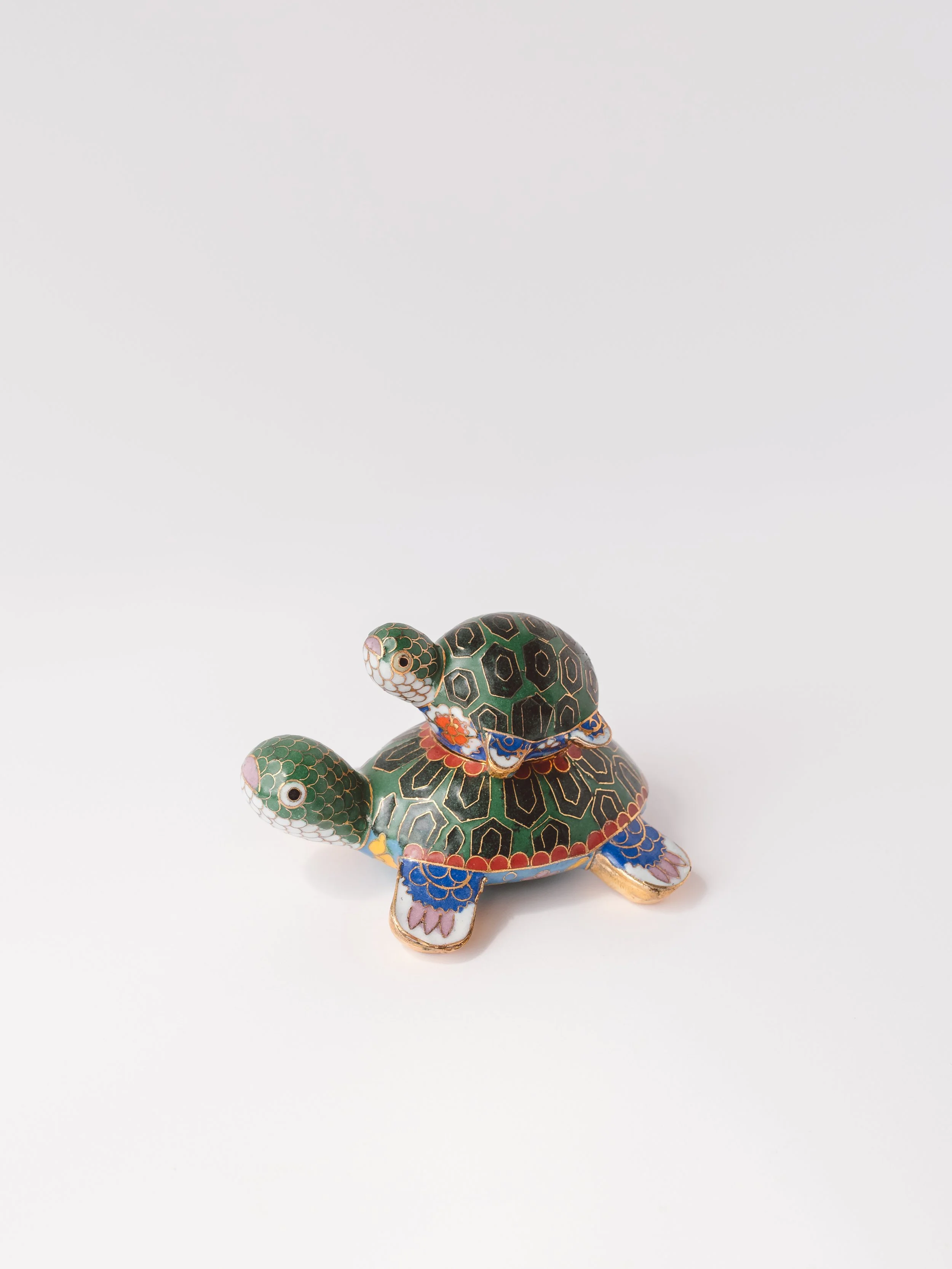 Image 1 of 13
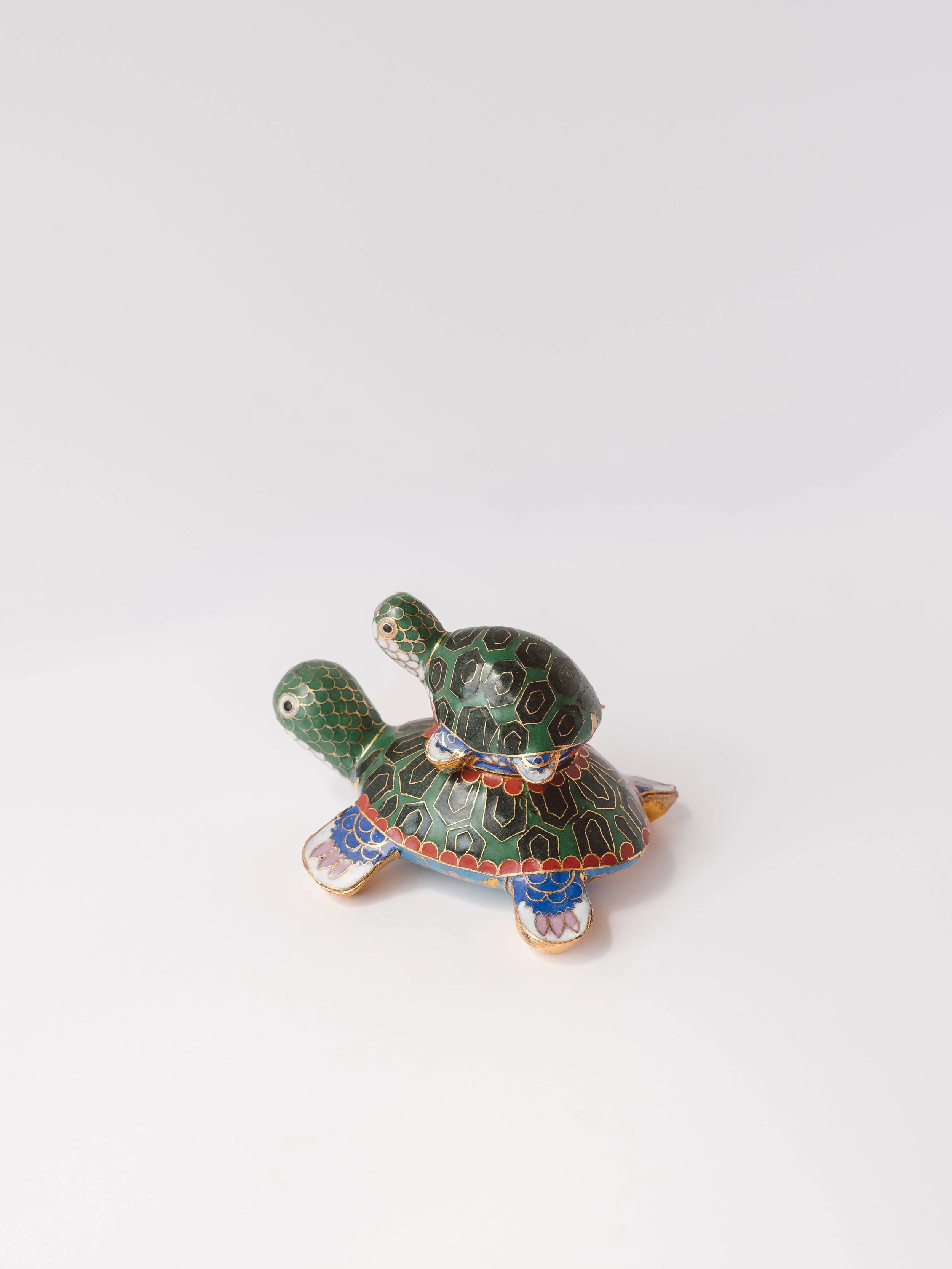 Image 2 of 13
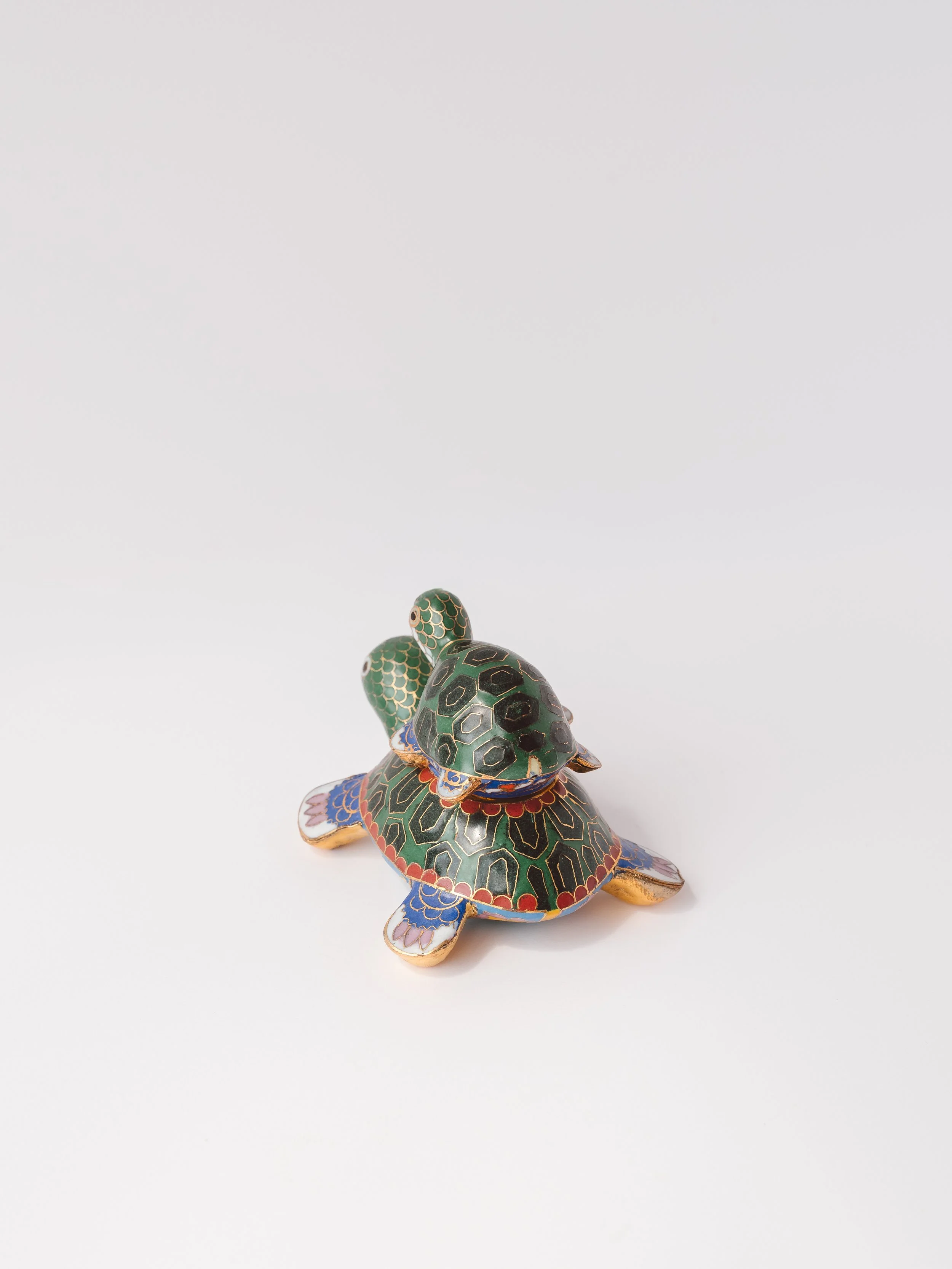 Image 3 of 13
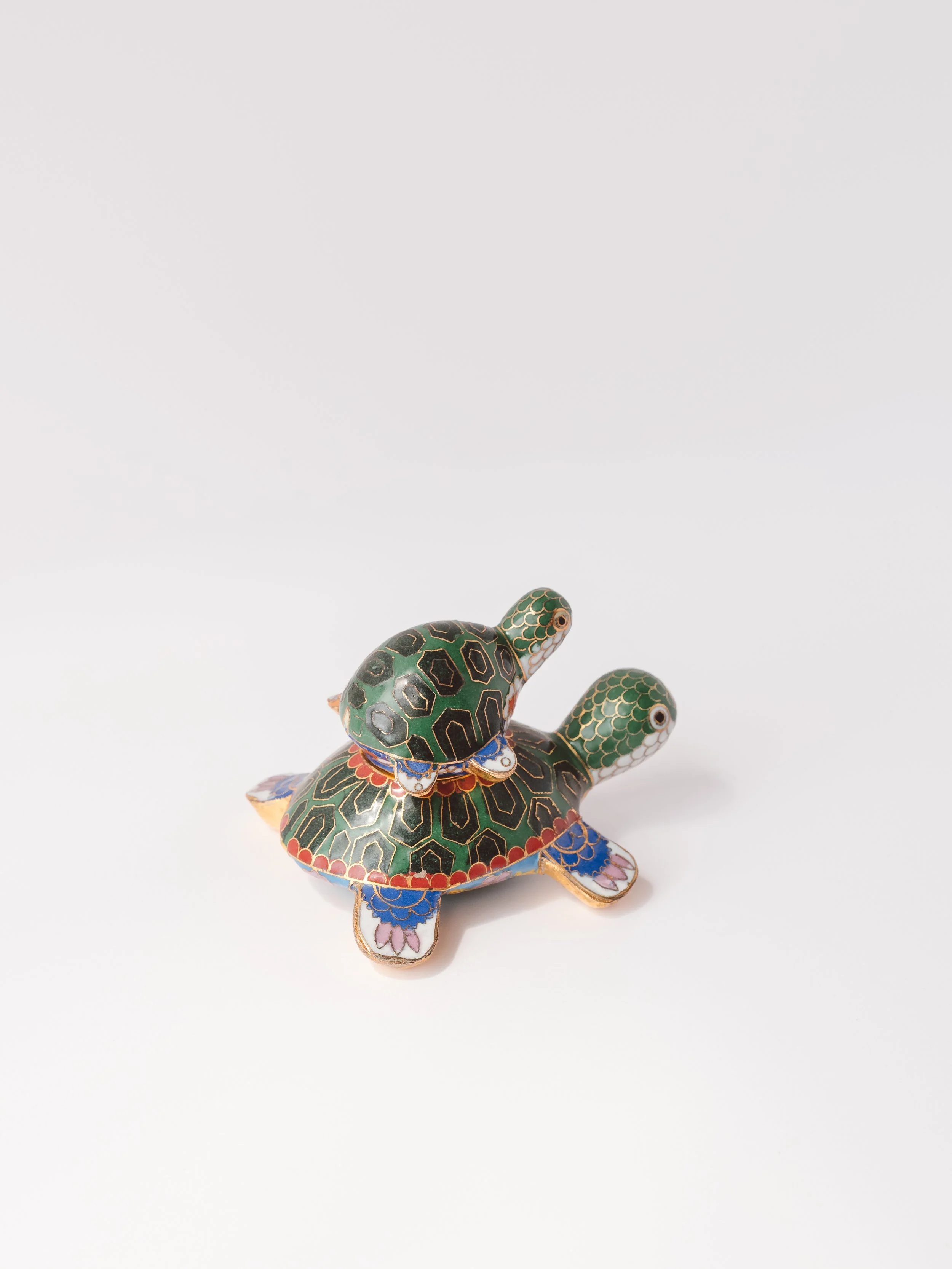 Image 4 of 13
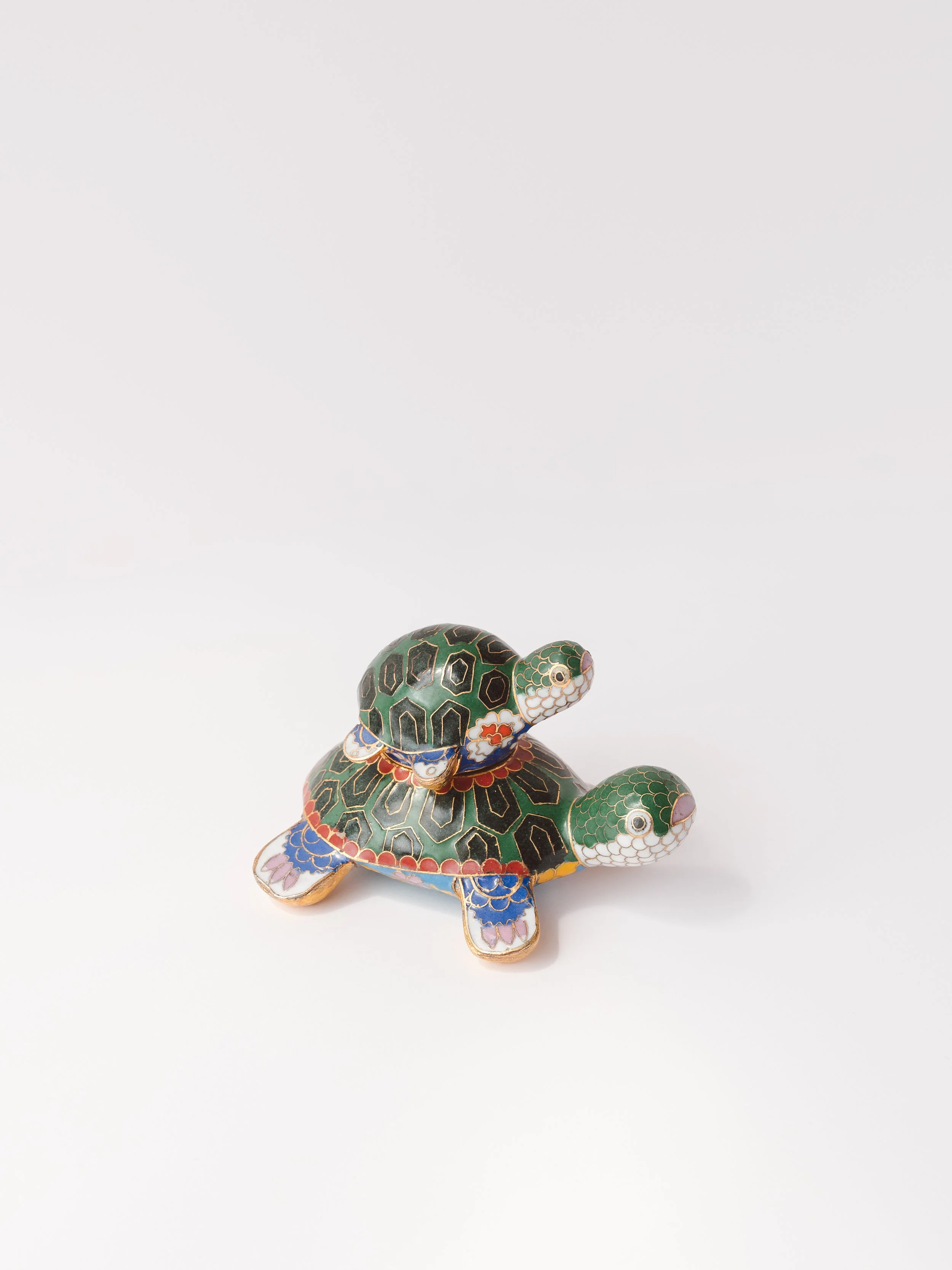 Image 5 of 13
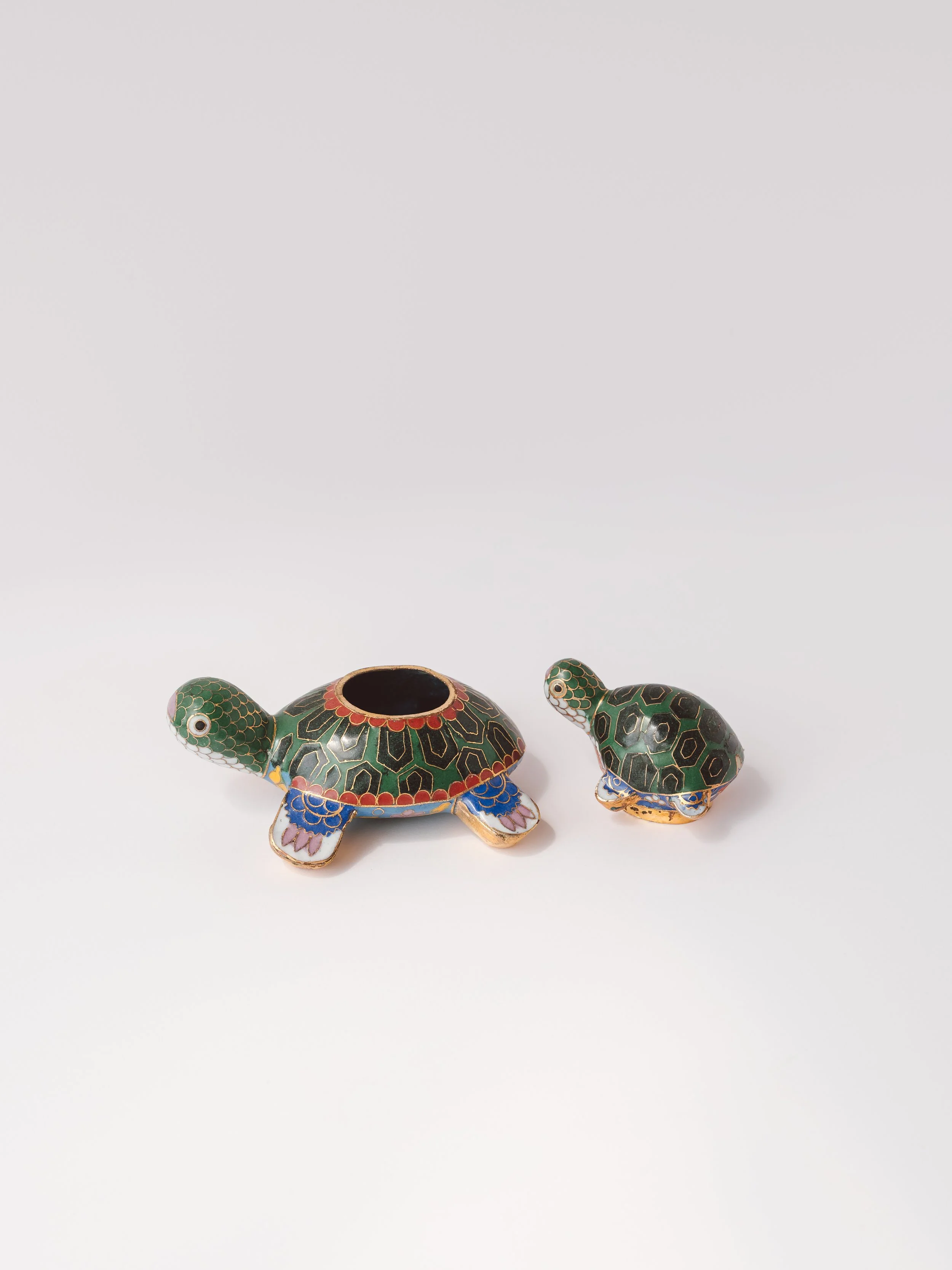 Image 6 of 13
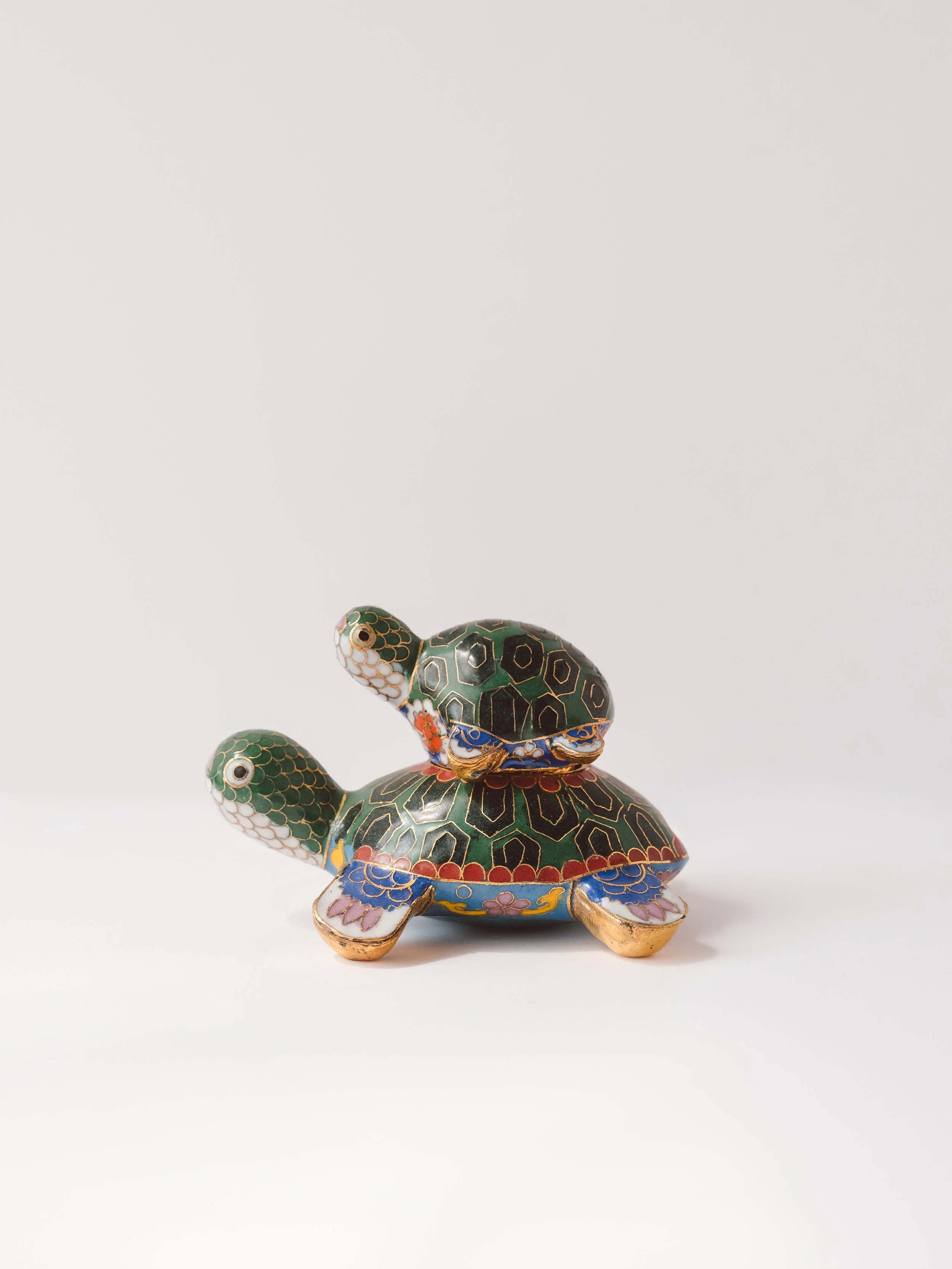 Image 7 of 13
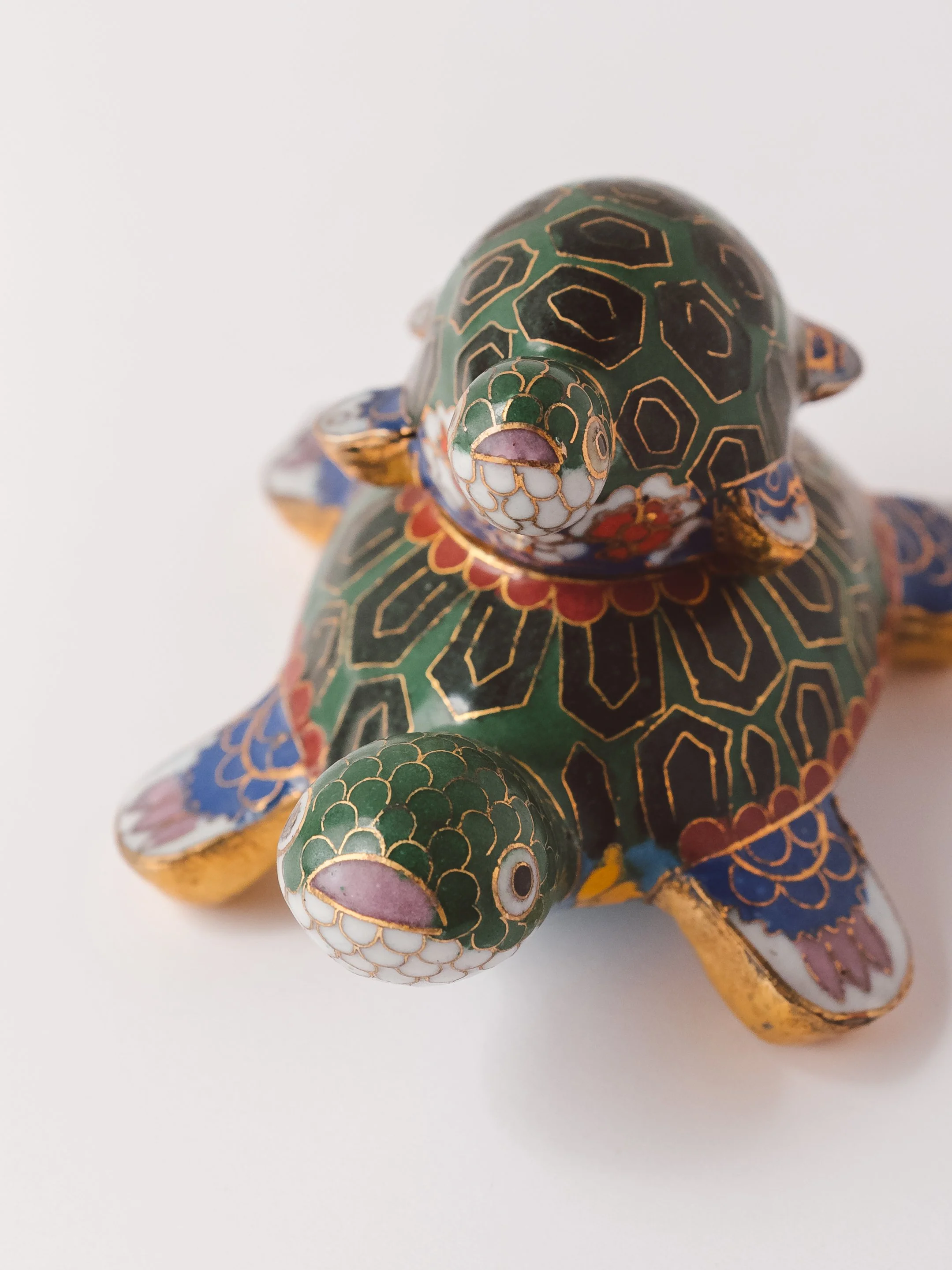 Image 8 of 13
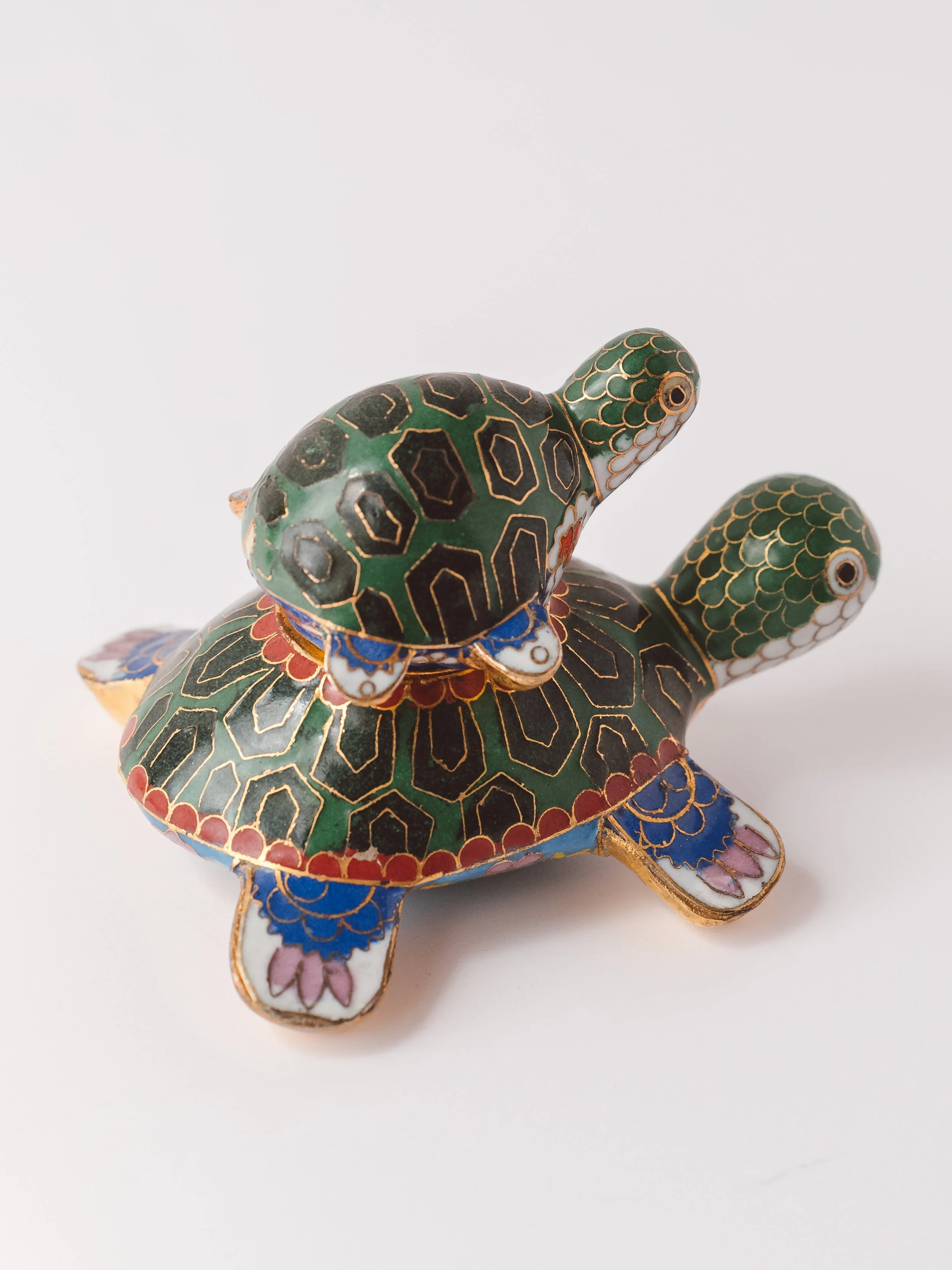 Image 9 of 13
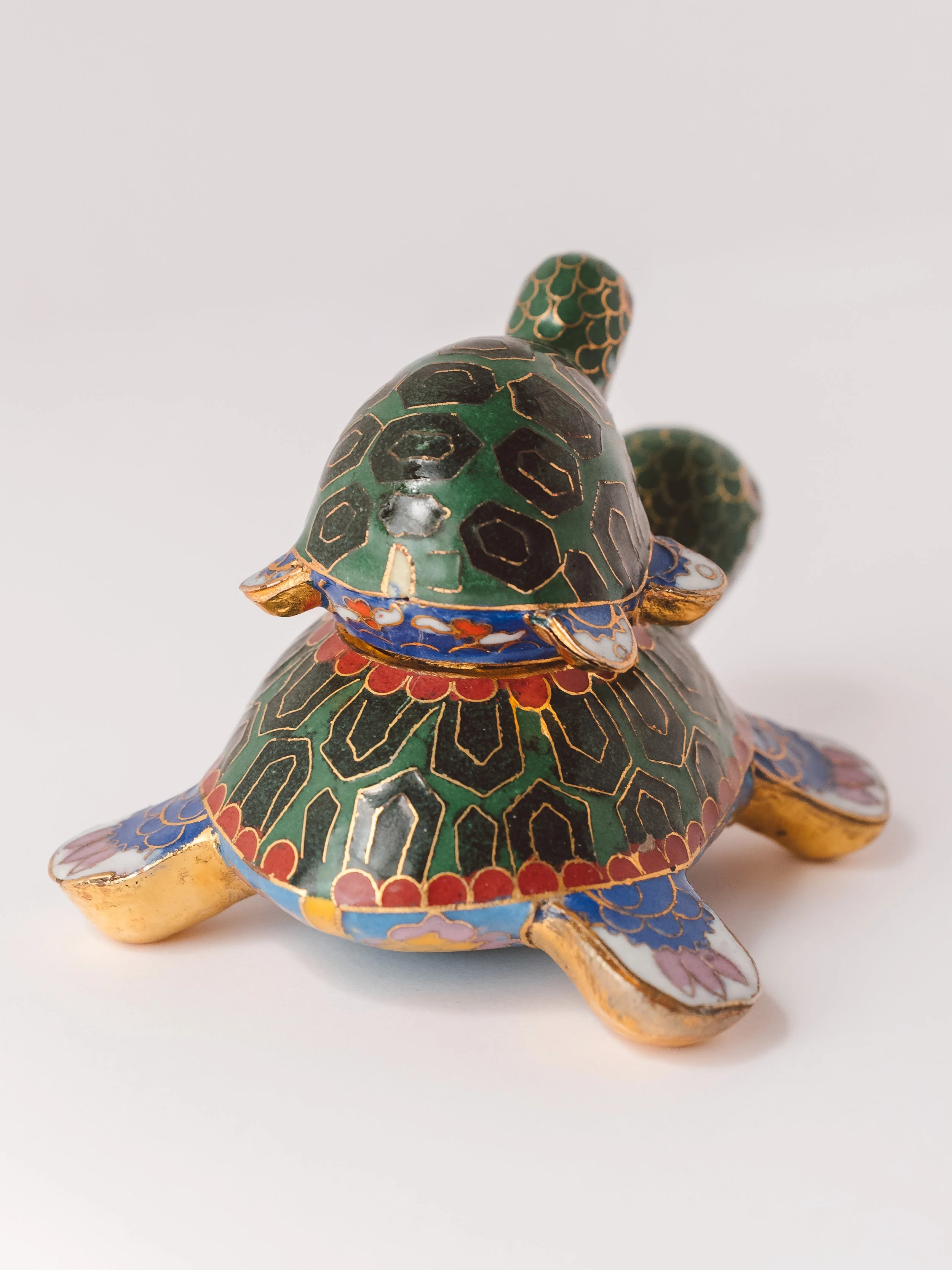 Image 10 of 13
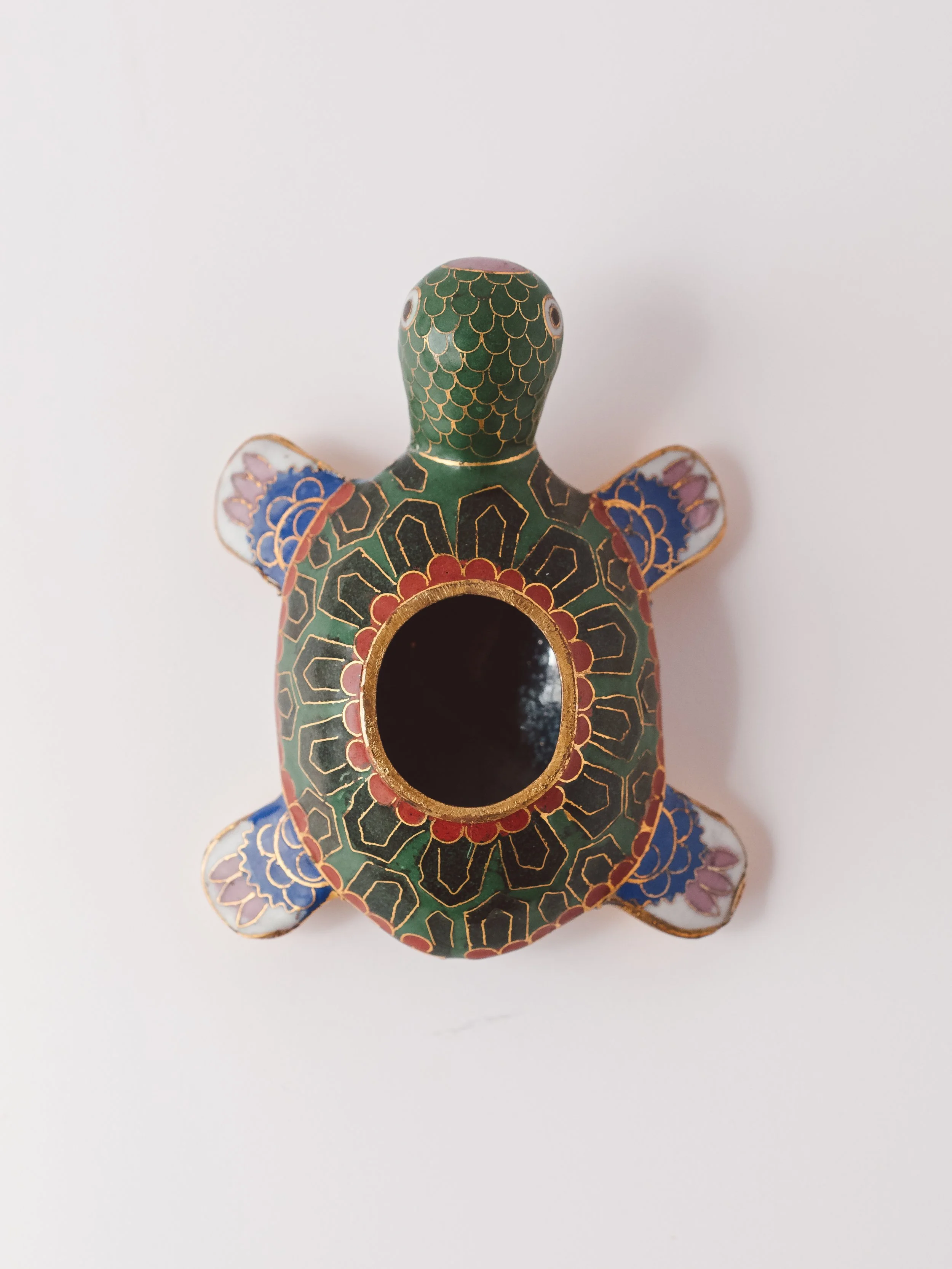 Image 11 of 13
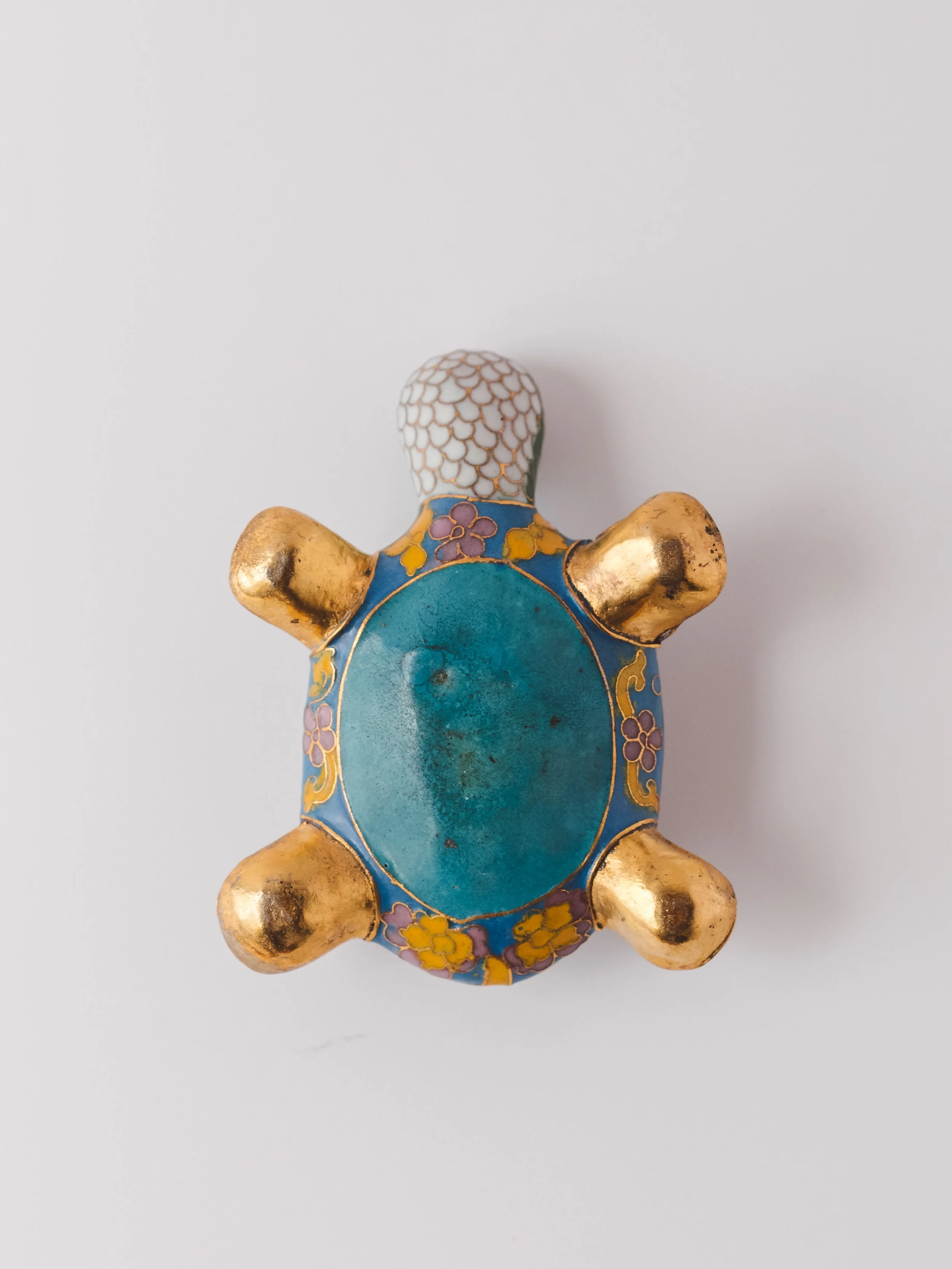 Image 12 of 13
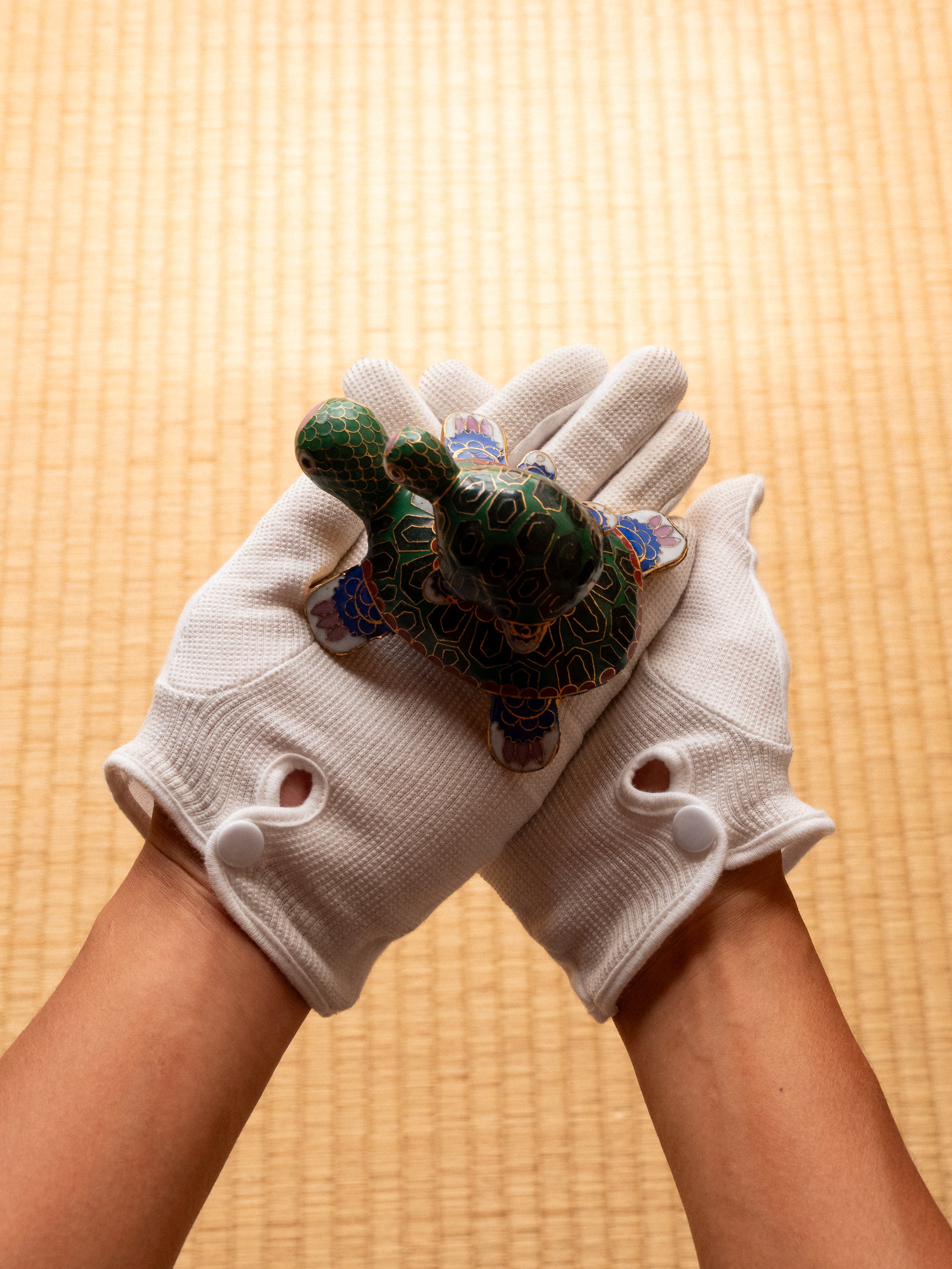 Image 13 of 13