

 Image 1 of 3
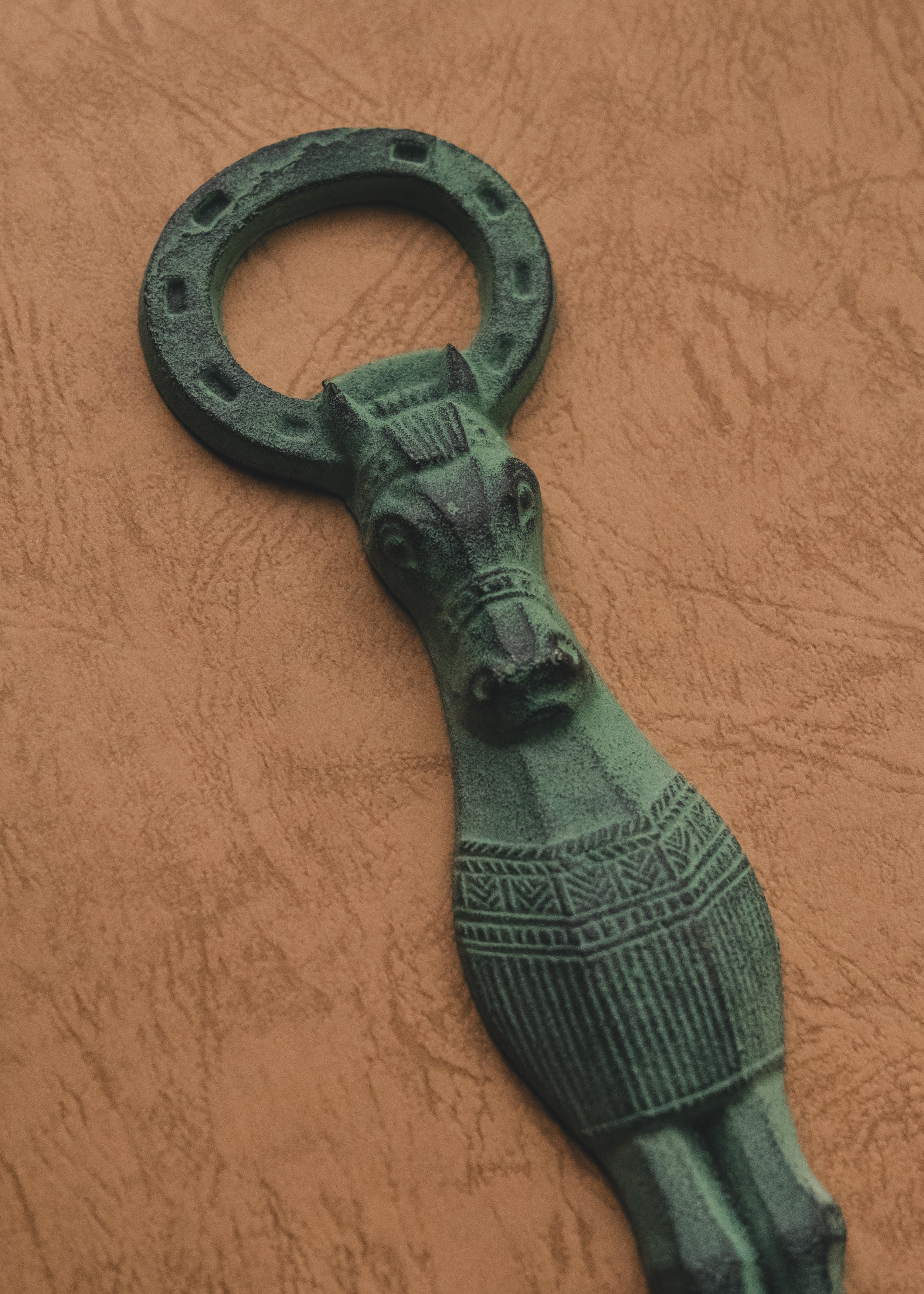 Image 2 of 3
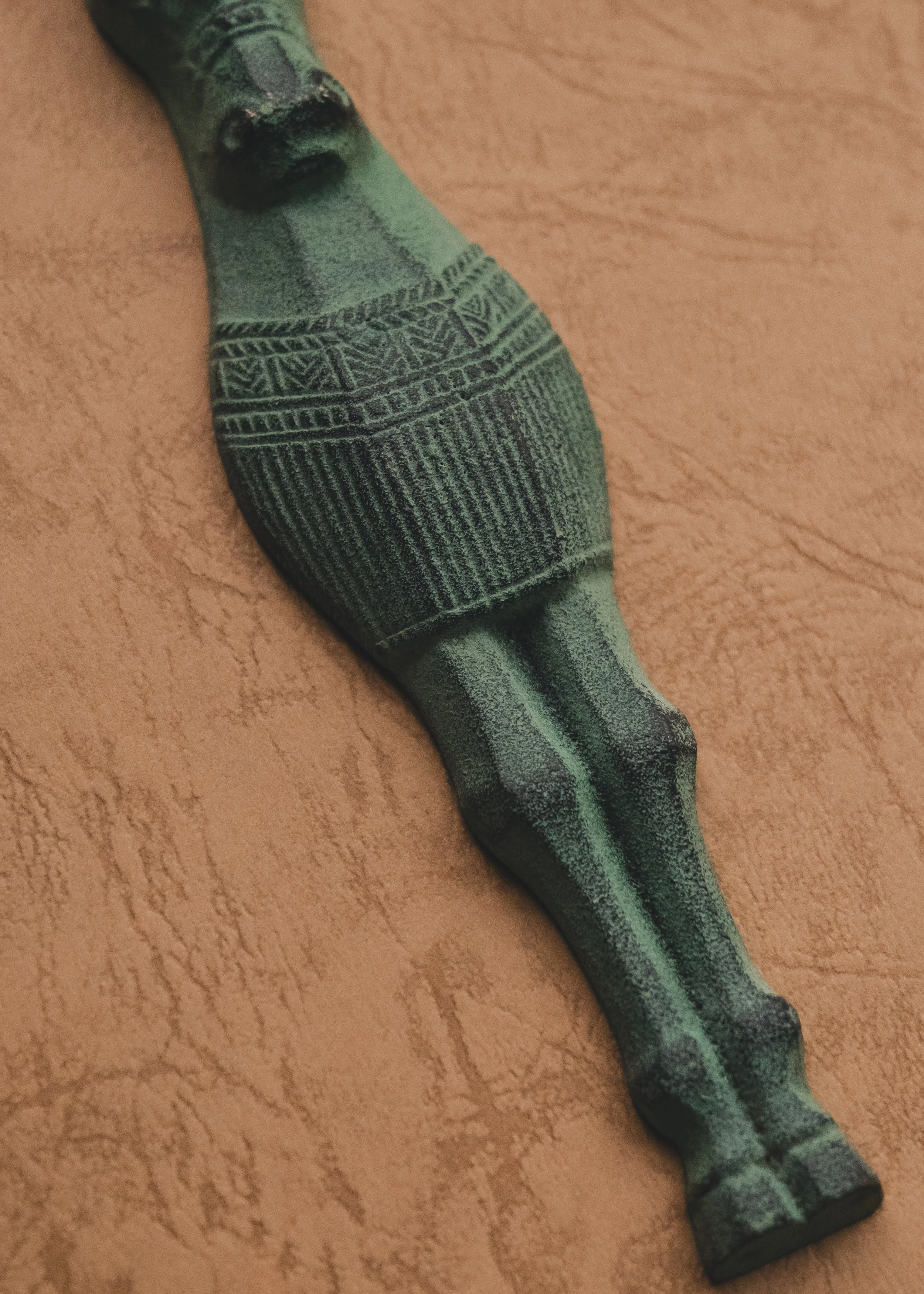 Image 3 of 3
【Context】
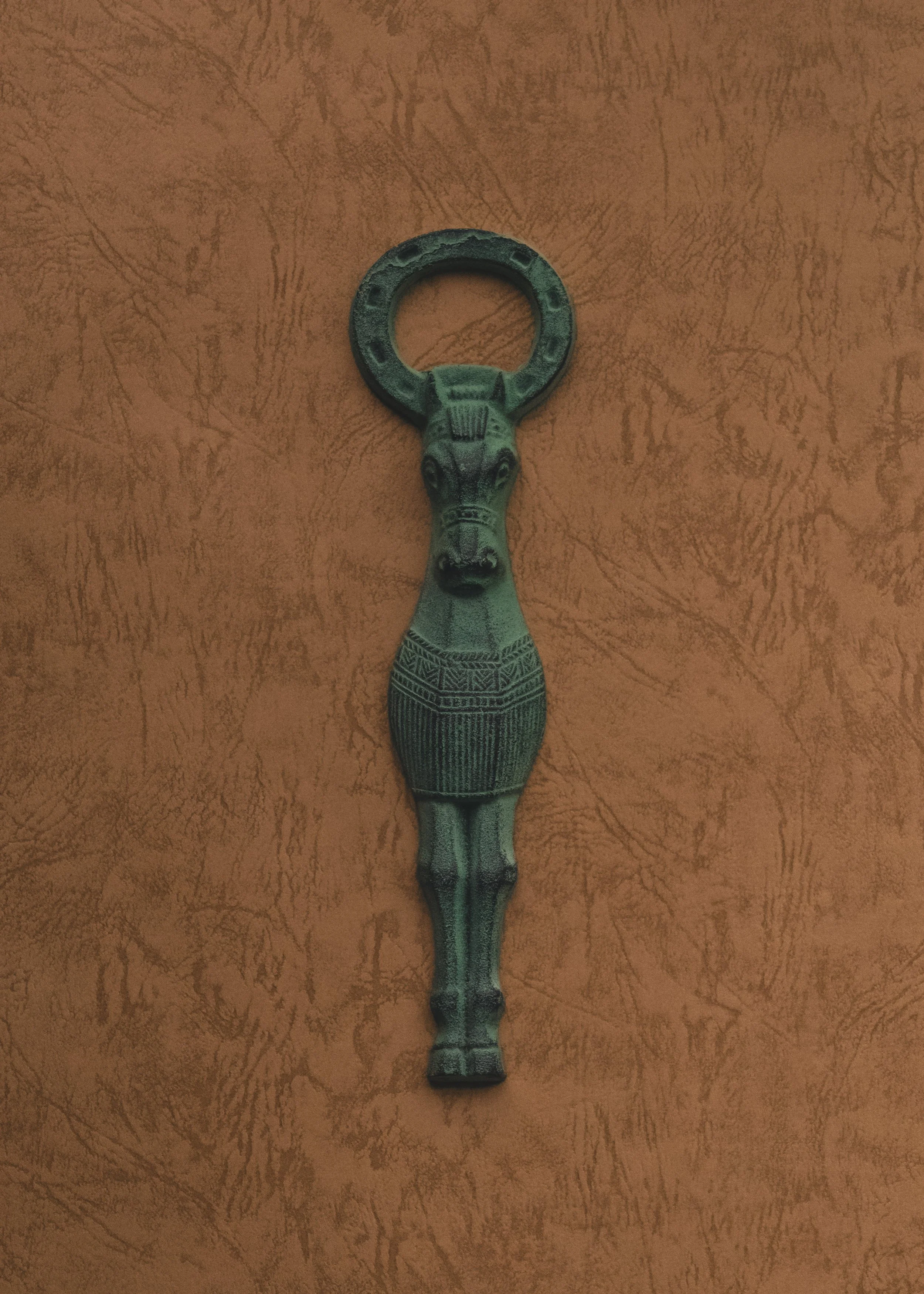
Identity: Anonymous Provincial Metalwork / Horse-Form Desk Object.Origin: Western Province (Historic Metalware Region), Japan.Technique: Sand-Cast Bronze, Patinated Oxidation, Hot-Lacquer Finish.Function: Paperweight / Bottle Opener / Sculptural Object.
【 Dimensions (Approx.) 】
Height: 18.5 cm (7.3 in)Width: 5 cm (2.0 in)Weight: 192 g (6.8 oz)
RELATED ARCHIVAL SPECIMENS
【 The Concept 】
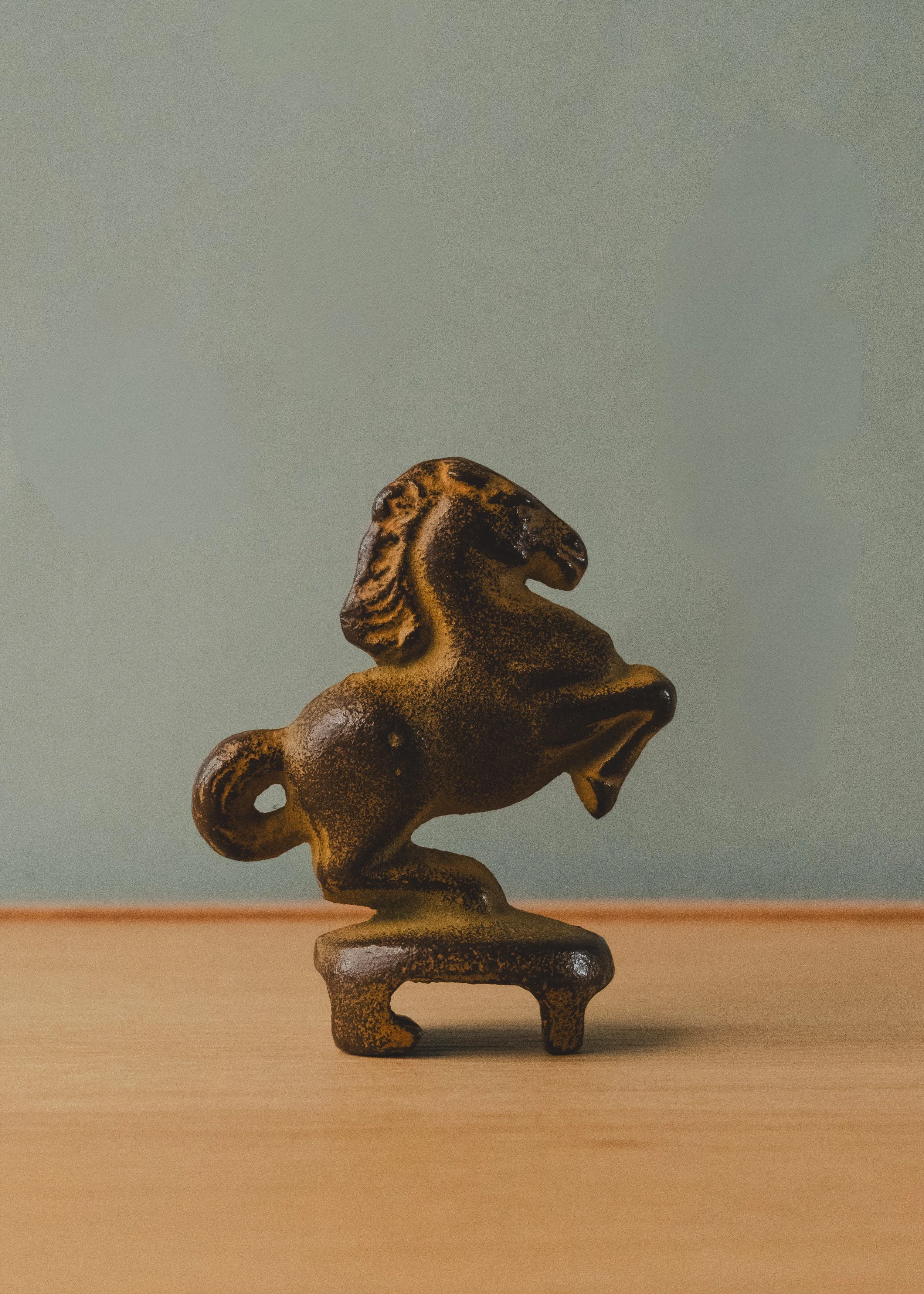
A horse that only moves forward. In Japanese tradition, the horse is the one animal that never retreats — it runs, it leaps, it falls, but it does not step backward. This made it sacred. Temples kept living horses as vessels for carrying prayers to the gods. When living horses became too costly, people carved wooden ones and painted them. When wood was not enough, they cast them in iron. An anonymous ironworker in a northern foundry province made this one mid-leap — front legs raised, weight thrown forward, frozen at the exact moment before landing. Then they carved a notch into its base and turned the whole animal into a bottle opener.
【 The Function 】
A bottle opener. A sculptural object. A paperweight when it is not opening anything — which is most of the time. The base is flat enough to stand upright on any surface without support. The iron is dense enough to hold paper steady in a draft. Between these tasks, it stands on a desk or a shelf and does what rearing horses have always done in this culture: it faces forward and refuses to look back.
【 The Texture 】
Cast iron with an antique bronze-toned finish that has deepened unevenly over decades. The surface carries the grain of the sand mold — a fine roughness that catches light at low angles and disappears under direct illumination. The mane flows backward. The tail curls tightly against the haunch. The front legs are raised with knees bent, caught at the peak of the leap. The face is simplified to a suggestion — two eyes, a flared nostril, and an expression that shifts between determination and calm depending on the angle of approach. At 201 grams, the weight is disproportionate to the size. That is the nature of iron.
【 Presence 】
It is eight centimeters tall — small enough to share a desk with a laptop, large enough to be the first thing a visitor notices. The leap is permanent. The landing never comes. That tension between motion and stillness is what makes it impossible to ignore and unnecessary to explain. Place it near anything that needs momentum.
Sourced from a private collection in northern Japan.
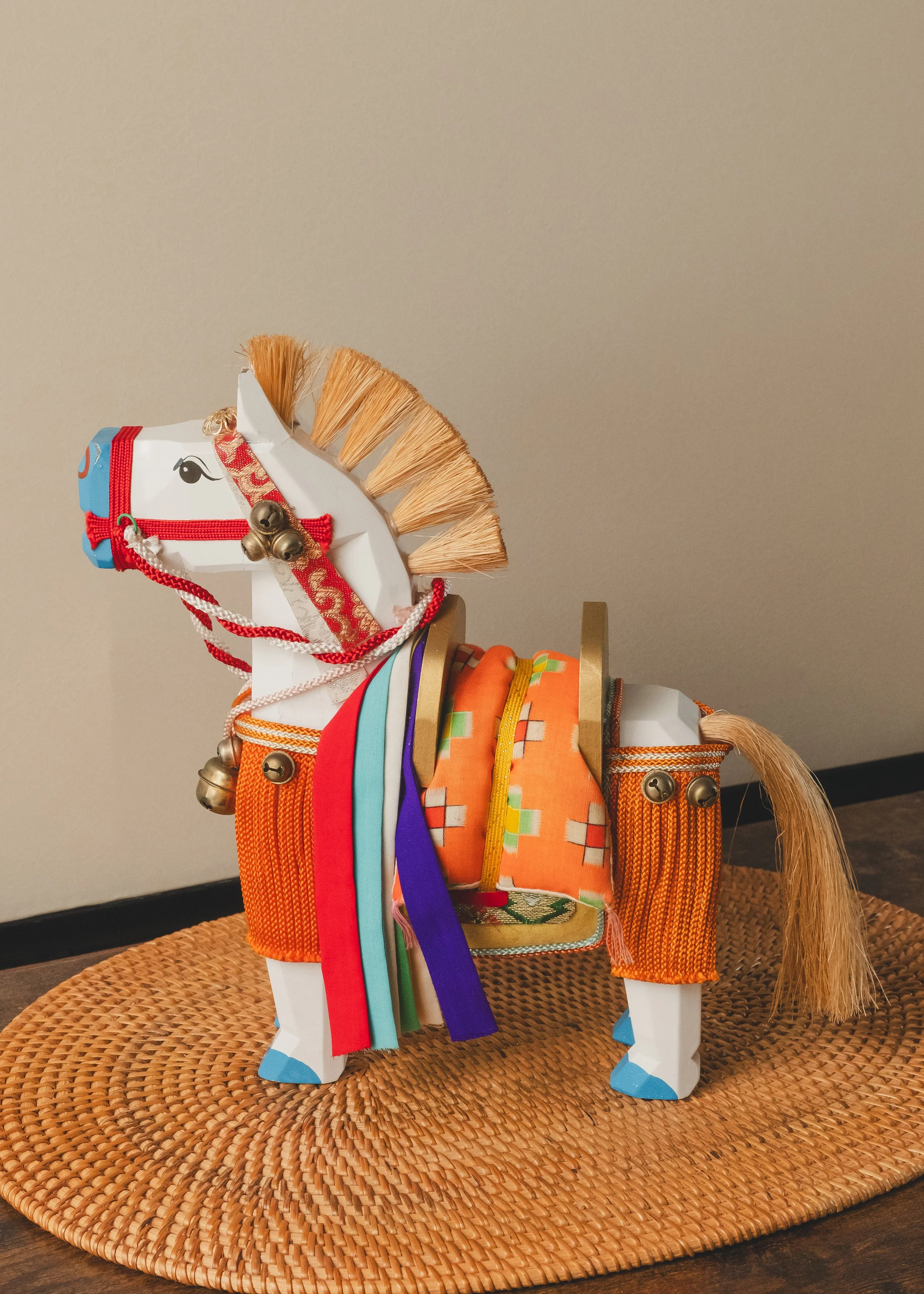
【 The Concept 】
In the northern provinces of Japan, the horse was not livestock. It lived inside the house, under the same roof, separated from the family by a single wall. When the rice planting was done and the animal had nothing left to carry, the family dressed it — not in a saddle, but in armor, bells, ribbons, and silk. They walked it to the shrine of the horse god and said thank you. An anonymous woodcarver took this procession and carved it into a single standing figure: a white horse in full ceremonial dress, wearing more decoration than the people who walk beside it. It does not move. It does not need to. The bells do the talking.
【 The Function 】
A standing figure. Twenty-six centimeters tall, carved from light timber in an interlocking construction — body, neck, and legs shaped separately, then fitted together. The horse wears a layered textile coat in orange with a woven cross-hatch pattern, tied at the belly. Ribbons in red, blue, green, and purple hang from the sides. Small brass bells are knotted to the harness with twisted cord. Shake the figure gently and the bells sound — a faint, dry chime that the Japanese government listed among the hundred sounds worth preserving.
【 The Texture 】
Carved timber sealed with gesso and painted in flat, opaque color. The body is white — clean, chalky, and matte. The hooves are sky blue. The ears are lined in red. A gold medallion sits on the forehead. The mane and tail are natural plant fiber, pale blonde, cut blunt and left to fall. The textile coat is real cloth — not painted on — with a printed pattern stitched and glued to the wooden body. The bells are real metal, small enough to fit on a fingertip, strung on red-and-white twisted cord. Every surface is a different material: wood, cloth, fiber, metal. The hand moves from smooth to rough to soft to cold in a single pass.
【 Presence 】
It is the tallest and most decorated object in any room it enters. The white body and orange coat make it impossible to ignore. The ribbons hang still until someone walks past, and then they move. The bells stay silent until someone picks it up, and then they ring. It stands the way the real horse stands at the shrine — still, patient, and covered in more gratitude than it knows what to do with.
Sourced from a private collection in northern Japan.
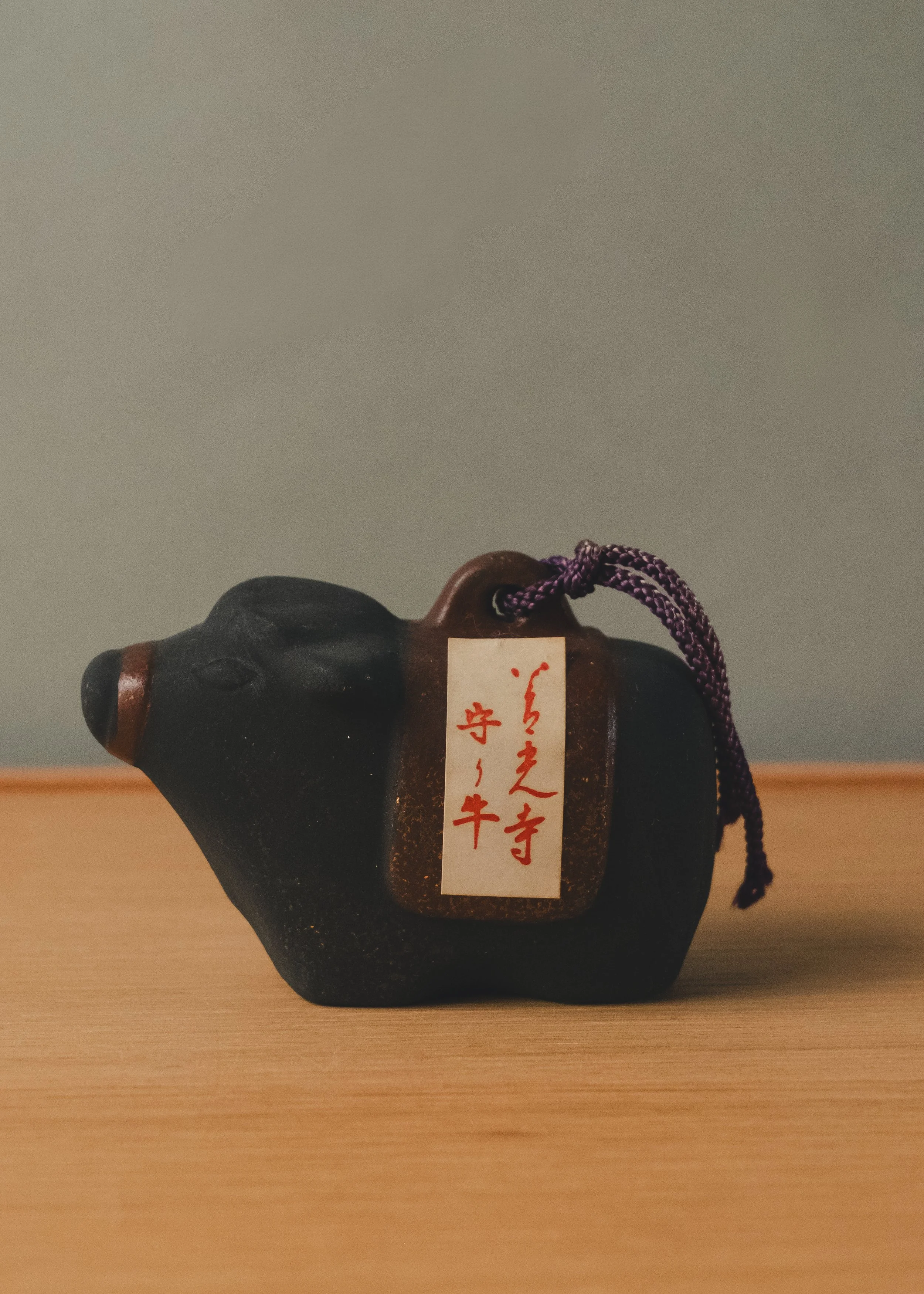
【 The Concept 】
A thousand years ago, a scholar was exiled from the capital. On his way out, he stopped to say goodbye to his aunt. Assassins followed him. A white bull appeared from nowhere and drove them back. The scholar died in exile, but the bull never left the shrine. Every temple built in his name placed a seated bull at the gate — not standing, not charging, but kneeling. Because the bull that carried his body to its final resting place sat down and refused to move, and the people who buried him took that as a sign. This is one of those bulls. Black clay, hollow body, a small stone sealed inside that rattles when shaken. It is not a toy. It is a prayer that someone decided to make portable.
【 The Function 】
A clay bell and a guardian figure. In the tradition it comes from, the faithful touch the bull's body in the place that corresponds to their own affliction — the head for clarity, the back for burden, the legs for safe passage — and the illness or trouble is believed to transfer into the clay. This version is small enough to hold in one hand, which means the ritual does not require a temple visit. Shake it and it rings. Set it down and it kneels. It has been kneeling since it was made.
【 The Texture 】
Fired clay coated in matte black. The surface absorbs light the way dark fabric does — no reflection, no shine, just depth. The nose and the saddle are painted in brown. The saddle carries traces of gold. A paper tag is pasted to the side, bearing the name of the shrine in brushed red ink. The eyes are open — steady, focused, the way someone looks when they are listening carefully to something no one else can hear. A purple cord with a tasseled end hangs from the back, marking this as a shrine object rather than a household ornament.
【 Presence 】
It kneels. That is the first thing. Not standing, not walking, not looking up — kneeling, the way it has knelt at every shrine gate for a thousand years. The second thing is the weight. It is light enough to carry in a pocket, but the black pulls attention toward it in any room. Place it on a desk, on a shelf, beside a door. The bull does not move. That is the entire point. It chose its spot a long time ago.
Sourced from a private collection in western Japan.