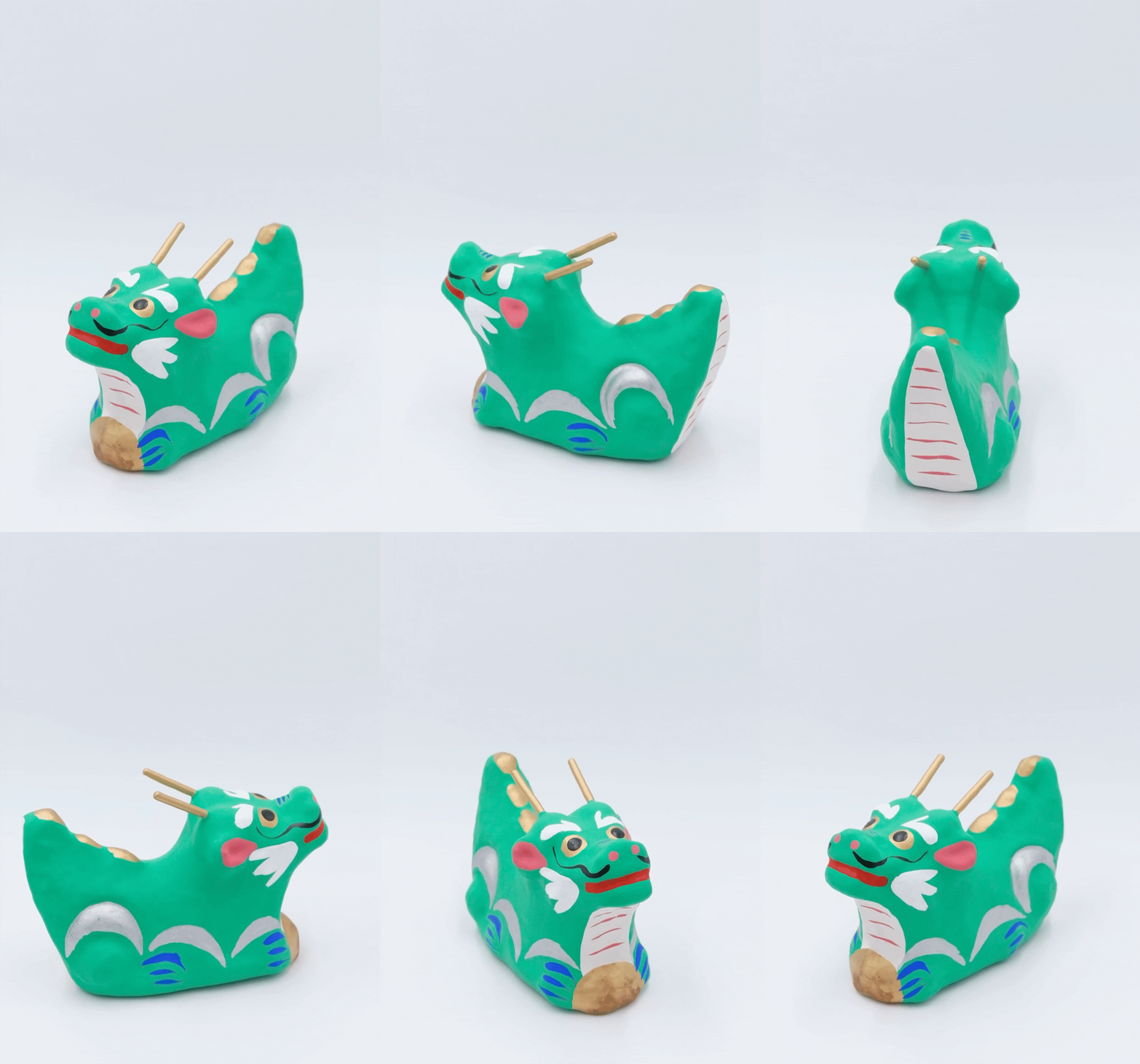
WATER DRAGON 1976

$165.00

【Narrative】

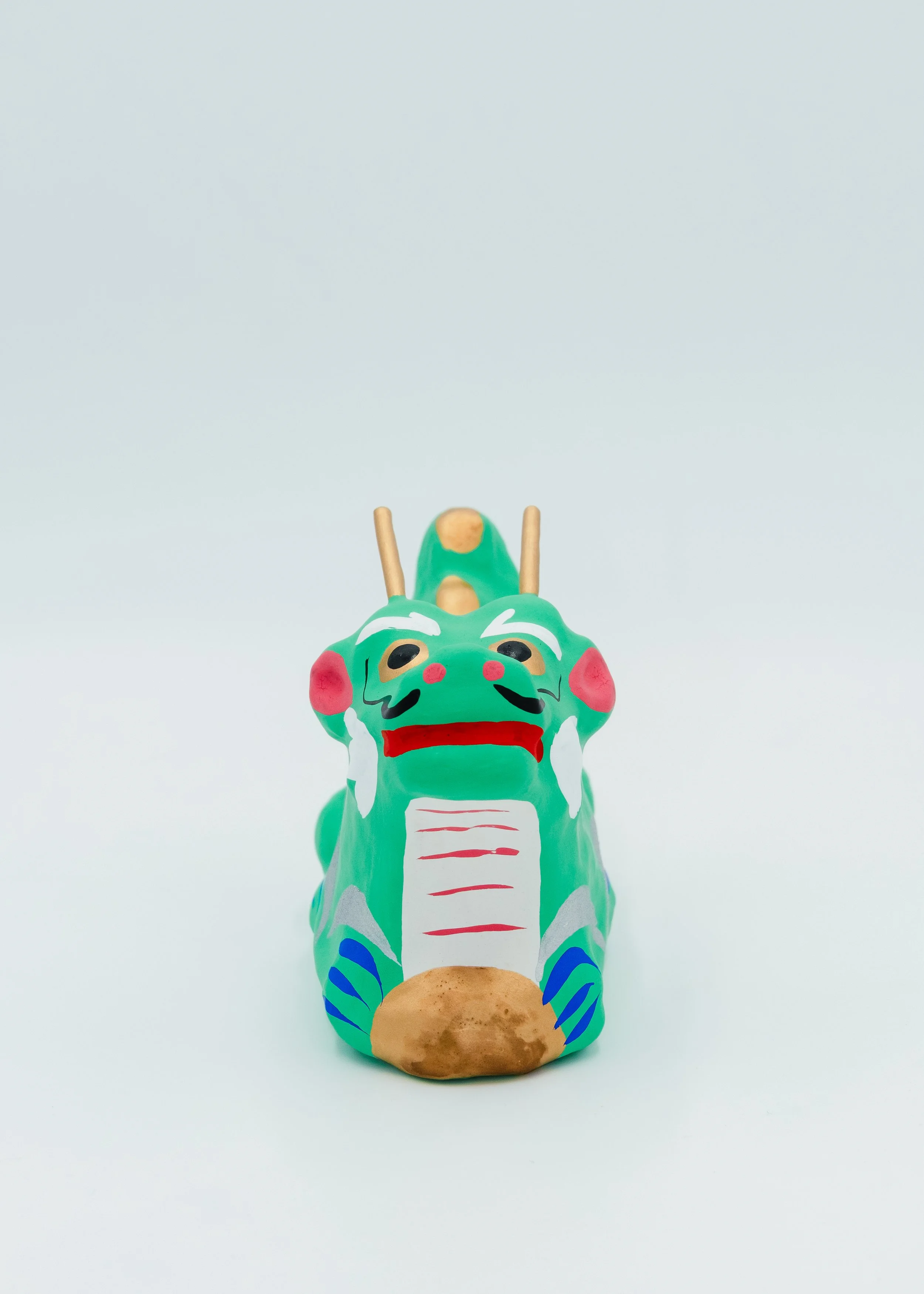
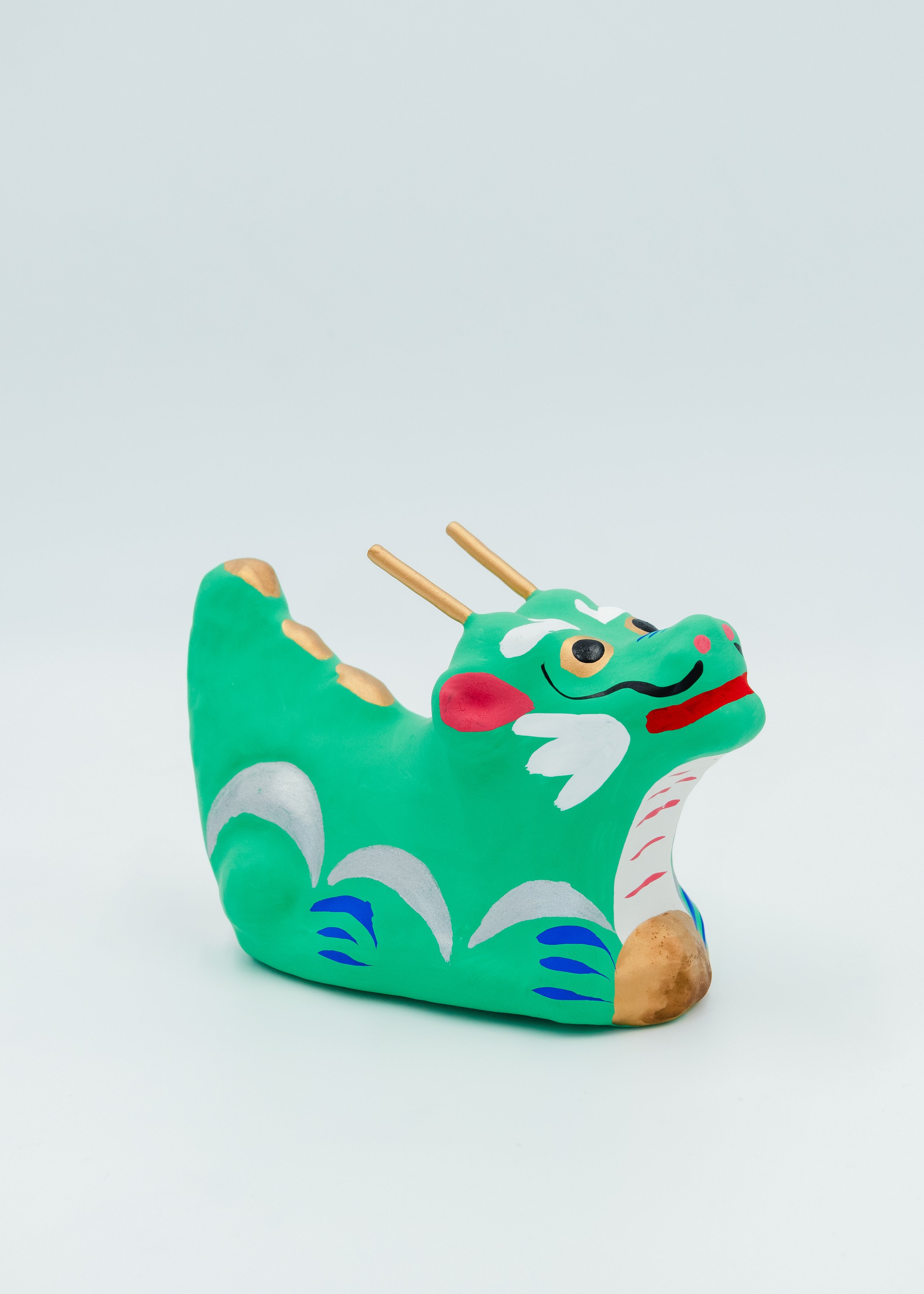
Monster or Deity? In Western lore, the dragon is often a fearsome beast to be conquered. In Japan, however, the Dragon (Tatsu) is the sacred sovereign of the waters—a benevolent deity that commands the rain and grants prosperity. This "Hariko" (papier-mâché) specimen transforms a colossal elemental power into a vibrant, approachable guardian. Through layers of delicate Washi paper, a ferocious god is transmuted into a cheerful companion, embodying the gentle and often humorous nature of Japanese folk spirituality.

【Heritage & Craft】

Originating from Himeji (Hyogo Prefecture), this piece is a testament to regional artisanal pride. Himeji Hariko is a traditional craft where paper is meticulously applied over molds and finished with brilliant natural pigments.

  • Emerald Green: Symbolic of growth and life force.

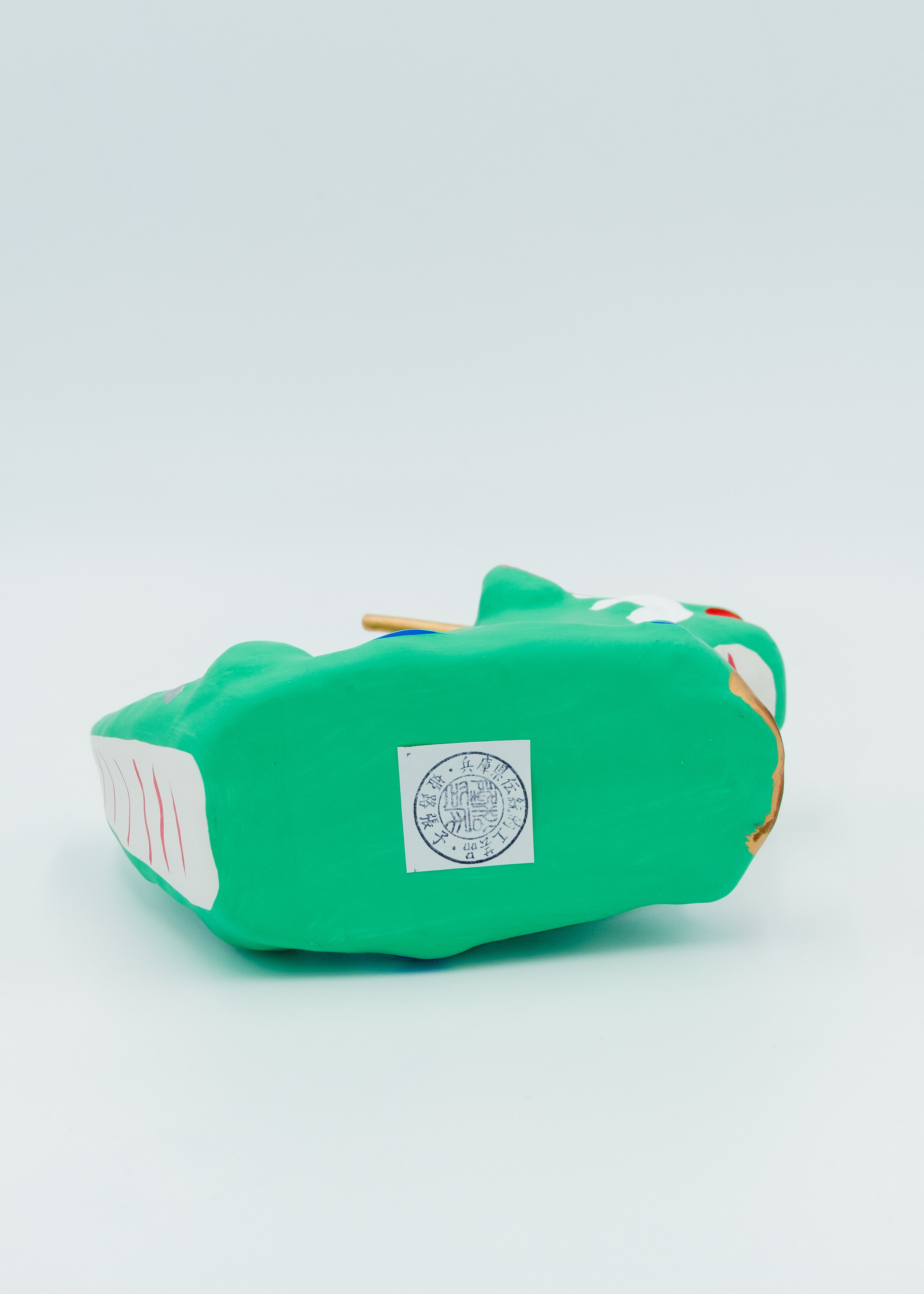
  • The Golden Seal: The preserved sticker on the base identifies this as "Himeji Traditional Craft," marking its authenticity as a legitimate artifact of regional legacy.

【Condition & Provenance】

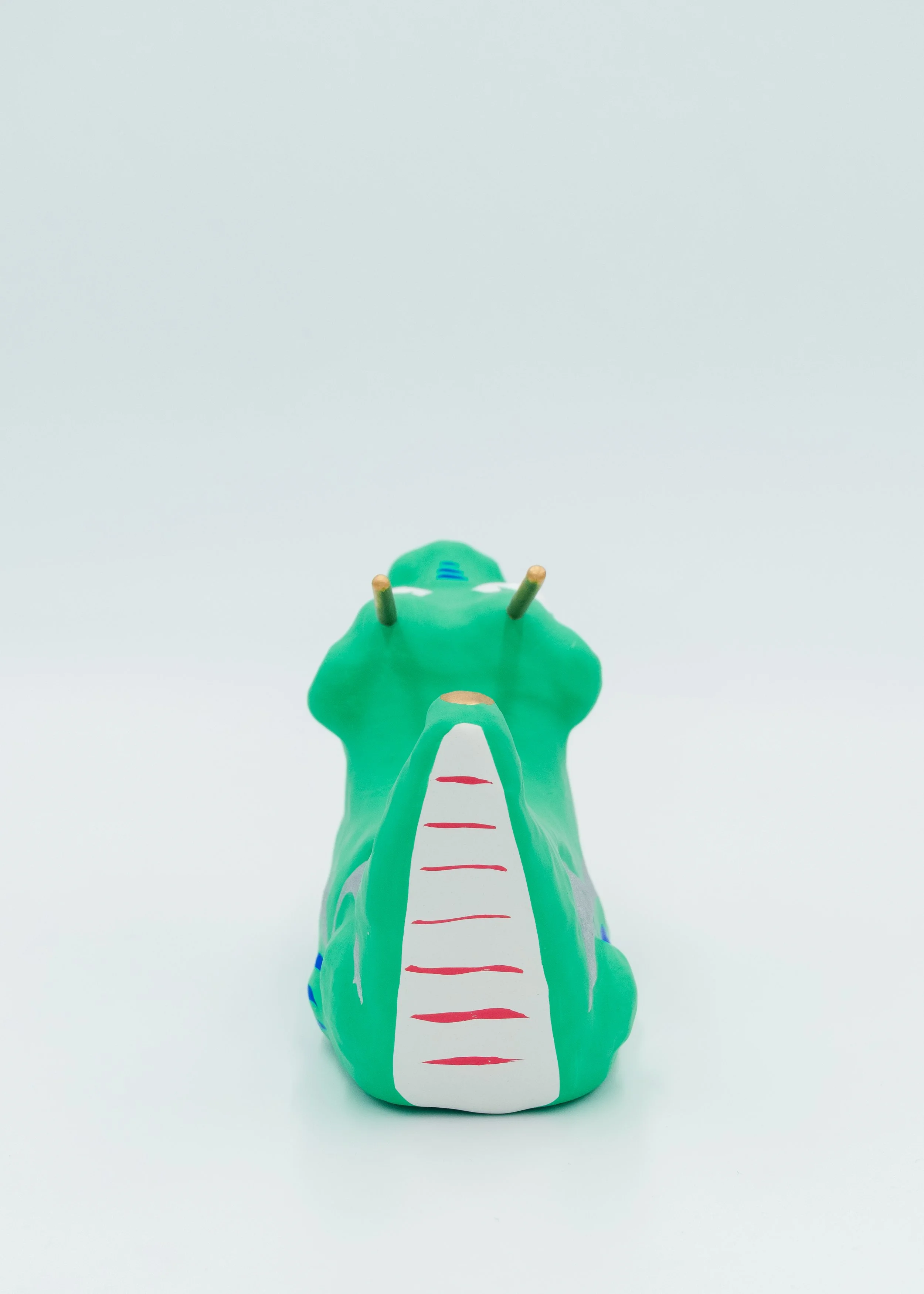
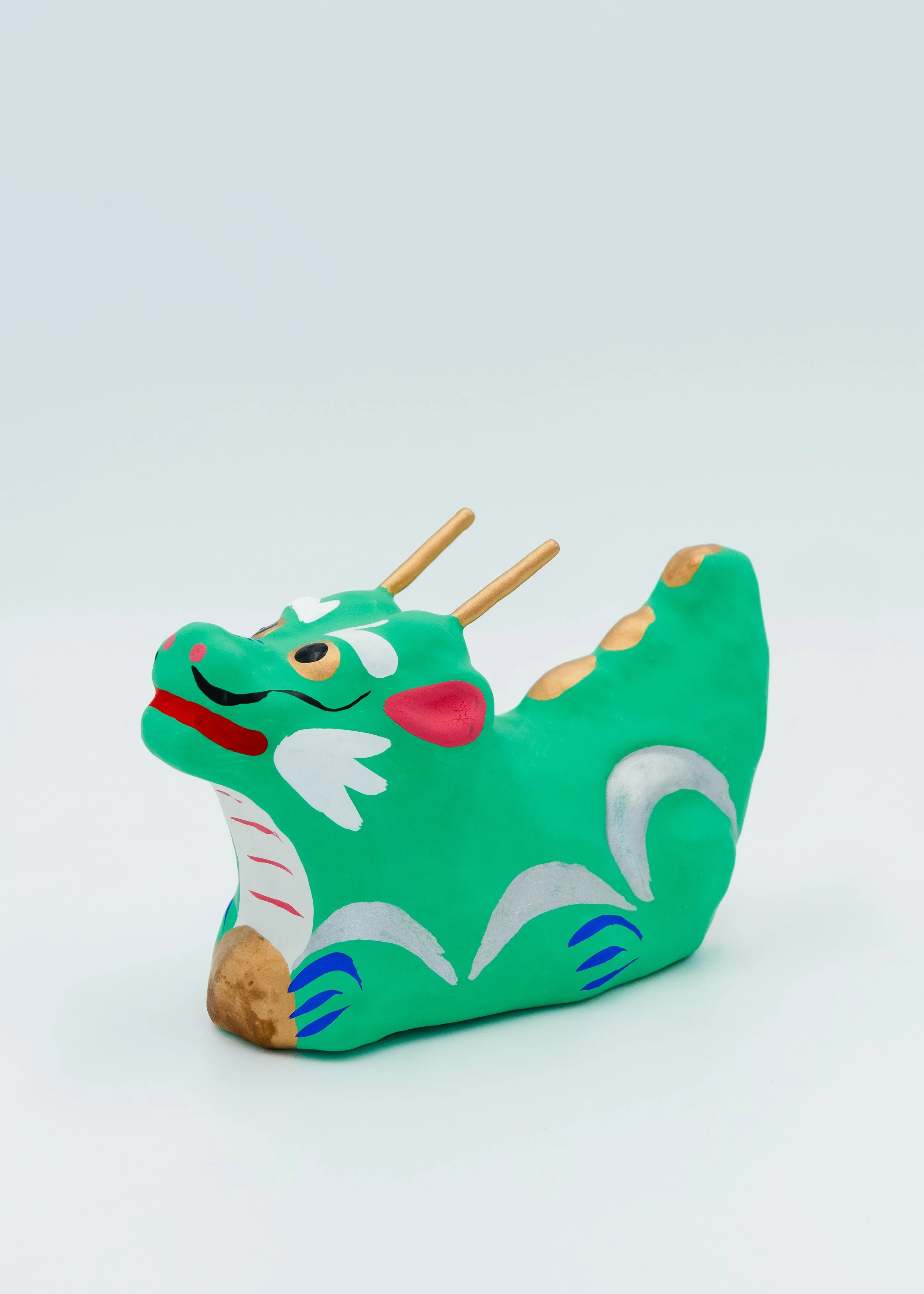
The vibrant emerald body, playful whiskers, and gilded horns remain in remarkable vintage condition. Unlike the solid gravity of clay or iron, the "lightness" of the dragon represents its ethereal nature—capable of ascending to the clouds at a moment's notice. It is a vessel of hollow, sacred space, designed to invite good fortune into the vacuum of a quiet home.

【Placement】

A "Spiritual Tool" for the modern home. Because it is lightweight and hollow, it is suited for elevated placement—perched upon minimal shelving, within glass displays, or even as a focal point in a child’s room. Its emerald hue adds a shock of traditional Japanese "vividness" to an otherwise muted minimalist interior.

【Narrative】

Monster or Deity? In Western lore, the dragon is often a fearsome beast to be conquered. In Japan, however, the Dragon (Tatsu) is the sacred sovereign of the waters—a benevolent deity that commands the rain and grants prosperity. This "Hariko" (papier-mâché) specimen transforms a colossal elemental power into a vibrant, approachable guardian. Through layers of delicate Washi paper, a ferocious god is transmuted into a cheerful companion, embodying the gentle and often humorous nature of Japanese folk spirituality.

【Heritage & Craft】

Originating from Himeji (Hyogo Prefecture), this piece is a testament to regional artisanal pride. Himeji Hariko is a traditional craft where paper is meticulously applied over molds and finished with brilliant natural pigments.

  • Emerald Green: Symbolic of growth and life force.

  • The Golden Seal: The preserved sticker on the base identifies this as "Himeji Traditional Craft," marking its authenticity as a legitimate artifact of regional legacy.

【Condition & Provenance】

The vibrant emerald body, playful whiskers, and gilded horns remain in remarkable vintage condition. Unlike the solid gravity of clay or iron, the "lightness" of the dragon represents its ethereal nature—capable of ascending to the clouds at a moment's notice. It is a vessel of hollow, sacred space, designed to invite good fortune into the vacuum of a quiet home.

【Placement】

A "Spiritual Tool" for the modern home. Because it is lightweight and hollow, it is suited for elevated placement—perched upon minimal shelving, within glass displays, or even as a focal point in a child’s room. Its emerald hue adds a shock of traditional Japanese "vividness" to an otherwise muted minimalist interior.
【Context】

  • Period: Mid-Showa Era (1950s - 1960s)
  • Technique: Himeji Hariko (Traditional Papier-mâché)
  • Material: Hand-pressed Washi Paper, Bamboo, Natural Pigment
  • Origin: Himeji, Hyogo Prefecture, Japan
  • Features: Original "Traditional Craft" Authenticity Seal on the base

【Dimensions (Approx.)】

  • H: 9.5 cm (3.7 in)
  • W: 6.5 cm (2.6 in)
  • L: 14 cm (5.5 in)
  • Weight: Extremely lightweight (Hollow structure).
 

RELATED ARCHIVAL SPECIMENS

GOLD KINRANDE 1958
$410.00

The Spirit

Earth and Celestial Gold.
Bizen ware is usually a dialogue between fire and raw clay, unglazed and primitive. However, this extraordinary specimen represents a bold evolution.

Born from the 1,000-year-old kilns of Imbe, this piece shatters the silence of "Wabi-sabi" by incorporating "Kinsai" (gold-lustre) and hand-painted narratives. It is the visual equivalent of a lone, ancient poem found etched upon a rock. It asks the observer: Can a goddess of gold truly live within a body of mud?

Provenance

Attributed to the Studio of Atsuo Suzuki (Contemporary Master).
Traditionally, Bizen is baked for two continuous weeks at 1,300°C without a drop of glaze. Its surface is the result of natural ash "accidents."

This modern masterpiece elevates the "Shihouguchi" (Quadrilateral Mouth)—a rare architectural form historically associated with the legendary National Treasure Kanemige Toyo—and infuses it with noble metallic pigments. The handwritten Waka poetry on its side serves not just as text, but as a prayer to the flow of seasons, capturing the very essence of the Japanese "Spiritual Utensil."

The Box

Accompanied by its original "Tomobako" (Artisan-signed Wooden Box).
In the world of Japanese high-art, the box is the passport. The ink calligraphy upon its lid serves as a testament to its authenticity and the master's soul.

This piece carries the weight of a generational lineage. The surface tension between the rough, "Sangi-ri" ash patterns and the refined gold leaf creates a sensory vibration. It is a mature specimen of late 20th-century experimentation, where the austerity of the Showa era meets the vibrancy of a new world.

Presence

From the Tea Room to the Minimalist Interior.
Designed originally for the "Sado" (Tea Ceremony), its quadrangular form grounds the energy of any room. We recommend placing it in an alcove or a centerpiece table where natural side-lighting can ignite the gold script against the darkened clay. It does not just hold flowers; it holds the stillness of the room.

VANGUARD STALLION 1930
$190.00

【 The Concept 】

A 12th-century epic crystallized in wood.
This unique rocking artifact traces its aesthetic origins back to one of the most legendary martial episodes in Japanese history—a fierce vanguard race to breach enemy lines by crossing a raging, freezing river. An anonymous woodcarver in the snowy northern province of Japan (a region renowned for breeding supreme wild horses) stripped this samurai lore down to its essential geometry.

The result is an awe-inspiring juxtaposition: a fearless black stallion mounted upon an arched, blue-and-white wave pedestal. By merging high-stakes history with the rustic authenticity of provincial folk art, the craftsman elevated a simple rural object into an abstract monument of momentum and willpower.

【 The Function 】

A kinetic instrument for mental breakthrough.
Unlike stationary decor, this piece operates as a dynamic, kinetic sculpture. Engineered with a convex, rocking base, a slight touch causes the stallion to powerfully pitch back and forth—physically simulating the visceral struggle of a heavy beast fighting through strong currents.

While historically created as an amulet for agricultural prosperity and success, modern collectors adopt it as a "Spiritual Utility." Kept on executive desks or creative workstations, its rhythmic physical motion acts as a meditative trigger, silently inspiring its guardian to push past difficult barriers and claim victory.

【 Material & Craft 】

The tactile clash of organic textures.
Hand-carved from lightweight Paulownia wood (Kiri), the stallion's body is finished in a commanding, time-worn black. This smooth, austere foundation is dramatically contrasted by the insertion of genuine raw dry straw to form the mane and tail—capturing the chaotic wind of a battlefield and providing an unparalleled tactile sensation.

The vibrant hand-painted motifs feature sacred vermilion reds, striking golds, and an intense cerulean blue base decorated with white, arching "Seigaiha" (ocean wave) patterns. The slight fading of these artisanal pigments confirms its journey through the early mid-century.

【 Presence 】

An active force in the minimalist void.
Most mid-century or Japandi aesthetics focus on absolute subtraction and quietness. This rare specimen introduces a necessary "Yang" (active, forceful) energy to that silence. Its vivid palette and potential for motion beautifully disrupt overly pristine, mass-produced environments, bringing a deep, grounding gravity to the room.

Position it atop an entryway console, or within reach next to your monitor. Whenever digital fatigue or stagnation settles over your day, a single physical touch brings the stallion’s ancient river crossing back to life—an uncompromising, interactive anchor to history.