【 The Concept 】
A slender standing figure of Kannon, the bodhisattva of compassion, in the form known as Gyoran Kannon, “Kannon of the Fish Basket.” She stands barefoot, her hair gathered in a high knot beneath a long veil that falls over her head and shoulders and down her back. Her eyes are lowered, almost closed, the brows and lids picked out in fine black ink, and her round face holds a calm, inward expression. A jewelled necklace with a flower-shaped medallion and strings of beads rests on her chest. In her right hand she carries, by a long looped handle, a woven basket with a single fish lying in it, its scales and fanned tail clearly modelled. The whole figure is made of fired clay with a warm ochre-yellow surface, softened and worn by time.
【 The Kannon Who Comes in Any Form 】
In the Lotus Sutra, Kannon is said to take whatever form will best reach the person in need of help: a monk, a king, a child, or a woman. Out of this teaching grew the tradition of the Thirty-Three Forms of Kannon, each a different face of the same compassion. Gyoran Kannon, the Fish-Basket Kannon, is one of them. She is not found in the early Indian scriptures but was born from Chinese folk legend, and she became especially dear to people who live by the sea.
【 The Fish Seller of Jinshatan 】
The story is set in China in the year 817, in the reign of the Tang dynasty. In a place called Jinshatan, where few people knew anything of the Buddha’s teaching, a beautiful young woman appeared, selling fish from a basket. Many men wished to marry her. She promised herself to whoever could learn the Buddhist scriptures by heart, and in the end only one young man, Ma, was able to recite the Lotus Sutra. The wedding was arranged, but as soon as she entered his house, she died. Then an old monk appeared and told Ma that the woman had been Kannon herself, who had come in this form to lead him and the people of the region to the teaching. From that day she has been honoured as Merōfu Kannon, “the Wife of Ma,” and as Gyoran Kannon, the Kannon who carries fish.
【 The Goldfish of the Frozen River 】
The Fish-Basket Kannon also appears in Journey to the West, the great Chinese novel of the monk Tripitaka and the Monkey King. At the Tongtian River, a demon calling himself the Great King of Miraculous Power freezes the water, and when the monk walks across the ice it breaks and he is dragged into the depths. Monkey cannot defeat the creature under the water and goes to ask Kannon for help. She arrives carrying a bamboo basket, and with it she captures the demon, who turns out to be nothing more than an escaped goldfish. It is one of the best-loved scenes of the novel and part of the reason the fish basket became her emblem.
【 The Fish-Basket Temple of Tokyo 】
The Fish-Basket Kannon travelled to Japan and was taken to heart by fishermen and people of the sea. In the Mita district of Tokyo stands Gyoranji, the “Fish-Basket Temple,” founded in 1652 and named after its main image, a Kannon holding a fish basket. The slope it stands on is still called Gyoran-zaka, Fish-Basket Hill, a small reminder in the middle of the modern city of a bodhisattva who came to the world as a fish seller.
【 What Owning This Piece Brings 】
・ Compassion close at hand. Kannon is the bodhisattva who hears the cries of the world; this figure is a quiet reminder of kindness and help that comes in unexpected forms.
・ Protection by the sea. The Fish-Basket Kannon has long been honoured by fishermen and sailors as a guardian of safety on the water and of a good catch.
・ A story of the everyday made sacred. A goddess who chose to appear as a fish seller in the market speaks to the dignity of ordinary work.
・ Gentle presence. Her lowered eyes and soft, worn surface bring calm to a room.
A meaningful gift for someone who lives by the sea or loves fishing, works in food or the kitchen, or simply finds comfort in the figure of Kannon.
【 Where to Place It 】
On a home altar, a bookshelf, a quiet corner of a study, or near the kitchen, where the fish seller’s basket feels at home. Soft side light brings out the folds of the robe and the details of the necklace and basket.
【 Care 】
This is fired clay with a fragile, matt surface: keep it dry and dust it lightly with a soft, dry brush. Do not wash it or wipe it with a damp cloth, as the colour and the ink lines of the face may be lost. Handle with both hands, supporting it from beneath, and place it where it will not be knocked over.
【 Reading the Object 】
A standing female figure of Kannon in fired clay. High topknot beneath a long hood-like veil that covers the head, falls over both shoulders and descends down the back. Round face with lowered, half-closed eyes; eyebrows and eyelids painted in fine black lines. A necklace on the chest with a central flower medallion and hanging strands of beads, modelled in relief. Long robe with flowing, layered folds front and back, the hem spreading over the base, with bare toes showing beneath. The right hand holds the looped handle of a woven basket containing a single fish with incised scales and a fanned tail; the left arm rests at her side within the folds of the robe. Warm ochre-yellow surface, matt, with darker earth in the recesses and lighter clay showing through where it is worn. It stands on its own on the spreading hem of the robe.
【 Presence 】
Quiet, gentle and humble. Compassion in the form of a woman carrying her day’s catch.
Archive Note: The number in the name (817) marks the year in which, according to legend, Kannon appeared as the fish seller of Jinshatan in Tang China. NOT the date this piece was made.
Provenance Note: Sourced from a private household in Japan. A vintage fired-clay figure of Gyoran (Fish-Basket) Kannon. The maker and place of manufacture are unidentified.


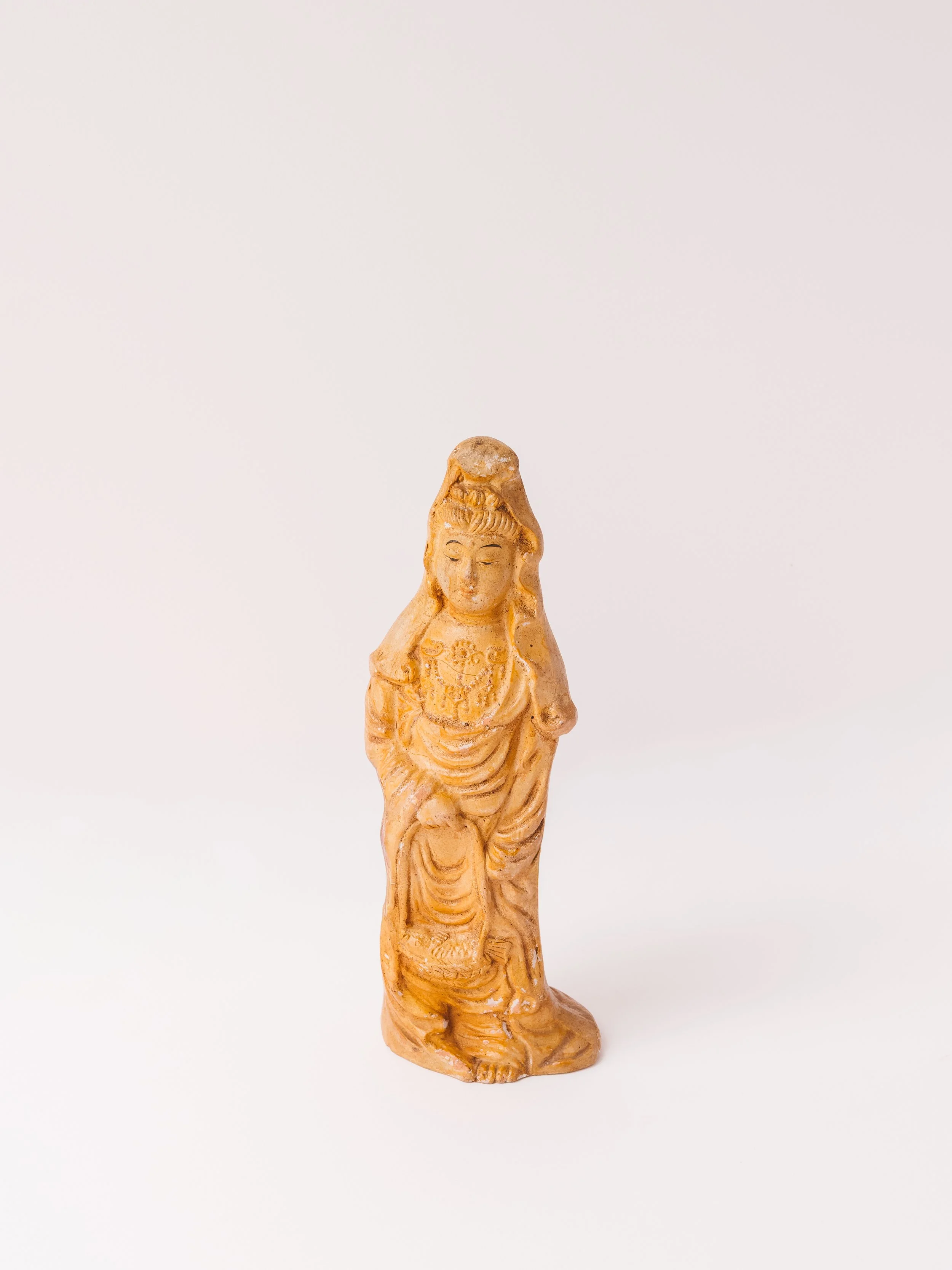 Image 1 of 9
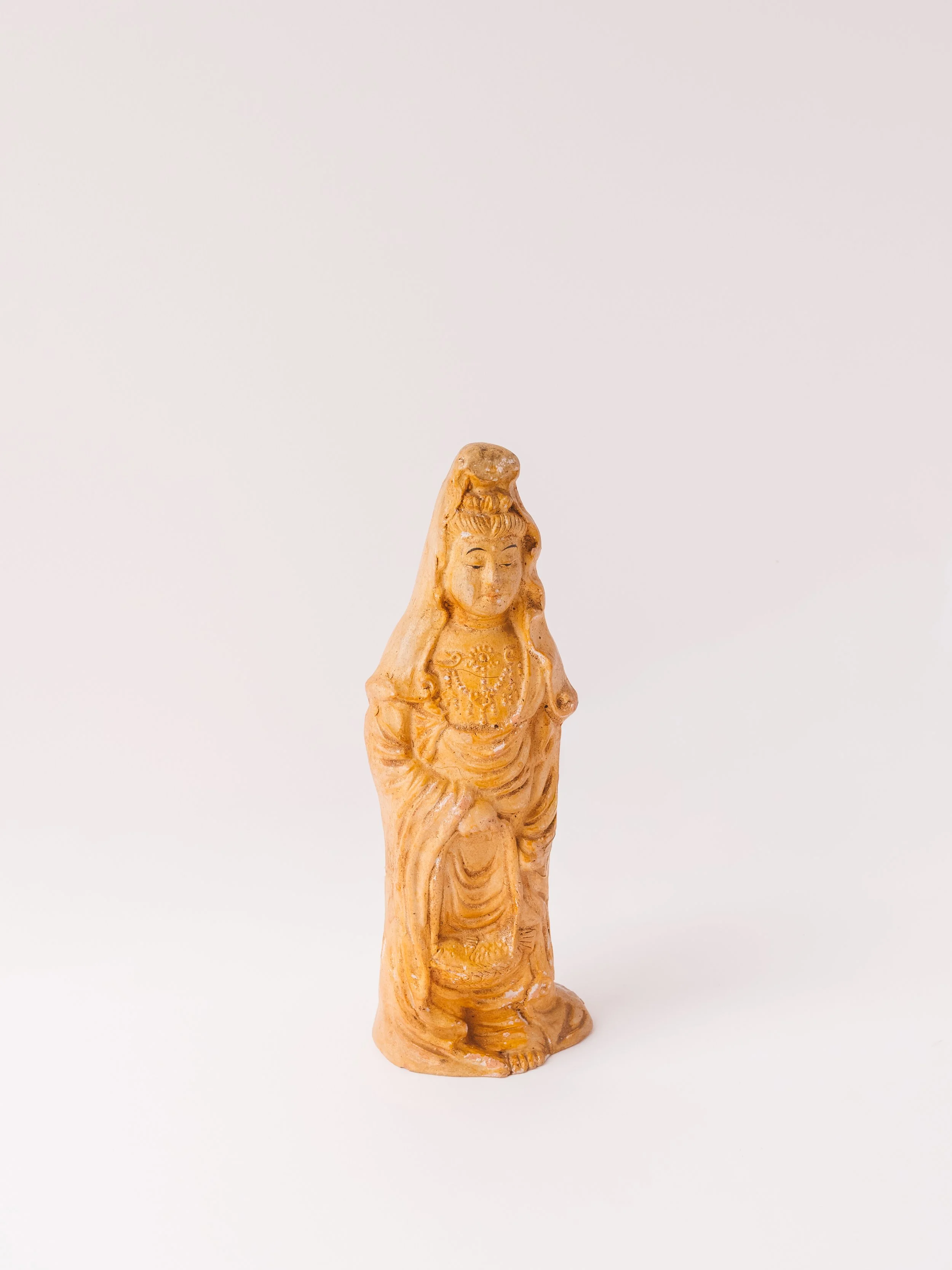 Image 2 of 9
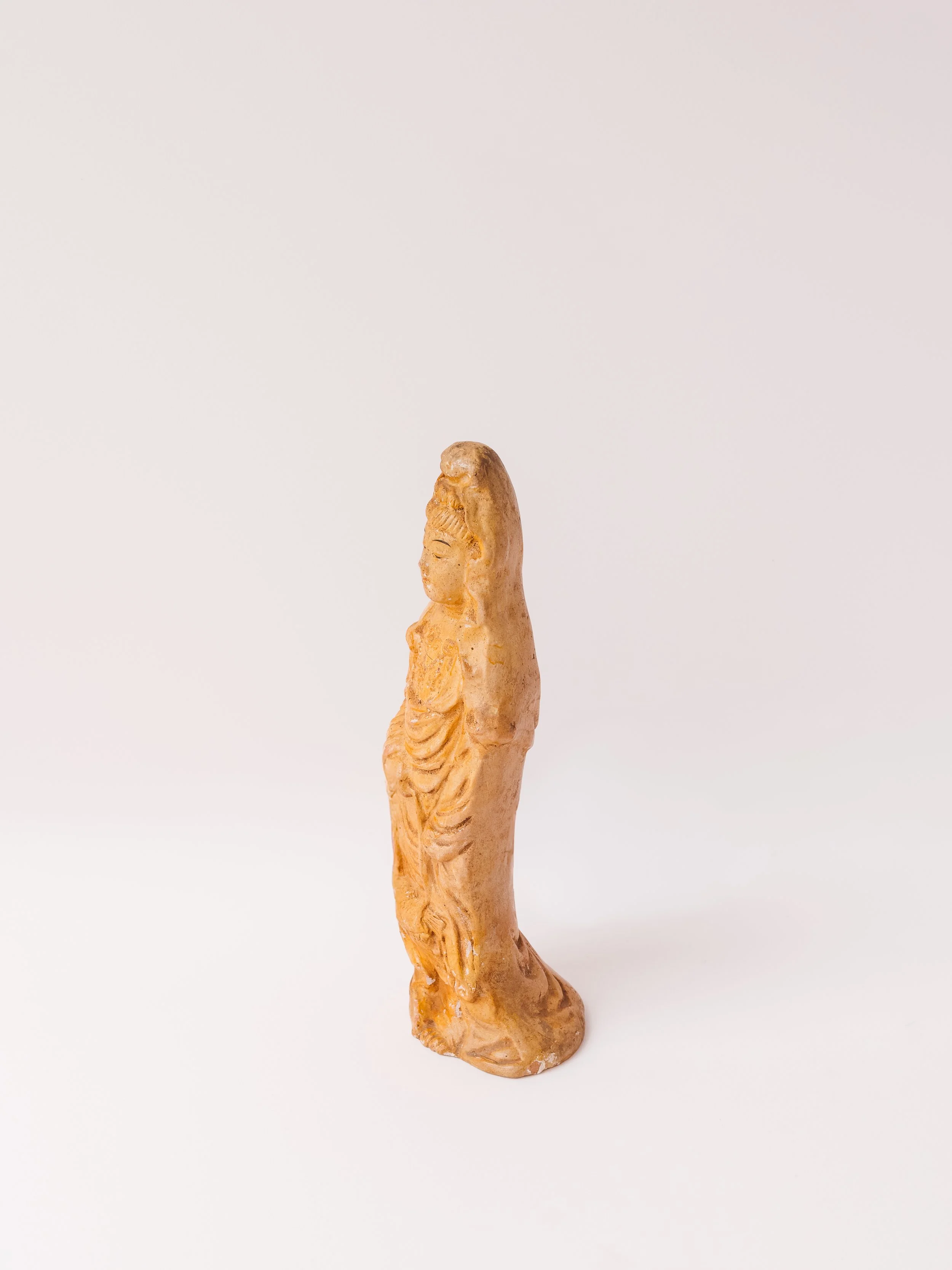 Image 3 of 9
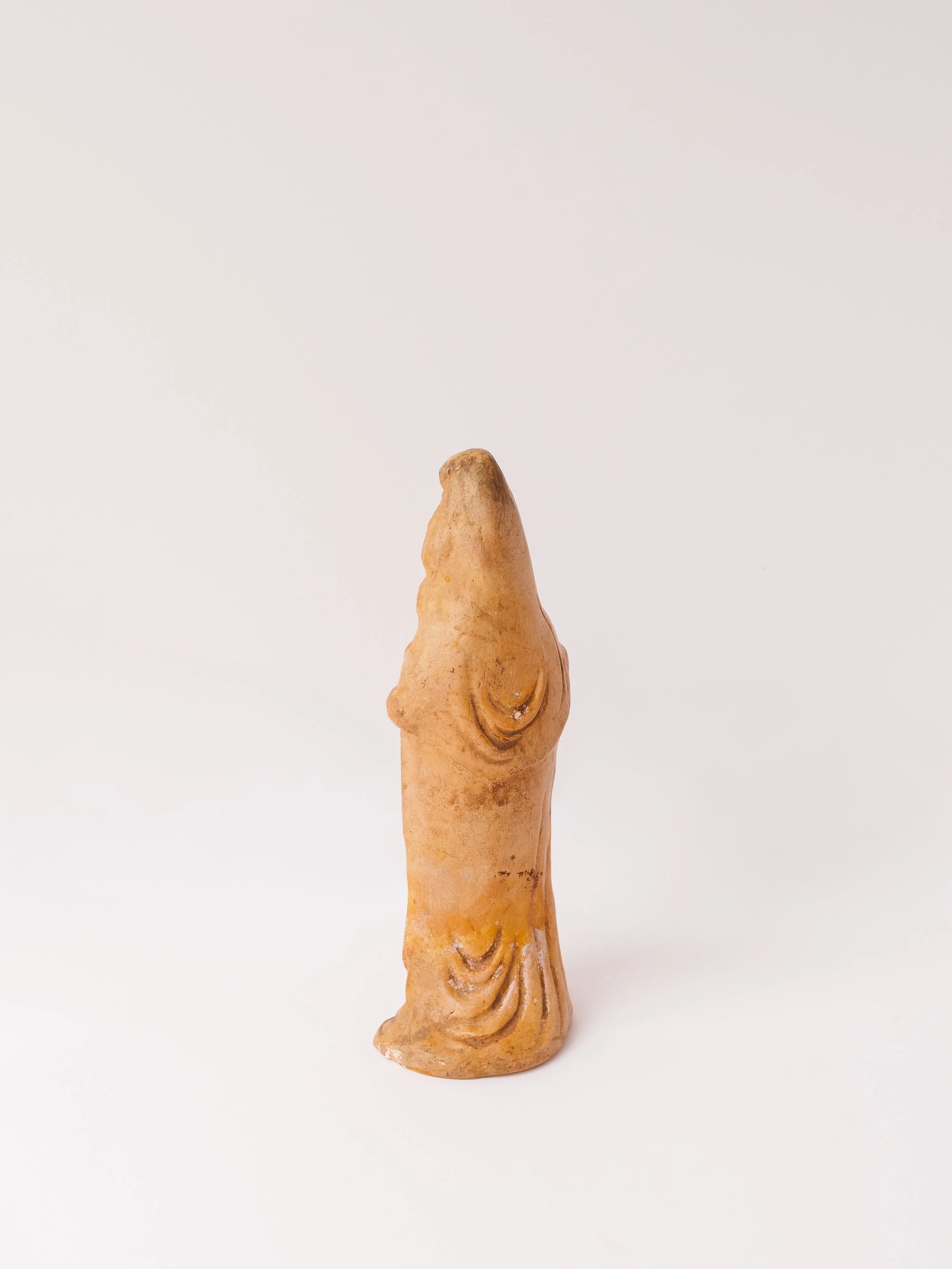 Image 4 of 9
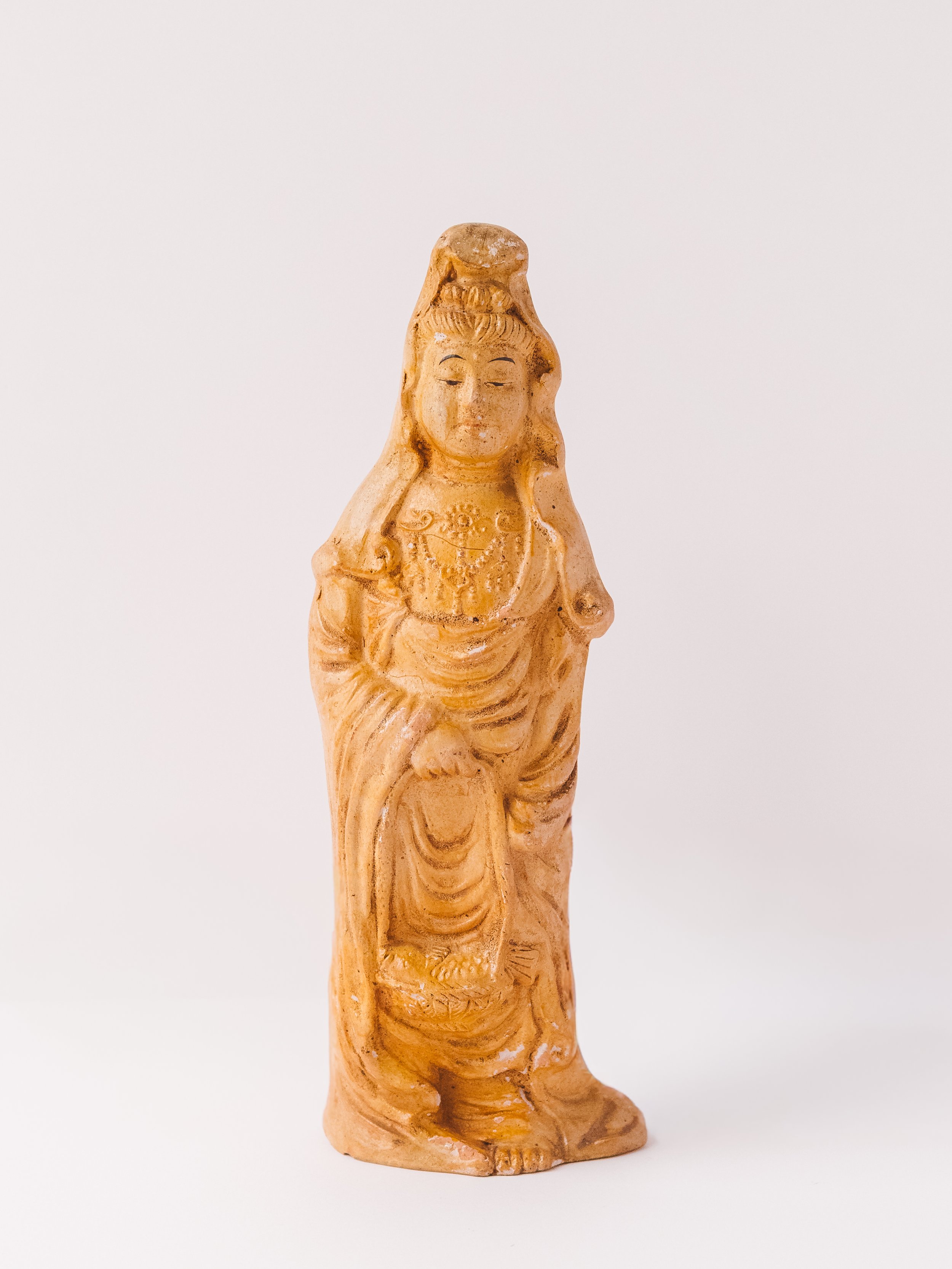 Image 5 of 9
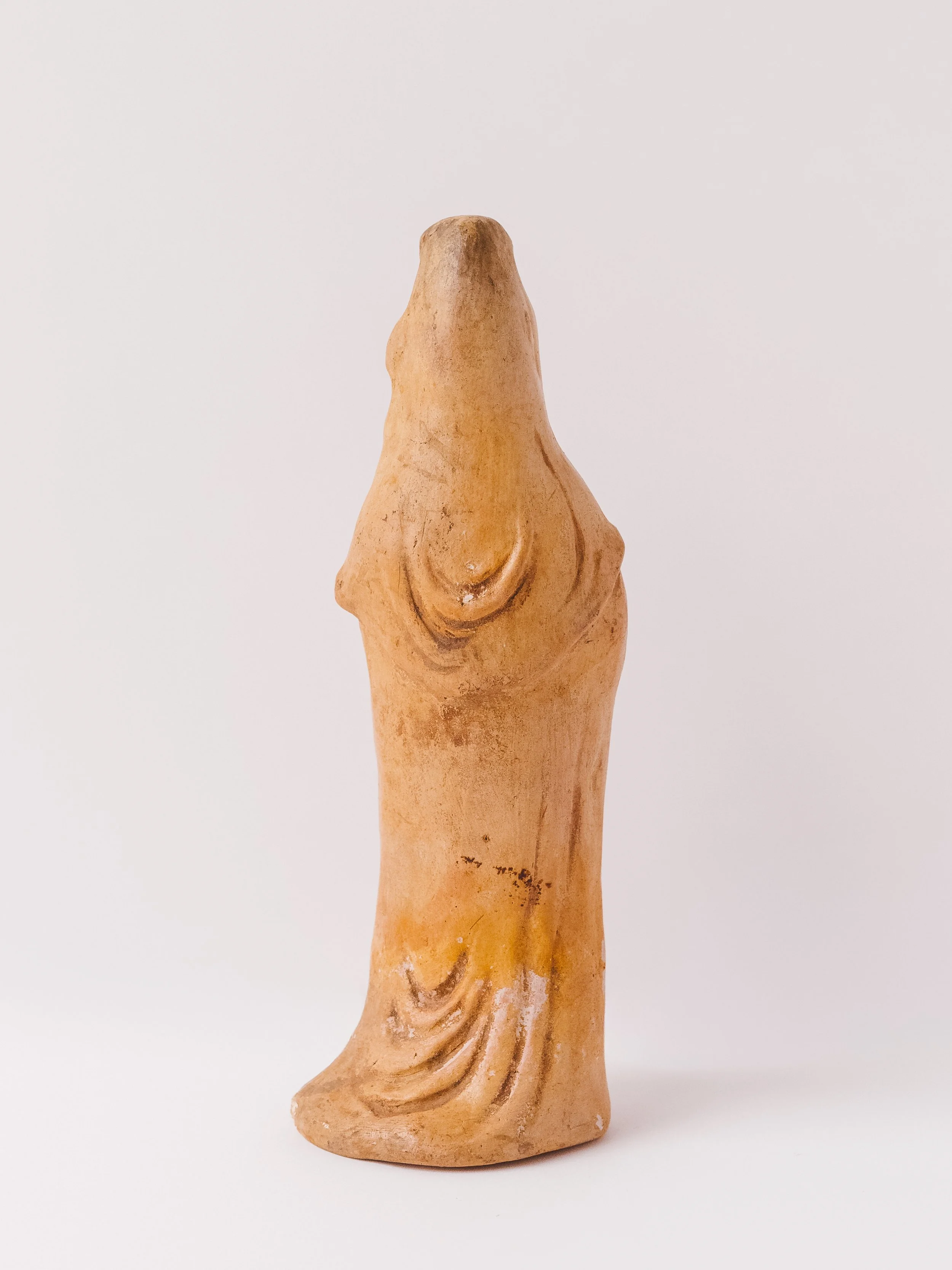 Image 6 of 9
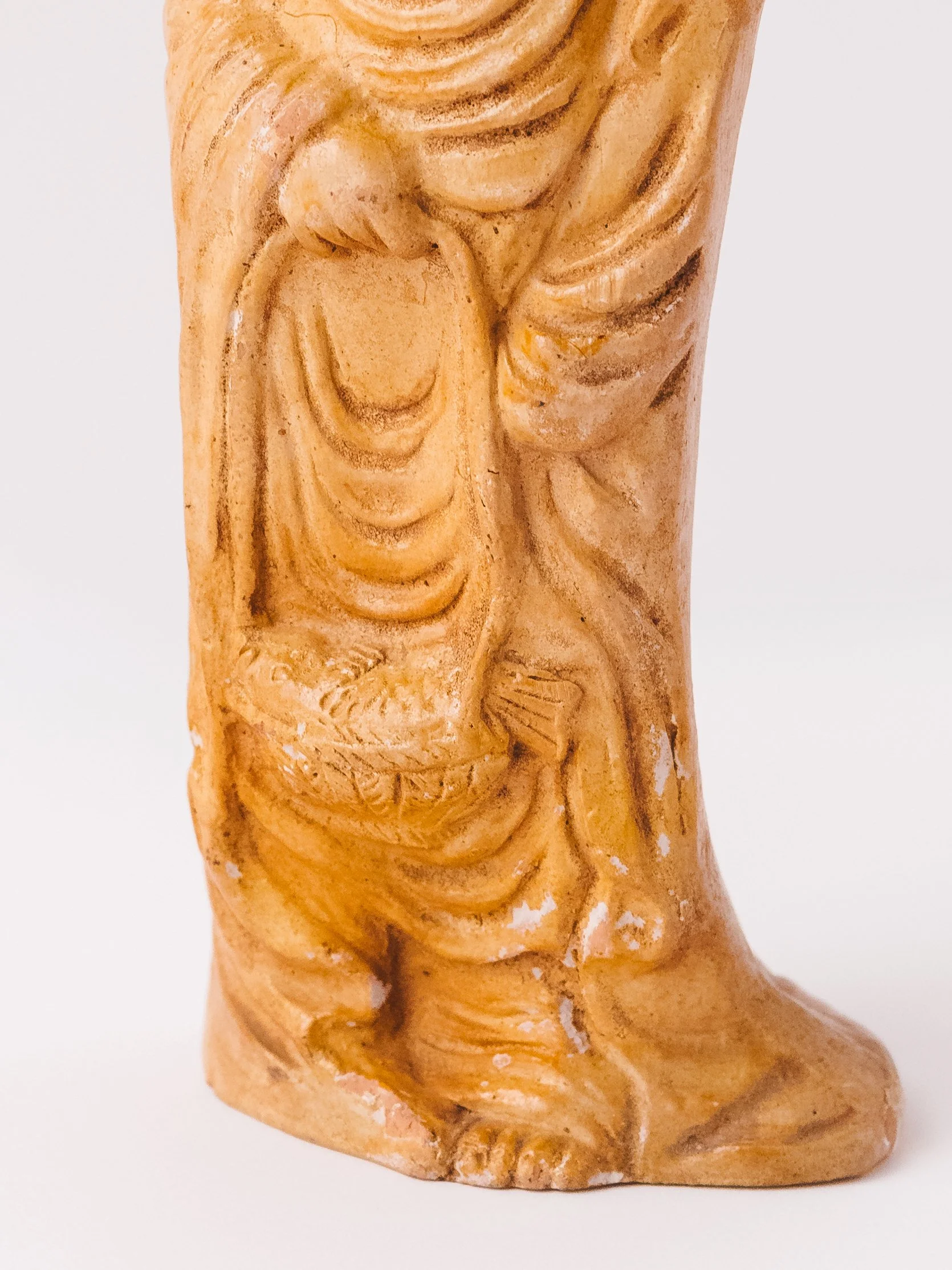 Image 7 of 9
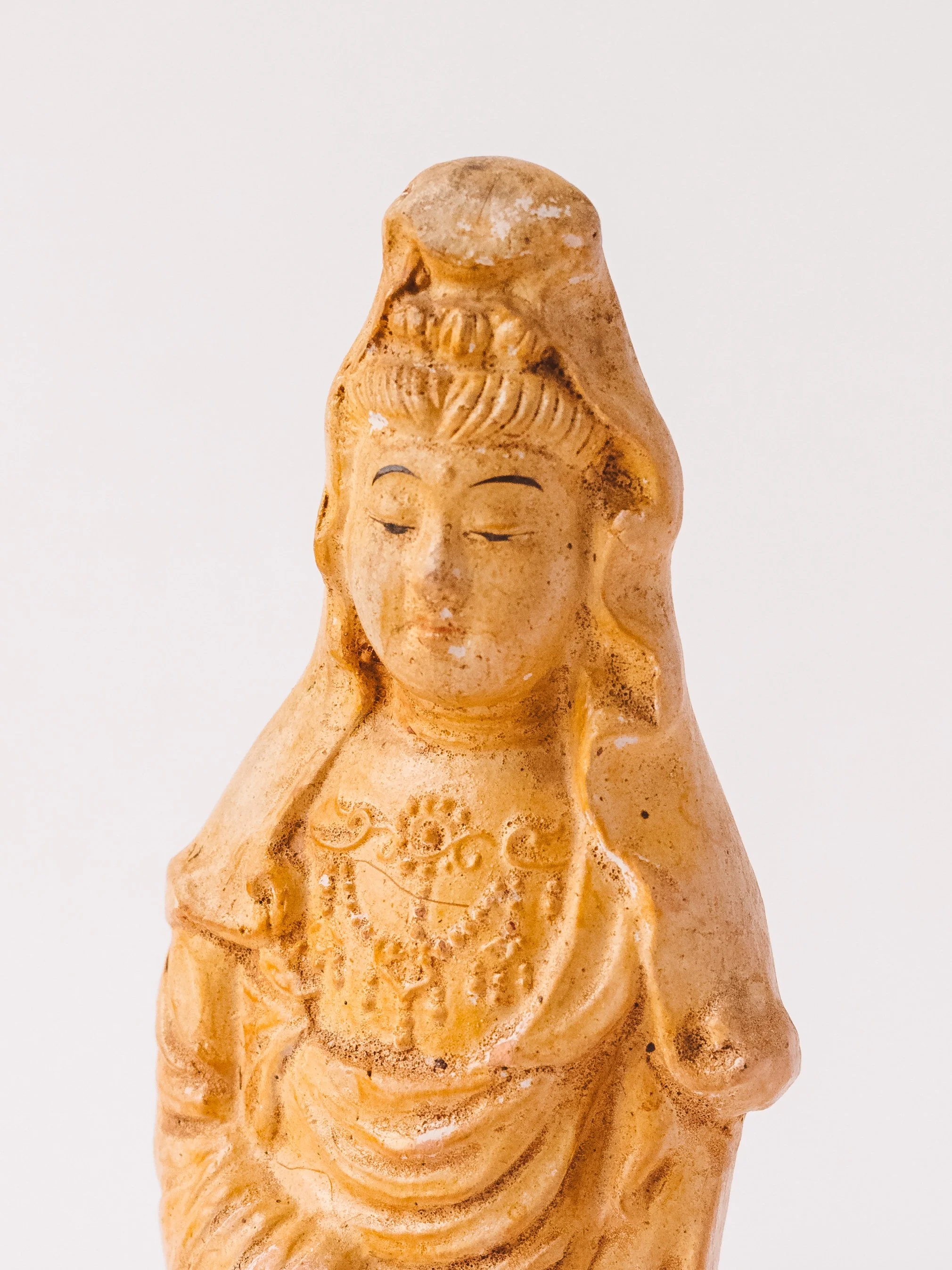 Image 8 of 9
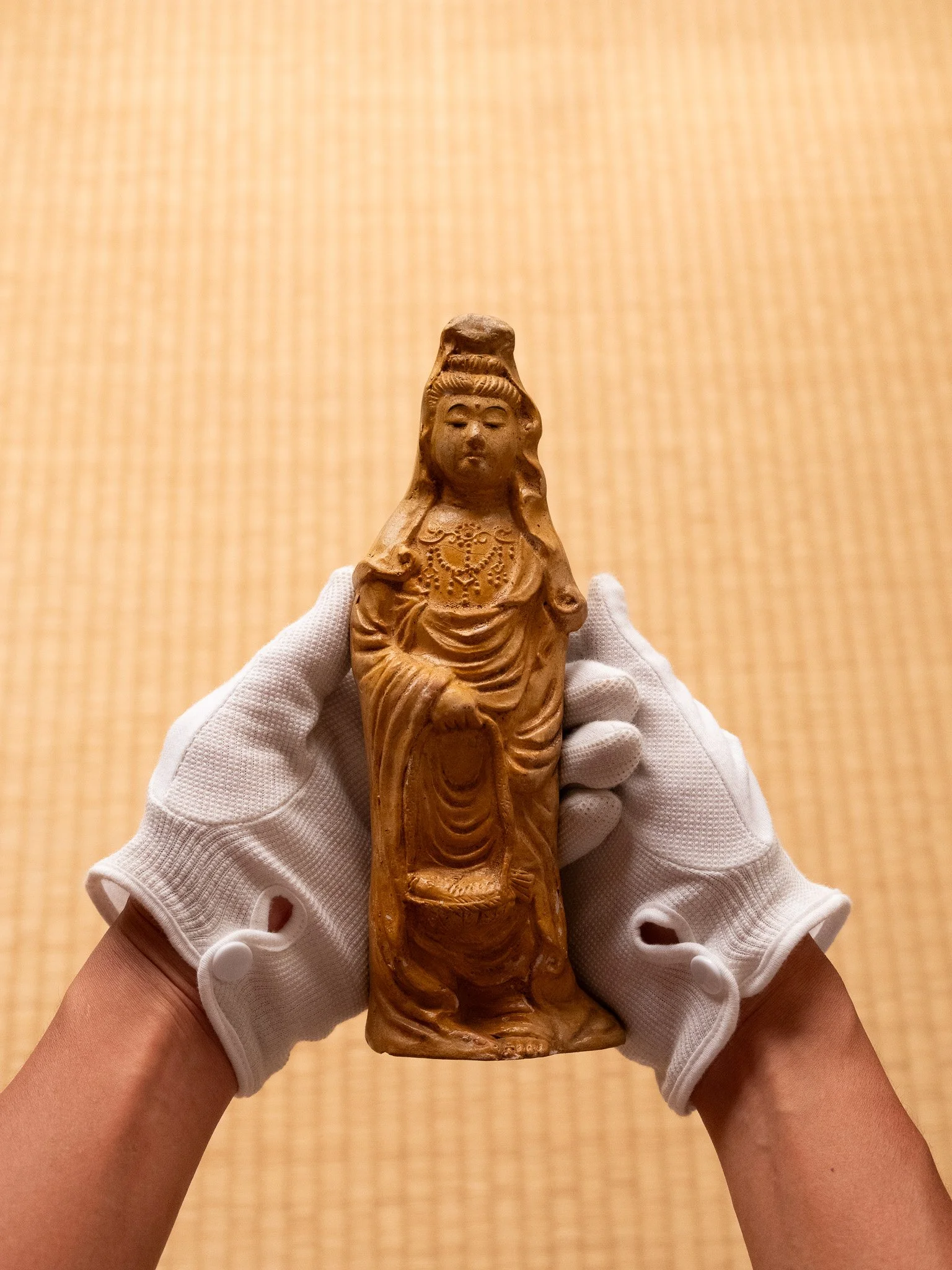 Image 9 of 9