【 The Concept 】
A standing Buddha of gilt metal, caught in the act of coming toward you. This is Amida, the Buddha of the Pure Land — in the old texts Amitābha, "infinite light," and Amitāyus, "infinite life" — the figure at the centre of the most widely held faith in Japanese history, the belief that anyone at all, whatever their learning or station, could be received into paradise simply by calling the Buddha's name. Where earlier practice reserved salvation for those who could master hard scripture and long retreat, this teaching threw the gate open to everyone. The statue is that promise made solid.
Read the body and it speaks. The right hand rises palm-out, the left hangs low and open, and each closes thumb to forefinger in the welcoming gesture — the mudra of a Buddha who does not wait to be reached but sets out to meet the dying and carry them across. The whole figure leans a breath forward, not off-balance but eager, a stillness with somewhere to be. Note too what the body lacks: no crown, no jewels, no ornament of any kind, only a plain monastic robe and the snail-curl hair, the forehead mark, the cranial rise that belong to a fully awakened Buddha — the marks that distinguish a Buddha from the princely, crowned bodhisattvas. Behind it all, a boat-shaped halo of openwork foliage and rising mist stands for the light itself, spreading to the far edges of the world. Where GILDED BOAR renders a wish in gold, this renders light in gold.
【 The Function 】
Unlike a purely ornamental figure, this piece was made to be the still centre of a room set apart for it — the object you place high, light a small flame before, and return to. It asks for a shelf, an alcove, a quiet corner where it can stand above eye level and preside. Kept for devotion or simply for the composure it lends a space, it turns whatever surface holds it into a place that feels deliberately calm.
【 The Texture 】
Gold made to hold light rather than throw it. The whole figure and its halo carry a warm gilt surface, bright on the raised ground — the folds of the robe, the curls of the hair, the scrolling edge of the halo — and settling to a darker, older tone in every recess and deep-cut line. The pedestal is a tiered hexagon of stacked lotus: upturned petals at the top receiving the feet, a band of beading, downturned petals below, each course crisp and distinct. Set a single flame nearby and the recesses stay in shadow while the ridges catch fire, so the figure seems lit from within.
【 Presence 】
At twenty-seven centimetres it has real stature for its footprint — tall, narrow, and weighted low by its dense metal base, so it stands with unhurried authority. It does not merely decorate a corner; it composes one, drawing the eye up the column of the robe to the raised hand and the radiating halo. Placed alone on a high shelf against a plain wall, or in a traditional alcove, it holds the space the way a held breath holds a room — quiet, upright, and complete.
Sourced from a private collection in Japan.
【 The Concept 】
A standing Buddha of gilt metal, caught in the act of coming toward you. This is Amida, the Buddha of the Pure Land — in the old texts Amitābha, "infinite light," and Amitāyus, "infinite life" — the figure at the centre of the most widely held faith in Japanese history, the belief that anyone at all, whatever their learning or station, could be received into paradise simply by calling the Buddha's name. Where earlier practice reserved salvation for those who could master hard scripture and long retreat, this teaching threw the gate open to everyone. The statue is that promise made solid.
Read the body and it speaks. The right hand rises palm-out, the left hangs low and open, and each closes thumb to forefinger in the welcoming gesture — the mudra of a Buddha who does not wait to be reached but sets out to meet the dying and carry them across. The whole figure leans a breath forward, not off-balance but eager, a stillness with somewhere to be. Note too what the body lacks: no crown, no jewels, no ornament of any kind, only a plain monastic robe and the snail-curl hair, the forehead mark, the cranial rise that belong to a fully awakened Buddha — the marks that distinguish a Buddha from the princely, crowned bodhisattvas. Behind it all, a boat-shaped halo of openwork foliage and rising mist stands for the light itself, spreading to the far edges of the world. Where GILDED BOAR renders a wish in gold, this renders light in gold.
【 The Function 】
Unlike a purely ornamental figure, this piece was made to be the still centre of a room set apart for it — the object you place high, light a small flame before, and return to. It asks for a shelf, an alcove, a quiet corner where it can stand above eye level and preside. Kept for devotion or simply for the composure it lends a space, it turns whatever surface holds it into a place that feels deliberately calm.
【 The Texture 】
Gold made to hold light rather than throw it. The whole figure and its halo carry a warm gilt surface, bright on the raised ground — the folds of the robe, the curls of the hair, the scrolling edge of the halo — and settling to a darker, older tone in every recess and deep-cut line. The pedestal is a tiered hexagon of stacked lotus: upturned petals at the top receiving the feet, a band of beading, downturned petals below, each course crisp and distinct. Set a single flame nearby and the recesses stay in shadow while the ridges catch fire, so the figure seems lit from within.
【 Presence 】
At twenty-seven centimetres it has real stature for its footprint — tall, narrow, and weighted low by its dense metal base, so it stands with unhurried authority. It does not merely decorate a corner; it composes one, drawing the eye up the column of the robe to the raised hand and the radiating halo. Placed alone on a high shelf against a plain wall, or in a traditional alcove, it holds the space the way a held breath holds a room — quiet, upright, and complete.
Sourced from a private collection in Japan.


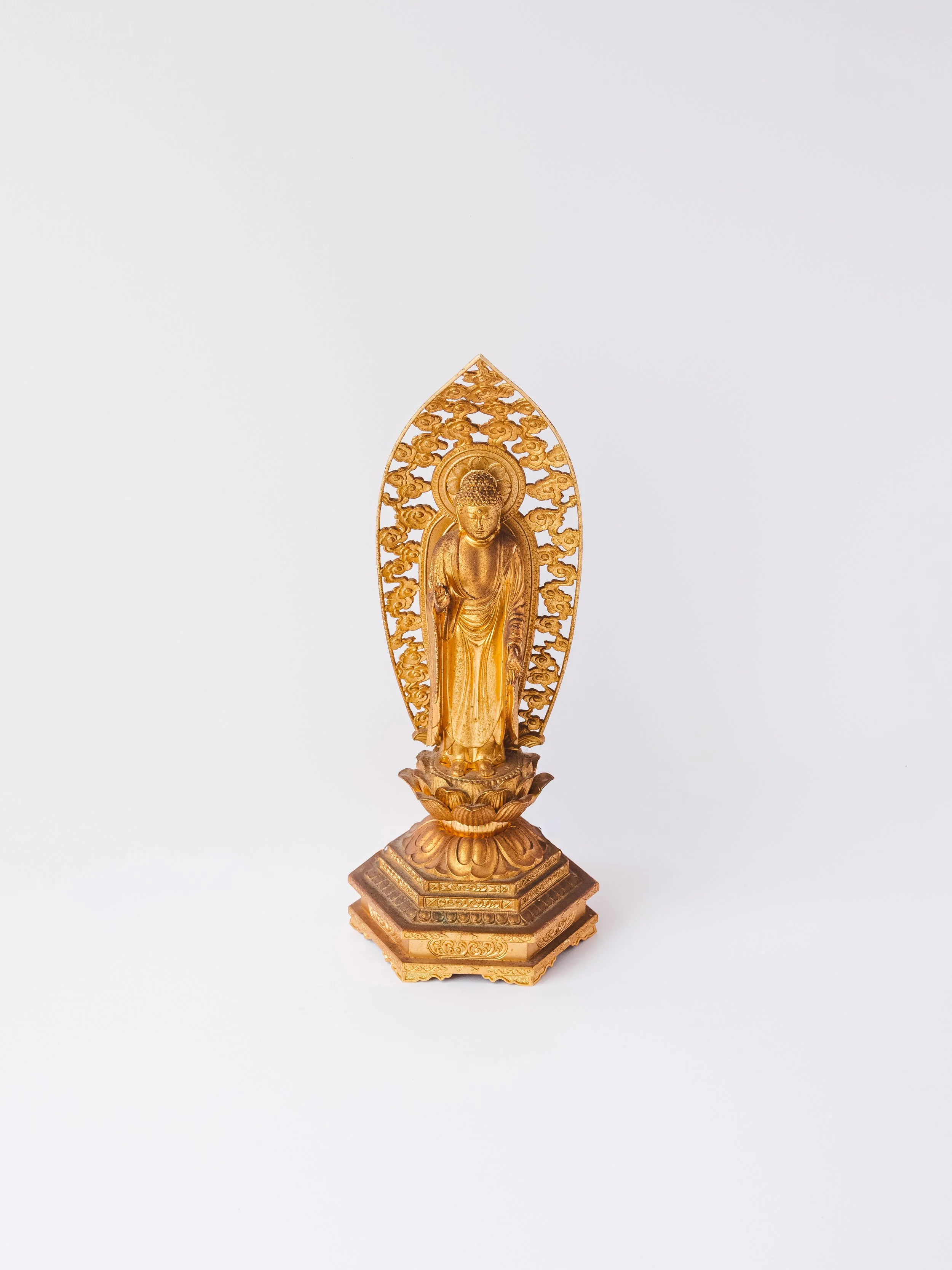 Image 1 of 9
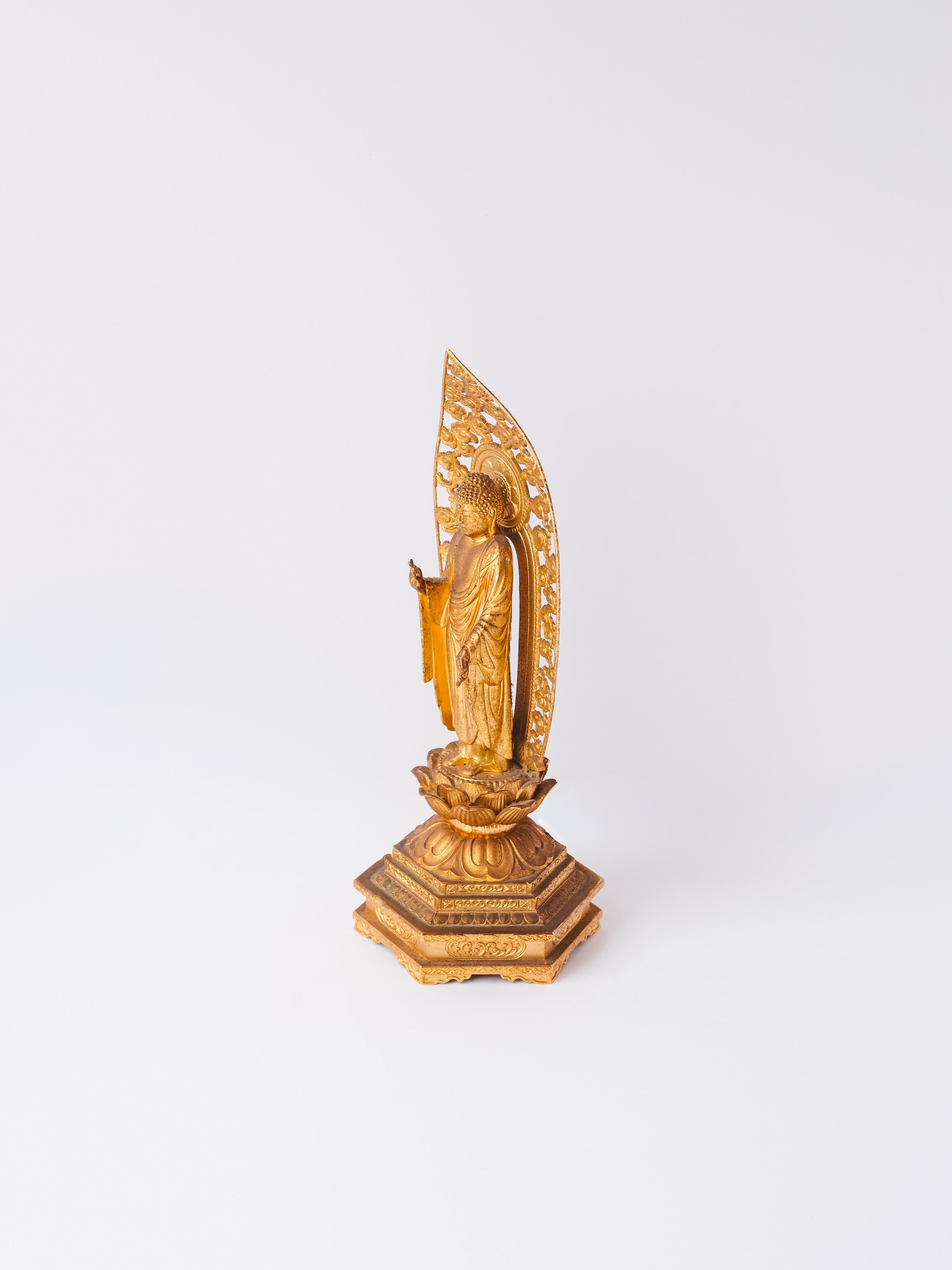 Image 2 of 9
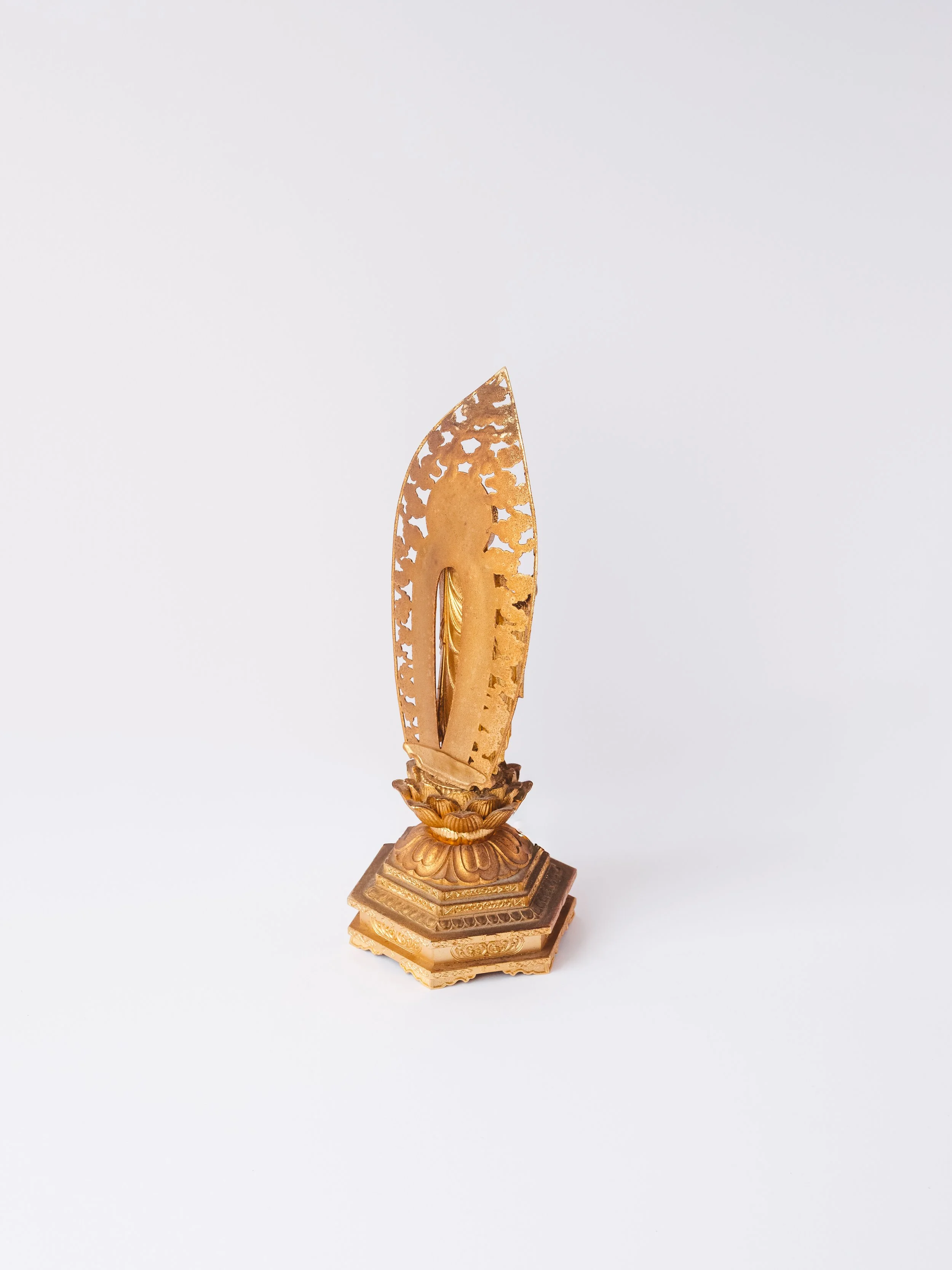 Image 3 of 9
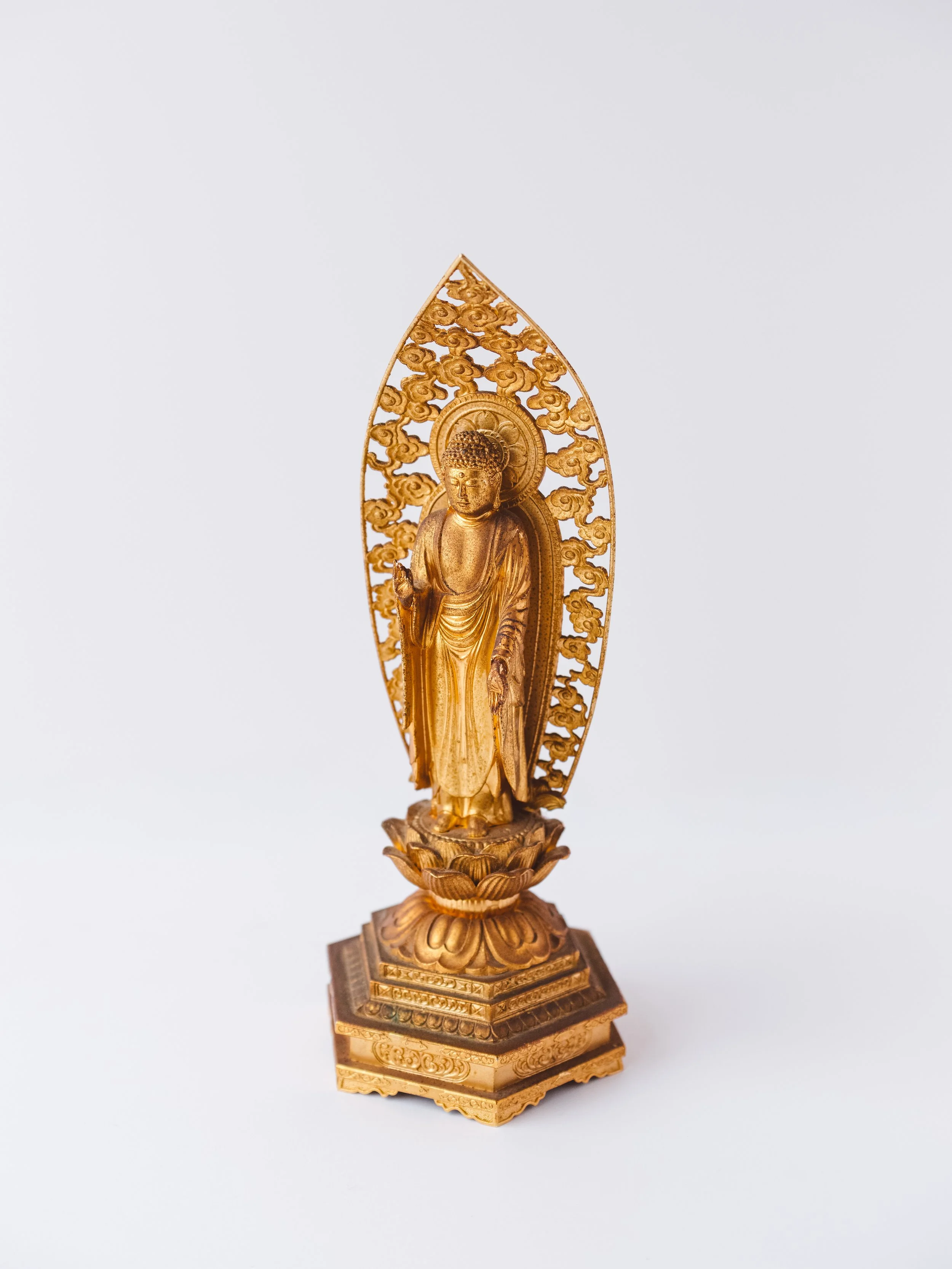 Image 4 of 9
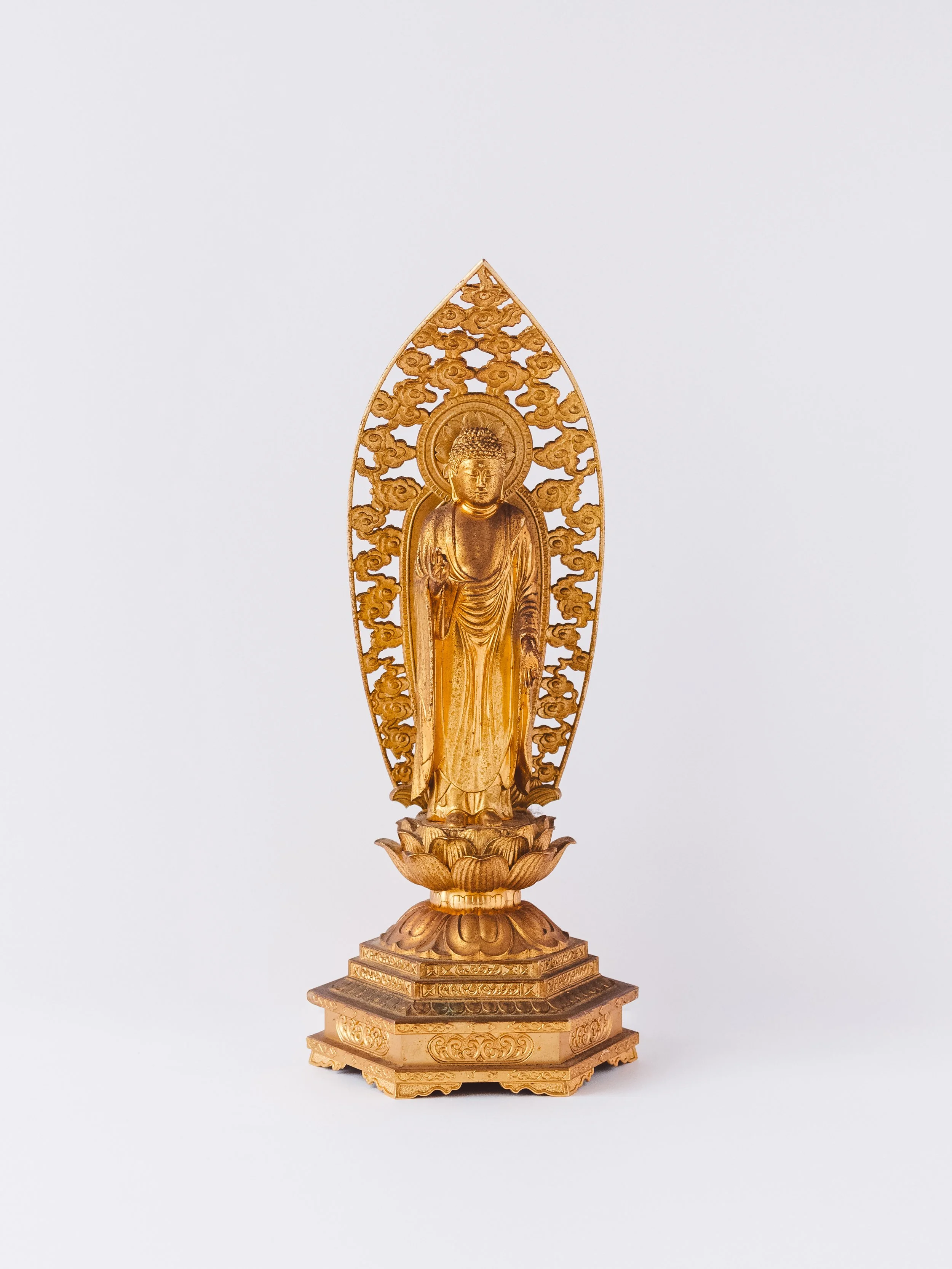 Image 5 of 9
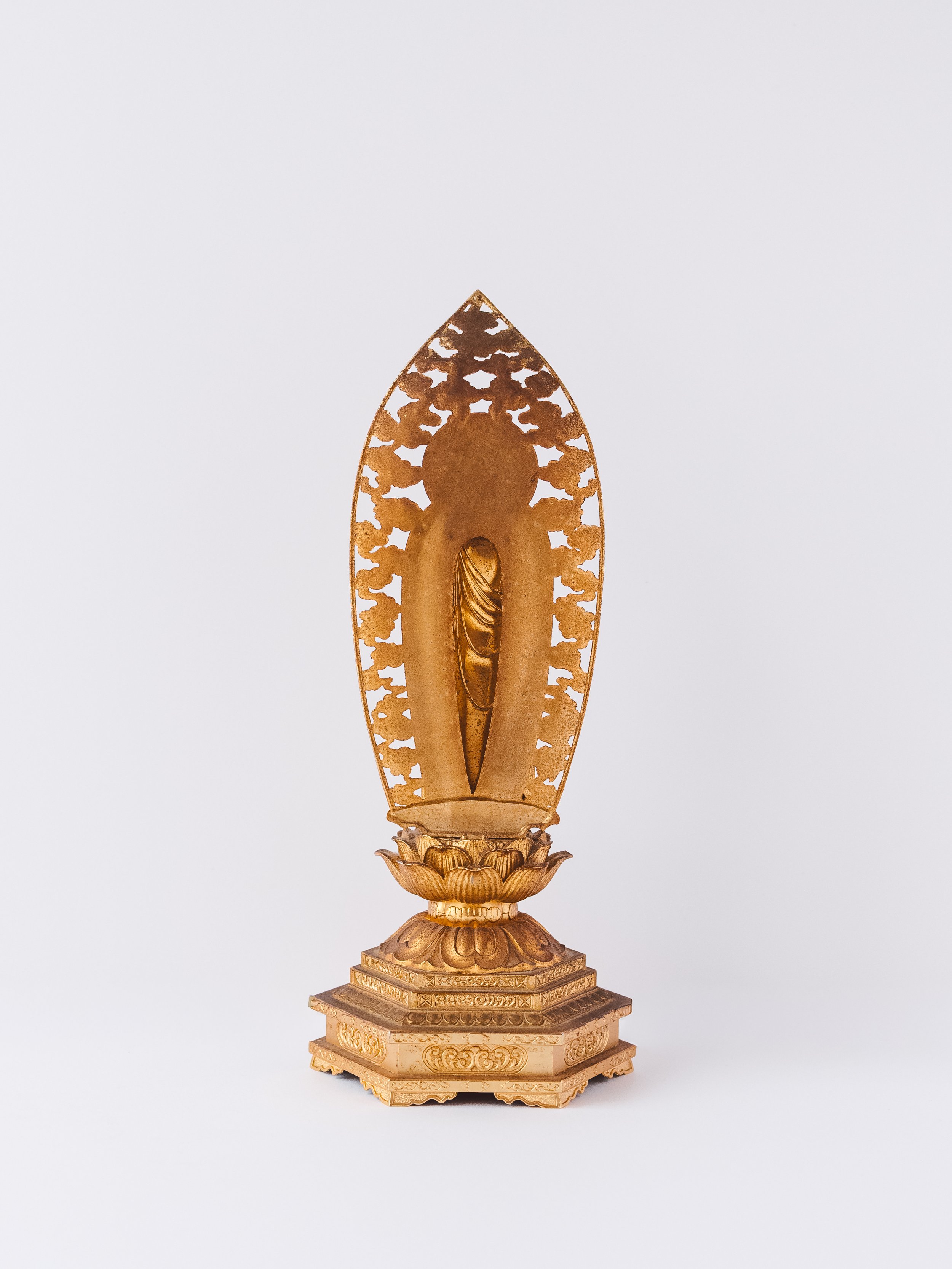 Image 6 of 9
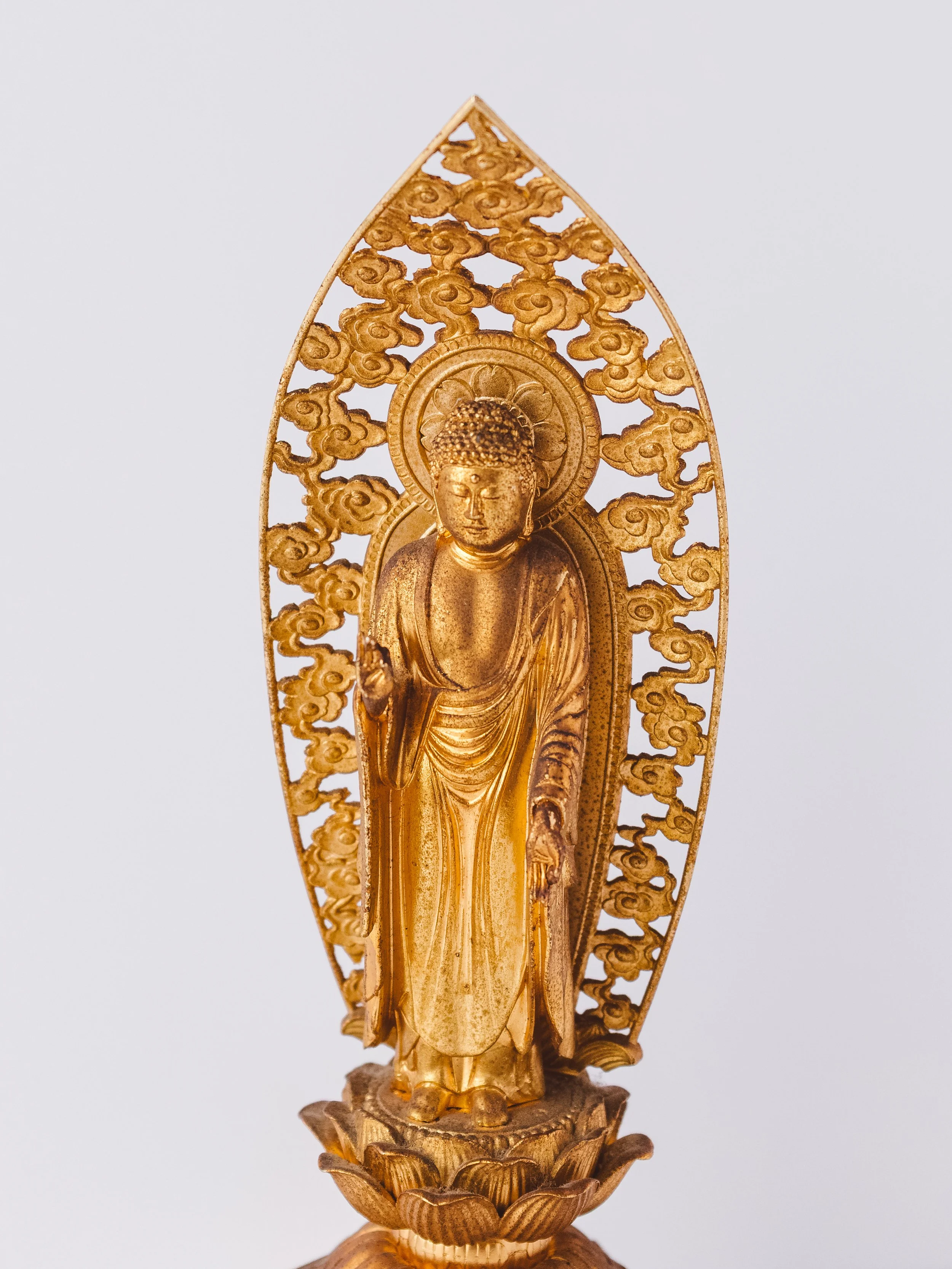 Image 7 of 9
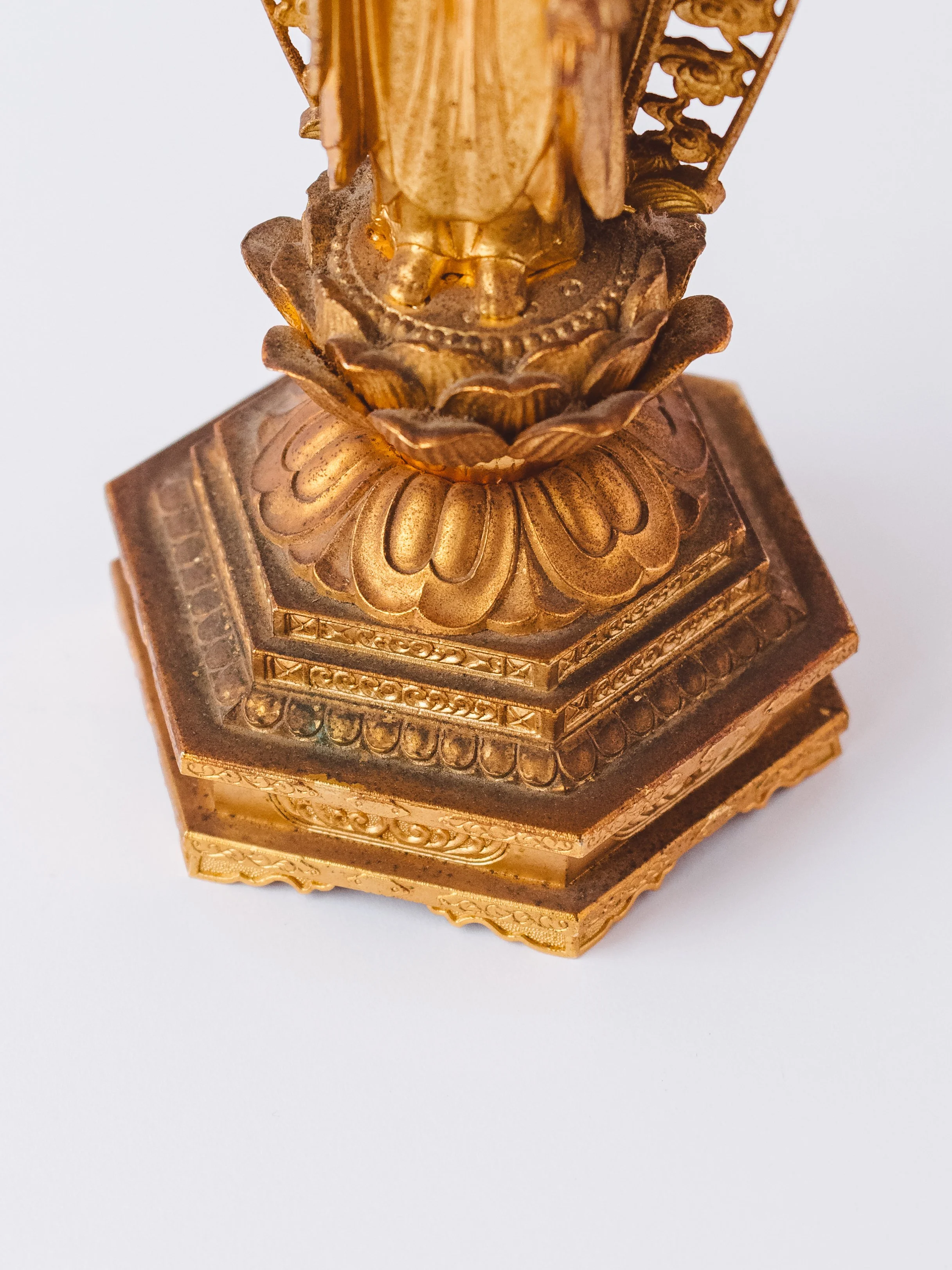 Image 8 of 9
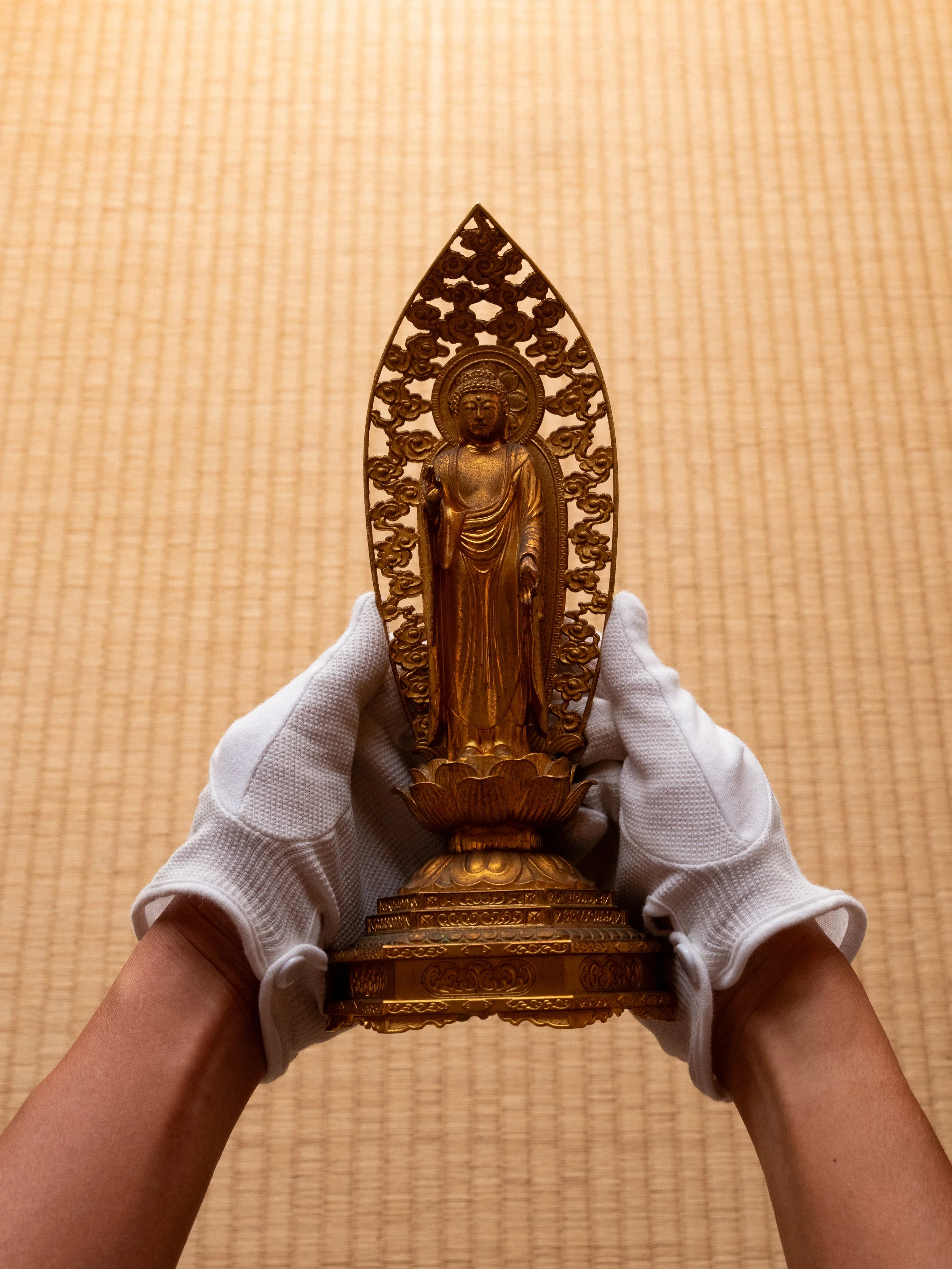 Image 9 of 9