【 The Concept 】
A monkey dressed as a priest. It sits cross-legged on a square cushion, knees drawn up, and on its head is a tall pointed cap of the kind worn by Shinto clergy. In both hands it grips a tall wand of folded paper streamers, stepped in a zigzag, and holds it upright against one shoulder — braced there the way a sentry holds a staff. This is the implement a priest waves to purify a space, to drive the impurity out of it. This is not a monkey being funny. It is a monkey doing a job, and the job is protection.
The reason a monkey holds that job is a pun, and the pun is old. In Japanese the word for monkey is saru, which is also the verb to leave, to depart. A monkey in the house sends misfortune out of it — ma ga saru, the evil departs. The same sound produces masaru, to prevail, to surpass. From that coincidence the monkey became a messenger of the mountain gods, a masaru, a sacred animal kept to turn away what should not enter. Dressing it in a priest's cap and giving it a purification wand is the literal version of that belief: not an animal that happens to be lucky, but an animal ordained to do the warding itself.
The archive already holds monkeys — the five hanging tricksters of HOOKED TROOP, all mischief and motion. This one is their opposite. Same animal, same pun, entirely inverted: where those play, this one presides. It sits perfectly still, robed and capped, and keeps watch.
【 The Function 】
602 grams, 20 centimeters tall, 9 centimeters wide at the base. Glazed porcelain, seated on a square plinth carved with a diamond lattice — the woven texture of a cushion or a tatami mat, the small consecrated ground the figure sits on. The low, wide base and the compact folded posture make it stable and self-contained; it sits where it is put and stays.
The figure comes with its original wooden box, the lid inscribed in ink and stamped with a red seal. Boxes of this kind function as certificates: they identify a piece as the genuine work of its kiln, and their presence is what allows a ceramic to keep its standing and its value over decades. This is the second piece in the archive to arrive with its original inscribed box.
【 The Texture 】
Pale blue-green celadon — the soft, cool, watery green of the tiger CELADON PROWL and the seated dogs of QUIET KIN, not the deep jade of the dragon COILED AUSPICE. The glaze is thick, glassy, and highly reflective, and it does what celadon does best: it pools. Wherever the form dips — the zigzag valleys of the paper wand, the diamond grid of the cushion, the folds of the robe, the crease behind the cap — the glaze runs deep and the green darkens. Wherever the form stands proud, it thins toward near-white. The color is a single glaze, and every gradation of it is the sculpture's own depth made visible.
Across the whole surface runs a fine web of crackle — kannyu, the network of hairline cracks in the glaze layer. It is not damage. It is deliberate, produced in the firing when the glaze and the body beneath it cool at different rates and the glaze settles into a fixed lacework of fine lines. It catches light across what would otherwise be an unbroken green, and it is the mark, to anyone who knows celadon, of the real thing rather than an imitation of it.
The eyes carry the one touch of paint: dark pupils on white, alert and slightly comic, the single note of expression on an otherwise solemn, ceremonial figure. The wand held at the shoulder is where the glaze pools most dramatically — the stepped zigzag traps the celadon in every notch, so the object the figure holds is also the greenest, deepest-colored thing on it.
【 Presence 】
The comedy and the solemnity sit on top of each other and neither wins. It is unmistakably a monkey — the face, the crouch, the bright watchful eyes are all monkey — and it is unmistakably a priest, capped and robed and armed with the tools of purification, sitting on consecrated ground with complete composure. The figure holds both at once: the animal that folklore made into a guardian, caught in the act of guarding.
And it takes the work seriously. There is nothing slack about the posture — knees up, both hands closed around the wand, back straight, the streamer-staff held firm against the shoulder, eyes forward. It has been set down on its square of woven ground to turn away whatever should not come in, and it is doing exactly that, in pale green porcelain, with a web of fine cracks across its surface and a wooden box that has kept it safe for its whole life. Same animal as the tricksters on the shelf below. Opposite job entirely.
Sourced from a private collection in the Shikoku region, Japan. Accompanied by its original inscribed wooden box.
【 The Concept 】
A monkey dressed as a priest. It sits cross-legged on a square cushion, knees drawn up, and on its head is a tall pointed cap of the kind worn by Shinto clergy. In both hands it grips a tall wand of folded paper streamers, stepped in a zigzag, and holds it upright against one shoulder — braced there the way a sentry holds a staff. This is the implement a priest waves to purify a space, to drive the impurity out of it. This is not a monkey being funny. It is a monkey doing a job, and the job is protection.
The reason a monkey holds that job is a pun, and the pun is old. In Japanese the word for monkey is saru, which is also the verb to leave, to depart. A monkey in the house sends misfortune out of it — ma ga saru, the evil departs. The same sound produces masaru, to prevail, to surpass. From that coincidence the monkey became a messenger of the mountain gods, a masaru, a sacred animal kept to turn away what should not enter. Dressing it in a priest's cap and giving it a purification wand is the literal version of that belief: not an animal that happens to be lucky, but an animal ordained to do the warding itself.
The archive already holds monkeys — the five hanging tricksters of HOOKED TROOP, all mischief and motion. This one is their opposite. Same animal, same pun, entirely inverted: where those play, this one presides. It sits perfectly still, robed and capped, and keeps watch.
【 The Function 】
602 grams, 20 centimeters tall, 9 centimeters wide at the base. Glazed porcelain, seated on a square plinth carved with a diamond lattice — the woven texture of a cushion or a tatami mat, the small consecrated ground the figure sits on. The low, wide base and the compact folded posture make it stable and self-contained; it sits where it is put and stays.
The figure comes with its original wooden box, the lid inscribed in ink and stamped with a red seal. Boxes of this kind function as certificates: they identify a piece as the genuine work of its kiln, and their presence is what allows a ceramic to keep its standing and its value over decades. This is the second piece in the archive to arrive with its original inscribed box.
【 The Texture 】
Pale blue-green celadon — the soft, cool, watery green of the tiger CELADON PROWL and the seated dogs of QUIET KIN, not the deep jade of the dragon COILED AUSPICE. The glaze is thick, glassy, and highly reflective, and it does what celadon does best: it pools. Wherever the form dips — the zigzag valleys of the paper wand, the diamond grid of the cushion, the folds of the robe, the crease behind the cap — the glaze runs deep and the green darkens. Wherever the form stands proud, it thins toward near-white. The color is a single glaze, and every gradation of it is the sculpture's own depth made visible.
Across the whole surface runs a fine web of crackle — kannyu, the network of hairline cracks in the glaze layer. It is not damage. It is deliberate, produced in the firing when the glaze and the body beneath it cool at different rates and the glaze settles into a fixed lacework of fine lines. It catches light across what would otherwise be an unbroken green, and it is the mark, to anyone who knows celadon, of the real thing rather than an imitation of it.
The eyes carry the one touch of paint: dark pupils on white, alert and slightly comic, the single note of expression on an otherwise solemn, ceremonial figure. The wand held at the shoulder is where the glaze pools most dramatically — the stepped zigzag traps the celadon in every notch, so the object the figure holds is also the greenest, deepest-colored thing on it.
【 Presence 】
The comedy and the solemnity sit on top of each other and neither wins. It is unmistakably a monkey — the face, the crouch, the bright watchful eyes are all monkey — and it is unmistakably a priest, capped and robed and armed with the tools of purification, sitting on consecrated ground with complete composure. The figure holds both at once: the animal that folklore made into a guardian, caught in the act of guarding.
And it takes the work seriously. There is nothing slack about the posture — knees up, both hands closed around the wand, back straight, the streamer-staff held firm against the shoulder, eyes forward. It has been set down on its square of woven ground to turn away whatever should not come in, and it is doing exactly that, in pale green porcelain, with a web of fine cracks across its surface and a wooden box that has kept it safe for its whole life. Same animal as the tricksters on the shelf below. Opposite job entirely.
Sourced from a private collection in the Shikoku region, Japan. Accompanied by its original inscribed wooden box.


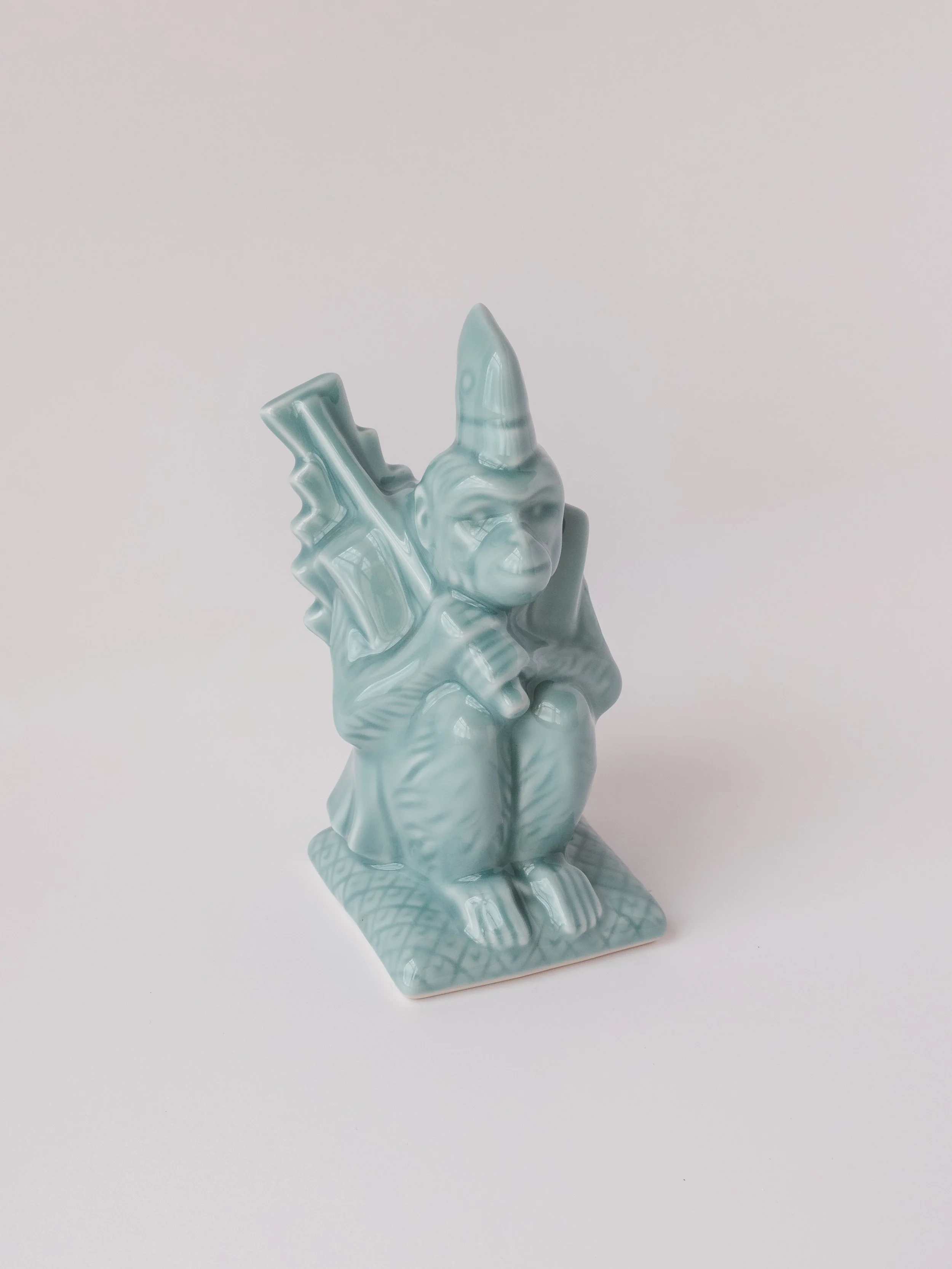 Image 1 of 11
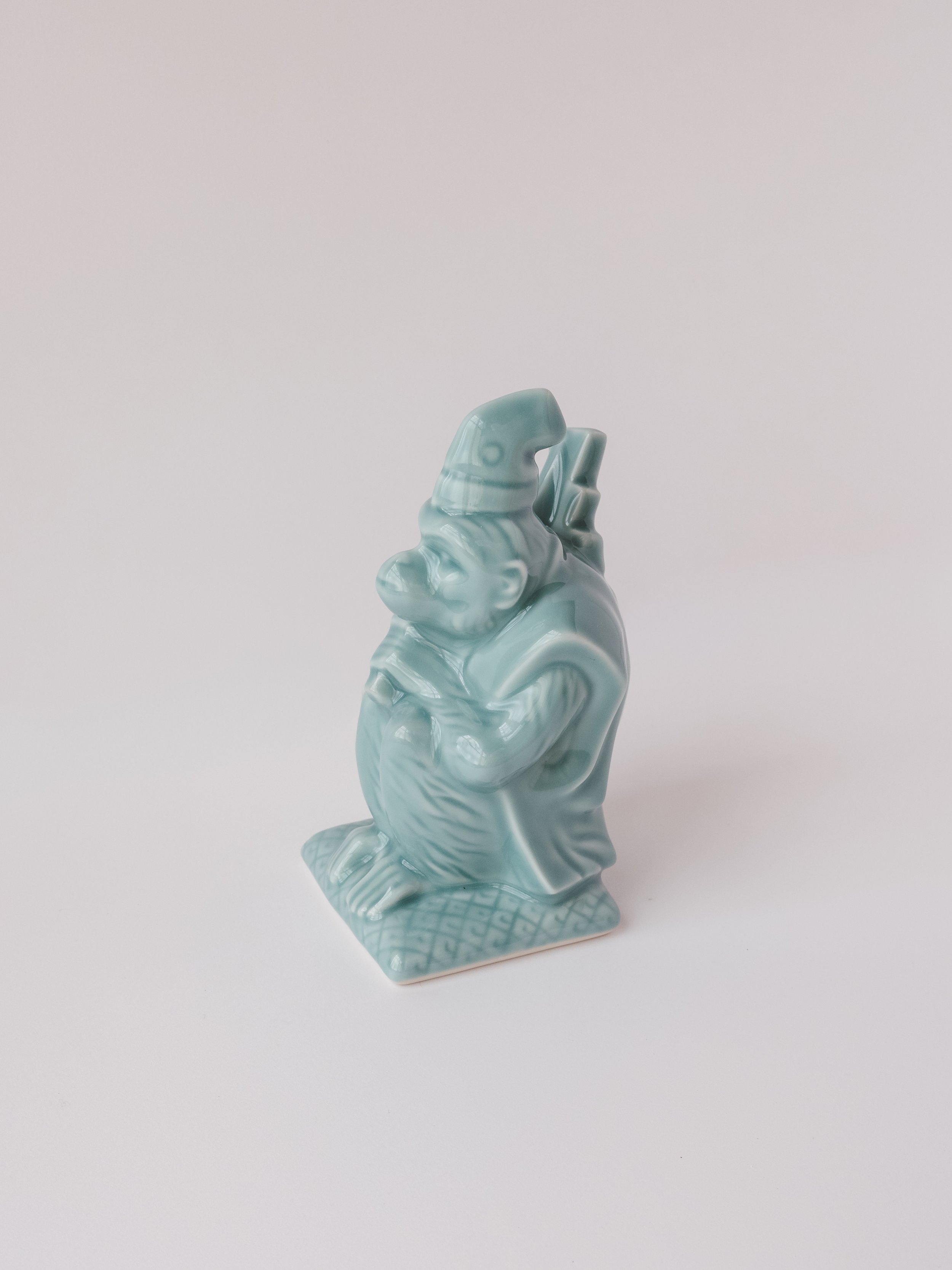 Image 2 of 11
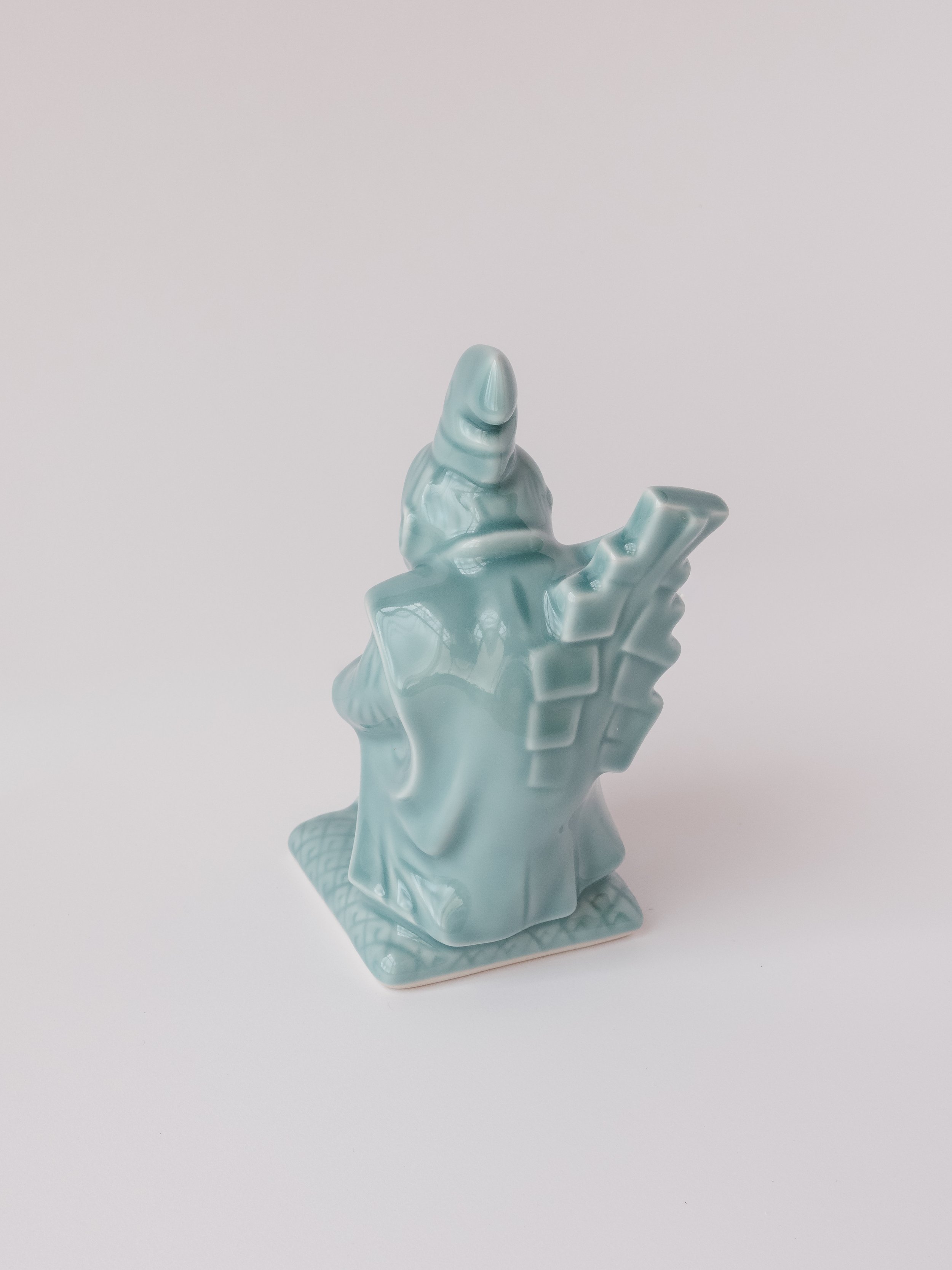 Image 3 of 11
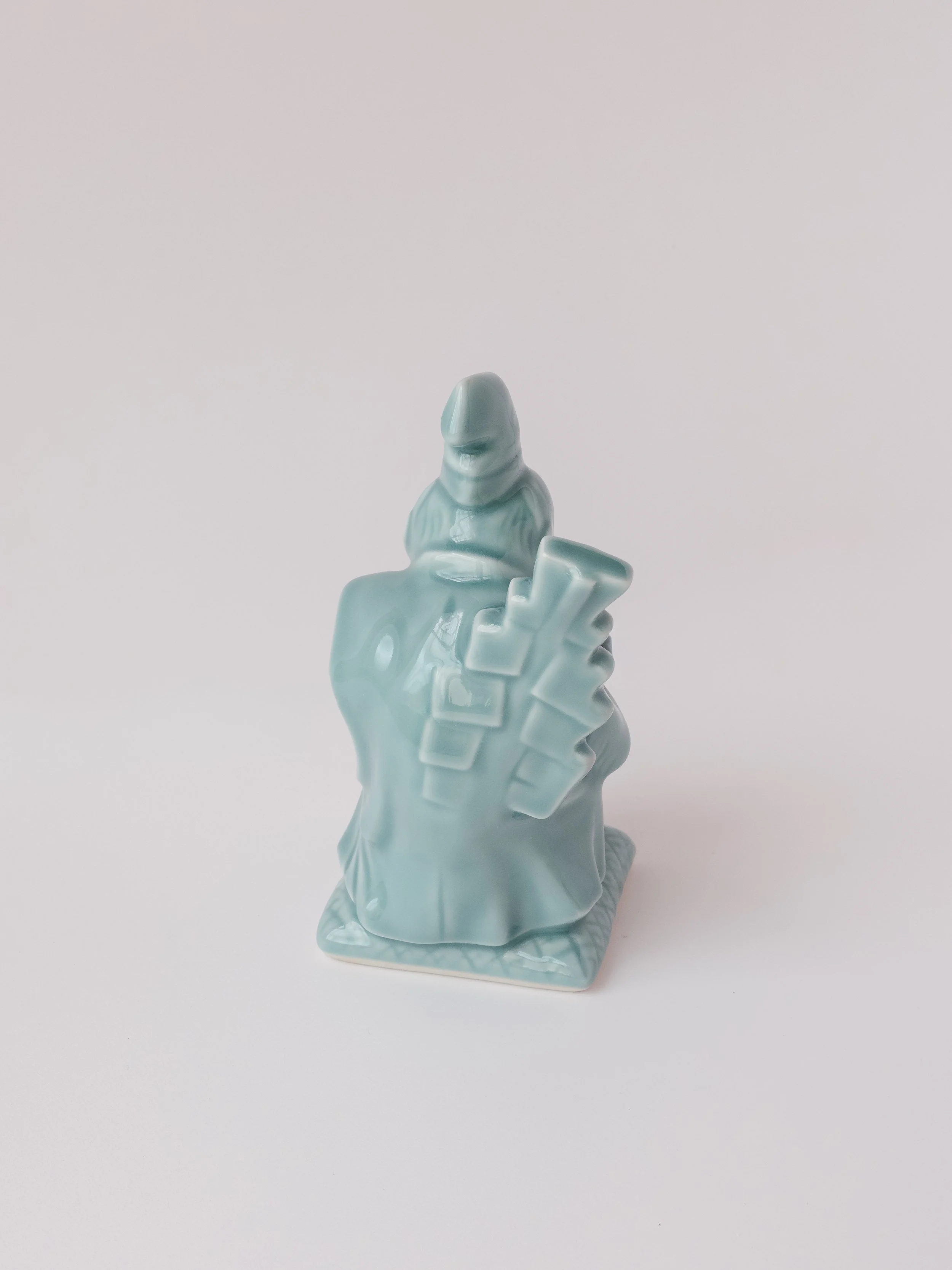 Image 4 of 11
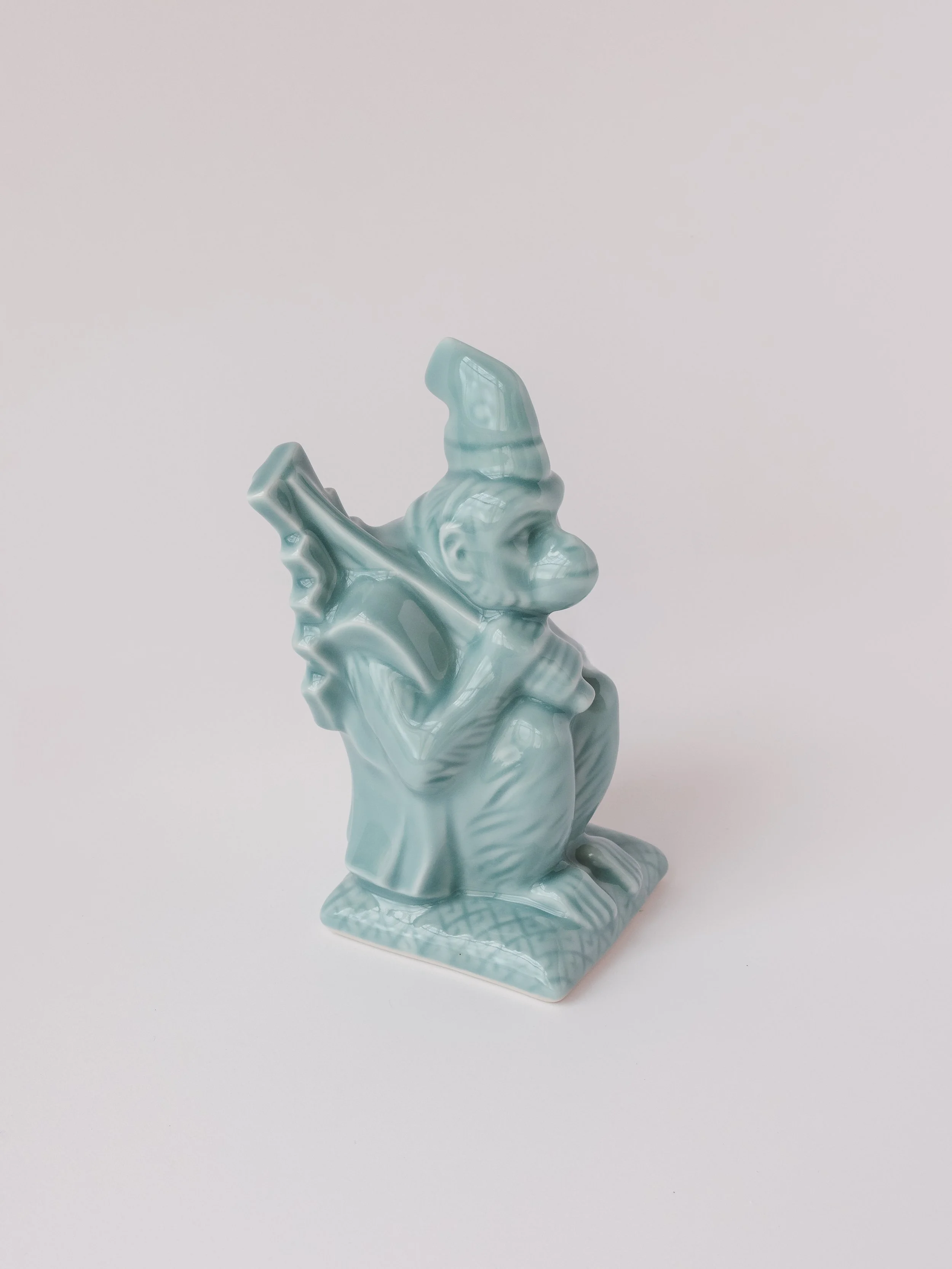 Image 5 of 11
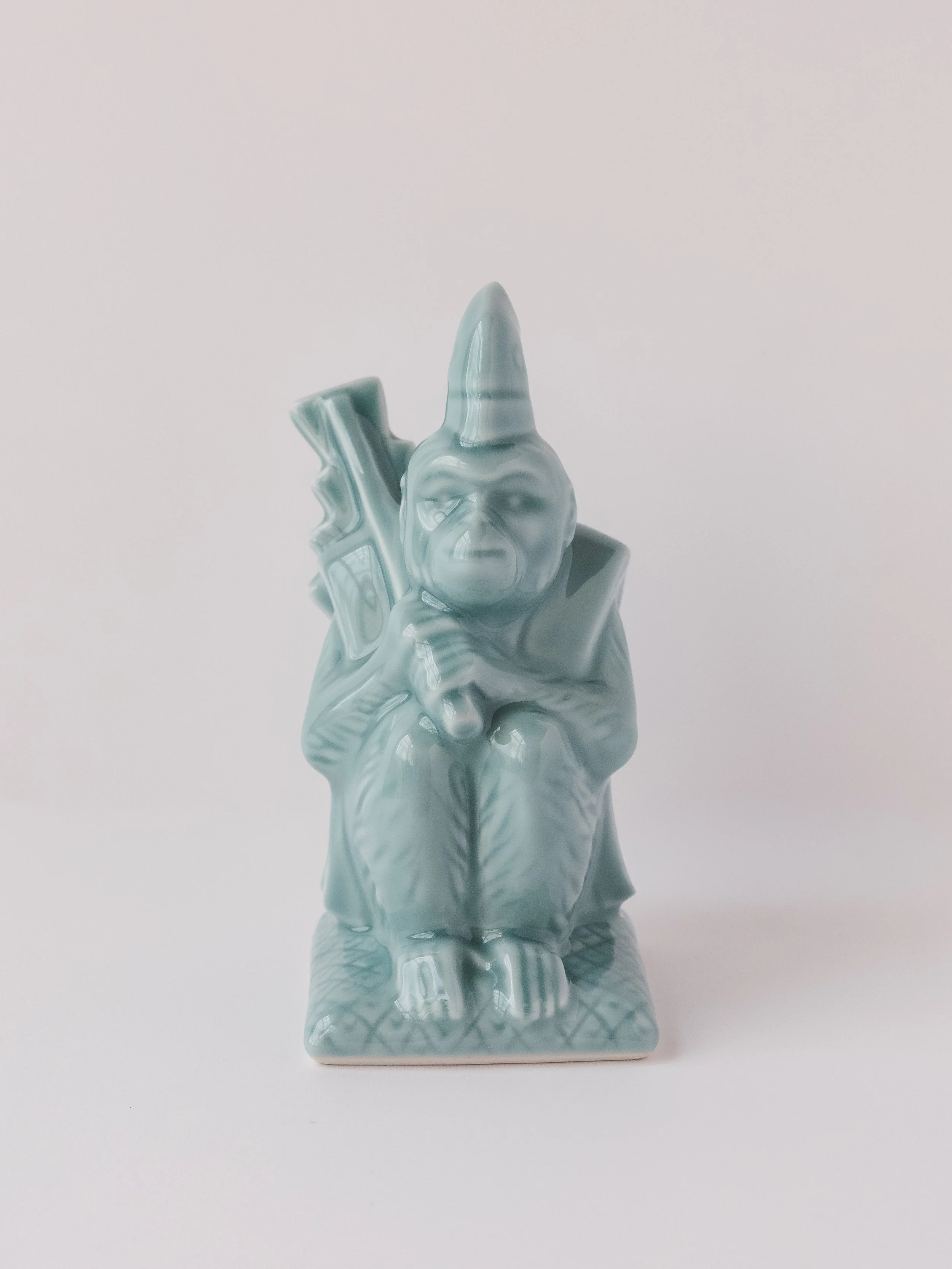 Image 6 of 11
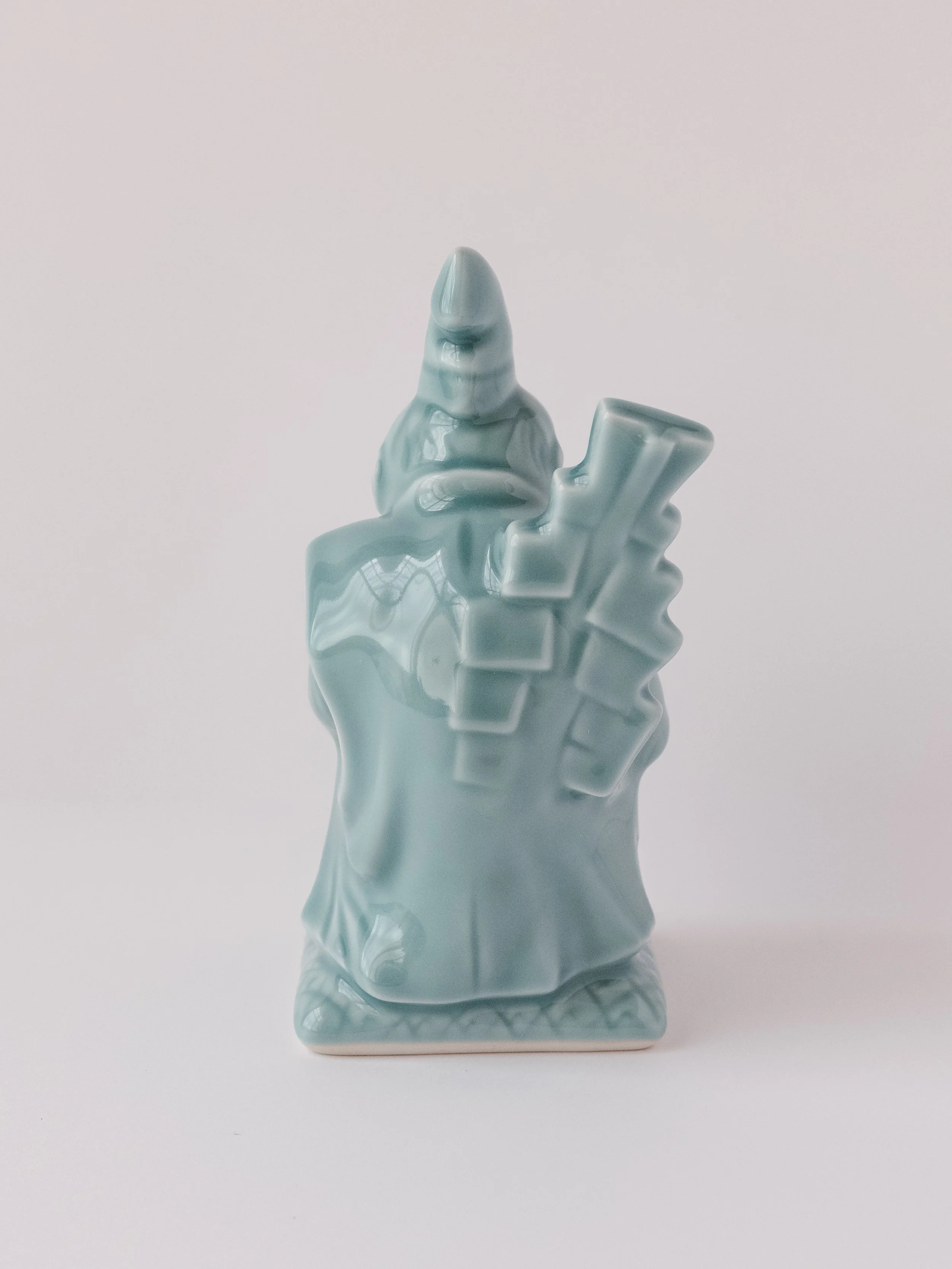 Image 7 of 11
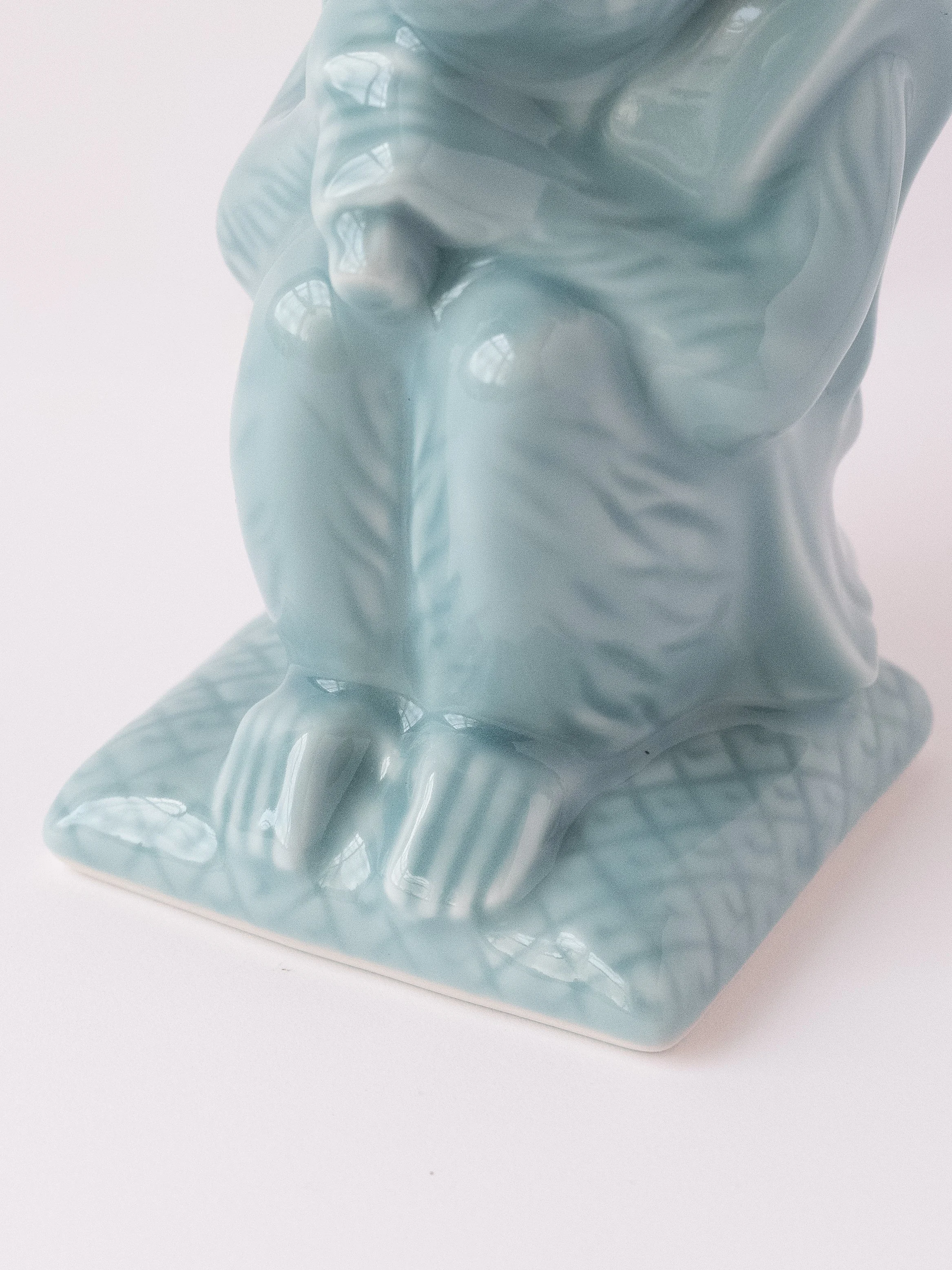 Image 8 of 11
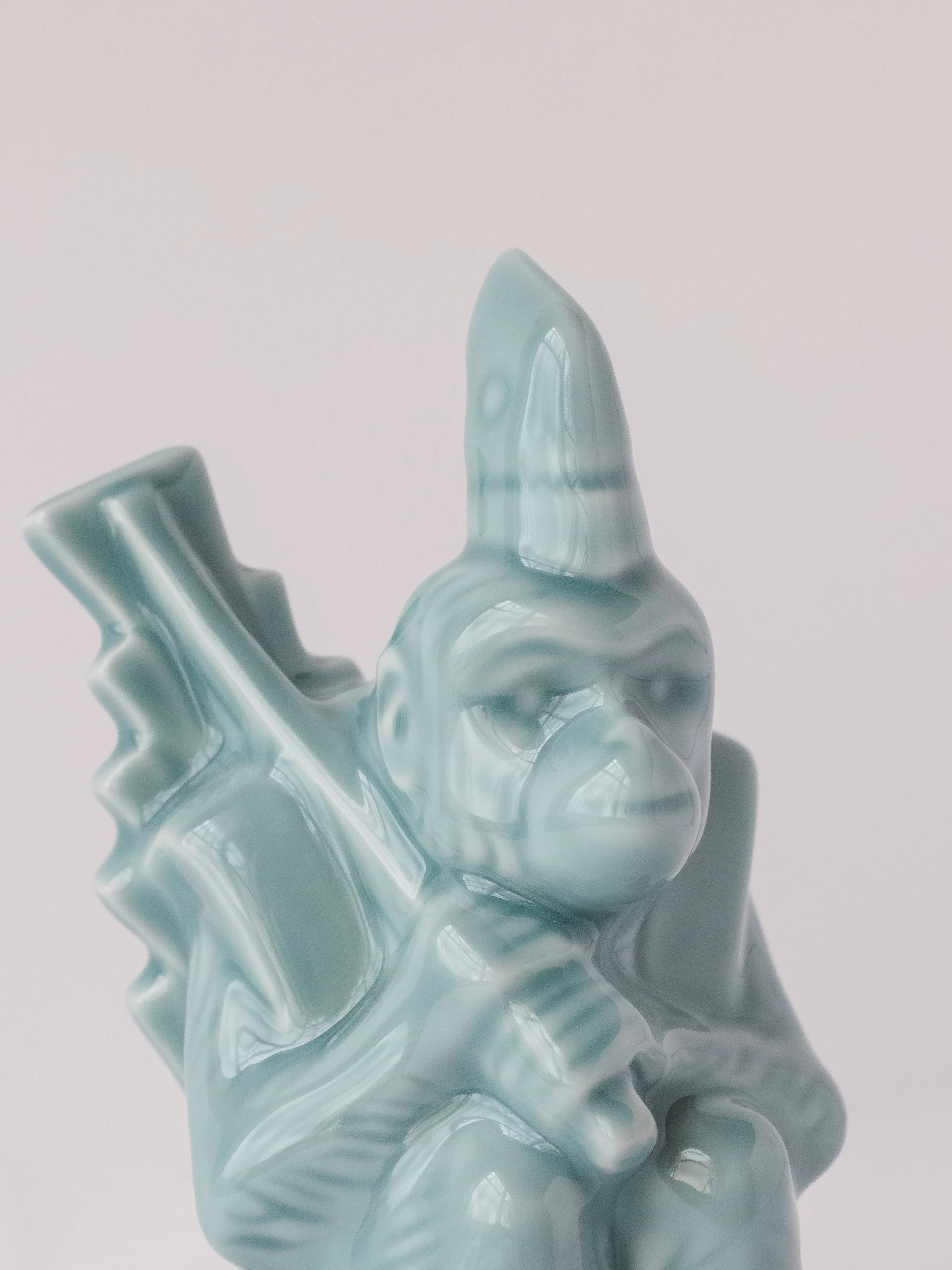 Image 9 of 11
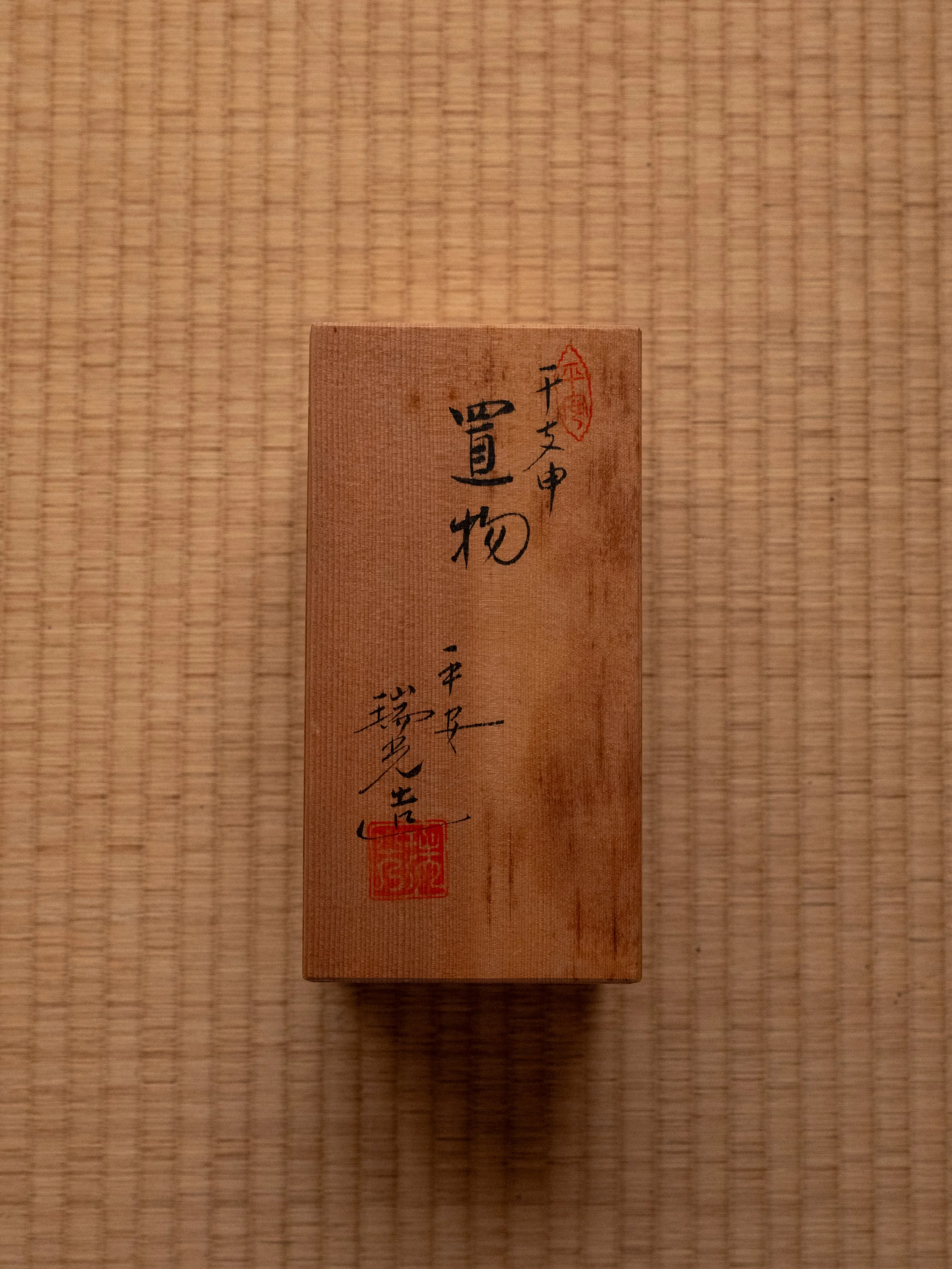 Image 10 of 11
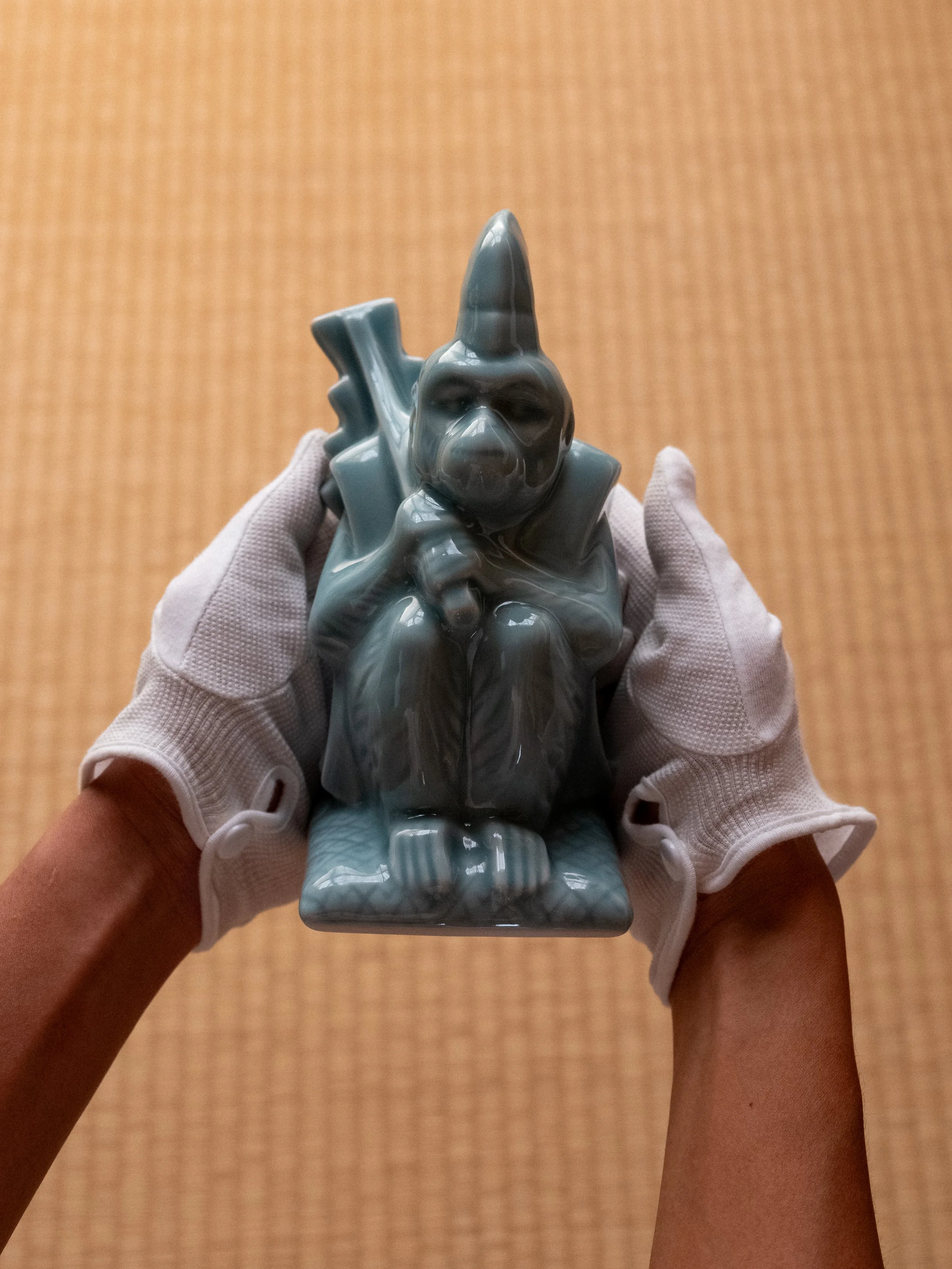 Image 11 of 11