【 The Concept 】
The scarecrow stands in the field all day. It does not move, does not eat, does not sleep. It knows everything that passes by, because it has nothing else to do but watch. In the oldest record of this country's mythology, the scarecrow was not a tool. It was a god — one who could not walk but knew all things under the sky. An anonymous metalsmith cast that god into a bottle opener. The face is spelled out in seven characters from the local alphabet, arranged to form two eyebrows, two eyes, a nose, a mouth, and a chin. The hat is a farmer's rain hat. The body is a farmer's coat. The legs are a single post that ends in a hook. The hook opens bottles.
【 The Function 】
A bottle opener in the shape of a scarecrow. Ten centimeters tall, six centimeters wide, half a centimeter thick. Sand-cast iron, matte black, flat on the back. The arms extend horizontally like a crossbar. The opener is the triangular gap at the bottom of the post — hook a cap under the edge, press down, and the crown comes off. A purple cord loops through a hole in the top of the hat for hanging. At 114 grams it doubles as a wall ornament or a paperweight. The face is not drawn. It is spelled.
【 The Texture 】
Sand-cast iron with the fine grit of a mold pressed into every surface. The black is matte and lightless — not painted, but baked onto the metal with lacquer and tea. The hat carries radiating grooves that mimic woven straw. The coat shows folds at the collar and a belt at the waist. The face is raised in relief — seven curved strokes standing proud of the surface, legible to the touch with eyes closed. Where time has passed, faint brown oxidation has crept into the edges and the creases of the coat, like rust on a fence post left standing through too many seasons.
【 Presence 】
It hangs on a wall or lies on a desk, and either way it watches. The expression never changes. It is not happy or sad — it is the simplest possible arrangement of lines that still reads as a face. Two arches for brows. Two circles for eyes. A curve for a mouth, turned slightly upward. It has the look of something that has seen every bird in the field and is no longer impressed. Hang it in the kitchen and it does what it was always meant to do: stand in one place, watch everything, and open whatever needs opening.
Sourced from a private collection in northern Japan.
【 The Concept 】
The scarecrow stands in the field all day. It does not move, does not eat, does not sleep. It knows everything that passes by, because it has nothing else to do but watch. In the oldest record of this country's mythology, the scarecrow was not a tool. It was a god — one who could not walk but knew all things under the sky. An anonymous metalsmith cast that god into a bottle opener. The face is spelled out in seven characters from the local alphabet, arranged to form two eyebrows, two eyes, a nose, a mouth, and a chin. The hat is a farmer's rain hat. The body is a farmer's coat. The legs are a single post that ends in a hook. The hook opens bottles.
【 The Function 】
A bottle opener in the shape of a scarecrow. Ten centimeters tall, six centimeters wide, half a centimeter thick. Sand-cast iron, matte black, flat on the back. The arms extend horizontally like a crossbar. The opener is the triangular gap at the bottom of the post — hook a cap under the edge, press down, and the crown comes off. A purple cord loops through a hole in the top of the hat for hanging. At 114 grams it doubles as a wall ornament or a paperweight. The face is not drawn. It is spelled.
【 The Texture 】
Sand-cast iron with the fine grit of a mold pressed into every surface. The black is matte and lightless — not painted, but baked onto the metal with lacquer and tea. The hat carries radiating grooves that mimic woven straw. The coat shows folds at the collar and a belt at the waist. The face is raised in relief — seven curved strokes standing proud of the surface, legible to the touch with eyes closed. Where time has passed, faint brown oxidation has crept into the edges and the creases of the coat, like rust on a fence post left standing through too many seasons.
【 Presence 】
It hangs on a wall or lies on a desk, and either way it watches. The expression never changes. It is not happy or sad — it is the simplest possible arrangement of lines that still reads as a face. Two arches for brows. Two circles for eyes. A curve for a mouth, turned slightly upward. It has the look of something that has seen every bird in the field and is no longer impressed. Hang it in the kitchen and it does what it was always meant to do: stand in one place, watch everything, and open whatever needs opening.
Sourced from a private collection in northern Japan.


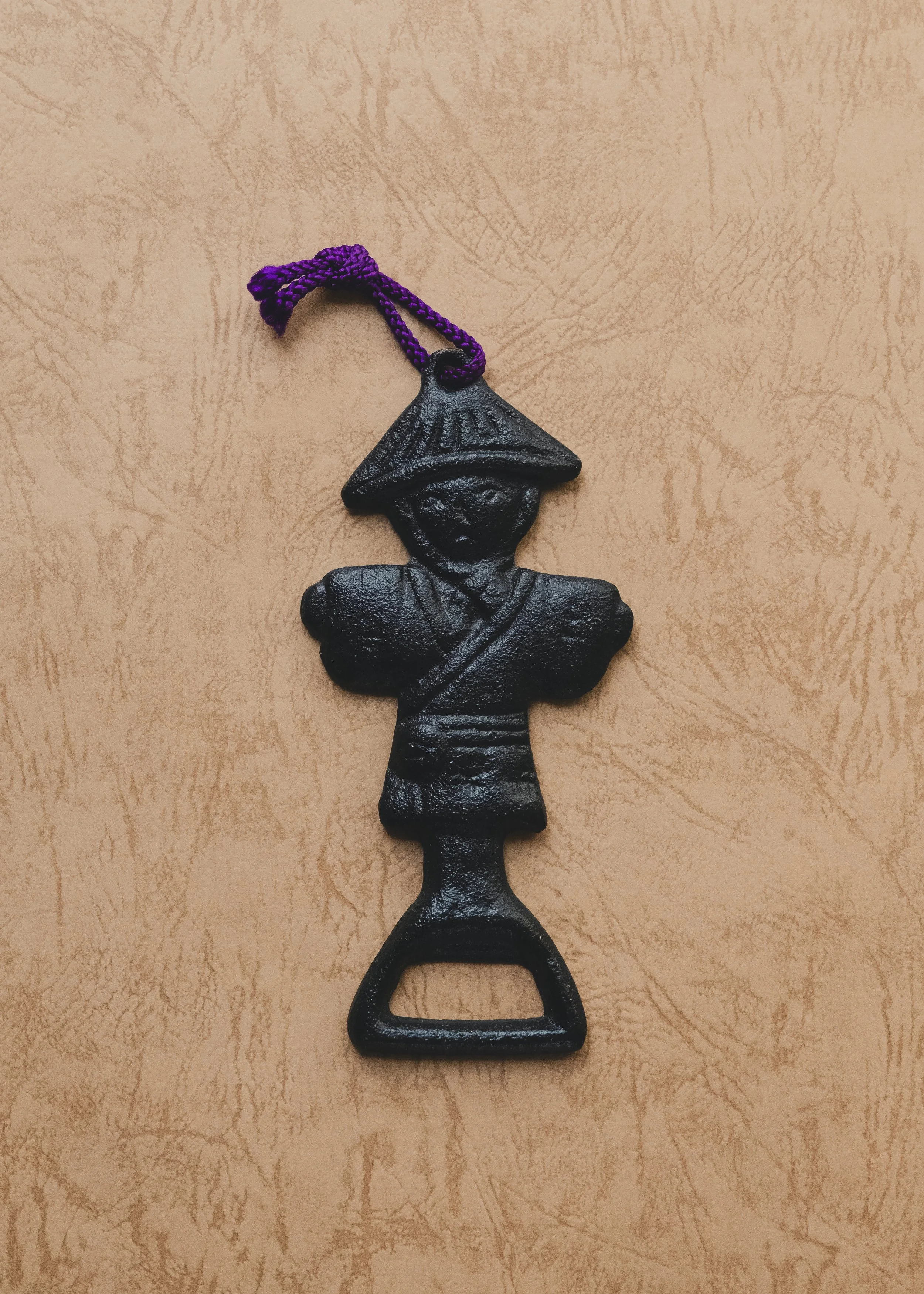 Image 1 of 3
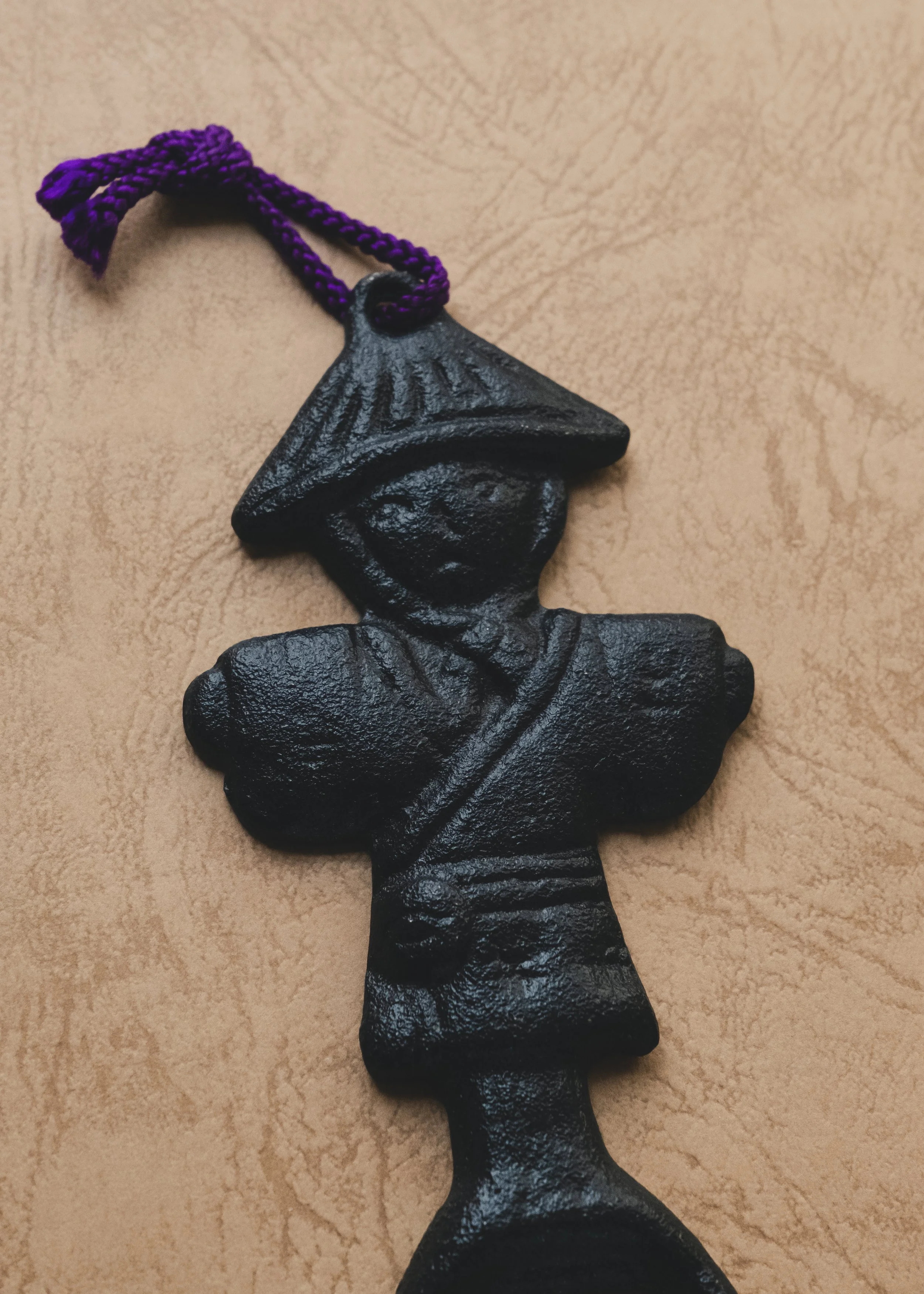 Image 2 of 3
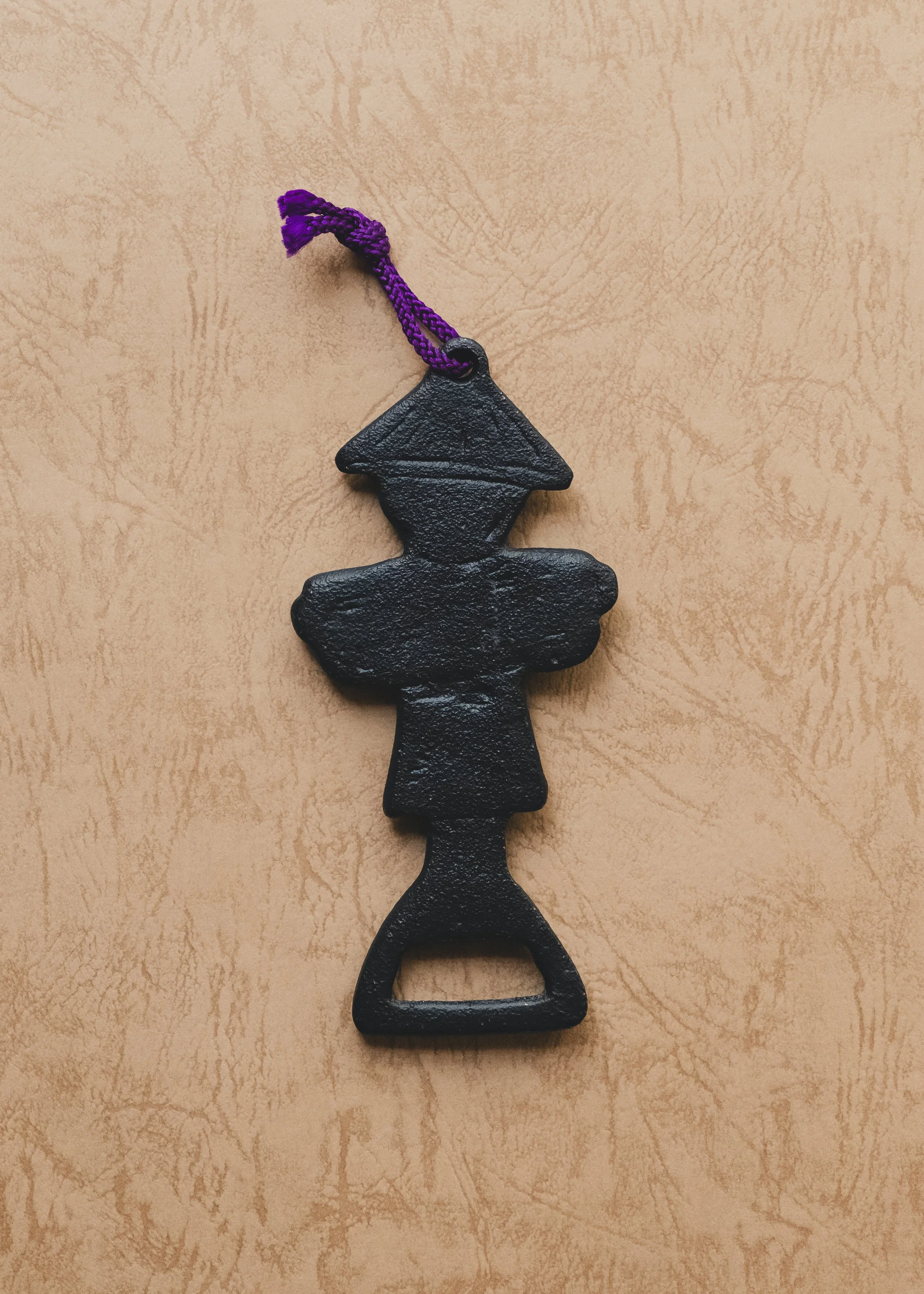 Image 3 of 3