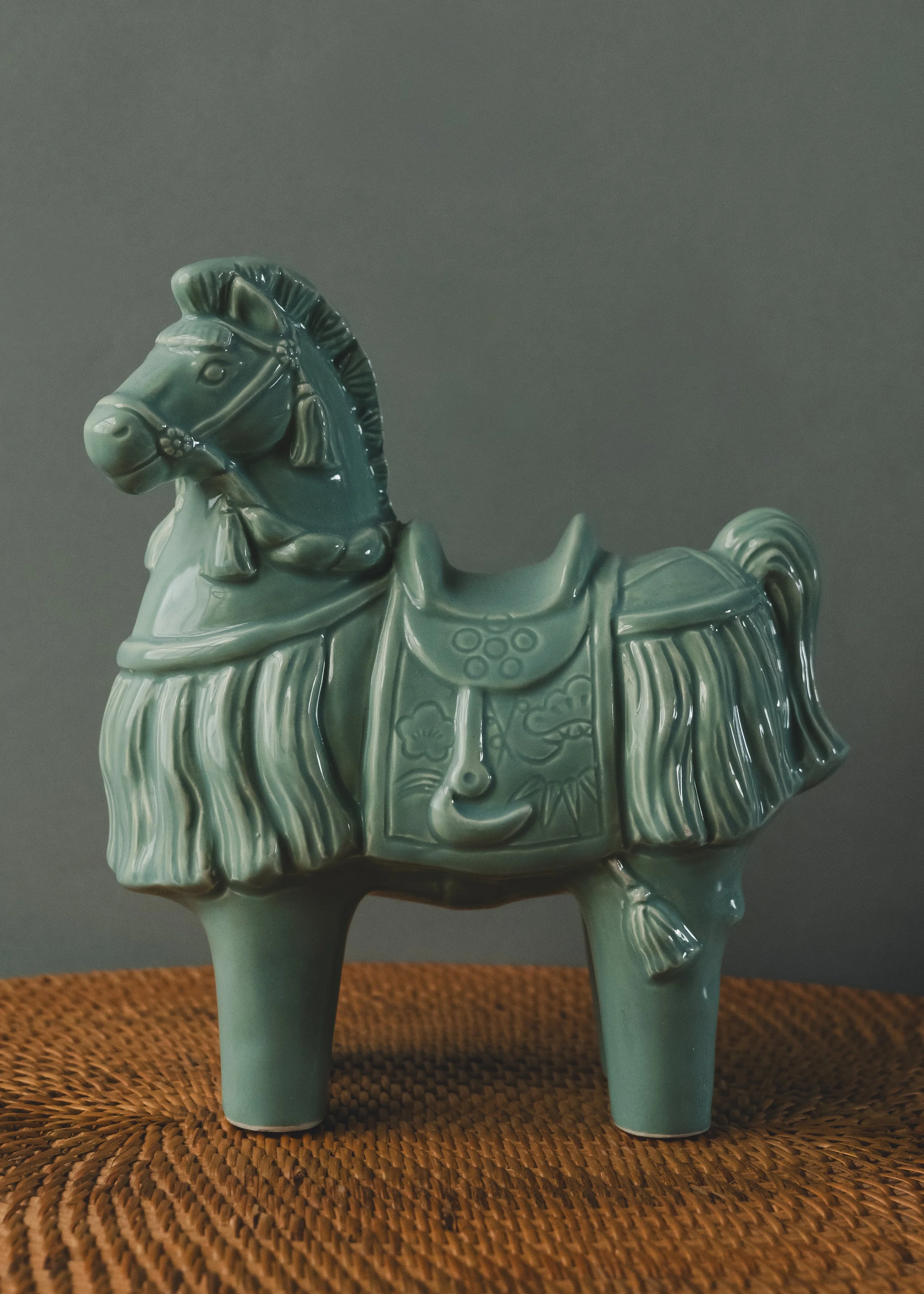
JADE STALLION 1960

$250.00
SOLD

【 The Concept 】

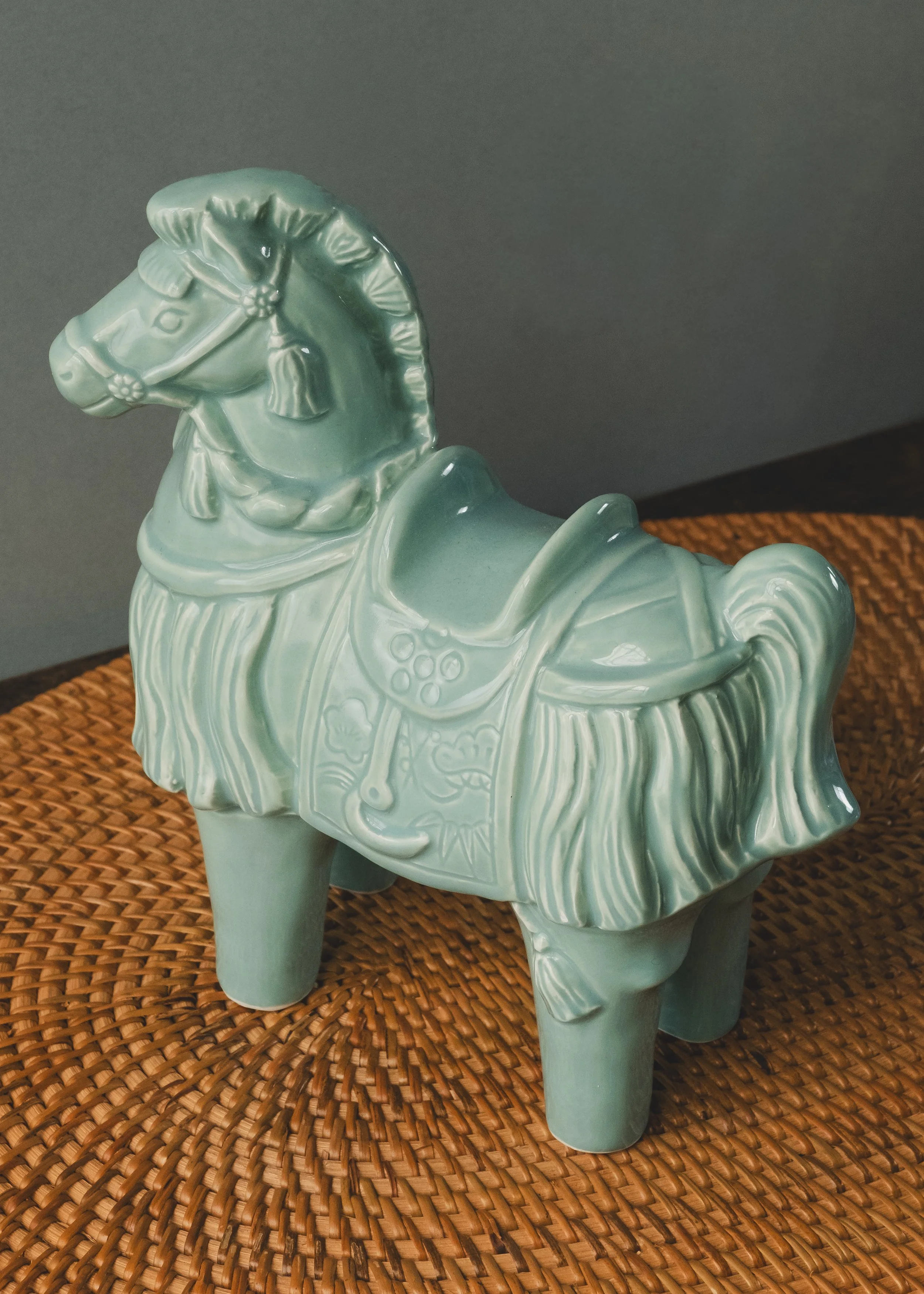
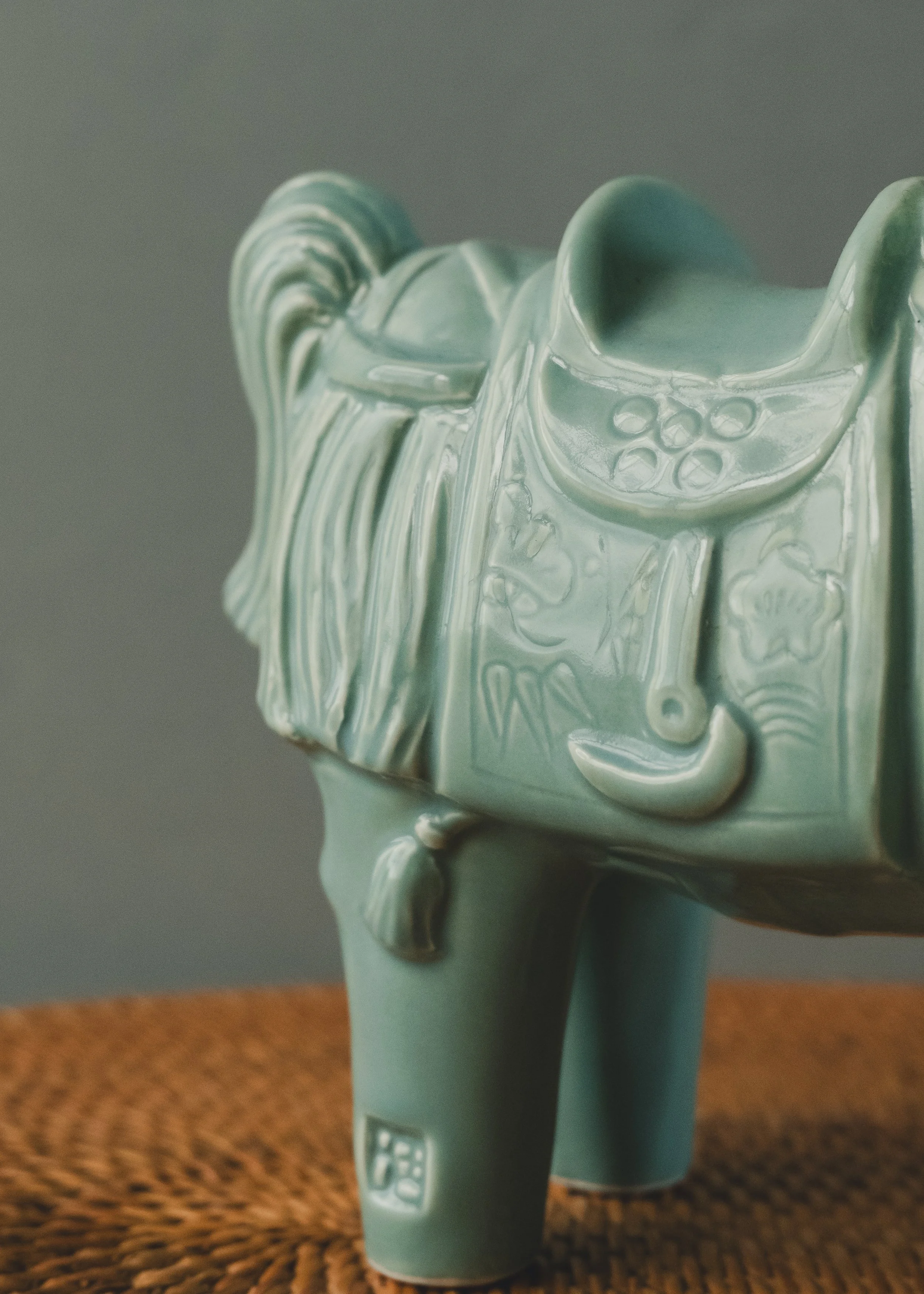
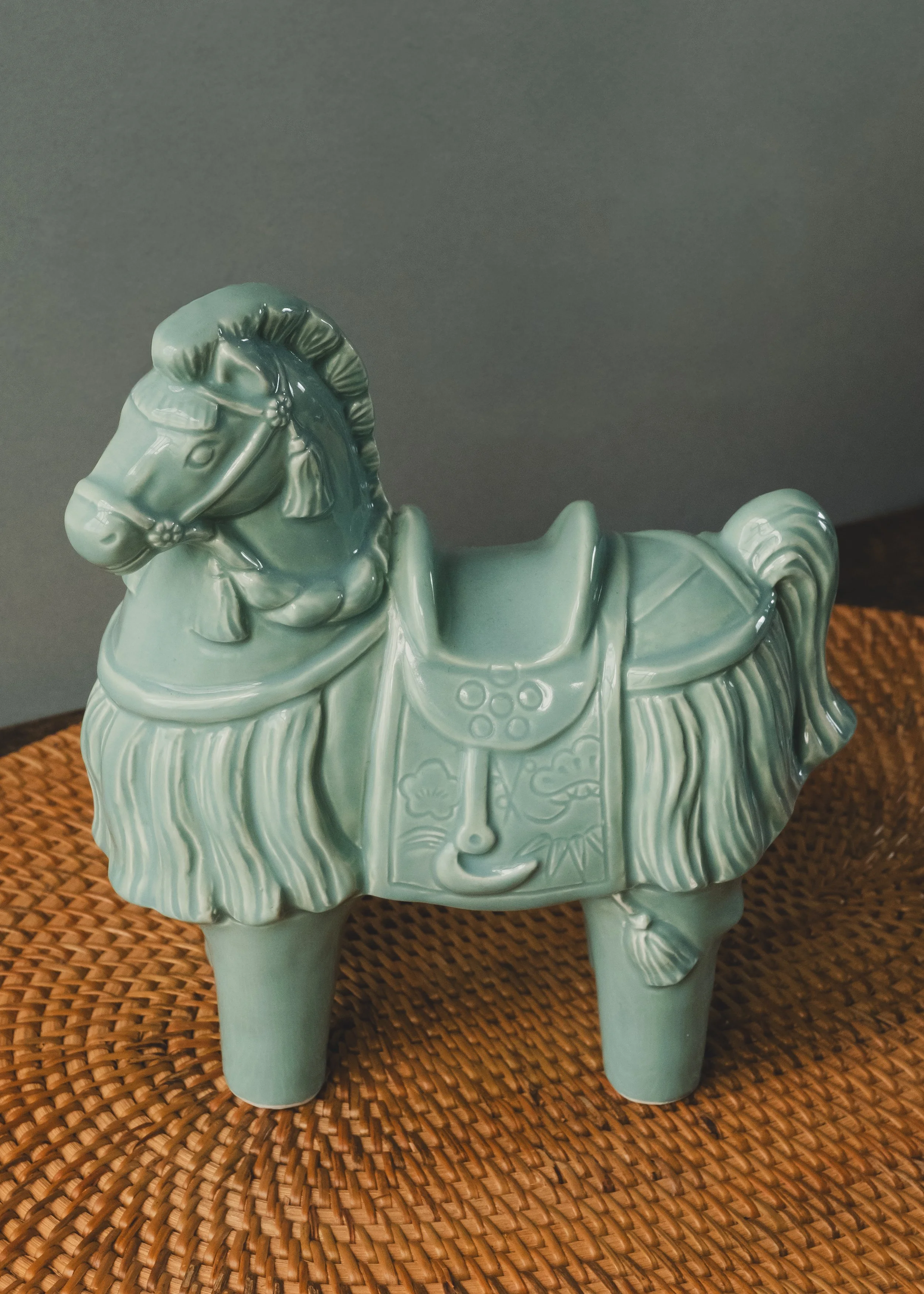
In ancient East Asia, there was a stone more valuable than gold. They called it jade — and for centuries, every attempt to replicate its color in clay ended in failure. Then a potter discovered that iron, starved of oxygen inside a sealed kiln, would turn green. Not painted green. Green from within — the way jade is green from within. The technique became the most coveted in the ceramic world. An anonymous craftsman took that technique and applied it to a form that had nothing to do with vessels or bowls. They made a horse. Not a running horse, not a rearing horse — a standing one, legs straight, head level, facing forward with the plain composure of an animal that has no reason to move. The glaze settled into the carved lines of the saddle, darkened in the grooves of the mane, and caught the light along the ridge of the spine in a way that changes with the hour of the day.

【 The Function 】

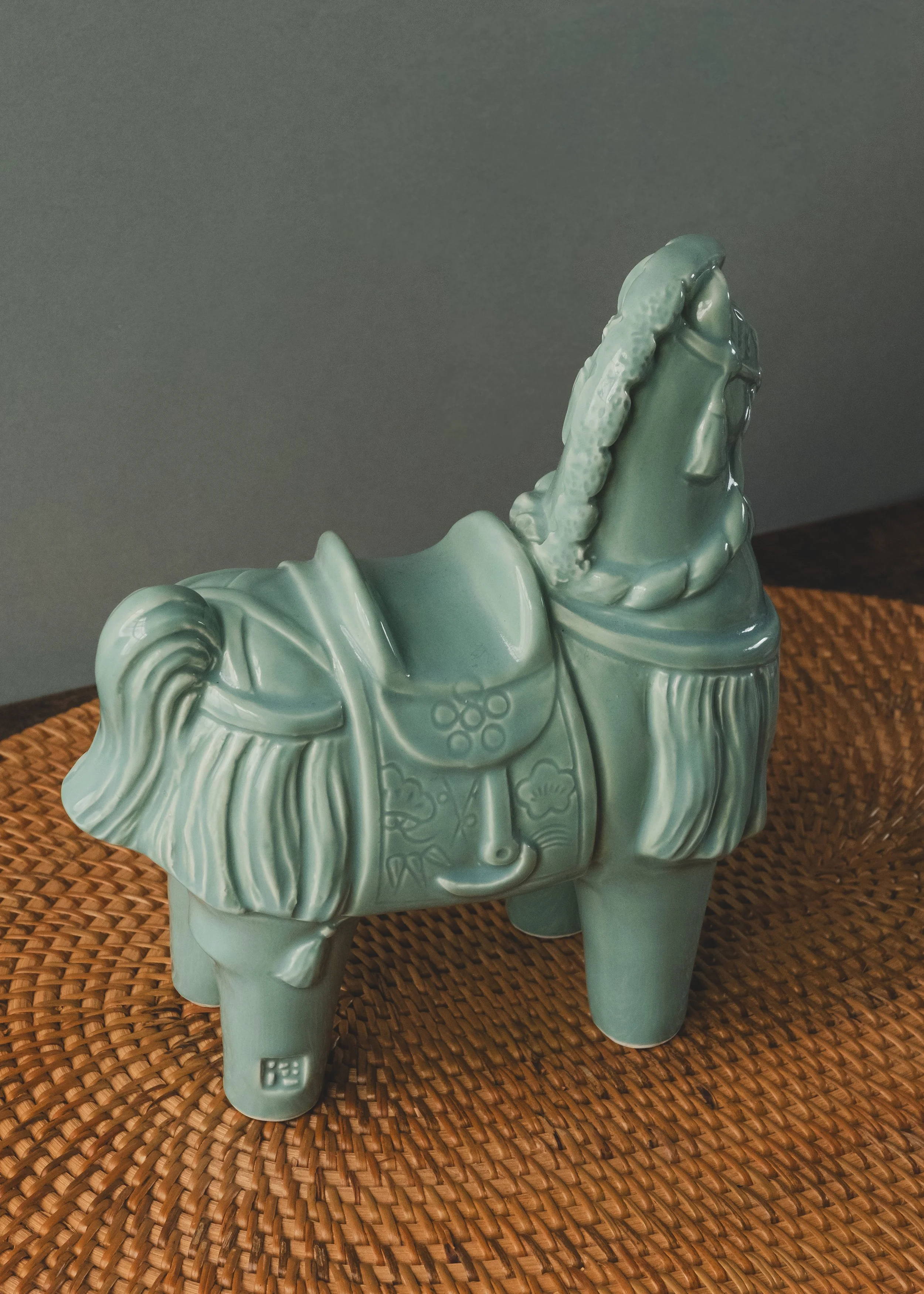
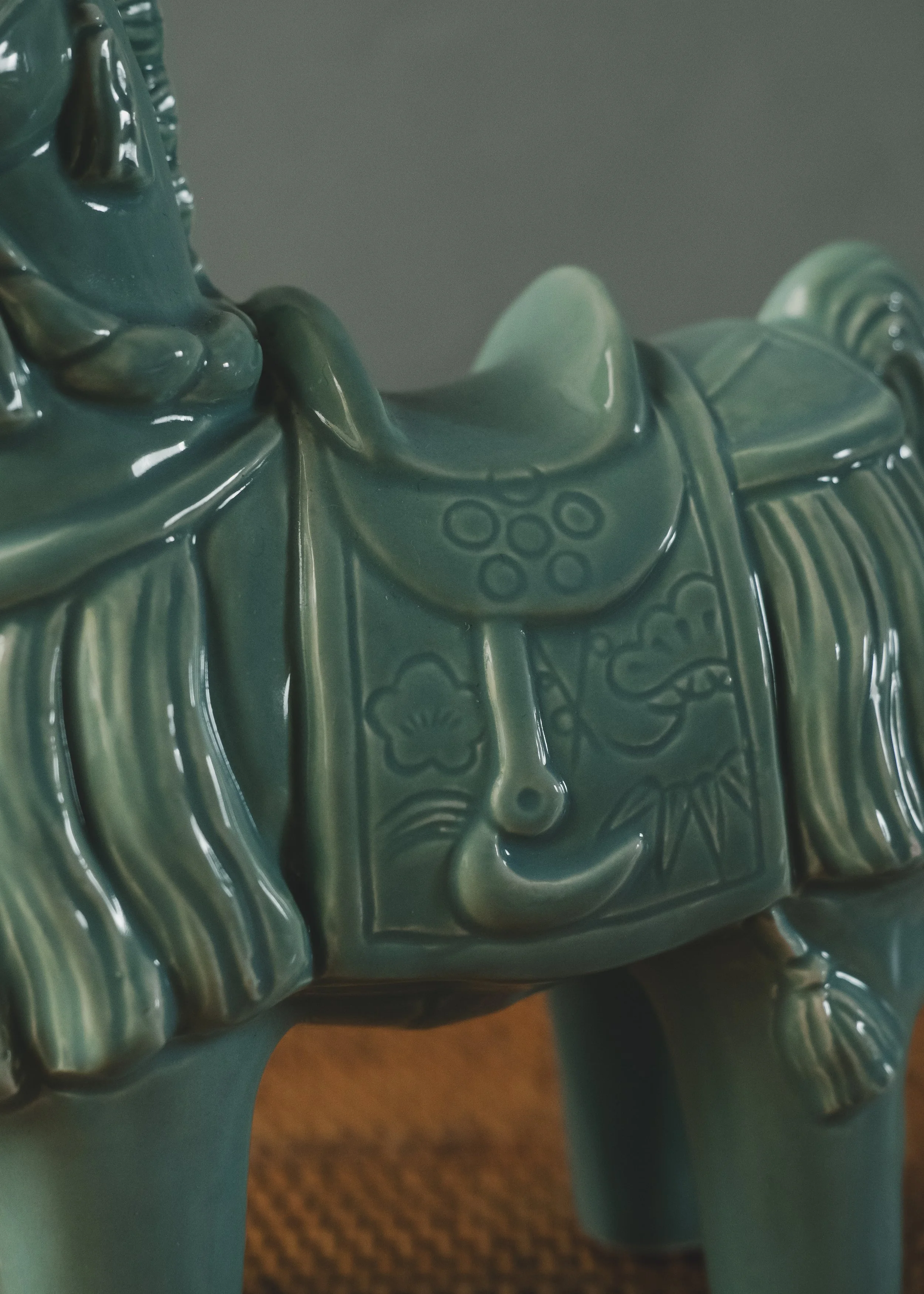
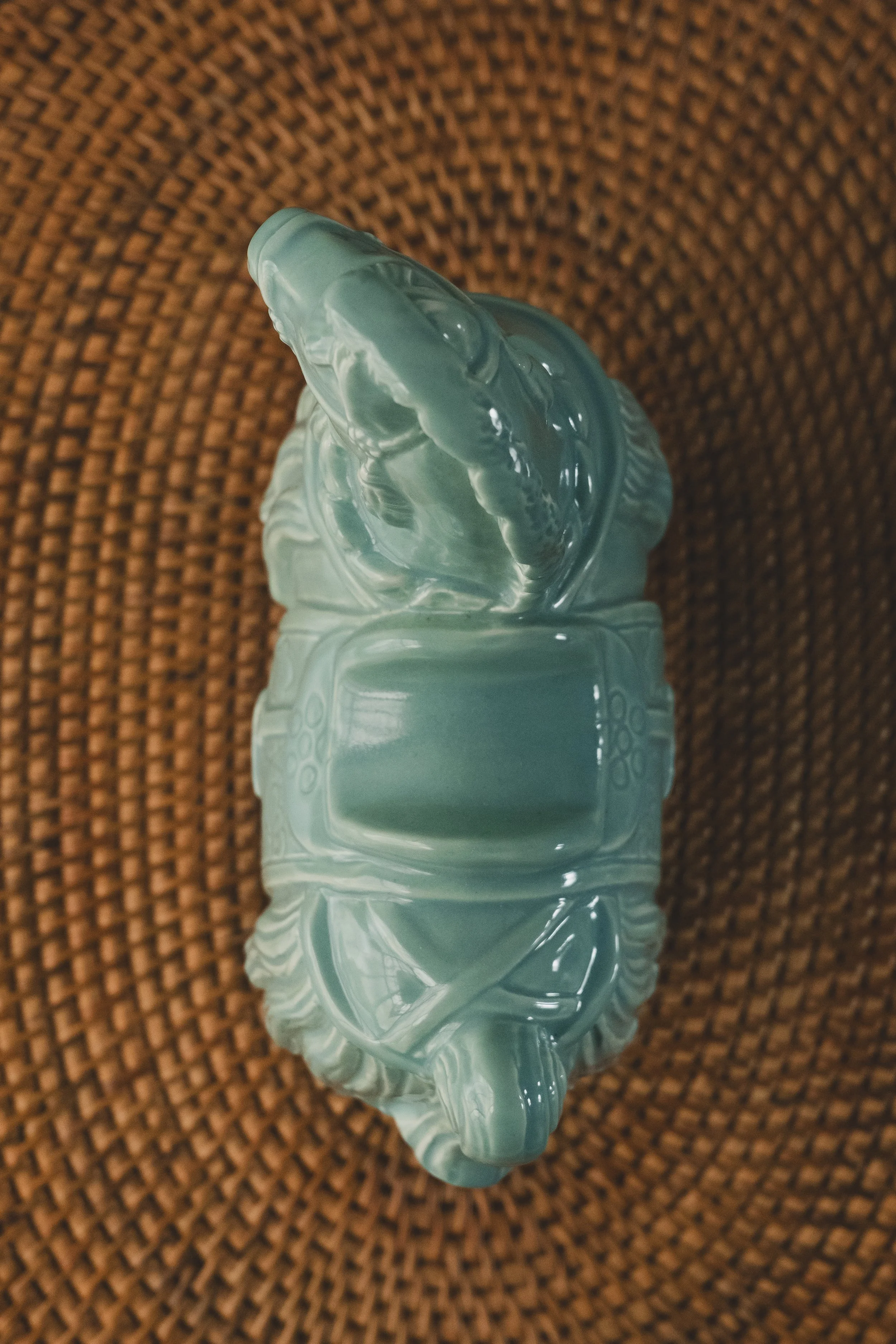
A sculptural object. It does not hold anything, pour anything, or open anything. Its function is presence — the act of occupying a shelf, a desk, or a mantelpiece with enough visual weight that nothing else needs to be placed beside it. The saddle carries relief patterns pressed into the clay before firing — geometric motifs that reference textile traditions far older than the glaze itself. These marks are not painted on. They are built into the surface and revealed by the way the glaze settles into them.

【 The Texture 】

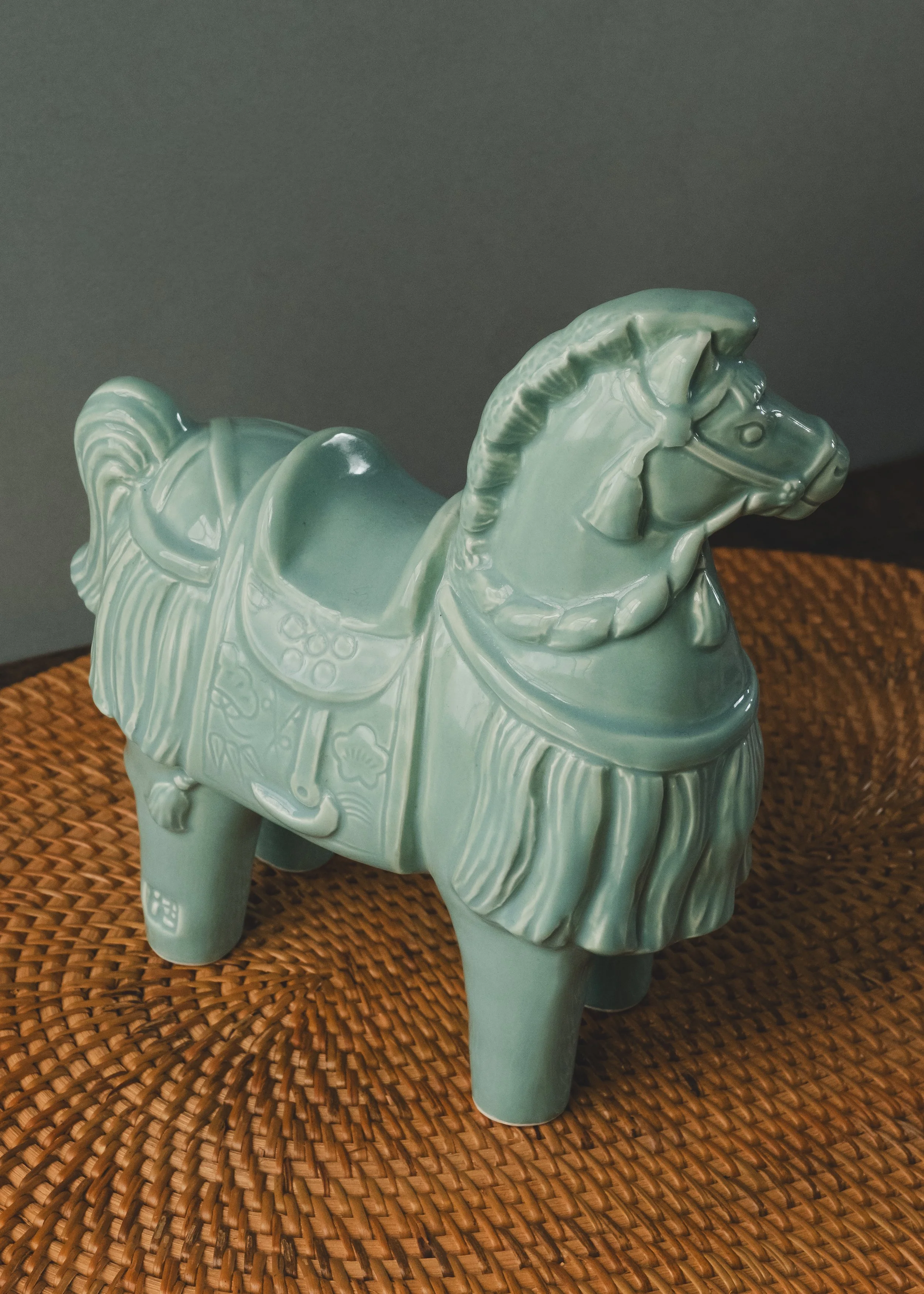
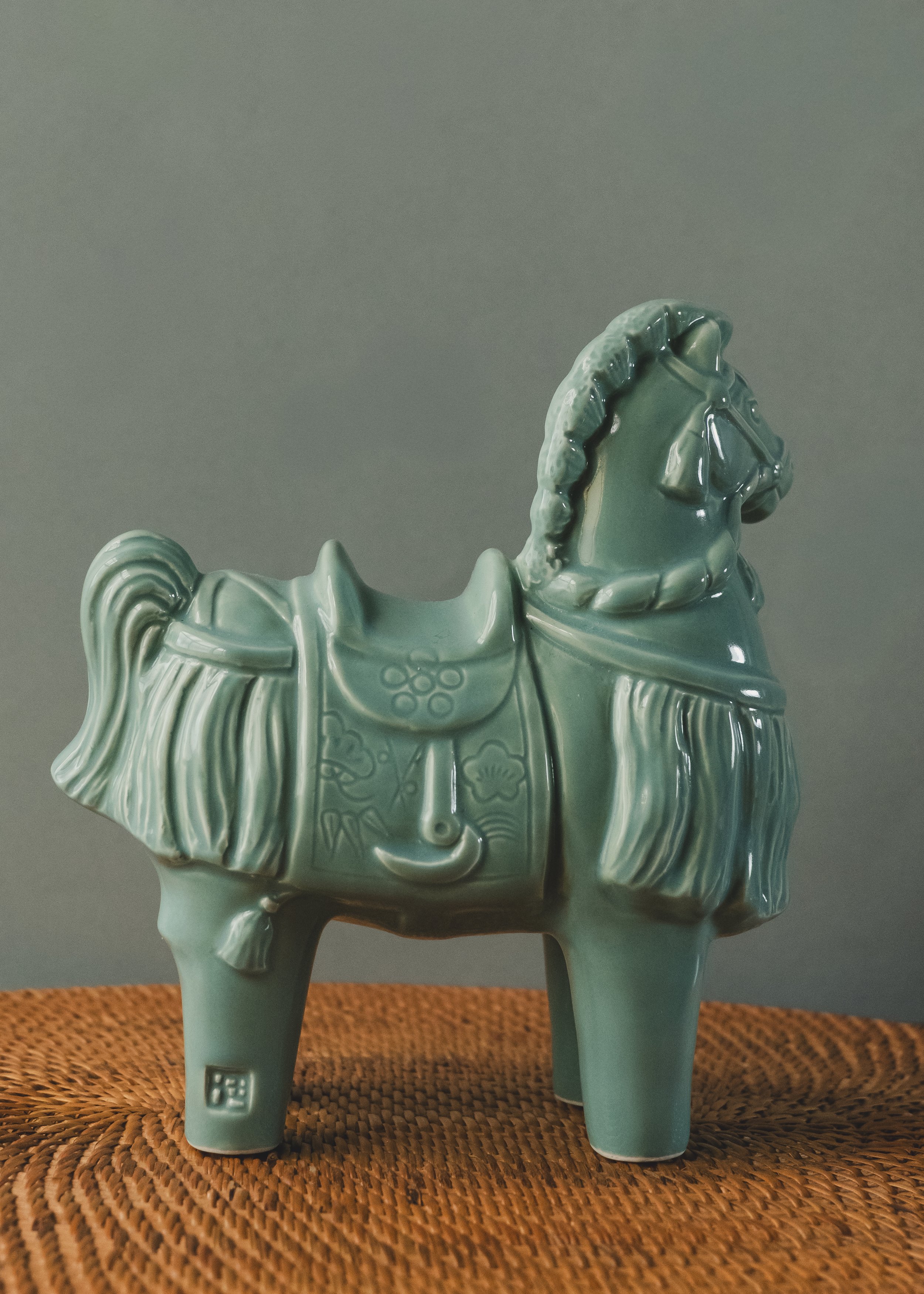
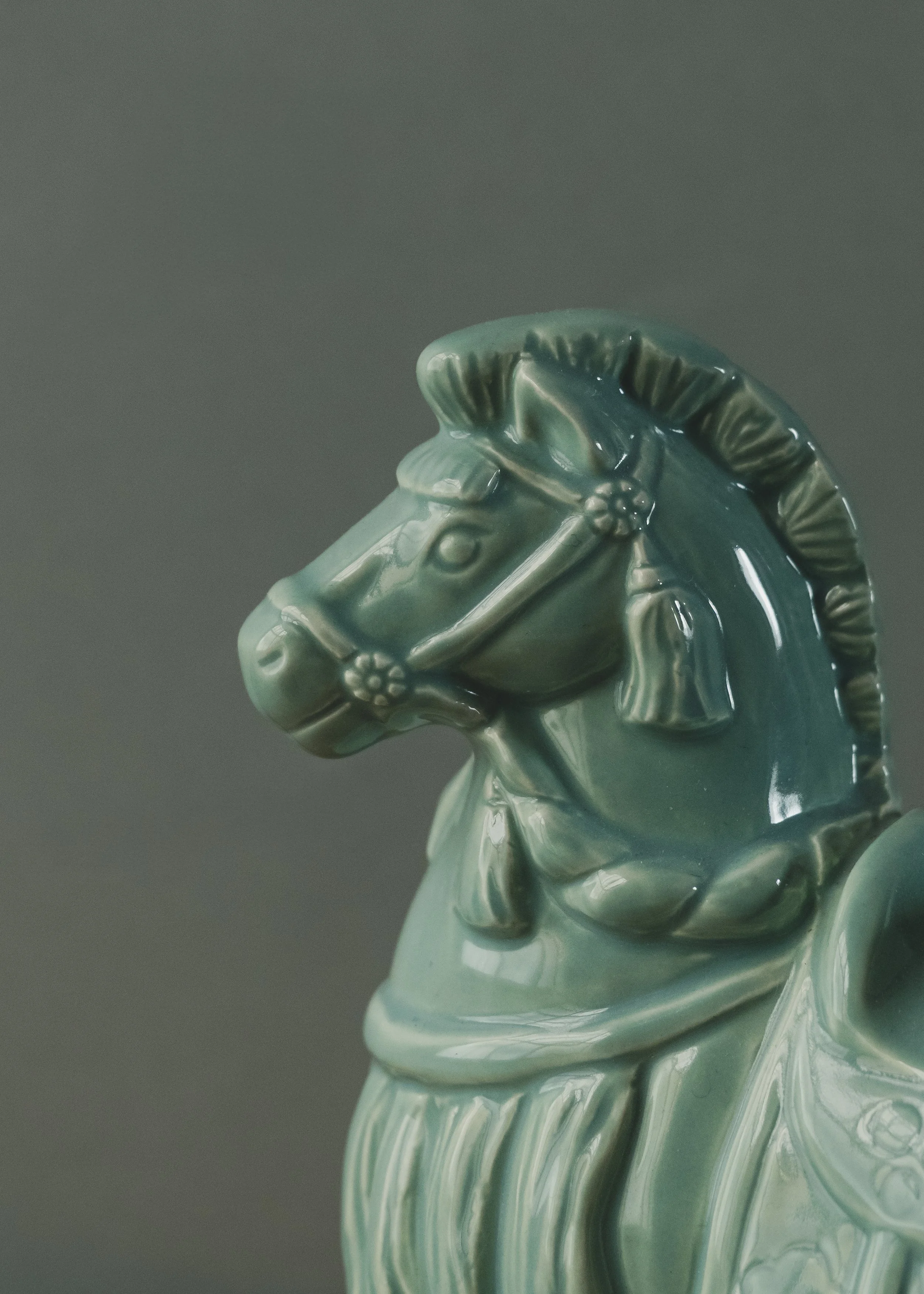
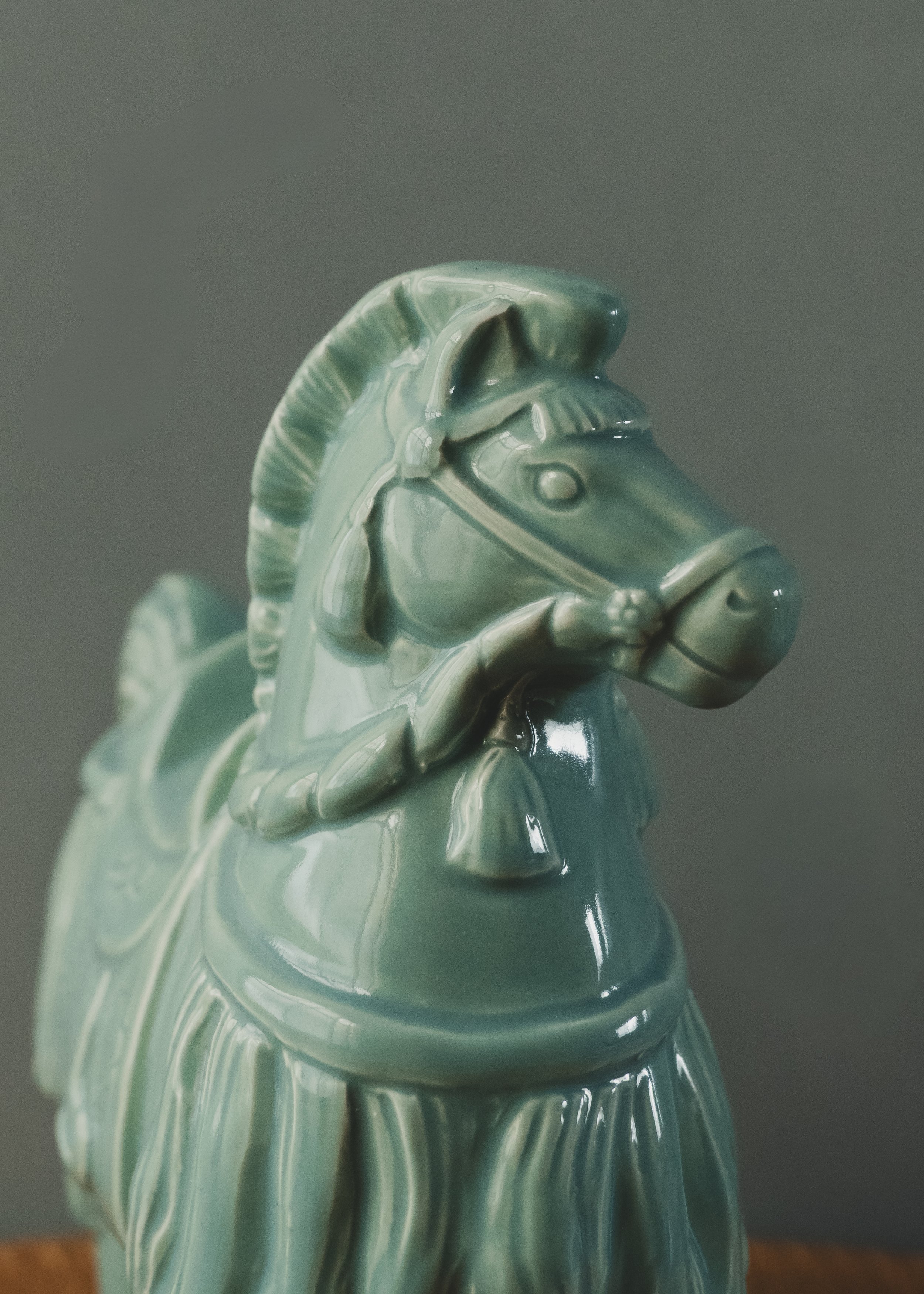
The entire body is covered in a single glaze — a grey-green celadon that shifts between sage and seafoam depending on the light. The surface is smooth and luminous, with a glass-like quality that invites touch. Beneath the glaze, the clay is pale and dense. The mane is carved in low relief. The tail curls against the body in a single continuous line. The hooves are planted, the ears are pointed, and the face is simplified to the edge of abstraction — just enough detail to read as a horse, just little enough to read as sculpture.

【 Presence 】

At nineteen centimeters tall, this is not a miniature. It commands a shelf the way a single vase commands a table — by being the only thing that matters. Pick it up and the surprise is immediate: it is lighter than it looks. The body is hollow, a shell of fired clay and glaze with nothing inside but air. That lightness is not a flaw. It is the proof that this object was made to be seen, not to anchor anything down. The celadon surface reflects its surroundings in a soft, distorted way, absorbing the colors of the room and returning them greener, quieter, older. Place it where natural light reaches it in the morning. By afternoon, it will look like a different object.

Sourced from a private collection in Japan.

【 The Concept 】

In ancient East Asia, there was a stone more valuable than gold. They called it jade — and for centuries, every attempt to replicate its color in clay ended in failure. Then a potter discovered that iron, starved of oxygen inside a sealed kiln, would turn green. Not painted green. Green from within — the way jade is green from within. The technique became the most coveted in the ceramic world. An anonymous craftsman took that technique and applied it to a form that had nothing to do with vessels or bowls. They made a horse. Not a running horse, not a rearing horse — a standing one, legs straight, head level, facing forward with the plain composure of an animal that has no reason to move. The glaze settled into the carved lines of the saddle, darkened in the grooves of the mane, and caught the light along the ridge of the spine in a way that changes with the hour of the day.

【 The Function 】

A sculptural object. It does not hold anything, pour anything, or open anything. Its function is presence — the act of occupying a shelf, a desk, or a mantelpiece with enough visual weight that nothing else needs to be placed beside it. The saddle carries relief patterns pressed into the clay before firing — geometric motifs that reference textile traditions far older than the glaze itself. These marks are not painted on. They are built into the surface and revealed by the way the glaze settles into them.

【 The Texture 】

The entire body is covered in a single glaze — a grey-green celadon that shifts between sage and seafoam depending on the light. The surface is smooth and luminous, with a glass-like quality that invites touch. Beneath the glaze, the clay is pale and dense. The mane is carved in low relief. The tail curls against the body in a single continuous line. The hooves are planted, the ears are pointed, and the face is simplified to the edge of abstraction — just enough detail to read as a horse, just little enough to read as sculpture.

【 Presence 】

At nineteen centimeters tall, this is not a miniature. It commands a shelf the way a single vase commands a table — by being the only thing that matters. Pick it up and the surprise is immediate: it is lighter than it looks. The body is hollow, a shell of fired clay and glaze with nothing inside but air. That lightness is not a flaw. It is the proof that this object was made to be seen, not to anchor anything down. The celadon surface reflects its surroundings in a soft, distorted way, absorbing the colors of the room and returning them greener, quieter, older. Place it where natural light reaches it in the morning. By afternoon, it will look like a different object.

Sourced from a private collection in Japan.

【Context】

  • Identity: Anonymous Ceramic / Celadon-Glazed Sculptural Figure.
  • Origin: East Asian Ceramic Tradition, Japan.
  • Technique: Reduction-Fired Celadon Glaze over Carved Clay Body.
  • Function: Sculptural Object / Shelf Anchor / Contemplative Figure.
    

【 Dimensions (Approx.) 】

  • Height: 19 cm (7.5 in)
  • Width: 8 cm (3.1 in)
  • Length: 18 cm (7.1 in)
  • Weight: 0.320 kg (0.71 lbs)
 

RELATED ARCHIVAL SPECIMENS
IRON REPOSE 1962
$220.00

【 The Concept 】

In Japan, the bull does not charge. It sits. In temple grounds across the country, stone bulls lie with their legs folded beneath them, waiting to be touched. Visitors rub the head for wisdom, the back for strength, the flank for healing. The animal became sacred not through action but through stillness — through the willingness to remain in one place long enough to absorb the prayers of everyone who reached for it. An anonymous ironworker in a northern foundry province understood this. They cast a bull in iron, gave it weight far beyond its size, and shaped it so that it would never be knocked over, never slide, never move unless someone decided to lift it. It was made to stay.

【 The Function 】

A paperweight. A bottle opener. A sculpture that earns its place by doing two things without being asked. The arch beneath the body catches a bottle cap with the precision of a tool designed for exactly that purpose — because it was. The mass of the iron holds paper, receipts, letters flat against a desk without effort. Between these tasks, it sits. That is its primary function.

【 The Texture 】

Cast iron, hand-finished with a lacquer-baked surface that has deepened over decades into a tone somewhere between black and dark bronze. The texture is not smooth. The casting process leaves a fine grain across the entire body — a roughness that catches light at low angles and absorbs it everywhere else. The horns curve upward like a helmet. The face is simplified to two eyes and a suggestion of expression that changes depending on which side you approach from. Pick it up. The weight is immediate and disproportionate to the size. Set it down. It does not wobble.

【 Presence 】

At 289 grams in an object that fits inside a closed hand, the density is the message. Everything about this bull is heavier than it looks, quieter than it should be, and more useful than it appears. It does not compete for attention on a desk. It simply holds its ground — which is exactly what it was cast to do.

Sourced from a private collection in northern Japan.

SACRED TRINITY 1965
$240.00


【 The Concept 】

Earthen spirits born from 1,300 years of silence.
Tracing its mystical origin to the 8th century (723 AD), this rare archival set is considered one of Japan’s oldest surviving lineages of provincial craft. The legend tells of a noble migrant who, following a divine vision, used local red clay to forge sacred vessels. When he discarded the remaining fragments, they miraculously transformed into living spirits.

Unlike refined urban ceramics, these 1-of-1 archival specimens capture a brutal, primal beauty known as "Anonymous Elegance." Praised by the mid-century philosopher Muneyoshi Yanagi as the pinnacle of the "Beauty of Utility," these figures are a fierce counter-argument to the ego of the individual artist. They represent the "Unconscious Beauty" born of necessity, intended to protect the family sanctum through pure material honesty.

【 The Function 】

Grounding the senses in an era of digital noise.
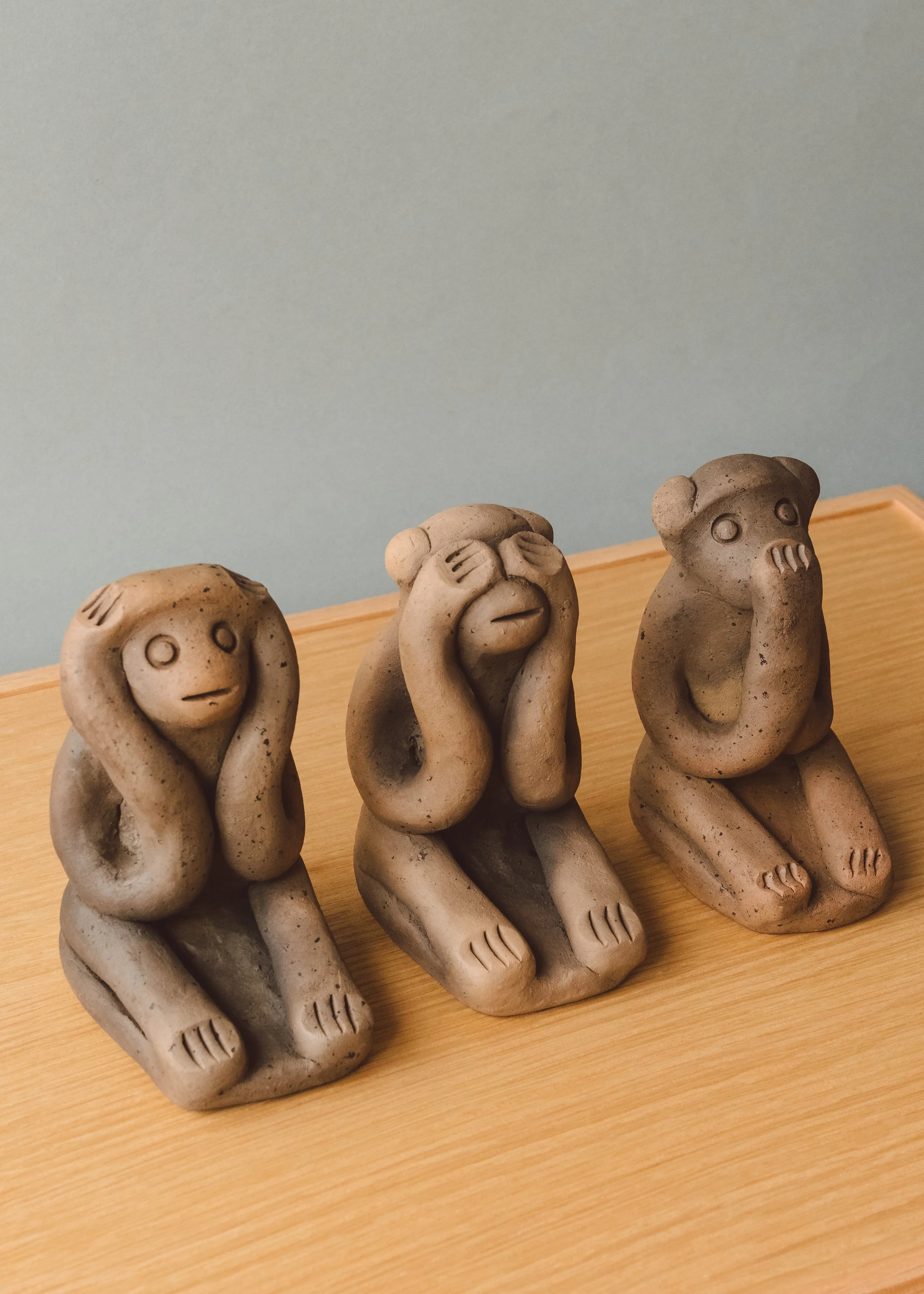
This trio represents the profound Three Spirits: "Hear no Evil, See no Evil, Speak no Evil." Far from mere educational adages, these time-traveled survivors were engineered as a psychological anchor—spiritual utility designed to cleanse the mental workspace. In traditional Japanese houses, these amulets served as substitutes to absorb misfortune on behalf of their keepers.

Positioned together, they serve as a meditative reset mechanism. In our hyper-accelerated digital culture, their presence reminds the guardian to consciously curate what they hear, see, and say—offering a protective refuge of stillness against the surrounding chaos.

【 Material & Craft 】

Fingerprints of history on unglazed integrity.
Hand-forged without the use of a single mold, every curve of these specimens is formed through the master’s physical touch. Utilizing "Kibushi" clay—a primeval red soil from a vanishing volcanic terrain—the artisans utilized a 1,300-year-old "pinch-clay" (Te-bineri) technique where fingers speak directly to earth.

Each figure was high-fired and then traditionally smoldered with smoldering pine needles, creating an unpredictable, smoke-stained patina. There is no artificial gloss. The surface features microscopic fissures and mineral stains, known as "Patina of Survival." Each unit carries the tangible heat and pressure of a human palm from nearly seven decades ago.

【 Presence 】

Brutalist Stillness.
Place this trinity at the center of a minimal bookshelf or directly on your workstation desk. Their vertical gravity and uneven, hand-squeezed textures create a striking focal point against cold metal or smooth wooden surfaces. Their uneven silhouettes, lacking mechanical symmetry, evoke a "Zen" quality that immediately transforms the surrounding atmosphere.

They are meant to be curated as one unified defensive line. Secure these IRREPLACEABLE 1-of-1 archival discoveries and experience the ritual of archiving the silent narrative of vanishing Japan.

CLAY GUARDIAN 1926
$175.00

【Narrative】

Paper or Earth? Traditionally, the "Inu-Hariko" (Guardian Dog) is a transient figure made of lightweight papier-mâché. However, this rare vintage specimen is born from the soil itself. Crafted from solid clay (Tsuchi-ningyo), it possesses a comforting gravity and a grounded presence that paper cannot imitate. It is not just a form; it is an anchor for the spirit.

【Symbolic Provenance】

In the spiritual landscape of Japan, the dog is more than a pet; it is a sacred guardian of life.

  • Safe Passage: Historically placed near the bedside of expecting mothers to wish for easy childbirth and protection.

  • Pure Barrier: Designed as an "Amulet" to ward off invisible anxieties and evil spirits from the nursery and home.

  • The Bell: The painted bell around its neck is a symbolic instrument, calling for luck and positive energy to manifest.

【The Patina of Existence】

Time is the secondary artist of this piece. The visible weathering and the exposed raw earth are not defects; they are the "Patina" highly sought by collectors—visual proof of its long vigil over a Japanese family. It stands stable, heavy, and resolute, bearing the marks of its journey with quiet dignity.

【Placement】

Its rounded, "Wabi-sabi" form brings a much-needed softness to the sharp edges of a modern interior. Perfect as a desk companion to "guard" your creative focus, or placed on a quiet bookshelf as an intellectual observer of your collection.